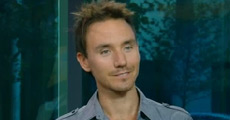
SUMMARY: Welcome to a power-packed Radio Ecoshock Show. I'm Alex Smith. My guests are George Kourounis, host of
the TV show "Angry Planet", and the solar-powered international musician known as Turtuga Blanku. But first, we'll talk with a
high-powered international lawyer who switched from taking multinational companies into China, to creating new alternatives for
local economies.
Download or listen to this Radio Ecoshock show in CD Quality (56 MB) or Lo-Fi (14 MB)
Or listen on Soundcloud right now!
LAURENCE BRAHM - TOWARD A NEW ECONOMY FOR A DAMAGED WORLD
Radio Ecoshock has remarkable guests. Our next is no exception. He was a lawyer advising China, to bring big name multinational companies into that Asian economy. Now he's writing about anti-globalization, localizing economies, and the coming eclipse of the Western banking model. His latest book is "Fusion Economics - How Pragmatism Is Changing the World".
Who is Laurence J. Brahm? Let's find out.
In the 1990's, as an international trade lawyer, Laurence Brahm was instrumental in bringing big-name multinational into China. In 1996, he wrote a book called "China's Number One" predicting China would become the world's largest economy. That drew heat and criticism, but now, according to the World Bank, China is the world's largest economy.
More and more, Brahm turned to advising the government of China, which he still does. He wrote a biography of Zhu Rongji, the former Premier of China, and often seen as an architect of the modern Chinese economy.
Laurence Brahm
In 2002 Laurence retired from his practice as an investment lawyer, to seek "Shangri-La". In 2005, he moved to Tibet, and started a business restoring buildings. He helped found the Himalayan Consensus (more about that in the interview). One of his role models is the Bengladeshi Muhammed Yunis, founder of micro-credit banking.
Also in 2011, he helped form the African Consensus. One innovations of this Consensus was to say the true cause of violence and terrorism is economic poverty and identity stripping.
In 2011 Laurence attended the Climate Conference in Durban South Africa. He found it useless, and joined the protesters outside. He says China is more aware of the dangers of climate change, especially since the disappearing Himalayan Glaciers will dry out the Yellow River. Brahm is quite aware of the challenges climate change is posing for many countries and peoples.
In 2014 he attended the Nepal Economic Forum (see You tube presentations here), and in 2013 the G20 Counter Summit in St. Petersburg (You tube here).
On the economy, Laurence sees the end of world domination by the Bretton Woods World Bank IMF model. In the near-term he sees two parallel universes: the Western reserve currency system, and the BRICS (Brazil, Russia, India, China, South Africa) system, based mainly on the Chinese currency Yuan (pronounced Yen) and in Beijing.
He sees the latest sanctions on Russia driving that country closer to China. The two can be natural trading partners, because China needs to import clean food (much of China is not able to produce food, and Chinese food may be contaminated); and water (Beijing itself is facing desertification, China needs a lot of water). To make this trade happen, there needs to be more infrastructure, such as pipelines and roads, connecting the two countries.
His latest book is "Fusion Economics - How Pragmatism Is Changing the World". Brahm is a curious mix of a lawyer at home with CEO's and bankers, who also protests as an activist.
Laurence has his own You tube channel.
He talks about "compassionate capital" and "conscientious consumption". Brahm recommends we set up our own alternative financial systems (like local currencies, or bitcoin).
On BBC in December, Brahm said 80% of the wealth of America comes from betting on stocks, currencies and other financial games, and not from producing goods and services. That is not sustainable.
China's super growth came at tremendous cost. Brahm told the BBC that, "about 70% of the underground water in China is undrinkable" (BBC interview 8:49) and "about 60% of all surface water is too toxic for human contact".
Brahm is not a total advocate for all things Chinese. He is critical of their use of fossil fuels, the pollution in major cities, and doesn't think top-down government is good for other countries. He says the emphasis on growth in China was a machine for
burning fossil fuels, which has ruined the environment. We can learn from China, but should not try to emulate them.
He says the oil-fossil fuel sector forms an oligarchy that currently runs America. That is why there is no Amercian leadership on
climate change. Oil-fossil fuels run in a partnership with the Financial Sector, labelled "Wall Street". Quantitative easing, and over a trillion of tax payer money, went to reboot that financial sector, not to the people. He advises the Chinese that government funding should go to a new green economy, instead of the banks.
Laurence is listed as "Chief Economist" for the New Earth Nation (with Sasha Stone).
Download or listen to this Radio Ecoshock interview with Laurence Brahm in CD Quality or Lo-Fi
GEORGE KOUROUNIS - HOST OF ANGRY PLANET TV
There's so much interest in extreme weather. Almost every news cast features a storm. And with climate disruption, there will be plenty more to see.
That's good news for our next guest, George Kourounis. He travels the world looking for adventure and downright dangerous weather, for his television series "Angry Planet". There's a new batch of shows running right now, so it's a pleasure to welcome George to Radio Ecoshock.
There have been 4 Angry Planet series, running on everything from the Weather Network, the Outdoor Life Netowork in Canada to cable TV channels all over the world (including Finland MTV3, TV8 Sweden, and TVB Hong Kong).
This new season 4 has a special emphasis on stories about the impact of global warming, all over the world, but with a focus on the South Pacific. Some countries there are already flooding regularly, and some will disappear as nations during this century, due to rising seas.
You can watch the free Episode One on the Pivot TV web site here.
George got the storm-chasing bug in the 1990's. He's flow into the heart of hurricanes, and run down the back roads in Oklahoma and the Mid-West looking for the big one. He's also a fan of volcanoes. In fact, he and his wife Michelle hiked into a volcano in their wedding clothes to tie the knot in 2006. It's wasn't a dead mountain either. That one has erupted every 5 minutes for the past 800 years, he tells us.
George has been in Amazon forest fires. One time he landed in the South Pacific island of Tuvalu just as they had 354 mm of rain (13.9 inches, over a foot!) in 24 hours. That's an extreme precipitation event for sure.
It's great that Kourounis is so aware of climate change. He worries we are going to leave a legacy to coming generations they may not be able to deal with. He's getting the word out through this new Angry Planet series: the relationship between extreme weather events and climate change. It's refreshing to find an adventure TV host this climate aware. Catch his new Angry Planet series on Pivot TV if you can.
Download or listen to this Radio Ecoshock interview with Geourge Kourounis in CD Quality of Lo-Fi
TURTUGA BLANKU AND HIS SOLAR STUDIO
Regular listeners know one of my hobbies is writing music using computer synthesizers. Martin, who is known at Turtuga Blanku, got in touch, to tell me about his solar studio in the Caribbean. You can visit the studio in this You tube video.
Here is a You tube listing of his eco music.
Why the name Turtuga Blanku? It literally means "white turtle" but is also a name given in the Caribbean to the green turtle. You see, Martin is also a diver and ocean lover. He was in the Caribbean at one of the finest dive locations in the world. That's where he got his knick-name.
During the interview, I learned something new (as I often do from guests). Martin tells us that solar panels are less efficient in high heat. While he got lots of power from his panels in the Caribbean (enough to run his house and studio) - he's get as much or more from the same panels in France. The sub-tropics are good for solar.
Martin has just moved back to "the middle of France". He'll set up a solar studio again. Plenty of his neighbors have solar installations, some large ones, thanks to the French policy of guaranteeing a good rate for renewable power, and in some cases, helping finance the original purchase.
We talk a bit about music. Martin has more talents than I - he can play a range of instruments, which he records and then tweaks on a studio computer. It's good stuff - hard to describe - you just have to click around to find the songs you like best. I enjoyed his music, and his conversation.
Find all of Martin's songs, or at least a lot of them, on You tube here.
Then head over and buy your favorite tunes (quite inexpensive) at his Bandcamp page here.
Martin has also done some podcast interviews, including with Alan Weisman, the author of the World Without Us, who also spoke on Radio Ecoshock. Find Martin's interview with Alan here.
And here's a bunch more contact info:
Web: http://www.TurtugaBlanku.com
Facebook: https://www.facebook.com/TurtugaBlanku
Soundcloud: https://soundcloud.com/turtuga_blanku
Download or listen to this Radio Ecoshock interview with Turtuga Blanku in CD Quality (recommended for the best music) or Lo-Fi (not recommended unless you have a very slow internet connection).
In this program I play a clip from a Turtuga Blanku tune called "No More" from his album Golden Bubble.
BLOG READERS AND PODCAST SUBSCRIBERS SUPPORT THIS PROGRAM, GETTING IT OUT TO NON-PROFIT RADIO STATIONS IN 4 COUNTRIES.
My special thanks to those who sent donations this week, and particularly the person who arranged a $10 a month contribution. All that helps me get through the summer, when donations crash. In a way, it's almost unfair that blog readers, and podcast subscribers pay the whole cost of Radio Ecoshock. The non-profit stations prohibit anyone asking for money, other than themselves. So a few people are really paying to get Radio Ecoshock to all those radio listeners on 87 non-profit stations! You are doing a good thing.
If you can help, click here for details.
Thanks for joining us this week. Stay tuned for more shocking news from Planet Earth. I'm Alex Smith. Keep caring about your planet.
Showing posts with label localization. Show all posts
Wednesday, April 29, 2015
Tuesday, October 29, 2013
Desperately Seeking Solutions
SUMMARY: A medley of ways. From New Zealand, green alternative economy with Laurence Boomert. Dr. Sharon Gourdji, U of Fla. on crops & climate. Josh Fox (Gasland) riff on fracking. Pacific growing expert Lorene Edwards Forkner.
QUICK WRAP: Laurence Boomert green business and politics in New Zealand. After founding a biz network, he now runs the Bank of Solutions. Terrific ideas for all of us.
Dr. Sharon Gourdji, Stanford University, researches the impacts of climate heating on crops - especially during the critical period when they flower. We talk the case study of her recent trips to Nicaragua.
At Powershift 2013, the Director of the movie "Gasland" wowed the crowd with his anti-fracking speech/rant. France banned it, the Netherlands is next, and fracking protests explode in the U.S. & Canada. Australia and UK take note!
Lorene Edwards Forkner is editor of Pacific Horticulture Magazine, and a home-grower extraordinaire. Tips for grow-it-yourself and local production. This interview was recorded in June 2013 at the Mother Earth News Fair in Puyallup Washington.
Download/listen to this Radio Ecoshock Show 131030 in CD Quality or Lo-Fi
LAURENCE BOOMERT: REAL SOLUTIONS
Almost every week Radio Ecoshock details our head-long flight into a complex series of environmental, economic, and social disasters. But where are the solutions?
There are many answers out there. What we need is a collection place to gather the things we need to know. Enter Laurence Boomert and the "Bank of Real Solutions".
Boomert is a long-time New Zealand activist who founded the successful Environmental Business Network in the 1990's. Along with a group called "Living Economies", Laurence co-published and wrote for the book "Fleeing Vesuvius: Responding to the effects of economic and environmental collapse”.
Laurence Boomert is currently on a tour of North America with our previous guest Nicole Foss.
Download/listen to this 18 minute Radio Ecoshock interview with Laurence Boomert in CD Quality or Lo-Fi
Most of the doomers I track, picture New Zealand as the place to run, after Fukushima or the economy blows up. At least New Zealand could feed itself. Is it all a green garden party there down-under?
Laurence says New Zealand has a lot going for it, but the current political climate is anti-green. In fact the Prime Minister formerly worked for a big investment house, Merrill Lynch. Previous green legislation is being dismantled, just like in Australia.
We talk about the political party Laurence co-founded, (the New Economics Party) - but more about his web site The Bank of Real Solutions. Currently it is a collection of things that really work to change the world in New Zealand. Take a look, you will get some great ideas for your own area.
Laurence is just now taking it global, working on founding The World Bank of Real Solutions. Watch for that.
Laurence Boomert, in You tube videos and writing, says cities could be sustainable. Looking at cities designed entirely around automobiles and fossil fuels, I'm not so sure. Can mega-cities really transition?
We also talk about collapse. It can happen quickly, Boomert says. Just look at Argentina in 2001. Or Ireland trying to recover right now.
In the United States, we are seeing shadows of collapse already. Detroit went bankrupt. The federal government shut down. Food stamps stopped working for a few hours, leading to mini-riots. Is there still time to organize and launch local economies? Boomert says yes, if we can get going now.
He offers some terrific examples from New Zealand, like community currency, and time banking that even helps the needy. Ten percent of his own small community operates on local currency.
Boomert suggests you visit this web site from South Africa for a look at more solutions being tried around the world: ces.org.za The full name is Community Exchange.
Laurence also has an ebook - a $3 manual on local currency "Get A Handle on Hands." More info about that here. Or buy it here.
This interview is full of useful tips. Like this organization "Living Economies".
Oh, by the way, Laurence also adapted an Irish idea, helping to organize and publish the solutions book called “Fleeing Vesuvius: Responding to the effects of economic and environmental collapse.” That book is hard to find at the moment. Look here.
In this You tube video, Boomert says the financial system is "horrifically ruined" and fragile. He claims we have a corrupt parasytical system build on fraud. Then he outlines how you and I can bypass that system to create our own.
Part 2 of that You tube video is here.
Contact Laurence Boomert by email: laurenceboomert@xtra.co.nz
SHARON GOURDJI: THE SCIENCE OF CROPS AND CLIMATE
Since gaining her PHD in Environmental Engineering, and moving to Stanford University, Sharon Gourdji has specialized in the impacts of climate change and food production around the world.
Her latest co-authored paper was published in Environmental Research letters in June 2013. It's title tells us something important for everyone who eats: "Global crop exposure to critical high temperatures in the reproductive period: historical trends and future projections."
Here is the official citation: Environmental Research Letters, Vol. 8 no. 2, page(s) doi:10.1088/1748-9326/8/2 June 14, 2013
Your can read the abstract, and the full paper online here.
Download or listen to this interview with Sharon Gourdji in CD Quality or Lo-Fi
I was introduced to this subject by an unlikely source. A hippie You-tuber from Texas complained his garden flowered but set no fruit - because night-time temperatures stayed too high at a critical time. So it's not just that it's hotter, but WHEN it's hotter that counts for agriculture - and gardens.
That full video from "humptydumptytribe" is worth a watch.
But in this show we head for the real science. Sharon Gourdji has just finished a year-long Fulbright Nexus program focused on climate change and adaptation strategies in the Western Hemisphere.
I'm going to quote a communication from Sharon here to explain some of her other work:
"Prior to the extreme heat study, I published a paper looking at gains in breeding wheat for heat-tolerance by the world's preeminent wheat breeding organization CIMMYT (or International Center for the Improvement of Maize and Wheat in Spanish, based in Mexico, primarily responsible for developing the germplasm behind the Green Revolution in Latin America and Asia). The results were that most of the gains in breeding wheat for high yield potential have come in optimal environments with high radiation, cool temperatures and irrigation."
On a down-to-earth level, Sharon has just returned from Nicaragua, where she visited farming regions to determine how climate has affected the bean crop.
Apparently the red beans so loved by Nicaraguans are stressed by excess heat and the yields are declining. Black beans do better in the new growing conditions, but Nicaraguan farmers grow them mainly for export at this time. Folks in Columbia, where Gourdji also did research, like the black beans as a staple.
Complicating all this: Nicaragua has lost at least one third of it's forest cover since 1980. This changes microclimates, rainfall, and soil erosion. Deforestation and climate change can play off against one another.
Lester Brown from the Earth-Policy Institute has stressed some major crops, including rice, are already near their temperature limits. I've covered that on Radio Ecoshock. We discuss these important limits with Sharon.
It's hard to imagine a more important subject for scientific study! How will we feed the world's increasing population if climate change harms the growing cycle at critical times? Gourdji is fairly optimistic. She says farmers have always had to adapt to changes in weather - and there are international organizations working to breed plants better able to produce - even without Genetic Modification (GMO's).
Here is Sharon's professional page.
JOSH FOX RANTS AGAINST FRACKING AT POWERSHIFT 2013
In previous Radio Ecoshock shows we've had young people testifying about their drive to save the climate and find eco-justice - partly through the Powershift 2013 program in Pittsburg in October.
This week I run an 8 minute riff from Josh Fox, the Director of the anti-fracking expose "Gasland".
You can see the Powershift video here. (It will take a couple of minutes to load to the Josh Fox clip I've selected. Hang in, it's worth it).
France has banned fracking. The Netherlands is about to. People all over the world question why we need to blow up the underground, poisoning it with super toxic chemicals, just to get more dangerous fossil fuels.
Josh's follow-up to Gasland is now playing on HBO.
LORENE EDWARDS FORKNER - PACIFIC SUPER GARDENER
When I was at the Mother Earth News Fair last June, I had the pleasure of talking with Lorene Forkner.
Her blog is called "Planted at Home".
Lorene is the editor of Pacific Horiculture Magazine, and author of several books. Her latest is "Handmade Garden Projects: Step-by-Step Instructions for Creative Garden Features, Containers, Lighting & More".
She's the co-author of 3 previous titles published by Sasquatch Books including: "Growing Your Own Vegetables: An Encyclopedia of Country Living Guide" and "Canning and Preserving Your Own Harvest: An Encyclopedia of Country Living Guide".
With all that going for her, you can bet we have a great conversation about growing food - from California right up to Washington State. People around the world can learn from Lorene Forkner. I did.
Download or listen to this interview with Lorene Edwards Forkner in CD Quality or Lo-Fi
THREE INTERVIEWS PLUS ONE RANT
That was a packed show. I hope you pass it around.
I'm Alex Smith. Help support Radio Ecoshock and get free downloads at the web site ecoshock.org.
Welcome to all our new listeners, and thank you for listening - and caring about your world.
QUICK WRAP: Laurence Boomert green business and politics in New Zealand. After founding a biz network, he now runs the Bank of Solutions. Terrific ideas for all of us.
Dr. Sharon Gourdji, Stanford University, researches the impacts of climate heating on crops - especially during the critical period when they flower. We talk the case study of her recent trips to Nicaragua.
At Powershift 2013, the Director of the movie "Gasland" wowed the crowd with his anti-fracking speech/rant. France banned it, the Netherlands is next, and fracking protests explode in the U.S. & Canada. Australia and UK take note!
Lorene Edwards Forkner is editor of Pacific Horticulture Magazine, and a home-grower extraordinaire. Tips for grow-it-yourself and local production. This interview was recorded in June 2013 at the Mother Earth News Fair in Puyallup Washington.
Download/listen to this Radio Ecoshock Show 131030 in CD Quality or Lo-Fi
LAURENCE BOOMERT: REAL SOLUTIONS
Almost every week Radio Ecoshock details our head-long flight into a complex series of environmental, economic, and social disasters. But where are the solutions?
There are many answers out there. What we need is a collection place to gather the things we need to know. Enter Laurence Boomert and the "Bank of Real Solutions".
Boomert is a long-time New Zealand activist who founded the successful Environmental Business Network in the 1990's. Along with a group called "Living Economies", Laurence co-published and wrote for the book "Fleeing Vesuvius: Responding to the effects of economic and environmental collapse”.
Laurence Boomert is currently on a tour of North America with our previous guest Nicole Foss.
Download/listen to this 18 minute Radio Ecoshock interview with Laurence Boomert in CD Quality or Lo-Fi
Most of the doomers I track, picture New Zealand as the place to run, after Fukushima or the economy blows up. At least New Zealand could feed itself. Is it all a green garden party there down-under?
Laurence says New Zealand has a lot going for it, but the current political climate is anti-green. In fact the Prime Minister formerly worked for a big investment house, Merrill Lynch. Previous green legislation is being dismantled, just like in Australia.
We talk about the political party Laurence co-founded, (the New Economics Party) - but more about his web site The Bank of Real Solutions. Currently it is a collection of things that really work to change the world in New Zealand. Take a look, you will get some great ideas for your own area.
Laurence is just now taking it global, working on founding The World Bank of Real Solutions. Watch for that.
Laurence Boomert, in You tube videos and writing, says cities could be sustainable. Looking at cities designed entirely around automobiles and fossil fuels, I'm not so sure. Can mega-cities really transition?
We also talk about collapse. It can happen quickly, Boomert says. Just look at Argentina in 2001. Or Ireland trying to recover right now.
In the United States, we are seeing shadows of collapse already. Detroit went bankrupt. The federal government shut down. Food stamps stopped working for a few hours, leading to mini-riots. Is there still time to organize and launch local economies? Boomert says yes, if we can get going now.
He offers some terrific examples from New Zealand, like community currency, and time banking that even helps the needy. Ten percent of his own small community operates on local currency.
Boomert suggests you visit this web site from South Africa for a look at more solutions being tried around the world: ces.org.za The full name is Community Exchange.
Laurence also has an ebook - a $3 manual on local currency "Get A Handle on Hands." More info about that here. Or buy it here.
This interview is full of useful tips. Like this organization "Living Economies".
Oh, by the way, Laurence also adapted an Irish idea, helping to organize and publish the solutions book called “Fleeing Vesuvius: Responding to the effects of economic and environmental collapse.” That book is hard to find at the moment. Look here.
In this You tube video, Boomert says the financial system is "horrifically ruined" and fragile. He claims we have a corrupt parasytical system build on fraud. Then he outlines how you and I can bypass that system to create our own.
Part 2 of that You tube video is here.
Contact Laurence Boomert by email: laurenceboomert@xtra.co.nz
SHARON GOURDJI: THE SCIENCE OF CROPS AND CLIMATE
Since gaining her PHD in Environmental Engineering, and moving to Stanford University, Sharon Gourdji has specialized in the impacts of climate change and food production around the world.
Her latest co-authored paper was published in Environmental Research letters in June 2013. It's title tells us something important for everyone who eats: "Global crop exposure to critical high temperatures in the reproductive period: historical trends and future projections."
Here is the official citation: Environmental Research Letters, Vol. 8 no. 2, page(s) doi:10.1088/1748-9326/8/2 June 14, 2013
Your can read the abstract, and the full paper online here.
Download or listen to this interview with Sharon Gourdji in CD Quality or Lo-Fi
I was introduced to this subject by an unlikely source. A hippie You-tuber from Texas complained his garden flowered but set no fruit - because night-time temperatures stayed too high at a critical time. So it's not just that it's hotter, but WHEN it's hotter that counts for agriculture - and gardens.
That full video from "humptydumptytribe" is worth a watch.
But in this show we head for the real science. Sharon Gourdji has just finished a year-long Fulbright Nexus program focused on climate change and adaptation strategies in the Western Hemisphere.
I'm going to quote a communication from Sharon here to explain some of her other work:
"Prior to the extreme heat study, I published a paper looking at gains in breeding wheat for heat-tolerance by the world's preeminent wheat breeding organization CIMMYT (or International Center for the Improvement of Maize and Wheat in Spanish, based in Mexico, primarily responsible for developing the germplasm behind the Green Revolution in Latin America and Asia). The results were that most of the gains in breeding wheat for high yield potential have come in optimal environments with high radiation, cool temperatures and irrigation."
On a down-to-earth level, Sharon has just returned from Nicaragua, where she visited farming regions to determine how climate has affected the bean crop.
Apparently the red beans so loved by Nicaraguans are stressed by excess heat and the yields are declining. Black beans do better in the new growing conditions, but Nicaraguan farmers grow them mainly for export at this time. Folks in Columbia, where Gourdji also did research, like the black beans as a staple.
Complicating all this: Nicaragua has lost at least one third of it's forest cover since 1980. This changes microclimates, rainfall, and soil erosion. Deforestation and climate change can play off against one another.
Lester Brown from the Earth-Policy Institute has stressed some major crops, including rice, are already near their temperature limits. I've covered that on Radio Ecoshock. We discuss these important limits with Sharon.
It's hard to imagine a more important subject for scientific study! How will we feed the world's increasing population if climate change harms the growing cycle at critical times? Gourdji is fairly optimistic. She says farmers have always had to adapt to changes in weather - and there are international organizations working to breed plants better able to produce - even without Genetic Modification (GMO's).
Here is Sharon's professional page.
JOSH FOX RANTS AGAINST FRACKING AT POWERSHIFT 2013
In previous Radio Ecoshock shows we've had young people testifying about their drive to save the climate and find eco-justice - partly through the Powershift 2013 program in Pittsburg in October.
This week I run an 8 minute riff from Josh Fox, the Director of the anti-fracking expose "Gasland".
You can see the Powershift video here. (It will take a couple of minutes to load to the Josh Fox clip I've selected. Hang in, it's worth it).
France has banned fracking. The Netherlands is about to. People all over the world question why we need to blow up the underground, poisoning it with super toxic chemicals, just to get more dangerous fossil fuels.
Josh's follow-up to Gasland is now playing on HBO.
LORENE EDWARDS FORKNER - PACIFIC SUPER GARDENER
When I was at the Mother Earth News Fair last June, I had the pleasure of talking with Lorene Forkner.
Her blog is called "Planted at Home".
Lorene is the editor of Pacific Horiculture Magazine, and author of several books. Her latest is "Handmade Garden Projects: Step-by-Step Instructions for Creative Garden Features, Containers, Lighting & More".
She's the co-author of 3 previous titles published by Sasquatch Books including: "Growing Your Own Vegetables: An Encyclopedia of Country Living Guide" and "Canning and Preserving Your Own Harvest: An Encyclopedia of Country Living Guide".
With all that going for her, you can bet we have a great conversation about growing food - from California right up to Washington State. People around the world can learn from Lorene Forkner. I did.
Download or listen to this interview with Lorene Edwards Forkner in CD Quality or Lo-Fi
THREE INTERVIEWS PLUS ONE RANT
That was a packed show. I hope you pass it around.
I'm Alex Smith. Help support Radio Ecoshock and get free downloads at the web site ecoshock.org.
Welcome to all our new listeners, and thank you for listening - and caring about your world.
Wednesday, October 3, 2012
Tough Transition
From "The Farm" in Summertown, Tennessee, deep green thinker and activist Albert Bates on Tough Transition. Then one of the pioneers of localization and sustainable community, Dr. Mark Roseland. Alex reports on new ocean/climate movie to save... us. Rob Stewart's film "Revolution". Radio Ecoshock 121003.
Download 1 hour program in CD Quality (56 MB)
or faster download/lower quality Lo-Fi (14MB)
Radio Stations: Ecoshock 121003 Part 1 29 min and Part 2 29 min
This week we're still talking about social change to save the environment and ourselves. From "The Farm" in Summertown, Tennessee, deep green thinker and activist Albert Bates on Tough Transition - how to make a local community work - even if people can't agree on why it must.
Then we're going to one of the fathers of movements like Transition and localization, Dr. Mark Roseland in his 1992 book "Toward Sustainable Communities" became a handbook for local and regional politicians, non-profits, and citizen groups. Now it's out in a Fourth Edition, with a goal of providing, quote "Solutions for Citizens and Their Governments."
We'll get a call for Revolution from the maker of the movie Sharkwater. Rob Stewart says the species we need to save now is us. I've just seen his new film "Revolution". It's the ultimate challenge, literally our do or die time to save ocean life, and all life, from mass extinction. Our coverage of the dying oceans continues.
All coming your way this week, on Radio Ecoshock. I'm Alex Smith.
ALBERT BATES - TOUGH TRANSITION
Just like organisms, there are simple people. Others, like Albert Bates, are complex. He's a former attorney, a designer, bio char expert, author, speaker, and an international and local organizer. Albert has lived at the famous intentional community called "The Farm" in Summertown, Tennessee since 1972. His book "Climate in Crisis" was published back in 1990, with more following, like "The Post-Petroleum Survival Guide and Cookbook" in 2006, and "The Biochar Solution" in 2010.
In last week's program, we heard from successful Transition Towns in New England. That's easy enough with progressive voters. Albert, can it be done in a conservative "Red State" like Tennessee?
I've called up Albert to ask him about forming a Transition community in the rural Republican South.
When "The Farm" began in 1971 - it was part of the hippie movement. Bates tells us when the collection of school buses arrived from Haight-Ashbury in San Francisco, in rural Tennessee - to local residents it seemed like Martians landing. Over the course of a generation, there has been a general acceptance and interaction between The Farm and its surroundings.
You can learn more about "The Farm" in Albert's book "Voices from The Farm" (1998) co-authored with Rupert Fike.
TRANSITION IN A RED STATE
One sign of that was when Hohenwald Tennessee became the 25th Transition Town in America. That was accepted by all the local politicians, County Commissioners and so on - even though, as Bates tells us, practically none of the locals accepted the human-induced climate change or Peak Oil.
So how did they do it? The Farm organized a regular film and speaker night. Sure they showed "An Inconvenient Truth", but one of their most successful nights (garnering 130 people from a population of 4,000) was about "Financial Permaculture". In a very hard economy, people wanted to know how to improve their financial situation, and learned about permaculture almost as a side subject.
In fact Hohenwald had many Swiss settlers from the late 1800's. The Transition organizers were able to draw on a common community value of "frugality". It's frugal not to waste things, and so recycling and other ways to avoid waste are acceptable. It's a fantastic lesson: find out what your community values, and help deliver that as a road to transition.
In a bit of humor, one of their speakers was David Bloom, who explains how to make your own alcohol for energy and other uses. That was quite popular in rural Tennessee, where moon-shining is traditional. But the Transition group also brought in the Republican speaker Catherine Austin Fitts, who is quite aware of things like the energy decline.
Albert wrote an excellent book on the subject "The Post-Petroleum Survival Guide and Cookbook".
In Lewis County Tennessee the Transition group set up a community kitchen and a business incubator. Bates suggests it's better to fund local small business with funds raised in the area, instead of depending on big banks headquartered far away. They initiated their first local currency, namely "Chamber Bucks" which could be spent at any business that was a member of the Chamber of Commerce.
Now with Peak Oil and a rotten economy, we're seeing a surge of very different folks, some with guns and deep basements. Is "the great change” going to work with such different actors? Even the publishers of Mother Earth News have noticed an increase of survivalists and preppers in their readers. They want to grow their own food and make things themselves, in preparation for collapse.
ECOVILLAGES VERSUS TRANSITION TOWNS
I ask Albert Bates about the relationship between the Eco village Network, where he has been a leader, and Transition Towns.
First, let's look at what Wiki says about Albert and the Eco village Network:
"Bates has played a major role in the Eco village movement as one of the organizers of the Global Eco village Network (GEN), and served as GEN's chairman of the board (from 2002 to 2003) and president (from 2003 to 2004). He was also the principal organizer of the Eco village Network of the Americas and served as its president (from 1996 to 2003). In 1994 he founded the Eco village Training Center, a "whole systems immersion experience of Eco village living."[1] He has taught courses in sustainable design, natural building, permaculture and technologies of the future to students from more than 50 nations."
Bates is one of the teachers in Eco village training at The Farm, as well as teaching at Gaia University.
Essentially Bates suggests the Eco villages are like living laboratories. People experiment with ways to live together, sharing skills, learning how to produce locally. Some of the valuable lessons from those social experiments are applied more broadly in Transition Towns.
THE ZOMBIE APOCALYPSE
Albert is one of the first to point out there are no islands of security, even in an intentional community. If the rest of the society is falling apart, or even suddenly starving, they will come to take what you've got. It's a long-time point of discussion, which Bates labels the "Zombie Apocalypse" problem.
When I lived in a community of back-to-the-landers in the early 1980's, we often talked about what to do with starving city refugees. One local intentional community - a group of Russian Catholic nuns, decided they would put away lots of extra food and clothing, to welcome people who arrived.
For what it's worth, the historic record in Soviet Russia in the early 1930's, when the cities were starving, didn't work out that way at all. Instead, the army sent out trucks to take away all the grain, including the seed stock for the following year, plus any livestock and food they could find, hauling it back to the cities. The farmers and rural communities starved to death by the millions. It's in the Robert Conquest book "The Harvest of Sorrow: Soviet Collectivization and the Terror-Famine" published in 1986.
Anyway, unless there is a massive solar flare knocking out the grid, I don't expect Western civilization to collapse that quickly. It's far more likely our over-extended system will decline more slowly.
THE FARM AND CLIMATE CHANGE
As Bates knows all too well, the American South is experiencing record numbers of super-hot days, and recurring droughts. I ask what is the The Farm doing to prepare for a changed climate?
Albert describes the various ways they are collecting water, and more importantly, preparing their soil to hold more water and use it intelligently. This includes experiments with the Keyline system of agriculture, and using bovines to enrich both soil and water following the ideas of Allan Savory. It's also called "Mob Grazing". To learn more, listen to my 24 minute interview with Allan Savory in 2011 here.
The Farm is expecting 50 or more days where the temperature climbs above 100 degrees each summer - the range where plants stop growing and just go into a defensive dormancy. In the future, the Farm may see 5 or 6 months without rain. They are trying to get ready for all that, for the plants, the animals, and themselves.
Bates does travel around. He speaks at a lot of green fairs, to conferences, and international gatherings. Albert learned about global warming when he was researching deep injection of chemicals into the ground, in his former incarnation as an attorney. He spoke to his young Senator for Tennessee, one Al Gore, and then published his book "Climate in Crisis" in 1990, making Bates another of the pioneers of climate change.
To offset some of the carbon produced in traveling, way back in 1985 he established The Albert Bates Forest.
GETTING MORE BATES
In general, Albert thinks the Transition Town movement in America has been held back by media fog and mistaken ideas of making everything "American" instead of learning from other parts of the world. There are many more Transition Towns and Eco Villages in Europe, Asia, and the rest of the world than in the U.S. It appears Sri Lanka alone has more Eco villages than the U.S.A.
Follow Albert Bates on Twitter @peaksurfer and his blog is peaksurfer@blogspot.ca.
You can find a lot more Albert Bates links, including some of his fascinating past writing and interviews, here.
--------------------------------
TOWARD SUSTAINABLE COMMUNITIES - DR. MARK ROSELAND
We've been talking about Transition, from Europe through New England to the American Deep South. There is more to come, we can't stop talking about what to do, except to get busy doing it.
This wave has been building since at least 1992. As we'll hear, the few expert pioneers have become a big network of community builders, around the world. I'm going to challenge you to tune in, with a slightly different language, with new ears, to one of the pioneers of localization and sustainable community, Mark Roseland.
It's a messy world. We are bombarded by negative stories. Big governments fail to make our lives better, or save us from threats like climate change.
Many of our Radio Ecoshock guests say only local governments are worth your political attention. That's why you need to hear Mark Roseland. He's been advising local governments how to build on a human scale, for cities that can keep going through many challenges.
Dr. Mark Roseland is Director of the Simon Fraser University Centre for Sustainable Community Development, and he is a Professor in the Resource and Environmental Management Program.
Roseland came to world attention back in 1992 with the release of his best-selling book, "Toward Sustainable Communities: Resources for Citizens and Their Governments." That book is being released in a Fourth Edition by New Society Publishers in September 2012.
Mark Roseland on You tube
RIO +20 ROSELAND PROJECTS
IS ROSELAND PART OF A U.N. PLOT FOR WORLD DOMINATION?
We talk for a minute about the strange resistance to becoming more sustainable. Unbelievably, in rural America, and even a few people in the Occupy movement in the United States, are afraid any move toward sustainability is just part of a United Nations plot to take over the world. They think everything is part of "Agenda 21" which came out of the first Rio Conference in 1992.
I ask Dr. Roseland point blank: "Are you part of a plot to take over the world?"
Then we both laugh. It's such a weird distortion. The United Nations has hardly managed to do anything, except a lot of good charitable work in the poorest countries. There is no U.N. army ready to conquer the world. In fact, in some U.N. sanctioned military actions, it's the U.S. Armed Forces in command.
That doesn't stop fringe talk show hosts like Alex Jones from drumming it into weak minds that the U.N. is out to take their liberties and the environmentalists and "sustainability" is out to take away their freedom.
One of the alleged villains is something called the ICLEI - the International Council For Local Environmental Initiatives. That is a vehicle where local governments can talk to one another to find out what works. Perfect for localization, and yet some Americans who allegedly want independence have convinced their governments to stop paying for membership!
I think some paranoid Americans are missing a chance at their best allies. They attack Transition Towns as a communist plot. But the same people call for local action, participation in local governments, and prepping for disasters.
Roseland knows where this attack on sustainable communities is coming from: the Tea Party movement (partly funded by the notorious fossil fuel billionaires the Koch brothers) and the Republican Party itself. Back in January 2012 the Republican Party targeted ICLEI as villains to be defunded and fought off if they are elected. It's a political ruse, working against the best interests of America and Transition.
SUSTAINABILITY IS NO LONGER A PIONEER MOVEMENT
When Roseland published his book "Toward Sustainable Communities" back in 1992, it quickly became THE handbook for local governments, NGO's and interested citizens. There were only a few academics and institutes working on sustainability.
Now in unstable economic times, topped up with rampant energy costs and climate disruption, there are literally thousands, if not hundreds of thousands, of non-profits, local governments, academics, college-level courses, and resources of all kinds on making sustainable communities.
Roseland realized the movement was so big, and growing so fast, no resource book could hope to keep up. That is partly why at the Rio+ 20 Conference he announced PANDO. That's a kind of combined database and network for the sustainable community movement. Find it here.
PANDO is named after a giant community of aspen trees in Colorado that are all linked as one big organism by their joint root systems. It may be the largest single organism on land, and it's quite resilient.
UNIVERcity
As a long-time Professor at Simon Fraser University, in Burnaby Canada (part of Greater Vancouver) - Mark Roseland has been a guiding light in the redevelopment of the mountaintop where that university is situated. Amid some controversy, the University decided the system of staff and students living elsewhere, requiring giant parking lots, needed to be converted to a livable and sustainable community.
Now there are residences, a school, and other services right around the University, called "Univercity". Mark tells us about one day-care center which is not just net zero, but actually contributes more to the environment than it takes. Is that more expensive? No, it cost less than a conventional building.
There is a lot more to this interview. It's not in the usual activist language you hear on Radio Ecoshock, but it cuts exactly to what we are all really trying to accomplish in the real world: creating sustainable communities.
Look for Mark's new Fourth Edition of his classic "Toward Sustainable Communities: Solutions for Citizens and Their Governments." from New Society publishers. REVOLUTION - THE FILM
During this show I play brief clips from Neil Young's song "Rumblin'" that's from his 2010 album "Le Noise", and earlier clips from Brian Eno's instrumental "The Big Ship", in the album "Green World".
There is a rumbling'. That kind of low noise of something big coming, but we can't quite tell what. The mass media news is one big distraction. As the headlines scroll by, I have this creepy feeling there are big stories not being told.
One of them is pretty simple. We have built a consumer machine that is chewing up the planet, spitting out toxic waste. Most of the greenhouse gases we pour into the sky are being sucked back into the ocean. Radio Ecoshock guests like paleoclimatologist Peter Ward have made one thing clear. The ocean makes the oxygen we breathe, the ocean determines the weather, and in the big picture, the state of the ocean dictates the big biological clock of abundance or mass extinction.
FROM SHARKWATER TO REVOLUTION
Today, I saw more graphic evidence the ocean is far more disturbed than our weather. Rob Stewart set out to save the sharks from the lunacy of shark fin soup. His audience, and then the ocean experts, told Stewart he's missed the big story.
Despite the success of his first film "Sharkwater" Stewart had to battle to make his second. He spent another four years travelling to the biological hot spots of the ocean, and to the dead zones. What he learned inflamed him. Stewart found out what we all know in our hearts: we need a big fast change in our economy, culture, and hearts to save not the sharks, not the polar bears, but ourselves. He's calling for nothing less than Revolution. That's the title of his new film.
The movie has just been released at the Toronto Film Festival, and again at the Vancouver Film Festival. It's a full-length bundle of astounding underwater photography, followed by a quest to find out who can stop our civilization from self-destructing.
We are introduced to creatures hidden below the waves. Like a relative of the Octopus that is smarter than your house cat. Crazy and adorable animals that only Nature could dream up.
Their world is dying. The ocean is becoming acidic. It's getting hotter, and it's filling up with plastic and chemicals. The single biggest threat to all sea life, greater even than deforestation, is the way we dump fossil carbon into the atmosphere. Estimates range from 33 up to 50% of all the carbon dioxide we emit goes into the ocean. Everything that makes a skeleton, from tiny plankton through coral to all fish and sea mammals, are endangered by ocean acidification. If we can't control our emissions, quickly, we can't save life in the sea.
Stewart rediscovers what I found out in 1990: the oceans campaign is the climate campaign is the oceans campaign.
So the shark man ends up at two U.N. climate conferences. Both fail miserably. Dependent on consensus, with a negotiations wrecker like Canada, out to promote the dirty Tar Sands oil, the talks go nowhere.
You and I aren't changing much either, even though we know. Stewart glumly tallies up his own carbon pollution, and it's too much. Just like me.
Who isn't invested in the climate death machine? The children. They will bear the ruined climate. Child activists are springing up all around the world. Stewart tirelessly reaches out to them, informing, warning, inspiring youth as our best hope.
COMING UP NEXT WEEK ON RADIO ECOSHOCK
Next week I'll bring you a full interview with Rob Stewart underground film-maker, and unlikely revolutionary.
We'll also hear from Lester Brown of the Earth-Policy Institute. He's got the facts on rising food costs at home, and food-less days abroad.
And we'll continue our Transition series, as guest Wes Regan describes food localization in the poorest neighborhood.
We opened Radio Ecoshock this Fall with Gareth Renowden. He and co-host Glenn Williams have managed a new edition of "The Climate Show" bridging the time gap between London and rural New Zealand. Check out the new program at theclimateshow.com
Another tip from the film Revolution: only you can educate yourself. Sorry, whatever school you went to didn't teach what we all need to know. The government won't tell you. Media plans to distract you.
As the hard facts roll away the delusions of a mass suicide pact, I encourage you to dig, dig, dig. You can get college level knowledge free in You tube and Google lectures. Watch the TED talks. Bulk up your list of blogs that tilt toward natural reality.
You can find every back show of Radio Ecoshock on our web site at ecoshock.org. Please tune in, and spread it around. Use those links, Facebook, Twitter, everything. Hand out copies to neighbors or on the street. Talk it up.
Some of the world's best experts teach us. We have to strip away layers of ignorance and greed. We need to know the truth, and then we need to act on it. Nothing else will save a livable future for our descendants. That IS the big story.
I'm Alex Smith. This has been Radio Ecoshock. Join us next week.
Download 1 hour program in CD Quality (56 MB)
or faster download/lower quality Lo-Fi (14MB)
Radio Stations: Ecoshock 121003 Part 1 29 min and Part 2 29 min
This week we're still talking about social change to save the environment and ourselves. From "The Farm" in Summertown, Tennessee, deep green thinker and activist Albert Bates on Tough Transition - how to make a local community work - even if people can't agree on why it must.
Then we're going to one of the fathers of movements like Transition and localization, Dr. Mark Roseland in his 1992 book "Toward Sustainable Communities" became a handbook for local and regional politicians, non-profits, and citizen groups. Now it's out in a Fourth Edition, with a goal of providing, quote "Solutions for Citizens and Their Governments."
We'll get a call for Revolution from the maker of the movie Sharkwater. Rob Stewart says the species we need to save now is us. I've just seen his new film "Revolution". It's the ultimate challenge, literally our do or die time to save ocean life, and all life, from mass extinction. Our coverage of the dying oceans continues.
All coming your way this week, on Radio Ecoshock. I'm Alex Smith.
ALBERT BATES - TOUGH TRANSITION
Just like organisms, there are simple people. Others, like Albert Bates, are complex. He's a former attorney, a designer, bio char expert, author, speaker, and an international and local organizer. Albert has lived at the famous intentional community called "The Farm" in Summertown, Tennessee since 1972. His book "Climate in Crisis" was published back in 1990, with more following, like "The Post-Petroleum Survival Guide and Cookbook" in 2006, and "The Biochar Solution" in 2010.
In last week's program, we heard from successful Transition Towns in New England. That's easy enough with progressive voters. Albert, can it be done in a conservative "Red State" like Tennessee?
I've called up Albert to ask him about forming a Transition community in the rural Republican South.
When "The Farm" began in 1971 - it was part of the hippie movement. Bates tells us when the collection of school buses arrived from Haight-Ashbury in San Francisco, in rural Tennessee - to local residents it seemed like Martians landing. Over the course of a generation, there has been a general acceptance and interaction between The Farm and its surroundings.
You can learn more about "The Farm" in Albert's book "Voices from The Farm" (1998) co-authored with Rupert Fike.
TRANSITION IN A RED STATE
One sign of that was when Hohenwald Tennessee became the 25th Transition Town in America. That was accepted by all the local politicians, County Commissioners and so on - even though, as Bates tells us, practically none of the locals accepted the human-induced climate change or Peak Oil.
So how did they do it? The Farm organized a regular film and speaker night. Sure they showed "An Inconvenient Truth", but one of their most successful nights (garnering 130 people from a population of 4,000) was about "Financial Permaculture". In a very hard economy, people wanted to know how to improve their financial situation, and learned about permaculture almost as a side subject.
In fact Hohenwald had many Swiss settlers from the late 1800's. The Transition organizers were able to draw on a common community value of "frugality". It's frugal not to waste things, and so recycling and other ways to avoid waste are acceptable. It's a fantastic lesson: find out what your community values, and help deliver that as a road to transition.
In a bit of humor, one of their speakers was David Bloom, who explains how to make your own alcohol for energy and other uses. That was quite popular in rural Tennessee, where moon-shining is traditional. But the Transition group also brought in the Republican speaker Catherine Austin Fitts, who is quite aware of things like the energy decline.
Albert wrote an excellent book on the subject "The Post-Petroleum Survival Guide and Cookbook".
In Lewis County Tennessee the Transition group set up a community kitchen and a business incubator. Bates suggests it's better to fund local small business with funds raised in the area, instead of depending on big banks headquartered far away. They initiated their first local currency, namely "Chamber Bucks" which could be spent at any business that was a member of the Chamber of Commerce.
Now with Peak Oil and a rotten economy, we're seeing a surge of very different folks, some with guns and deep basements. Is "the great change” going to work with such different actors? Even the publishers of Mother Earth News have noticed an increase of survivalists and preppers in their readers. They want to grow their own food and make things themselves, in preparation for collapse.
ECOVILLAGES VERSUS TRANSITION TOWNS
I ask Albert Bates about the relationship between the Eco village Network, where he has been a leader, and Transition Towns.
First, let's look at what Wiki says about Albert and the Eco village Network:
"Bates has played a major role in the Eco village movement as one of the organizers of the Global Eco village Network (GEN), and served as GEN's chairman of the board (from 2002 to 2003) and president (from 2003 to 2004). He was also the principal organizer of the Eco village Network of the Americas and served as its president (from 1996 to 2003). In 1994 he founded the Eco village Training Center, a "whole systems immersion experience of Eco village living."[1] He has taught courses in sustainable design, natural building, permaculture and technologies of the future to students from more than 50 nations."
Bates is one of the teachers in Eco village training at The Farm, as well as teaching at Gaia University.
Essentially Bates suggests the Eco villages are like living laboratories. People experiment with ways to live together, sharing skills, learning how to produce locally. Some of the valuable lessons from those social experiments are applied more broadly in Transition Towns.
THE ZOMBIE APOCALYPSE
Albert is one of the first to point out there are no islands of security, even in an intentional community. If the rest of the society is falling apart, or even suddenly starving, they will come to take what you've got. It's a long-time point of discussion, which Bates labels the "Zombie Apocalypse" problem.
When I lived in a community of back-to-the-landers in the early 1980's, we often talked about what to do with starving city refugees. One local intentional community - a group of Russian Catholic nuns, decided they would put away lots of extra food and clothing, to welcome people who arrived.
For what it's worth, the historic record in Soviet Russia in the early 1930's, when the cities were starving, didn't work out that way at all. Instead, the army sent out trucks to take away all the grain, including the seed stock for the following year, plus any livestock and food they could find, hauling it back to the cities. The farmers and rural communities starved to death by the millions. It's in the Robert Conquest book "The Harvest of Sorrow: Soviet Collectivization and the Terror-Famine" published in 1986.
Anyway, unless there is a massive solar flare knocking out the grid, I don't expect Western civilization to collapse that quickly. It's far more likely our over-extended system will decline more slowly.
THE FARM AND CLIMATE CHANGE
As Bates knows all too well, the American South is experiencing record numbers of super-hot days, and recurring droughts. I ask what is the The Farm doing to prepare for a changed climate?
Albert describes the various ways they are collecting water, and more importantly, preparing their soil to hold more water and use it intelligently. This includes experiments with the Keyline system of agriculture, and using bovines to enrich both soil and water following the ideas of Allan Savory. It's also called "Mob Grazing". To learn more, listen to my 24 minute interview with Allan Savory in 2011 here.
The Farm is expecting 50 or more days where the temperature climbs above 100 degrees each summer - the range where plants stop growing and just go into a defensive dormancy. In the future, the Farm may see 5 or 6 months without rain. They are trying to get ready for all that, for the plants, the animals, and themselves.
Bates does travel around. He speaks at a lot of green fairs, to conferences, and international gatherings. Albert learned about global warming when he was researching deep injection of chemicals into the ground, in his former incarnation as an attorney. He spoke to his young Senator for Tennessee, one Al Gore, and then published his book "Climate in Crisis" in 1990, making Bates another of the pioneers of climate change.
To offset some of the carbon produced in traveling, way back in 1985 he established The Albert Bates Forest.
GETTING MORE BATES
In general, Albert thinks the Transition Town movement in America has been held back by media fog and mistaken ideas of making everything "American" instead of learning from other parts of the world. There are many more Transition Towns and Eco Villages in Europe, Asia, and the rest of the world than in the U.S. It appears Sri Lanka alone has more Eco villages than the U.S.A.
Follow Albert Bates on Twitter @peaksurfer and his blog is peaksurfer@blogspot.ca.
You can find a lot more Albert Bates links, including some of his fascinating past writing and interviews, here.
--------------------------------
TOWARD SUSTAINABLE COMMUNITIES - DR. MARK ROSELAND
We've been talking about Transition, from Europe through New England to the American Deep South. There is more to come, we can't stop talking about what to do, except to get busy doing it.
This wave has been building since at least 1992. As we'll hear, the few expert pioneers have become a big network of community builders, around the world. I'm going to challenge you to tune in, with a slightly different language, with new ears, to one of the pioneers of localization and sustainable community, Mark Roseland.
It's a messy world. We are bombarded by negative stories. Big governments fail to make our lives better, or save us from threats like climate change.
Many of our Radio Ecoshock guests say only local governments are worth your political attention. That's why you need to hear Mark Roseland. He's been advising local governments how to build on a human scale, for cities that can keep going through many challenges.
Dr. Mark Roseland is Director of the Simon Fraser University Centre for Sustainable Community Development, and he is a Professor in the Resource and Environmental Management Program.
Roseland came to world attention back in 1992 with the release of his best-selling book, "Toward Sustainable Communities: Resources for Citizens and Their Governments." That book is being released in a Fourth Edition by New Society Publishers in September 2012.
Mark Roseland on You tube
RIO +20 ROSELAND PROJECTS
IS ROSELAND PART OF A U.N. PLOT FOR WORLD DOMINATION?
We talk for a minute about the strange resistance to becoming more sustainable. Unbelievably, in rural America, and even a few people in the Occupy movement in the United States, are afraid any move toward sustainability is just part of a United Nations plot to take over the world. They think everything is part of "Agenda 21" which came out of the first Rio Conference in 1992.
I ask Dr. Roseland point blank: "Are you part of a plot to take over the world?"
Then we both laugh. It's such a weird distortion. The United Nations has hardly managed to do anything, except a lot of good charitable work in the poorest countries. There is no U.N. army ready to conquer the world. In fact, in some U.N. sanctioned military actions, it's the U.S. Armed Forces in command.
That doesn't stop fringe talk show hosts like Alex Jones from drumming it into weak minds that the U.N. is out to take their liberties and the environmentalists and "sustainability" is out to take away their freedom.
One of the alleged villains is something called the ICLEI - the International Council For Local Environmental Initiatives. That is a vehicle where local governments can talk to one another to find out what works. Perfect for localization, and yet some Americans who allegedly want independence have convinced their governments to stop paying for membership!
I think some paranoid Americans are missing a chance at their best allies. They attack Transition Towns as a communist plot. But the same people call for local action, participation in local governments, and prepping for disasters.
Roseland knows where this attack on sustainable communities is coming from: the Tea Party movement (partly funded by the notorious fossil fuel billionaires the Koch brothers) and the Republican Party itself. Back in January 2012 the Republican Party targeted ICLEI as villains to be defunded and fought off if they are elected. It's a political ruse, working against the best interests of America and Transition.
SUSTAINABILITY IS NO LONGER A PIONEER MOVEMENT
When Roseland published his book "Toward Sustainable Communities" back in 1992, it quickly became THE handbook for local governments, NGO's and interested citizens. There were only a few academics and institutes working on sustainability.
Now in unstable economic times, topped up with rampant energy costs and climate disruption, there are literally thousands, if not hundreds of thousands, of non-profits, local governments, academics, college-level courses, and resources of all kinds on making sustainable communities.
Roseland realized the movement was so big, and growing so fast, no resource book could hope to keep up. That is partly why at the Rio+ 20 Conference he announced PANDO. That's a kind of combined database and network for the sustainable community movement. Find it here.
PANDO is named after a giant community of aspen trees in Colorado that are all linked as one big organism by their joint root systems. It may be the largest single organism on land, and it's quite resilient.
UNIVERcity
As a long-time Professor at Simon Fraser University, in Burnaby Canada (part of Greater Vancouver) - Mark Roseland has been a guiding light in the redevelopment of the mountaintop where that university is situated. Amid some controversy, the University decided the system of staff and students living elsewhere, requiring giant parking lots, needed to be converted to a livable and sustainable community.
Now there are residences, a school, and other services right around the University, called "Univercity". Mark tells us about one day-care center which is not just net zero, but actually contributes more to the environment than it takes. Is that more expensive? No, it cost less than a conventional building.
There is a lot more to this interview. It's not in the usual activist language you hear on Radio Ecoshock, but it cuts exactly to what we are all really trying to accomplish in the real world: creating sustainable communities.
Look for Mark's new Fourth Edition of his classic "Toward Sustainable Communities: Solutions for Citizens and Their Governments." from New Society publishers. REVOLUTION - THE FILM
During this show I play brief clips from Neil Young's song "Rumblin'" that's from his 2010 album "Le Noise", and earlier clips from Brian Eno's instrumental "The Big Ship", in the album "Green World".
There is a rumbling'. That kind of low noise of something big coming, but we can't quite tell what. The mass media news is one big distraction. As the headlines scroll by, I have this creepy feeling there are big stories not being told.
One of them is pretty simple. We have built a consumer machine that is chewing up the planet, spitting out toxic waste. Most of the greenhouse gases we pour into the sky are being sucked back into the ocean. Radio Ecoshock guests like paleoclimatologist Peter Ward have made one thing clear. The ocean makes the oxygen we breathe, the ocean determines the weather, and in the big picture, the state of the ocean dictates the big biological clock of abundance or mass extinction.
FROM SHARKWATER TO REVOLUTION
Today, I saw more graphic evidence the ocean is far more disturbed than our weather. Rob Stewart set out to save the sharks from the lunacy of shark fin soup. His audience, and then the ocean experts, told Stewart he's missed the big story.
Despite the success of his first film "Sharkwater" Stewart had to battle to make his second. He spent another four years travelling to the biological hot spots of the ocean, and to the dead zones. What he learned inflamed him. Stewart found out what we all know in our hearts: we need a big fast change in our economy, culture, and hearts to save not the sharks, not the polar bears, but ourselves. He's calling for nothing less than Revolution. That's the title of his new film.
The movie has just been released at the Toronto Film Festival, and again at the Vancouver Film Festival. It's a full-length bundle of astounding underwater photography, followed by a quest to find out who can stop our civilization from self-destructing.
We are introduced to creatures hidden below the waves. Like a relative of the Octopus that is smarter than your house cat. Crazy and adorable animals that only Nature could dream up.
Their world is dying. The ocean is becoming acidic. It's getting hotter, and it's filling up with plastic and chemicals. The single biggest threat to all sea life, greater even than deforestation, is the way we dump fossil carbon into the atmosphere. Estimates range from 33 up to 50% of all the carbon dioxide we emit goes into the ocean. Everything that makes a skeleton, from tiny plankton through coral to all fish and sea mammals, are endangered by ocean acidification. If we can't control our emissions, quickly, we can't save life in the sea.
Stewart rediscovers what I found out in 1990: the oceans campaign is the climate campaign is the oceans campaign.
So the shark man ends up at two U.N. climate conferences. Both fail miserably. Dependent on consensus, with a negotiations wrecker like Canada, out to promote the dirty Tar Sands oil, the talks go nowhere.
You and I aren't changing much either, even though we know. Stewart glumly tallies up his own carbon pollution, and it's too much. Just like me.
Who isn't invested in the climate death machine? The children. They will bear the ruined climate. Child activists are springing up all around the world. Stewart tirelessly reaches out to them, informing, warning, inspiring youth as our best hope.
COMING UP NEXT WEEK ON RADIO ECOSHOCK
Next week I'll bring you a full interview with Rob Stewart underground film-maker, and unlikely revolutionary.
We'll also hear from Lester Brown of the Earth-Policy Institute. He's got the facts on rising food costs at home, and food-less days abroad.
And we'll continue our Transition series, as guest Wes Regan describes food localization in the poorest neighborhood.
We opened Radio Ecoshock this Fall with Gareth Renowden. He and co-host Glenn Williams have managed a new edition of "The Climate Show" bridging the time gap between London and rural New Zealand. Check out the new program at theclimateshow.com
Another tip from the film Revolution: only you can educate yourself. Sorry, whatever school you went to didn't teach what we all need to know. The government won't tell you. Media plans to distract you.
As the hard facts roll away the delusions of a mass suicide pact, I encourage you to dig, dig, dig. You can get college level knowledge free in You tube and Google lectures. Watch the TED talks. Bulk up your list of blogs that tilt toward natural reality.
You can find every back show of Radio Ecoshock on our web site at ecoshock.org. Please tune in, and spread it around. Use those links, Facebook, Twitter, everything. Hand out copies to neighbors or on the street. Talk it up.
Some of the world's best experts teach us. We have to strip away layers of ignorance and greed. We need to know the truth, and then we need to act on it. Nothing else will save a livable future for our descendants. That IS the big story.
I'm Alex Smith. This has been Radio Ecoshock. Join us next week.
Wednesday, September 26, 2012
Transition Yourself - Part One
Ideas from America on starting a Transition Town. Ruah Wennerfelt, Steve Chase & host Mark Helpsmeet in live stage conversation. Plus Greg Pahl, author of "Power from the People, How to Organize, Finance, and Launch Local Energy Projects." Max Keiser & Stacy Herbert on corporate corruption. Music: "In Your Eyes" by Peter Gabriel. Radio Ecoshock 120926 1 hour.
The climate has gone rogue, energy prices are threatening, and the economy sucks. You know the elections aren't going to make it better. Why wait for government? You can protect your community and yourself by helping your town withstand the shocks.
Download/listen to Radio Ecoshock for September 26, 2012 in CD quality (56 MB) here.
Or use the faster downloading, lower quality 14 MB version here.
RADIO STATIONS Two 29 minute segments allow time for station ID and announcements.
Radio Ecoshock 120926 Part 1 and Part 2
This program is about the Transition Town Movement and local power.
We begin with a half of an hour-long dialog with Ruah Swennerfelt and Steve Chase on the Transition Town movement in New England.
It's a rebroadcast of "Sprouts", radio production by independent community media. Last July, host Mark Helpsmeet of "Spirit in Action" hosted a live event Transition Town dialog in Rhode Island at the University of Kingston. It was originally broadcast on WHYS-LP in Eau Claire, Wisconsin, as part of Northern Spirit Radio. WHYS also broadcasts Radio Ecoshock.
MUSIC:
The opening of the Sprouts segment contains part of the song "The Turning of the World" performed by Sara Thomsen (written by Ruth Pellam) & "I Have No Hands But Yours" by Carole Johnson.
The show closes with the Peter Gabriel classic "In Your Eyes" (this You tube from a live concert from the 2003 Growing Up Tour in Filaforum, Milan, Italy. Or try this live classic recording Papa Wemba & Peter Gabriel
TRANSITION IN NEW ENGLAND
Our discussion of Transition in New England and Europe was recorded in front of a live audience, in early July, in Rhode Island at the University of Kingston.
One guest speaker is Ruah Swennerfelt, former long-time General Secretary of Quaker Earthcare Witness. She is currently involved with the Transition Town implementation in Charlotte, Vermont. Find her Transition US blog here.
Both our guests are involved in Quakers in Transition.
Steve Chase is Director of Advocacy for Social Justice and Sustainability at Antioch University New England. Steve talks about the Transition Town in Keene, New Hampshire, where their slogan is: "for local people concerned about peak oil, climate change, and a dysfunctional and unjust global economy - who want to respond with vision, courage, and creativity."
Helpsmeet asks how people who have very different political beliefs can work together in a Transition movement. One way is to stress "resilience" rather than the eco word "sustainability".
For the Quakers, the prospect of "energy famine" (as fossil fuels decline, become too expensive, or are taken over by others) can easily lead to resource wars. In this way, Peak Oil can really be a "peace" issue.
In Europe, some Neo-Nazi's took up the name "Transition" applied to their town. Partly in response to austerity in some European countries, this group agreed we have to learn to live on less, and so there is a need to keep immigrants out, using racist rhetoric.
In response, Transition US posted some core values, including posting local group constitutions on the Transition US web site.
It's ironic, because unlike the Nazi leadership cult, Ruah says success comes because Transition is a leaderless movement. Leadership is shared as well.
Having fun together is "a really core principle" says Ruah. Have fun, not long dreary meetings.
TRANSITION KEENE (NEW HAMPSHIRE)
Keene New Hampshire had a ground-breaking for a new food coop in mid-2012. It already has a thousand members in a town of 25,000.
They have around 20 community-supported agricultural projects in their area, which allows for more local food production. They now have a farmers' market and a winter farmers' market.
AS IN PERMACULTURE, THE SOLUTION IS FOUND WITHIN THE PROBLEM ITSELF
What's the hurry? asks host Mark. Is it just concern with oil supplies?
There are many reasons, says Ruah, but she doesn't think of it as all doom and gloom. In permaculture, she says, the solution is found in the problem itself.
Ruah still has a car, but is always aware of her pollution, that she is helping cause more global warming. She wants a group to help develop less harmful local transportation schemes. Like biking to a collector bus van, which leads to a larger bus to the city of Burlington, Vermont.
Central is the idea that we will have to learn to live well on less. Perhaps much less. Fossil fuels will be less available, cost more, and the damage they cause will become more and more apparent. But also, the idea of global equity, which is central to global peace, demands Western people use fewer resources, allowing the poorest people to get the basics.
In most cities, there is only 3 to 5 days’ worth of food. After that, if the trucks don't roll in, people run out of food. Local food production increases the ability to absorb coming shocks in the food production and delivery system, for whatever reason.
BOOKS TO GET YOU GOING
Ruah describes how to start a Transition Town. There are three books now available to help: the first one was "Transition Handbook" by Rob Hopkins. You'll have to get that one used from online services, as it is out of print. The Transition Culture blog now advocates buying "Transition Companion" also by Rob Hopkins. There is a third: "Transition Timeline" by Shaun Chamberlin published in 2009.
Here is the description of "Transition Timeline" from transitionculture.org
"The Transition Timeline lightens the fear of our uncertain future, providing a map of what we are facing and the different pathways available to us. It describes four possible scenarios for the UK and world over the next twenty years, ranging from Denial, in which we reap the consequences of failing to acknowledge and respond to our environmental challenges, to the Transition Vision, in which we shift our cultural assumptions to fit our circumstances and move into a more fulfilling, lower-energy world. The practical, realistic details of this Transition Vision are examined in depth, covering key areas such as food, energy, demographics, transport and healthcare, and they provide a sense of context for communities working towards a thriving future.
The book also provides a detailed and accessible update on climate change and peak oil and the interactions between them, including their impacts in the UK, present and future. Use it. Choose your path, and then make that future real with your actions, individually and with your community. As Rob Hopkins outlines in his foreword, there is a rapidly- spreading movement addressing these challenges, and it needs you."
Also see Rob Hopkins in a 17 minute presentation "Transition to a World without Oil" at TED, on You tube in 2009.
TRANSITION IS HUGE IN EUROPE (INCLUDING PARIS, LONDON, AND BARCELONA)
In 2011, Ruah visited Transition communities in 10 different European countries, as well as a "Transition France" conference and a "Transition UK" conference. All the communities took different steps, or in different order, to adapt to where they lived.
There is even Transition Paris. They broke down into smaller transition communities within the larger city. They had a central hub to serve these smaller groups.
They do the same thing in Transition Los Angeles and Transition Barcelona.
Find Transition Barcelona in Spanish or in English.
One group in England had members map out where food trees, like peak and apple trees, were accessible and perhaps not harvested. They asked homeowners for permission to harvest the fruit, rather than let it be wasted.
In Charlotte, Vermont they have an "Asset Directory". They took a survey of community skills, to allow skill-sharing. It also hooks up people who want to learn skills, whether it's canning, small scale farming or whatever.
Steve Case points out that social movements are not like corporate franchises. You don't buy a license to become a Transition Town. There are about 1,000 formal transition initiatives around the world.
They have workshops on how to deal with difficult people. We are a "cussed species" and sometimes the culture doesn't help us.
We need an outer transition to reconfigure our communities with resilience, an energy descent plan, to live without damaging the climate, and live on less and less.
"THE THEORY OF ANYWAY"
When Rob Hopkins wrote the Transition Handbook around 2008, he advanced "the theory of anyway". Even if climate change isn't as serious, or oil continues longer than thought, or the economy limps along - we'll still be living and eating better with the transition town, with a more resilient economy. You'll feel better with more local democracy, more skills, and more community involvement - no matter what happens.
The international site for Transition Towns is here.
The local producers and buyers try to reduce food miles, and the use of pesticides and fertilizers which are petroleum based. Like Ruah, Steve Chase says the challenges of energy depletion and economic downsizing also contain the solutions. For example, one water treatment plant in New England was getting swamped by sudden inflows of water. This problem was solved by installing micro-generators on the intake pipes. Now that plant is self-sufficient, generating its own energy from the former "problem".
They plan to have about 12 transition trainers in New England this year, to offer weekend workshops. Beyond this basic training there is a new training workshop called "Transition Thrive" (what to do next, after getting your group going).
Transition groups in Scotland are incorporated to do community business, like community bakeries. Ruah recommends the book "The Town That Food Saved". It's about Hardwick Vermont.
It's important to partner with town or city government. Their local government had one immediate problem: too many parents drove kids to school even though school buses are provided. It caused dangerous congestion, and more climate change. How to make riding the bus cool for kids? Now that's a challenge!
Transition may say "don't wait for government" but groups still work with existing governments to get things done, says Steve Chase.
In Keene, they have awareness raising "Transition Tuesday". One success was showing the film "A Convenient Truth" about Curitiba Brazil. That town transformed itself. See a short trailer for A Convenient Truth here.
People need to see examples of what is possible, Chase says, rather than only hearing the dire consequences if we don't do something. Once you begin to think creatively, all the problems seem like opportunities.
For the second part of this program "Local Power" with author Greg Pahl, click here.
The climate has gone rogue, energy prices are threatening, and the economy sucks. You know the elections aren't going to make it better. Why wait for government? You can protect your community and yourself by helping your town withstand the shocks.
Download/listen to Radio Ecoshock for September 26, 2012 in CD quality (56 MB) here.
Or use the faster downloading, lower quality 14 MB version here.
RADIO STATIONS Two 29 minute segments allow time for station ID and announcements.
Radio Ecoshock 120926 Part 1 and Part 2
This program is about the Transition Town Movement and local power.
We begin with a half of an hour-long dialog with Ruah Swennerfelt and Steve Chase on the Transition Town movement in New England.
It's a rebroadcast of "Sprouts", radio production by independent community media. Last July, host Mark Helpsmeet of "Spirit in Action" hosted a live event Transition Town dialog in Rhode Island at the University of Kingston. It was originally broadcast on WHYS-LP in Eau Claire, Wisconsin, as part of Northern Spirit Radio. WHYS also broadcasts Radio Ecoshock.
MUSIC:
The opening of the Sprouts segment contains part of the song "The Turning of the World" performed by Sara Thomsen (written by Ruth Pellam) & "I Have No Hands But Yours" by Carole Johnson.
The show closes with the Peter Gabriel classic "In Your Eyes" (this You tube from a live concert from the 2003 Growing Up Tour in Filaforum, Milan, Italy. Or try this live classic recording Papa Wemba & Peter Gabriel
TRANSITION IN NEW ENGLAND
Our discussion of Transition in New England and Europe was recorded in front of a live audience, in early July, in Rhode Island at the University of Kingston.
One guest speaker is Ruah Swennerfelt, former long-time General Secretary of Quaker Earthcare Witness. She is currently involved with the Transition Town implementation in Charlotte, Vermont. Find her Transition US blog here.
Both our guests are involved in Quakers in Transition.
Steve Chase is Director of Advocacy for Social Justice and Sustainability at Antioch University New England. Steve talks about the Transition Town in Keene, New Hampshire, where their slogan is: "for local people concerned about peak oil, climate change, and a dysfunctional and unjust global economy - who want to respond with vision, courage, and creativity."
Helpsmeet asks how people who have very different political beliefs can work together in a Transition movement. One way is to stress "resilience" rather than the eco word "sustainability".
For the Quakers, the prospect of "energy famine" (as fossil fuels decline, become too expensive, or are taken over by others) can easily lead to resource wars. In this way, Peak Oil can really be a "peace" issue.
In Europe, some Neo-Nazi's took up the name "Transition" applied to their town. Partly in response to austerity in some European countries, this group agreed we have to learn to live on less, and so there is a need to keep immigrants out, using racist rhetoric.
In response, Transition US posted some core values, including posting local group constitutions on the Transition US web site.
It's ironic, because unlike the Nazi leadership cult, Ruah says success comes because Transition is a leaderless movement. Leadership is shared as well.
Having fun together is "a really core principle" says Ruah. Have fun, not long dreary meetings.
TRANSITION KEENE (NEW HAMPSHIRE)
Keene New Hampshire had a ground-breaking for a new food coop in mid-2012. It already has a thousand members in a town of 25,000.
They have around 20 community-supported agricultural projects in their area, which allows for more local food production. They now have a farmers' market and a winter farmers' market.
AS IN PERMACULTURE, THE SOLUTION IS FOUND WITHIN THE PROBLEM ITSELF
What's the hurry? asks host Mark. Is it just concern with oil supplies?
There are many reasons, says Ruah, but she doesn't think of it as all doom and gloom. In permaculture, she says, the solution is found in the problem itself.
Ruah still has a car, but is always aware of her pollution, that she is helping cause more global warming. She wants a group to help develop less harmful local transportation schemes. Like biking to a collector bus van, which leads to a larger bus to the city of Burlington, Vermont.
Central is the idea that we will have to learn to live well on less. Perhaps much less. Fossil fuels will be less available, cost more, and the damage they cause will become more and more apparent. But also, the idea of global equity, which is central to global peace, demands Western people use fewer resources, allowing the poorest people to get the basics.
In most cities, there is only 3 to 5 days’ worth of food. After that, if the trucks don't roll in, people run out of food. Local food production increases the ability to absorb coming shocks in the food production and delivery system, for whatever reason.
BOOKS TO GET YOU GOING
Ruah describes how to start a Transition Town. There are three books now available to help: the first one was "Transition Handbook" by Rob Hopkins. You'll have to get that one used from online services, as it is out of print. The Transition Culture blog now advocates buying "Transition Companion" also by Rob Hopkins. There is a third: "Transition Timeline" by Shaun Chamberlin published in 2009.
Here is the description of "Transition Timeline" from transitionculture.org
"The Transition Timeline lightens the fear of our uncertain future, providing a map of what we are facing and the different pathways available to us. It describes four possible scenarios for the UK and world over the next twenty years, ranging from Denial, in which we reap the consequences of failing to acknowledge and respond to our environmental challenges, to the Transition Vision, in which we shift our cultural assumptions to fit our circumstances and move into a more fulfilling, lower-energy world. The practical, realistic details of this Transition Vision are examined in depth, covering key areas such as food, energy, demographics, transport and healthcare, and they provide a sense of context for communities working towards a thriving future.
The book also provides a detailed and accessible update on climate change and peak oil and the interactions between them, including their impacts in the UK, present and future. Use it. Choose your path, and then make that future real with your actions, individually and with your community. As Rob Hopkins outlines in his foreword, there is a rapidly- spreading movement addressing these challenges, and it needs you."
Also see Rob Hopkins in a 17 minute presentation "Transition to a World without Oil" at TED, on You tube in 2009.
TRANSITION IS HUGE IN EUROPE (INCLUDING PARIS, LONDON, AND BARCELONA)
In 2011, Ruah visited Transition communities in 10 different European countries, as well as a "Transition France" conference and a "Transition UK" conference. All the communities took different steps, or in different order, to adapt to where they lived.
There is even Transition Paris. They broke down into smaller transition communities within the larger city. They had a central hub to serve these smaller groups.
They do the same thing in Transition Los Angeles and Transition Barcelona.
Find Transition Barcelona in Spanish or in English.
One group in England had members map out where food trees, like peak and apple trees, were accessible and perhaps not harvested. They asked homeowners for permission to harvest the fruit, rather than let it be wasted.
In Charlotte, Vermont they have an "Asset Directory". They took a survey of community skills, to allow skill-sharing. It also hooks up people who want to learn skills, whether it's canning, small scale farming or whatever.
Steve Case points out that social movements are not like corporate franchises. You don't buy a license to become a Transition Town. There are about 1,000 formal transition initiatives around the world.
They have workshops on how to deal with difficult people. We are a "cussed species" and sometimes the culture doesn't help us.
We need an outer transition to reconfigure our communities with resilience, an energy descent plan, to live without damaging the climate, and live on less and less.
"THE THEORY OF ANYWAY"
When Rob Hopkins wrote the Transition Handbook around 2008, he advanced "the theory of anyway". Even if climate change isn't as serious, or oil continues longer than thought, or the economy limps along - we'll still be living and eating better with the transition town, with a more resilient economy. You'll feel better with more local democracy, more skills, and more community involvement - no matter what happens.
The international site for Transition Towns is here.
The local producers and buyers try to reduce food miles, and the use of pesticides and fertilizers which are petroleum based. Like Ruah, Steve Chase says the challenges of energy depletion and economic downsizing also contain the solutions. For example, one water treatment plant in New England was getting swamped by sudden inflows of water. This problem was solved by installing micro-generators on the intake pipes. Now that plant is self-sufficient, generating its own energy from the former "problem".
They plan to have about 12 transition trainers in New England this year, to offer weekend workshops. Beyond this basic training there is a new training workshop called "Transition Thrive" (what to do next, after getting your group going).
Transition groups in Scotland are incorporated to do community business, like community bakeries. Ruah recommends the book "The Town That Food Saved". It's about Hardwick Vermont.
It's important to partner with town or city government. Their local government had one immediate problem: too many parents drove kids to school even though school buses are provided. It caused dangerous congestion, and more climate change. How to make riding the bus cool for kids? Now that's a challenge!
Transition may say "don't wait for government" but groups still work with existing governments to get things done, says Steve Chase.
In Keene, they have awareness raising "Transition Tuesday". One success was showing the film "A Convenient Truth" about Curitiba Brazil. That town transformed itself. See a short trailer for A Convenient Truth here.
People need to see examples of what is possible, Chase says, rather than only hearing the dire consequences if we don't do something. Once you begin to think creatively, all the problems seem like opportunities.
For the second part of this program "Local Power" with author Greg Pahl, click here.
Labels:
alternative energy,
community,
energy,
environment,
localization,
movement,
radio,
radio ecoshock,
show,
solutions,
town,
transition
Subscribe to:
Posts (Atom)