Showing posts with label Russia. Show all posts

Wednesday, March 11, 2015

Heat and the Rising Sea

Coming up in this Radio Ecoshock show: what you and your government are not being told about the threat of rising seas. Plus, how climate change was a driver of civil war in Syria - and Yemen. We finish up with a frank talk about thawing permafrost and why millions of Russians think global warming is a good idea. More of the talk usually left unsaid - right here on Radio Ecoshock.

We don't very often hear about what is happening in Russia, especially now with the latest freeze in relations. So I'm happy to bring you this next interview about how the Russian north is thawing, and what that means for their economy, and the people who live there. Will disappearing permafrost change the future for the whole world? You bet it will.

Guests: Dr. Robert Nicholls, Dr. Colin Kelly, Dr. Nikolay Shilomanov

Listen to or download this Radio Ecoshock show in CD Quality (56 MB) or Lo-Fi (14 MB)

Or listen on soundcloud right now!


DR. ROBERT NICHOLLS: WHAT GOVERNMENTS AREN'T BEING TOLD ABOUT RISING SEAS

Scientists on Radio Ecoshock have warned that sea level rise, not heat, may be the biggest and most costly threat of climate change. We know coastal cities around the world are endangered. But are governments getting the best advice from official bodies like the Intergovernmental Panel on Climate Change?

A new report from researchers at the University of Southampton in the UK says "no". Their commentary, published in the journal Nature Climate Change, says critical risks are not being communicated.

The lead author for the paper "Sea-level rise scenarios and coastal risk management" is Professor Jochen Hinkel. He was on Radio Ecoshock this past February. Here to explain the new work is co-author Robert James Nicholls. He's an award-winning Professor of Coastal Engineering at the University of Southhampton. I reached Dr. Nicholls in the Maldives, an endangered island nation in the Indian Ocean.


Dr. Robert Nicholls.

The commentary we talk about was published in the journal Nature Climate Change. It is titled "Sea-level rise scenarios and coastal risk management"

Right at the opening of Nicholl's published commentary, the authors say the IPCC, quote:

"aims to understand and reduce uncertainty, a viewpoint that is quite different from the one of coastal management, which aims to reduce risks. Unfortunately, this is not spelled out clearly both within and beyond the IPCC reports."

The difference is rather large. Essentially if you look at sea level risk as a large Bell curve, the IPCC scientists take the conservative view that the central assumptions are the most likely, so that's what they tell governments. That's where under 1 meter sea level rise by the year 2100 comes from.

But wait. There is a 33% chance, shown as a fat tail of probability extending away from the main curve, that sea level rise will be far more serious. The most "extreme sea level rise" is what coastal planners on the ground want to know. Once they know how bad it could get, they can decide what berms, levees, dams, or tidal control measures will be needed. Once you spend some billions of dollars on coastal defences, you don't want to find it breached within 50 years.

The paper authors also say the Intergovernmental Panel results are not 100% reliable, because they are based on models, and even those model results are hard to understand. It sounds like we really don't know.

There's another huge problem, and that is when we try to interpret these global mean sea level rises to local realities. I've seen science saying, quote:

"Sea levels across the Northeast coast of the United States rose nearly 3.9 inches between 2009 and 2010".

We'll talk to the author of that work, Paul Goddard, in an upcoming Radio Ecoshock show.

That big rise along New England is temporary. It is attributed not to land sinking, but to changes in ocean currents. So it's not a simple equation for sea level rise. So much depends on other local conditions.

The highest global mean sea level rise prediction corresponds to the worst case IPCC scenario, which they call "RCP8.5". That is the course we are currently on. What would such a world look like, when my 5 year-old grandchild is an older man?

I'm concerned that governments, and our listeners, picture a gradual sea level rise which takes a century to really matter. But the forerunners can arrive much sooner. I'm thinking of things like hurricanes, storm surges, and super-tides. If sea levels go up faster and further than the middle-ground IPCC estimates, what would we see around the world?

Should governments try to prepare for the conservative, let's say optimistic, assessment of sea level rise? Or should they prepare for the extremes, even though that may cost many more billions of dollars in the short-term?

Nicholls tells us the most advanced countries in preparing for high sea level rise are the UK, the Netherlands and Germany. London, he says, can be protected for hundreds of years. They are already making plans for 2 meters of sea level rise by 2100.

New York is very vulnerable, as Hurricane Sandy showed us. New York City is not spending a few billion dollars to build the three tidal surge control gates it needs for the 3 entrances to their harbor. But at least, Nicholls says, NYC is built on solid rock, so flood control can work.

As I heard in a recent speech by Jeremy Jackson, that is not true for Miami. The land under Miami is very porous. There is no way to stop incursion by the sea. Jackson says that city will have to be abandoned. In our interview, Nicholls says some island nations in the Pacific will also have to be abandoned, and they know it.

To hear a longer presentation by Dr. Robert Nicholls, try this one: "Adaptation to sea-level rise" at the Geological Society of London, 2012 Shell Lecture, on You tube here.

Download or listen to this Radio Ecoshock interview with Robert Nicholls in CD Quality or Lo-Fi

DID CLIMATE CHANGE CONTRIBUTE TO THE CIVIL WAR IN SYRIA? DR. COLIN KELLEY

Scientists have predicted climate change could lead to instability within some nations, and war. Long-time listeners may recall my February 2010 show with clips from a speech by Gwynne Dyer, author of "Climate Wars". After interviewing top military people in many countries, Dyer concluded that wars driven at least in part by climate change are an inevitable part of our future history. Find those clips in this show.

In a report released in October 2014, the U.S. Pentagon said the same thing. See my links to that Pentagon paper below. Now we have the first peer-reviewed study saying climate wars are not just the future. One may already have happened, in Syria.

We have the lead author of a new paper with us, Dr. Colin Kelley. Colin is a post-doctoral fellow and visiting scholar with the Geography Climate Hazards Group at the University of California, Santa Barbara.

His paper published in the Proceedings of the National Academy, or PNAS, is titled "Climate change in the Fertile Crescent and implications of the recent Syrian drought".


Dr. Colin Kelley.

SYRIA IMPLODES

To sum up, in 2006 a multi-year drought appeared in Syria and its neighboring countries. After three years of drought, more than million Syrian farmers left their land, and went to the city to try to survive.

Syrian cities were already overcrowded. The population of the country zoomed from about 5 million in 1950 to over 20 million today. We don't know exactly how many refugees from the Iraq war streamed into Syrian cities, but it's thought to be well over 1 million people.

The government of Syria made the situation worse by helping intensive agriculture in North East Syria, considered the "bread-basket" of the country. Before the drought, about one quarter of Syria's GDP was based on wheat. That disappeared with the drought. Was it a mistake to promote such a water-intensive crop as wheat?

Have there been droughts in Syria before? Of course. But Colin Kelly and his associates calculated that the odds of a multi-year drought more than doubled with climate change. They concluded the overcrowding and crashing economy could not have happened without global warming. The authors don't call climate change a "cause" of the Syrian civil war, but a "catalyst" helping it happen.

Therefore, this is likely our first case of a "climate war". And like everything else about climate change, it arrived decades before the experts expected it!

Part of this stage was set by the 2011 study from NOAA, the National Oceanic and Atmospheric Administration. They found "Human-caused climate change [is] a major factor in more frequent Mediterranean droughts". The NOAA paper of 2011 said sea surface temperatures are the primary driver of drought in the Mediterranean.

I asked Colin Kelley if his research could apply to other countries, particularly those who felt instability or the "Arab spring" around 2010-2011. He said the climate factor was not likely associated with regime change in Libya or Egypt. But his team is now investigating the impact of climate on the problems in Yemen. Yemen is notorious for mass hunger, even starvation, and it gets very little rain lately.

Download or listen to this Radio Ecoshock interview with Dr. Colin Kelley in CD Quality or Lo-Fi.

You can read what Joe Romm at Climate Progess had to say about Syria and civil war here.

See also: Pentagon Report: U.S. Military Considers Climate Change a 'Threat Multiplier' That Could Exacerbate Terrorism by Zoe Schlanger of Newsweek 10/14/14.

The Dept of Defense press release is here.

The actual report "Department of Defense 2014 Climate Change Adaptation Roadmap" was publicly available but has since been pulled from defense.gov. But it's still available for online reading here.

THAWING PERMAFROST AND THE RUSSIAN ECONOMY: DR. NIKOLAY SHILOMANOV

We live on a strange planet. Few people realize that almost a quarter of the land in the Northern half of this world is frozen. Under a thin layer that thaws under the summer sun, the land there is always frozen. It's called permafrost, and it extends from Alaska, across Northern Canada, Scandinavia, and finds another giant kingdom in the Russian north, in Siberia.

New science confirms the world's permafrost has been slowly thawing. Now with climate change, that pace has quickened. Here to explain what that means for society and the economy of Russia, is Nikolay Shilomanov. Nikolay is an associate professor in the Department of Geography at George Washington University and an Arctic researcher.


DR. Nikolay Shilomanov

What is permafrost? Shilomanov says it is just frozen dirt. It has to stay frozen for two years running to be called permafrost.

In North America, the small population of the permafrost lands have become accustomed to it. They have adapted to a solid icy foundation. In fact, they depend on it.

It's different in Russia. Due to the Soviet experiments in populating and industrializing their Arctic, there are over 5 million Russians living on permafrost. These are not aboriginal settlements, but serious cities with modern conveniences.

All the infrastructure to support those cities, and for the large oil and gas industry, is built on permafrost. As it thaws (land thaws", only ice "melts") - there is a real challenge for the foundations of buildings, and long projects like pipelines. About 25% of the world's gas reserves are found in permafrost lands.

Previous research used living materials like pollen or tree rings to study the Arctic past. Now a group from the Alfred Wegener Institute managed to measure time and temperature in land ice by taking ice cores from spikes of ice going down into the Permafrost. This is important, because biological markers, like tree rings or pollen, can show the temperature in the summer. But not what is happening in the winter, as the ice samples can.

It turns out that there was a long period where the summers were cooler than today, but the winters were warmer. Until recently, we didn't know that.

Nikolay is quite frank in saying that millions of Russians want more global warming. They are tired of long, cold winters, and see real advantages (for them) in a longer growing season.

This interview is based on the paper in Nature Geoscience "Long-term winter warming trend in the Siberian Arctic during the mid-to- late Holocene" by H. Meyer, et al Find the abstract here.

Here is a good article about this new research into Permafrost, found in E&E News.

Also see this authoritative article from the Afred-Wegener-Institut in Germany. It's interesting to note that despite the "cold war" between the U.S. and Russia, German and Russian scientists are still cooperating on tracking the impacts of climate change.

THANKS FOR LISTENING!

As always, I appreciate the brave minds who are willing to follow the adventure of living in this new age, the Anthropocene. The science isn't always easy for me, or for you, but we struggle together to understand, and then to act.

My special thanks to all the people who contribute real money to this Radio Ecoshock project. You keep it alive!

Don't forget to check out our soundcloud page. We're are heading toward 20,000 listens there.

Alex Smith

host and producer of Radio Ecoshock, as broadcast on 87 non-profit radio stations, in the U.S., Canada, UK, and Australia, and around the world on the Internet. Now in our 8th year.

Tuesday, October 22, 2013

Climate Catastrophe Past and Future

SHOW SUMMARY

Washington University's Peter Ward specializes in the 4 past extinctions from global warming. He's appeared on TV, author of 14 books, and warns rising seas will change America forever.

Dr. Morgan Schaller of Rutgers tells us about a sudden heating event 55 million years ago when Earth warmed 9 degrees in 13 years. Could it happen again?

Plus Stephanie Goodwin of Greenpeace on the "Arctic 30" protesters being held for months in a Russian prison, after climbing on an Arctic drilling platform. Why are they charged with "piracy"? Radio Ecoshock 131023 1 hour.

Download/listen to this Radio Ecoshock show in CD Quality (56 MB) or Lo-Fi (14 MB)

WELCOME TO THIS SHOW

It's been another week of trouble on Planet Earth. Multiple cyclones hit Asia, plus tropical storm Wipha dumped so much water on the blown reactors at Fukushima, struggling utility owner TEPCO announced the highest radiation reading on record, 400,000 becquerels per liter near one of their storage tanks. We were told that was all over, everything under control.

Down under in Australia another fire season has hit earlier than ever, following that country's hottest year ever, and hottest September ever recorded. Naturally the new Abbott government is doing all it can - to dismantle every carbon control and climate change law in Australia. Nice work fellas - enjoy your hot new times.

PETER WARD: FOUR PAST MASS EXTINCTIONS FROM GLOBAL WARMING


Dr. Peter Ward


Of the five great extinctions, many people know a meteor crashed into Earth killing off the dinosaurs. The other four were caused by global warming - a fact that hasn't penetrated the minds of the public or our legislators.

Dr. Peter Ward is an expert on past climate and mass extinctions. He's an author, reseacher, paleontologist, and professor of Biology and of Earth and Space Sciences at the University of Washington. Among his 14 books, we find recently "Under A Green Sky: Global Warming, the Mass Extinctions of the Past and What They Can Tell Us About Our Future"; "The Medea Hypothesis: Is Life on Earth Ultimately Self-Destructive?"; and "The Flooded Earth: Our Future In a World Without Ice Caps".

You can download or listen to this 25 minute interview with Peter Ward here in CD Quality or Lo-Fi

I strongly recommend you watch this great Peter Ward video. It from the Brown Bag Lecture Series at Edmunds College in Seattle Washington on Apr. 11, 2013.

For the awful truth about rising seas, watch Peter in this National Geographic special 'Earth Under Water - Worldwide Flooding".

Peter assures us that rising seas, not heat, will be the most devastating impact we will feel under the new changing climate.

Or try this Radio Ecoshock You tube version of my previous 8 minute interview with Peter Ward about rising seas.

MORGAN SCHALLER: CLIMATE SHOCKER FROM THE PAST


What would happen if world temperatures jumped 5 degrees Centigrade, 9 degrees Fahrenheit, in just 13 years? Impossible says mainstream science. But a new paper published this September, in the Proceedings of the National Academy of Sciences, shows a rapid wild heating event struck before on this planet, 55 million years ago. Could it happen again?

Our guest Dr. Morgan F. Schaller is from the Wright Labs, at the Department of Earth and Planetary Sciences, at Rutgers University in New Jersey. Along with James Wright, Morgan is co-author of the paper “Evidence for a rapid release of carbon at the Paleocene-Eocene thermal maximum."

This is a hugely important paper. Joe Romm did an excellent article about it at Think Progress. Please take a look at it.

Listen to or download my interview with Rutgers scientist Morgan Schaller in CD Quality or Lo-Fi

GETTING THE CARBON NUMBERS RIGHT

I need to add this note about numbers. In this interview Dr. Schaller uses figures of elemental carbon emissions of all types emitted by humans, and in the atmosphere, rather than carbon dioxide only.

For example, while I was correct estimating the current mass of carbon dioxide in the atmosphere at 3,000 gigatons, Schaller sees that as 800 gigatons of elemental carbon, which is also correct.

We emit around 30 gigatons of carbon dioxide a year, but scientists consider this as the elemental mass of about 8 gigatons. There is no conflict in these numbers, but a different language and perspective.

I was confused, because Schaller says (7:50) we are releasing carbon into atmosphere at about 8 GT a year. But this article, apparently sourcing Alan Robuck, says we are releasing 30 GT a year.

That is based on this table from the EIA, the U.S. government Energy Information Administration, with a country by country total.

North America alone emits about 8 GT a year from energy consumption.

But remember, this is a case of apples and oranges. Morgan Schaller is not calculating the total mass of carbon dioxide, but just the carbon (in various forms) in the atmosphere. For me, it was another learning moment, as we attempt to translate deep science into the public domain.

You can find good graphics on the amounts of carbon dioxide in our atmosphere here.

GREENPEACE AND THE "ARCTIC 30"

We finish with an up-to-date issue: about a month ago, the Russians seized the Greenpeace ice-breaker "Arctic Sun Rise" - plus all of it's crew and journalists on board. They are being held in a jail for months, while prosecutors try to work up a case of "piracy". Piracy!

In reality, a few climbers tried to mount a Russian Gasprom oil rig, one of the first to drill in the Arctic for oil. Of course drilling there is very dangerous. An oil spill could last years, even decades, in the cold Arctic environment. The microbes that helped eat up some of the spilled oil in the Gulf of Mexico, after the BP Deep Water Horizon disaster, do not thrive in cold Arctic waters and ice.

But the real kicker is nobody would be drilling in the Arctic if the oil companies had not aleady triggered so much global warming that the Arctic Ocean experience record sea ice melt-back. Now they want to create even more global warming to finish the job?

Listen to or download my interview with Stephanie Goodwin, BC director for Greenpeace Canada in CD Quality or Lo-Fi

Greenpeace isn't against the Russian government, or any government. They just want to protect the Arctic, and our children. Putting a few protest ropes on a giant oil derrick is hardly "piracy". The Russians have way over-reacted. Even President Vladimir Putin commented he thought piracy charges were not appropriate.

The Executive Director of Greenpeace, Kumi Naidoo, grew up with resistance to Apartheid in South Africa. He bravely offered to go live in Russia, as a guarantee the protesters and crew would return for trial. That offer was not accepted.

Even a couple of journalists were dragged in to jail, and languish there. If an American citizen was taken in Iran, we'd hear about it forever. What about the American, and people of conscience of all nationalities taken from the Greenpeace ship, in international waters, and held for months?

Finally Hilary Clinton's office called for their release. The Dutch government has protested, and asked for the ship's release - but then a Dutch representative was strangely beaten up in Russia. It's a tough dirty game out there.

You can help free the Arctic 30 by going to Greenpeace.org, selecting your country, and following the suggestions there, asking for their release.

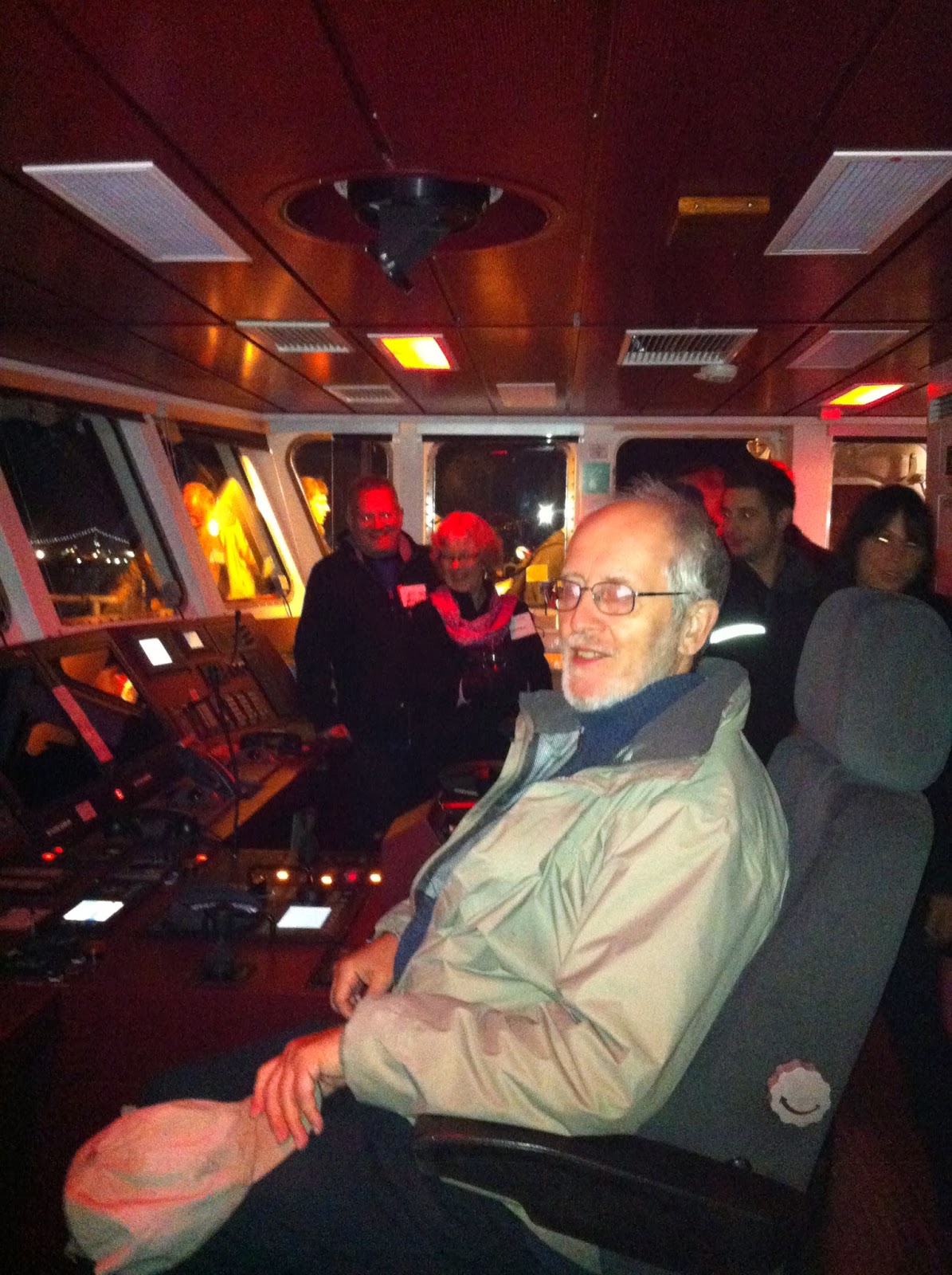
Here is a rare photo of Alex Smith, on the bridge of the Rainbow Warrior III in Vancouver in October.

Too bad my eyes were not open! But trust me, I'm not asleep at the wheel.


The Warrior III is a custom-built ship which can use sails instead of oil to cross the Pacific. It's a fast unique design, with a new type of mast, that any sailor would envy.

While the Warrior was in Vancouver, it launched an action against the expansion of the Kinder Morgan pipeline from the Tar Sands to the Port of Vancouver. Hundreds of tankers would to through the port, carrying diluted bitmumen. Unlike oil, "dilbit" sinks to the bottom as a gooey mess. What will they do to clean up the inevitable spill? Dam up the First Narrows and drain the whole port, to scrub the bottom?

One of the world's most gorgeous cities is under threat from the Tar Sands. But then, all cities are threatened by the Tar Sands, as our first speaker Peter Ward explained.

THANK YOU FOR YOUR SUPPORT

A small group of donors and members keep me going with Radio Ecoshock. We need a few more monthly members. Please join us, here at ecoshock.org.

While you are at the site, feel free to download a ton of free mp3's. Pass them out far and wide.

Background music for this program was provided from album "Deafmix" by Shane Philips from Vancouver Island. Thank you Shane. Check him out on You tube. Shane is a one-man band beyond belief.

We are out of time. Thank you for listening.

Tuesday, May 21, 2013

Who Will Control the Climate of the World?

Australian author Clive Hamilton on geoengineering & his new book "Earthmasters". Plots by big oil, Bill Gates & nuke scientists. Shocking new science shows Arctic could melt at current carbon levels. Plus world-wide growth of bike sharing with Janet Larsen of Earth-Policy. Radio Ecoshock 130522 1 hour http://tinyurl.com/mg5uj4w

Welcome traveller. Can you handle the truth?

I didn't think so. Me neither.

But it will happen anyway. Science is beginning to prove we have already changed the planet's climate in dangerous ways.

A small group of climate scientists, backed by a billionaire and big oil, are considering taking over control of the climate, to stave off disaster. Then we'll find proof our current 400 parts per million will melt so much Arctic and Antarctic ice, warming up to 8 degrees C, flooding the world's largest cities.

We'll wrap that up with one of the few positive alternatives growing in this disturbed scene: a wave of bike sharing around the world. Includes Europe, U.S., Mexico, South America, China.

FREE MP3 AUDIO DOWNLOADS FOR THIS PROGRAM

Listen to/download this Radio Ecoshock Show (1 hour) in CD Quality (56 MB) or Lo-Fi (14 MB)

Listen to/download the Clive Hamilton interview on "EarthMasters" (geoengineering 25 min) in CD Quality or Lo-Fi

Listen to/download Janet Larsen from Earth Policy Institute on world-wide bike sharing (24 min) in CD Quality or Lo-Fi

LISTEN TO THIS RADIO ECOSHOCK SHOW RIGHT NOW (courtesy of archive.org)


==========

CLIVE HAMILTON - EARTHMASTERS


Clive Hamilton

Gather round boys and girls as we tell the story of the Earthmasters - the men who would take over from nature, to run the climate of the world. Or do they mean to save us from our fossil-addicted selves?

For all who love a conspiracy, geoengineering has it all. The oil companies, far-right think-tanks, nuclear weapons scientists, and even Bill Gates. But you'll have to hang in, while we first look at a few small problems in their plans.

Our guide is Clive Hamilton. After careers in the Australian public service as an economics and resource advisor, and several stints at Universitites like Yale, Cambridge, and Oxford, Hamilton founded and ran a progressive think-tank called the Australia Institute. Now he's Professor of Public Ethics in a program run by two Australian universities.

You may have heard of books Clive's written or co-written, including "Growth Fetish", "Affluenza", "Silencing Dissent" and more recently "Requiem for a Species: Why we resist the truth about climate change." But his latest is "Earthmasters, The Dawn of the Age of Climate Engineering."

We reached Clive Hamilton in Canberra.

We cover a lot of important points. One of the big questions: if we start cooling the planet, say with Solar Radiation Management, what happens if we stop? Answer: the temperature goes up very quickly in a matter of months or even weeks, as the aerosols are rained out. It could be a jump of several degrees.

That leads to an absolutely key point: the RATE if temperature increase is possibly more important than the overall increase. If we gain a half a degree per decade, some plants, animals and ocean species will have time to migrate further toward the poles, or higher up mountains, to survive. But if there is a relatively sudden jump of one or two degrees global mean temperature, (more in some areas) - then mass extinctions will result. That is one of the supreme risks of geoengineering.

It's easy to picture a scenario where a fleet of aircraft spraying sulfates, or a fleet of ships spraying up salt water continuously, could stop. A financial crash, war, plague, or terrorism could end the program. Then all of the heating we've covered up with geoengineering would strike the planet. No one has a tenable answer for this problem.

A second key issue: who will decide when and how to start geoengineering? A single country could do it, like Russia, the United States, or even Malaysia. It's possible a billionaire could decide to cool off the planet, with no public consultation. In fact, we learn that Bill Gates, the Microsoft Founder, has been pouring millions into a research fund to develop science - and patents! - to cool the planet. Some businessmen hope to make money controlling the technology that could save us from extreme climate change.

The Gates foundation has been advised by two scientists in particular, Ken Caldeira and David Keith. These are highly regarded climate scientists, Caldeira from Stanford and Keith from Harvard. David Keith is a great example of a man who seems to deny climate change, or at least thinks it won't matter to humans, we can adapt - and yet he gets money from Canadian Tar Sands billionaire N Murray Edwards to further the cause of geoengineering. How can Conservatives have it both ways? Another important player in this "geo-clique" is Brad Allenby.

Gates has started several companies investigating geoengineering, one called "Intellectual Ventures". The CEO is Nathan Myhrvold, formerly Chief Technology Officer at Microsoft.

Another associate at Intellectual Ventures is Lowell Wood, a former nuclear weapons researcher at Lawrence Livermore National Laboratory and protege of the late Edward Teller, inventor of the hydrogen bomb. Before his death, Edward Teller was promoting a scheme to launch millions of mirrors into space to deflect the sun away from the Earth. Teller was a Cold Warrior who also championed the "Star Wars" scheme under President Ronald Reagan. Wood is one of a collection of people who moved from nuclear weapons research into geoengineering. And why not? If you think humans should control the Earth by force, why not control the climate the same way? In fact, some of these men want to control Nature entirely. Former Vice President Dick Cheney or the current Dictator of North Korea would probably agree that's a good thing.

Such schemes reduce sunlight for all creatures on Earth, including our own needs for agriculture. And they do nothing to stop the equally deadly acidification of the oceans from our fossil fuel pollution.

Obviously, big oil and coal companies would love to have a technological solution that lets them burn even more of their polluting produces. In the interview, and in his book Earthmasters, Clive Hamilton tells us how Exxon/Mobil and Shell are investing in geoengineering schemes.

Strangest of all, the right-wing think tank the American Enterprise Institute also backs Solar Radiation Management, or geoengineering, to stave off global heating. The AEI was previously given millions of dollars, and acted to deny global warming was even happening. That's quite a switch, going from denial straight to demanding emergency action to stop climate change!

Clive Hamilton suggests the problem of global warming indicates a failing of the free market system - since the true cost of polluting the atmosphere was never factored in. But now, with geoengineering, the capitalists system tries to vindicate itself by converting a horrible problem into a wonderful victory with technology it controls.

Due to time limitations, we didn't cover technologies to suck carbon dioxide out of the air. People are going to have to buy the book to get that.

Part of the reason Clive wrote the book, and is now touring North America, is to wake up the public and get a real discussion going about who should control this tech, if we ever need it. Naturally, the far better solution is to drastically reduce our greenhouse gas emissions before we lose the climate civilization depends on.

Find out more at Clive's web site.

Now in fairness, we have to say there are genuine and worthy climate scientists who are terrified about the way the climate trap is going. They don't get money from the military or Bill Gates. They just see the Arctic meltdown and species leaving the stage forever, and think "we've got to do something fast". What could we do that isn't too crazy or dangerous?

I think there will be a "climate emergency". We get two years where crops don't grow. It could be floods or extreme heat, whatever. Millions die and there is a call for action. The geoengineers step forward with a plan. Will we be able to say "no"?

That's why I didn't ask Clive about international negotiations or laws. It's still the Wild West of the atmosphere, where just one determined dictator, billionaire, or president could decide to cool the world.

NEW SCIENCE FROM THE ARCTIC: WE MAY HAVE ALREADY PASSED THE BIG MELTING POINT

In the last year, scientists discovered a climate record going back over 3 million years - long beyond the ice core records of 800,000 years. Research led by Professor Julie Brigham-Grette, from the University of Masschusetts, Amherst drastically changes our understanding of the world.


Julie Brigham-Grette

She's been studying a meteor-impact lake called El' gygytgyn on the Eastern tip of Siberia.Drilling into a lake in the Russian Arctic, created from a meteor strike ages ago, she found several periods where the Arctic was up to 8 degrees warmer than today. That despite carbon dioxide levels thought to be similar to, or below, today's 400 parts per million. Zoom out on this Google Map to see where that lake is.

The Greenland Ice sheets have repeatedly shrunk to half current size. The West Antarctic Ice Sheet completely disappeared 1.1 million years ago. The sea level was tens of meters higher than today.

All this happened not with carbon levels like the 600 parts per million and above projected by politicians and planners, but at only 400 parts per million, our current level. It appears we may have already arrived at greenhouse gas levels sufficient to drastically warm the poles, make sea ice history, melt Greenland and parts of Antarctica, and flood coastal areas around the world. All that may be only a matter of time.

In the radio show I play a selection of key clips recorded from a You tube video presentation by Dr. Julie Brigham-Grette, at Amherst, in the summer of 2012 - almost a year ago, and yet hardly anyone has heard of these startling findings. Find out more at frontierscientists.com, hosted by University of Alaska, Fairbanks.

I highly recommend you watch this full Youtube video of Julie Brigham-Grette with all the graphs and charts. Scary stuff.

FINALLY SOME GOOD NEWS: BIKE SHARING IS EXPLODING AROUND THE WORLD!

Quick quiz: what way of getting around is growing faster than "any mode of transport in the history of the planet?"

If you said cars, motorbikes, or skateboards... nope. The right answer is "bike sharing". It's almost enough to give us hope - and that's the intention of the the ongoing work called "Plan B" from Lester Brown's Earth Policy Institute.

Here to brighten our day with news about the wave of carbon-friendly bicycle travel around the world is Janet Larsen. She's the Director of Research for the Earth Policy Institute. Over 500 cities world-wide have installed millions of share-able bikes.


Janet Larsen, Earth Policy Institute

There's plenty of bike action in North America, but we start with Europe. They have been the world leaders in urban biking, other than China. A few of us heard about free bikes in Amsterdam back in the day, but those were stolen to be sold off in Eastern Europe. We talk about bicycle solutions today in Amsterdam and Copenhagen.

The Copenhagen "Bycyklen" system just shut down at the end of 2012, as part of "austerity". There was such a big public outcry, the government has now promised a new modern bike sharing system to replace it.

The French were never known for their biking, but Citi Group helped pioneer a sharing system in Rouen that was very successful. Now every tourist to Paris enjoys the great bike sharing system there.

I wince with pain when I think about what happened in China. In the early 1990's, we all saw video of throngs of commuters biking into work in most of China's cities. Now that's been wiped out by the same polluting car culture developed in America, and pushed by many of the same car companies, like General Motors. That car-culture is beginning to fail them. China is still the world's largest bicycle maker, and some Chinese cities have installed a lot of shared bikes, up to 90,000 in one city alone. There are lots of exciting things going on with biking in China.

In our interview, we also look at the challenges facing bicycle transport in Mexico, and innovative programs in Central and South America.

NORTH AMERICAN BIKE SHARING

Another whole aspect of this is bike messengers and inner-city deliveries. We have a small fleet of tricycle "freight" bikes operating in downtown Vancouver.


Freight Tricycle Vancouver (photo Alex Smith)

No doubt you've heard that New York City will be opening a giant new bike sharing program later this Spring. The first 5,000 subscriptions for shared bikes sold out quickly. Other cities, even Tusla Oklahoma, are scoring successes with new bike paths and bike sharing.

The list of bike benefits is so long. They offer independence, even if the main grid goes down, or oil prices skyrocket. You help save the climate, and help save your health at the same time. I wonder, is anyone doing the calculations about how fast we need to develop the bicycle transportation network, to be energy secure, and to make a major dent in climate-damaging car emissions?

This bicycle update is part of a series on the positive news coming from the institute, covering everything from clean alternative energy to climate-friendly diet changes. It's called "Plan B" as advanced by the Institute's founder, Lester Brown.

Track it down at earth-policy.org.

============= Please support Radio Ecoshock if you can, at our web site, ecoshock.org And grab lots of our free mp3 downloads of past shows.

Are we out of time? Find out next week, as I look into human extinction. I'm Alex. Thanks for hanging in.

Wednesday, September 1, 2010

WARNINGS: THE RUSSIAN HEAT STORM

Radio Ecoshock Show September 3rd, 2010

GO STRAIGHT TO THE TRANSCRIPT, with lots of links and downloads.

[Radio show starts with a clip from "Fire" by Arthur Brown, 1968][plus news radio clips...]

Welcome back to Radio Ecoshock. Thanks to the 22 college and community stations that carry this show - and Green 960 AM and online, in San Francisco.

And you downloaders and podcast subscribers! You amaze me. I don't keep close track of statistics, but I happened to check downloads of the Radio Ecoshock program for June. These shows come from a dedicated server (ecoshock.net) - so I know how many one hour shows, past and present, are carted away by hungry ears.

The total in June alone? Over 31,000 downloads. From all over the world.

It's my privilege to report for you. Find out listing of all our 2010 programs, with links to every program from the past 5 years, here.

It’s all free mp3’s. Load up your computer or IPOD. I claim no copyright on my work – so go ahead and share these programs with people who need to hear them.
---------

In the Summer of 2010, the world witnessed more signs of climatic instability on a grand scale.

The Arctic Ice again retreated to near-record levels. In the United States, new heat records were set in many states. In fact, 17 different countries set all-time heat records this past Summer, from Latin America through Africa and the Middle East to Russia.

In Pakistan, floods beyond imagination created the world's largest humanitarian disaster.

But the harbinger, messenger from the future, took the Russian people into uncharted Hell. Moscow, at the latitude of Alaska, boiled in the weather of Cairo, while gasping smoky air equivalent to two packs a day of cigarettes, for every man, woman and child.

Russian leaders, who bragged global warming would be good for that Northern country, got a taste of the coming century.

Scientists are still debating whether the abnormal heat, drought, and fires in Russia were caused by climate change. But we know for certain: this is the future, in the coming century, as temperatures climb, as the greenhouse atmosphere thickens with the exhaust of our fossil civilization.

Let us see what we can learn. About how people and governments act under stress. About our vulnerabilities. About our chances of survival.

In the radio show, we go straight to Moscow, talking with Vladimir Tchouprov of Greenpeace Russia. He's got news that never made the mainstream news.

That is followed by more analysis from Dmitry Orlov, author of "Reinventing Collapse: The Soviet Example and American Prospects." Dmitry has been scanning the Russian language press and blog, while talking with people inside and outside the country. Dmitry has some suggestions for survival.

Are you interested in your food supplies? We squeeze in a clip from a press conference with Lester Brown, on the Russian grain export ban, and the impact of climate on world food stocks.

Can we even comprehend these grand events, these warning signs?

I'm Alex Smith, and let's get started.

[READ MORE with all the links - plus 15 lessons from the Russian disaster.]