Showing posts with label hurricanes. Show all posts

Wednesday, December 17, 2014

STORMS OF RIGHT NOW

SUMMARY: Sandy, climate & coming superstorms: Kathryn Miles & Dr. Adam Sobel. Plus new science says our carbon hits in 10 years, not a generation later. Dr. Katharine Ricke.

WELCOME TO THE SHOW

Dr. James Hansen wrote his pivotal book "Storms of My Grandchildren". But in 2012, the Atlantic experienced the largest storm ever recorded. It was Hurricane Sandy, the most expensive storm ever, causing billions of dollars in damage. Manhattan was flooded. Parts of the New Jersey shore were demolished. Two hundred and eighty five people were killed. It was also the big new show-case for both rising seas and storm surge.

Was Hurricane Sandy a freak once-in-century storm, or can we expect more and worse as planet Earth heats up? What about Asia and the Pacific, where Japan was raked by a series of tropical cyclones this fall. A giant storm just battered the Philippines - again. Are those climate related? Radio Ecoshock investigates.

Download or listen to this Radio Ecoshock show in CD Quality (55 MB) or Lo-Fi (14 MB)

Or listen on Soundcloud right now!


KATHRYN MILES: "Superstorm: Nine Days Inside Hurricane Sandy"

These days, you and I face situations we've never encountered before. It's climate change, terrorism, a new disease, or maybe an economic crash . But humans and their governments act on experience, not the future. As our next guest can tell us, responses based on the past can fail badly.

Kathryn Miles has an exciting new book out about Hurricane Sandy. That's the monster storm that flooded New York City, and wrecked much of the New England shore, in late October 2012. Miles tells the gripping tale in "Superstorm: Nine Days Inside Hurricane Sandy." But I think the storm and the book are also a lens for looking at preparedness during a time of climate disruption.

Kathryn has written several books. She's a science writer published in Outside Magazine, Popular Mechanics, and many other periodicals. Miles is currently writer-in-residence at Green Mountain College in Vermont.


Kathryn explains this was the largest Atlantic storm ever, at over 1,000 miles in diameter. Operators in the International Space Station were amazed to see a continent-sized storm. It was larger than all of Europe.

After Hurricane Sandy raked the Caribbean Islands, 39 out of 40 weather models showed it spinning harmlessly out into the Atlantic. That's normal, as both the prevailing winds, and the spinning of the Earth, takes storms toward the East. I didn't know, until Kathryn told us, that hurricanes do not have much propulsion on their own. They more or less float with the prevailing wind and pressure systems.

The European weather modellers said Sandy would take a left hook into the area around New York City. Kathryn did exhaustive research with weather and climate scientists for this book. She says a combination of factors, including hotter seas, and a blocking high pressure zone over Greenland, pushed Sandy into combining with a different type of storm known as a "Nor'easter".

When "Hurricane Sandy" became this hybrid - the National Hurricane Center stopped sending warnings to top government agencies. Their aging software couldn't handle this hybrid, and they are only directed to work on "Hurricanes". So warnings fell to local stations of the National Weather Service.

No wonder then that various authorities fell into confusion! In this interview we cover the big difference between the approaches taken by New Jersey Governor Chris Christie, and then New York Mayor Michael Bloomberg. Having been stung by unnecessary evacuations for the previous Hurricane Irene, Bloomberg held a press conference telling New Yorkers not to worry. Then a 34 foot high wall of watery storm surge washed over the city, flooding downtown Manhattan, subway lines, businesses and homes.

By contrast, Chris Christie told people in no uncertain language to "get the Hell off the beach" and evacuate. No doubt he saved some lives. But even so, and this is critical in evaluating human response to extreme climate events: 70% of the people told to evacuate did not. They stayed put, were flooded out, and some died.

Author Miles looked into that too. It turns out humans need at least three days of warning, with repeated warnings, before they will really act. Apparently it takes us that long to believe. Maybe that applies to government officials as well? I'm thinking of the terrible fires in Australia - "Black Saturday" in February 2009. The government wrongly advised people to stay and defend their homes, facing an incredible climate-driven firestorm. 173 people died.

In the story of the late Robin Waldridge, the Captain of the sailing ship "The Bounty", Kathryn brings out a case study of our weakness in judging risk. That human flaw in risk judgment applies directly to our ability to survive a lot of things, including droughts, heat, storms, and fires. If we haven't seen it before, or we were always fine in the past, we don't get out of the way, or change our behavior. You can expect to see this time and time again. It may even happen to you!

Predictably, the only fiery criticism Kathryn received after writing "Superstorm: Nine Days Inside Hurricane Sandy" was from Meteorologists! Some weather specialists still don't get the long-term storm implications of climate change. Some continue to deny climate change plays a role.

Others, and certainly the climate scientists she interviewed, are certain a warmer world plays several key roles in extreme storms.

1. this warmer world holds at least 4% more water in the atmosphere. That gives storms more power, and can cause extreme rainfall events, as happened during Hurricane Irene.

2. the oceans are measurably hotter. It turns out, the ocean off New England is quite bit hotter during the last few years. That also adds to the power of extreme storms.

3. the seas are rising. I'll talk more about this with our next guest Adam Sobel. The water around New York City is about one foot higher than it was in the year 1900. There are several reasons for that, it's not just climate change. But a higher sea adds to the storm surge, and that was the most damaging part of Hurricane Sandy.

Climate scientists are less certain about other impacts of a warming world. Most think we may get fewer hurricanes or tropical cyclones, but the ones that do come will be more powerful. There's a lot we don't know for sure about that.

The U.S. currently has 500 un-staffed positions in the National Weather System, including staff needed to run radar and work. Their budget cut by 8.5%. America has Doppler radar that crashes, satellites beyond their lifespan. The Hurricane warning service has to borrow from other countries, including some excellent work done by Cuba. This weakness in predicting extreme weather is a national crisis, and a personal threat.

Aside from all the science and research in Kathryn Mile's book, it's a terrific drama, wound around a series of personalities well-drawn by the author. It's literally hard to put down.

You can download or listen to this interview with Kathryn Miles in CD Quality or Lo-Fi

ADAM SOBEL: SANDY, CLIMATE AND EXTREME WEATHER

We are lucky to have an extreme weather specialist and atmosphere scientist here to help. Columbia University Professor Adam Sobel just published his new book "Storm Surge: Hurricane Sandy, Our Changing Climate, and Extreme Weather of the Past and Future".


Adam wrote me saying he's just returned from the Eighth International Workshop on Tropical Cyclones (IWTC-VIII) organized by the World Meteorological Organization (WMO). That was held at Jeju Island, South Korea. It's invitation only for the world's top forecasters and researchers. They go over the past 4 years of new science on tropical cyclones (which are also called hurricanes or typhoons).

The Philippines was just rocked by cyclone "Ruby" also know in Asia as "Hagupit". I'm beginning to wonder if some places in the world will be so badly damaged by repeated storms that people will abandon coastal settlements. Certainly some Pacific Islands are already threatened, with Kiribati likely the first to go underwater during storms.

But will we have more storms due to climate change? I remember back in 2006 when the New England scientist Emanuel Kerry produced papers saying hurricanes would be more frequent due to climate change. Then he backtracked, and it seems to me they haven't been more frequent since the year 2000, compared to the late 1900's. Adam Sobel agrees, but cautions we don't know how this experiment with climate will translate into weather. Some scientists think we will see more large storms. Forget the "storm-of-the-century" lable. We'll see plenty of them.

Let's talk about the sea level around New York City. Sobel says the water is about one foot higher now than in 1900. Like many coastal cities, New York was actually partly build on former swamps and lowlands. Some of it is extended with landfill into the former ocean. Adam says about 2/3 of that foot higher water around NYC is due to rising seas, due to simple expansion of the hotter ocean, and new water pouring in from Greenland and Antarctica. The other 1/3 of a foot is due to a pattern of sinking coastlines, as a slow reaction to the retreat of the heavy glaciers thousands of years ago. It's called subsidence, which means the land is sinking.

Our guest last year, J. Court Stevenson from the University of Maryland explained that for 10 billion dollars New York could build tide and surge control gates at the three entrances to New York harbor. These would be like the surge gates on the Thames in London, or in the Netherlands. So far, following the Bloomberg lead, this is not part of the plan. I think it's only a matter of time before the next Sandy floods New York.

We also got a harsh lesson on the real value of coastal real estate. There's no doubt that during this century, humans will have to exercise a planned withdrawal from many parts of the coast-line. That will include from parts of mega-cities from New York to Shanghai. As Dr. Peter Ward warned, sea level rise will reshape geography and economies around the world. (Ward's You tube lecture on his book "The Flooded Earth, Our Future in a World Without Ice Caps" is here).

It seems strange that many New Yorkers think more about a single day terrorist attack on their city, than they do of a coming century of floods and multi-billions of dollars of damage from climate change. In 9/11 we found out how critical New York City is to our economic system. I think if New York is faced with rising seas, high storm surges, and probably killer heat waves, that is also a national security issue.

Here is a climate central article on new wave of research into impact of climate change on severe storms.

You can download or listen to this interview with Dr. Adam Sobel in CD Quality or Lo-Fi.

If you want to get more detail on the damage to New York City during Sandy, try this fascinating interview by WNYC Pacifica host Leonard Lopate, talking with Dr. Adam Sobel.

STARTLING NEW SCIENCE ON PEAK CO2

Every now and then there's a game-changing scientific paper about climate change. I saw this one , and right away invited our next guest. Katharine Ricke, known as Kate, joined well-known scientist Ken Caldeira to investigate a critical question: how long does it take the carbon we emit today to reach it's peak heating potential. If you answered 50 years or more, you are in for a shock.

The title of the new paper is a give-away: "Maximum warming occurs about one decade after a carbon dioxide emission". That was published December 2nd, 2014 in the journal Environmental Research Letters.

The lead author is Katharine Ricke, a Post Doctoral researcher at the Carnegie Institute for Science, at Stanford University in California. She is our guest in this segment of Radio Ecoshock.


This study is a bombshell. We've been told for years that carbon emissions will really impact our children and grandchildren, not us. Now we find out the peak heating is only ten years after emissions.

Or course it doesn't end there. The warming action of carbon dioxide goes on not just for centuries, but for tens of thousands of years. That's because carbon dioxide is a relatively inert chemical in the atmosphere. It doesn't change much chemically over time.

Contrast that with methane. After only ten years or so, methane starts to break down - mainly into carbon dioxide. That is why scientists like David Archer argue that we must concentrate on carbon dioxide, rather than fear methane emissions. That's another whole argument we've been carrying in various Radio Ecoshock shows.

An obvious question from a non-scientist would be: why does a puff of carbon dioxide take ten years to become most active in trapping heat radiation? Why doesn't it have the maximum impact as soon as it rises up into the atmosphere? Katharine answered it's because the oceans are slow to react, but to be honest, I still don't understand the answer to this question. If any scientists are reading this right now, or if you think you know why this delay occurs, please email me. The address is radio //at// ecoshock.org. Or post your response in the comments below.

Former US Energy Secretary Steven Chu said "It may take 100 years to heat up this huge thermal mass so it reaches a uniform temperature ... The damage we have done today will not be seen for at least 50 years."

I found plenty more like that. This is a long-running misconception. It has shaped climate negotiations and government responses. Now we have science that shows CO2 in a different light.

This discovery is personal too. If I think my crappy low-mileage car won't affect me, maybe I won't try to bike or use public transit. But it's a different story if my emissions could change the climate just ten years from now, isn't it?

Drawing from over 6,000 runs of the best climate models on the planet, about 90% of the results showed CO2 hitting it's great heating potential around 10 years. The window was something like 6 years at the earliest, with a few showing a period as long as 30 years. But the science is pretty clear on 10 years.

There are some large uncertainties, including climate sensitivity, and the reaction of the carbon cycle (including carbon used by living things) and thermal inertia of the oceans.

This paper was written partly in response to a school of scientific thought, lead by Matthews and Solomon's 2013 paper, saying our past emissions do not determine future warming. Our future emissions do. It's a tricky problem to explain. The paper is "Irreversible Does Not Mean Unavoidable" published in the journal "Science" on April 26, 2013.

WARMING IN THE PIPELINE

Following their paper, the excellent science blogger John Cooke bluntly says there is no warming in the pipeline. Future warming is only determined by future emissions, so we can control climate change by controlling our emissions. More warming is not "baked in" they say.

My understanding was that people like Dr. James Hansen talk about up to 1 degree, or more, in the pipeline, because of heat stored by the oceans and global dimming, or the aerosol pollution that diminishes sun arriving to the surface. Dr. Ricke agrees there is warming "in the pipeline" beyond the ten year lag you found in this new research.

AS AN ASIDE: WOULD "INDUSTRIAL SHUTDOWN" START RUNAWAY CLIMATE HEATING?

This debate about what happens if our air pollution clears up (likely a burst of heating) is discussed in yet another seminal paper by Andrew H. MacDougal, Avid and Weaver titled "Significant contribution to climate warming from the permafrost carbon feedback". For you doomsters out there, these scientists look at a case they describe as "industrial shutdown".

A guest article by Peter Cooke at Climate Progress says:

"Thawing permafrost will release carbon to the atmosphere that will have an appreciable additional effect on climate change, adding at least one quarter of a degree Celsius by the end of the century and perhaps nearly as much as one degree (about 1.5°F).

The permafrost feedback response to our historic emissions, even in the absence of future human emissions, is likely to be self-sustaining and will cancel out future natural carbon sinks in the oceans and biosphere over the next two centuries.
"

Thus, even if we "stopped emissions tomorrow" the MacDougall study suggests, contrary to Matthews and Solomon, that CO2 would not decrease (and so warming would continue) if only because of the warming set in motion now that the Permafrost is melting.

This Climate Progress article also discusses "the industrial shutdown experiment". The authors (MacDougall et al, including Canadian scientist Andrew Weaver) imagined a complete shut-down of carbon emissions in 2013, and in 2050.

It notes that because the added permafrost heating could be balanced by ocean and biosphere uptake, this feedback effect does NOT equate with a runaway greenhouse effect.

"Note that a self-sustaining feedback is not the same thing as a runaway greenhouse effect."

The shutdown in 2013 results in CO2 stabilizing around 400 ppm for at least the next 300 years. A shutdown in 2050 yields a stable level around 550 ppm, on average, with a higher or lower level dependent on the as-yet-uncertain climate sensitivity.

Find more on the "industrial shutdown" experiment in this article by John Cooke. It's deep.

A further article on this study can be found here.

My thoughts:

Scientists generally consider the "industrial shutdown" scenario so unlikely, they either ignore it, or just look at "what-if" scenarios. However, it is conceivable that an industrial shutdown could occur due to a mega solar storm knocking out electric grids, a major nuclear war, an unstoppable disease in humans (think ebola on steroids), a meteor striking the Earth, or even a collapse of the current system (similar to the collapse of the Soviet Union, but globally, and on a much larger scale).

A cessation of human caused carbon emissions sounds possible by 2050, but is not really viable if we keep our present system of agriculture, and persist in terraforming, such as deforestation, both of which contribute to substantial emissions even without an industrial culture.

BACK TO PEAK CARBON DIOXIDE

In a well-written article at climatecentral, Andrew Freedman found scientists who temper your discovery for several reasons. Some say the timing doesn't matter, all that matters to the climate system is the total greenhouse gases in the atmosphere, whenever that comes.

Another caution is from Zurich scientist Reto Knutti, who tells climatecentral, quote:

"It takes only a few years for the climate to respond to emissions, but it takes a generation, at least, to change the emissions. We are slow, not the climate.”

We discuss all that in our interview.

After reading this study, I was left wondering how long a particular carbon emission can stay active in the atmosphere. Your graphs appear to stop after 100 years, with the carbon impact still pretty high. In fact, it doesn't decline much after the 10 year peak. How long does carbon dioxide stay potent as a warming gas in the atmosphere?

I interviewed David Archer about this. In his book "The Long Thaw", and in his Radio Ecoshock interview, Archer said that CO2 emitted today would remain in the atmosphere for at least 50,000 years, if not 100,000. You can see a You tube video of that Radio Ecoshock interview here. Archer did not mean a particular molecule of CO2, which is recycled through the biosphere, but that additional molecule level would be maintained for a very long time. The paper by Ricke and Caldeira stops at 100 years not because they disagree, but because that was the time frame of the best data sets - and all they needed to answer their principal question: how long does it take for CO2 to reach it's peak potential for heating the atmosphere?

This was also published in this scientific paper: Archer D et al 2009 Atmospheric lifetime of fossil fuel carbon dioxide Annu. Rev. Earth Planet. Sci. 37 117–34

EVEN IF CARBON REACHES A PEAK IN 10 YEARS, THE TRUE IMPACTS MAY TAKE MUCH LONGER

From the paper by Ricke and Caldeira: "While the maximum warming effect of a CO2 emission may manifest itself in only one decade, other impact-relevant effects, such as sea level rise, will quite clearly not reach their maximum until after the first century (see, e.g., figure 2(c) of Joos et al (2013)). For many impacts, such as changes to natural ecosystems, degradation is the result of the cumulative effects of consecutive years of warming or precipitation change (Parmesan and Yohe 2003). Ice sheet melting can persist for thousands of years following a warming (Huybrechts et al 2011). As such, even if maximum warming occurs within a decade, maximum impact may not be reached until much later. From this perspective, Steven Chu's statement that today's damage 'will not be seen for at least 50 years' may well be accurate."

THIS NEW SCIENCE PUSHES MORE URGENCY TO ACT ON CARBON REDUCTIONS

This new science may help push climate negotiations into high gear in Paris next year. Now we know we don't have time to set long-term goals and slowly reduce CO2. Our emissions now will hit us hard and fast within 10 years!

From the conclusion of this paper:

"Our paper corrects a potential misconception that the largest effects of today's emissions will be felt only by future generations. Benefit from avoided CO2 emissions will most likely be manifested within the lifetimes of the people who act to avoid those emissions."

Find links to this paper, a video of Katharine explaining it here.

Download or listen to this Radio Ecoshock interview with Katharine Ricke in CD Quality or Lo-Fi

CONGRATULATIONS IF YOU MADE IT THIS FAR!

I admit this week's blog is too long. But I got almost a year of education just researching for this week's guests. There was way too much to cover on the radio, and I found deep tunnels going into science that can determine how our future develops, and maybe whether we will survive our own carbon civilization.

I invite you to follow up on the links, and ask yourself the same hard questions.

A NOTE TO N. IN BOSTON

I need to tell my anonymous donor and supporter "N." in Boston: I got your letter and I'm looking into your suggested reading and guests. Thank you.

COMING UP

We have some more tough questions in coming shows. I found a great radio documentary on the perils of dreaming about eco-community, and survival after oil. Then I'm going to challenge another green dream: alternative energy. Is it real, or just another carbon-dependent mirage. Stay tuned.

You can download all our past programs as free mp3 files from the web site ecoshock.org. Listen to our most recent programs on Soundcloud here. There have been so many top scientists, authors and activists on Radio Ecoshock its almost an open university, cruising the past interviews.

As always, I sincerely thank you for listening, and for caring about our world.

Alex

Tuesday, October 30, 2012

Sandy: Storms in the Emergency Room


Storms in the Emergency Room - Hurricane Sandy, coal & nukes - it's not pretty. From D.C. as storm hits, Earthbeat's Daphne Wysham on the climate connection. From Australia, Greenpeace's Georgina Woods on huge coal expansion. Then a Canadian plan to dump nuclear waste right next to Lake Huron & world's biggest running reactor. Radio Ecoshock 121031 1 hour

Download/listen in CD Quality (54 MB)

Or the faster downloading, lower quality Lo-Fi (14 MB)

MUSIC THIS SHOW: clips from:

"Secrets" by Xavier Rudd.

Or it your prefer the live acoustic version...

Rudd is coming to the Commodore Ballroom in Vancouver on November 16, 2012.

"When the Grid Goes Down" (by Craig Anderton)

This one is really about what happens after a big solar flare knocks out the electric grid behind civilization. It's all in the You tube video. I did a Radio Ecoshock feature on this possible catastrophe on November 5th, 2010, 15 minutes of audio here. But this time I played it for the millions without power on the U.S. east coast and Canada, thanks to Hurricane Sandy.

=======================

Welcome to Radio Ecoshock - the world's emergency room. At least that's what it feels like lately, as we begin to taste the high carbon future on Planet Earth.

North Americans are bragging about pumping out more oil from dirtier sources, even as drought kills off the crops, and now a humongous record Hurricane spins up the East Coast. We talk with green radio reporter Daphne Wysham just as the storm hits in the American capital, Washington D.C.

How is the brand new climate spiking these storms with steroids? I'll tell you what top scientists are saying.

At the other end of the world, following fires and floods of their own, the Australians are straining to break their own dismal carbon record. My head hurts trying to understand why such nice people want to double their coal exports. Australia is already the biggest coal exporter in the world, keeping black smokestacks in Japan, Taiwan, China, and now India pouring out more and more carbon dioxide into the overloaded atmosphere. We get the goods down under from Greenpeace Pacific Atmosphere and Energy Campaigner Georgina Woods.

You get to breathe that pollution, and we all get hit with the climate damage.

I'll wrap up with another story with warning sirens all over it. Canada is already building its own "Yucca North" - a porous hole where they'll dump nuclear waste. The best they can do is the worst they can do: the supposed deep geologic deposit is just limestone caves right beside the Great Lakes - up water from millions of people in Chicago, Cleveland, Buffalo, Toronto and Montreal. Brennain Woods of NorthWatch tells us how the aging Bruce Nuclear plant - the largest running nuclear complex on the planet, threatens the whole world.

I'm Alex Smith. Take a deep breath. We're all heading into a state of ecological shock.

SANDY: CLIMATE STORM OF THE CENTURY?

Let's start with the story covered by every network, with the part they leave out: global climate disruption makes deadly and costly storms like Hurricane Sandy much more violent. More than two decades ago, scientists told us this would happen. Now it's here.

How does it work? First, you need to know: we've created far more heat on this planet than we feel on land. The world's great oceans are absorbing more than half the heat held in by greenhouse gases in the atmosphere.

The Gulf Stream, that great ocean current running off North America's East Coast, until it warms Britain and Northern Europe, is heating up.

According to the UK Met Office, the government body measuring such things, there is a huge area off the mid-Atlantic coast that is 2.3 degrees Fahrenheit, or 1.3 degrees hotter than average. That doesn't sound impressive, but that much heat over a giant expanse of ocean is tremendous.

But it gets worse. The Gulf Stream itself is currently 5 degrees Fahrenheit above normal. Hurricane Sandy cruised up this Gulf Stream, gathering up both energy and extra water moisture in her half-continent sized clouds. As meteorologist and former storm chaser Jeff Masters tells us, the Atlantic was unusually warm right to the end of October, making Sandy stronger and wetter.

Did the record amount of open ocean in the Arctic this summer help the Atlantic stay warmer longer? Scientists aren't sure yet. Jennifer Francis of Rutgers, a recent guest on Radio Ecoshock, says the blocking weather in the last two weeks is consistent with what her team observed from the melting of sea ice in the Arctic. Kevin Trenberth of the National Center for Atmosphere Research agrees the Atlantic currents are 5 degrees Fahrenheit warmer than normal, and he attributes 1 degree of that is directly due to global warming. But he doesn't believe the Arctic melt this summer and fall contributed to it. The jury is still out on that - but the vast majority of scientists agree mega-storms like Sandy are more likely to become the new normal, due to climate disruption by human-induced emissions of greenhouse gases.

Of course there are skeptics, some of them well-paid by the fossil fuel lobby.

For example, Patrick J. Michaels of the Cato Institute, who we know has received lots of money from the Koch Brothers and others in the powerful oil and coal lobby, says a storm like Sandy could have happened on a cooling planet as well.

He writes Andy Revkin of the New York Times:

"I predict confidently that we will survive Sandy, which should not be a tropical cyclone at landfall."

Another ploy used by the climate deniers is to find papers showing there were big storms hundreds of thousands or millions of years ago. In many of those cases, carbon dioxide was high then too, and there was a "hothouse" world. And anyway, so what? We're dealing with now, and humans have ramped up the odds of getting a lot of big storms in a short period of time....

Meanwhile, on the ground, what was it like? On Monday night, as the big storm landed in Washington D.C., I spoke with Daphne Wysham. As the cell phone towers swayed, she called for calm.

DID CLIMATE CHANGE MAKE HURRICANE SANDY WORSE?

FROM WASHINGTON, AS THE STORM HIT, DAPHNE WYSHAM, long-time host of "Earthbeat" on Pacifica radio.

It's official. Hurricane Sandy is the largest storm ever to have crossed north of Virginia, greater even than the famous Nor’easter of September 1938, known as "The Long Island Express".

The mainstream media is delivering the news while keeping up the great American silence about the role of climate disruption in this unprecedented storm. That's what we're going to talk about with Daphne Wysham, host of the long-running green radio show "Earthbeat" and now a Fellow at the Institute for Policy Studies in Washington.

I reached Daphne in her home in D.C., just as Hurricane Sandy washed ashore on Monday. We talk about what it's like to live it out.

You can find links to Daphne Wysham's article about growing past the pat TV coverage of storms, and our need to be frightened. Instead, we need to look at the deep recurring patterns in these disasters, augments by a warming world. Read that at Firedog Lake here.

Here is another great article by Wysham - the Six Stages of Climate Grief published in the Huffington Post.

With Daphne, I mentioned the recent study by Munich Re - the insurance company that sort of insures smaller insurance company. This is the company that sees the big bills after weather disasters. They report that North America in particular has been hit by violent weather, and they think climate change is a big part of that picture.

Find the Munich Re press release here.

You can read more about it in Elizabeth Kolbert's article in The New Yorker. She's always a good read.

Kolbert writes:

"A couple of weeks ago, Munich Re, one of the world’s largest reinsurance firms, issued a study titled “Severe Weather in North America.” According to the press release that accompanied the report, “Nowhere in the world is the rising number of natural catastrophes more evident than in North America.” The number of what Munich Re refers to as “weather-related loss events,” and what the rest of us would probably call weather-related disasters, has quintupled over the last three decades. While many factors have contributed to this trend, including an increase in the number of people living in flood-prone areas, the report identified global warming as one of the major culprits: “Climate change particularly affects formation of heat-waves, droughts, intense precipitation events, and in the long run most probably also tropical cyclone intensity.”

Another good read: "Climate Change Sandy says to US, 'Take That, Idiots!'" in the Huffington Post.

Daphne and I briefly discuss the on-going argument in scientific circles: did the huge Arctic sea ice melt of 2012 help make Sandy larger? Jennifer Francis of Rutgers says "probably yes" while Kevin Trenberth thinks not. You can find more on that in this blog entry by Joe Romm from Climate Progress.

And check out this article about Kevin Trenberth on warming seas fueling big storms. Trenberth, who I trust, writes:

"The sea surface temperatures along the Atlantic coast have been running at over 3C above normal for a region extending 800km off shore all the way from Florida to Canada. Global warming contributes 0.6C to this. With every degree C, the water holding of the atmosphere goes up 7%, and the moisture provides fuel for the tropical storm, increases its intensity, and magnifies the rainfall by double that amount compared with normal conditions.

Global climate change has contributed to the higher sea surface and ocean temperatures, and a warmer and moister atmosphere, and its effects are in the range of 5 to 10%. Natural variability and weather has provided the perhaps optimal conditions of a hurricane running into extra-tropical conditions to make for a huge intense storm, enhanced by global warming influences.
"

Andy Revkin's Dot Earth blog has more input from scientists, both pro and con, about the link between Hurricane Sandy and climate change.

Jeff Masters, one of the most dependable storm writers on the Net, at wunderground.com, explains the connection between warming ocean waters and bigger storms in this post.

Jeff writes:

"Sandy to feed off near-record warm waters off the mid-Atlantic coast

During September 2012, ocean temperatures off the mid-Atlantic coast in the 5x10° latitude-longitude box between 35 - 40°N, 65 - 75° W were 2.3°F (1.3°C) above average, according to the UK Met Office. This is the 2nd greatest departure from average for ocean temperatures in this region since reliable ocean temperature measurements began over a century ago (all-time record: 2.0°C above average in September 1947.)

These unusually warm waters have persisted into October, and will enable Sandy to pull more energy from the ocean than a typical October hurricane. The warm waters will also help increase Sandy's rains, since more water vapor will evaporate into the air from a warm ocean. I expect Sandy will dump the heaviest October rains on record over a large swath of the mid-Atlantic and New England.

Hurricane rains and climate change

Hurricanes are expected to dump 20% more rain in their cores by the year 2100, according to modeling studies (Knutson et al., 2010). This occurs since a warmer atmosphere holds more water vapor, which can then condense into heavier rains. Furthermore, the condensation process releases heat energy (latent heat), which invigorates the storm, making its updrafts stronger and creating even more rain. We may already be seeing an increase in rainfall from hurricanes due to a warmer atmosphere.

A 2010 study by Kunkel et al. "Recent increases in U.S. heavy precipitation associated with tropical cyclones", found that although there is no evidence for a long-term increase in North American mainland land-falling tropical cyclones (which include both hurricanes and tropical storms), the number of heavy precipitation events, defined as 1-in-5-year events, more than doubled between 1994 - 2008, compared to the long-term average from 1895 - 2008. As I discussed in a 2011 post "Tropical Storm Lee's flood in Binghamton: was global warming the final straw?", an increase in heavy precipitation events in the 21st Century due to climate change is going to be a big problem for a flood control system designed for the 20th Century's climate.


A lot of us have wondered what it will take to get American politicians and media to finally admit climate change is here, and we need to act fast to salvage a livable climate. Some frustrated scientists and green activists think only a major disaster will force this change in thinking. Apparently the big drought of 2012 didn't do it. Even when the Arctic sea ice melts, that doesn't change our plans to drag even more fossil fuel out of the ground. Do you think Hurricane Sandy will help people wake up to climate disruption?"

During the Republican National Convention, presidential candidate Mitt Romney scoffed at efforts to stop rising seas. Now that the storm surge from Hurricane Sandy is threatening the American North East as never before, Bill McKibben of 350.org suggested Romney might want to rethink that. Find the best Bill McKibben article on Sandy here.

Even if we discount the role of global warming in this particular storm, this is a prime example of what the future will look like, as rising seas contribute ever higher storm surges along the U.S. East Coast.

We're also seeing how small our grid-dependent system becomes, when nature starts to roll out her awesome power. I can picture a future when the U.S. economy, and people around the world, just aren't going to be able to recover from being battered by climate disruption.

Of course, some of the scenes from the East Coast, from closed down transportation to empty food shelves and dark homes, will just fuel the growing myth of a Mayan or Christian end-of-days. There is a risk that mythology will grow instead of public acceptance of climate science.

SHOVEL OUT MORE COAL FROM AUSTRALIA!

You might think humans would learn from disasters like this. Apparently not yet.

Australia suffered a terrible drought for years, ending farming in parts of the country. The Black Saturday bushfires of 2009 killed 173 people. Then torrential rains flooded out coastal cities and towns.

No matter mate. Australia is steaming full ahead to expand their coal exports into world climate-wrecking status equal to Canada's infamous Tar Sands. Here is what you haven't heard.

Let's tune in to what is happening "down under", with Georgina Woods, Senior Climate and Energy Campaigner for Greenpeace Australia Pacific.

[Woods interview]

Australia is already the world's largest exporter of climate-killing coal. When you add up the thermal coal (for electricity and heat) and the coking coal (to make steel) it's been around 300 million tons of coal a year. Australia is keeping Japan going. Japan is a huge coal importer. But Australian coal also powers Taiwan, more of China every year, and now India.

An Indian company GVK Group just bought into one of the biggest coal conglomerates, run by the climate denier billionairess, Gina Rinehart. Rinehart buys newspapers and TV stations, and then installs deniers like Andrew Bolt into prime time. I feel sorry for the Aussies as this coal-powered media creates a big fog about climate change science.

The other big commercial competitor in Australian media is Rupert Murdoch. His Fox News outlets in America continually shout down climate change. It's obvious the Australian media has been polluted by coal smoke.

What shocks me about the rapid expansion of coal and climate denial in Australia. It seems like such an insult to all those who lost their lives in the horrible fires, big floods, and agricultural droughts that have struck Australia time and time again in recent years. How can anyone doubt the climate is changing after all that?

Then we have the simple fact that the Great Barrier Reef, a treasure to Australia and the world, is bleaching and dying mainly due to global warming. Are Australians ready to let these great coral reefs die, to provide more short-term jobs in the coal mining industry?

Apparently: yes! The government and corporations have just announced a giant new coal find inland in Queensland called Galilee.

They want to set up nine new coal mines there. Currently the biggest coal mines in Australia churn out about 30 million tons a year. Just two Galilee coal mines will produce twice that, 60 million tons a year.

Of course they'll need 5 new coal ports to ship it all out. Several of them are located right in the World Heritage Area allegedly protecting the Great Barrier Reef. These coal ships will navigate the coral reefs, and if there is an accident, it all goes into the coral. Blighty!

Greenpeace Australia has just released a new report "Cooking the Climate and Wrecking the Reef". Find it here.

Greenpeace writes:

"If these mines proceed, when they reach maximum production, the emissions from burning the coal would be 705 million tonnes of carbon dioxide per year. If the Galilee Basin were a country, it would be the seventh biggest emitter of carbon dioxide pollution from burning fossil fuels in the world.

And apart from becoming a key driver in global warming, these mines will also exact a terrible cost on farms, water supplies and coastal communities."<
br>
If all that Australian coal gets burned, that alone could take the carbon dioxide in the world's atmosphere from the current 394 parts per million, to 550 parts per million. We'd be back to the dinosaur climate, with sea level rise over 100 meters!

Find out more on the Greenpeace campaign to stop the coal disaster in Australia here.

That just can't be allowed to happen. The Australian farmers are gathering up to stop their fields from becoming open pit coal mines. Their alliance is called "Lock the Gate." They are also trying to stop coal seam gas.

Australians are getting used to coal revenues in their economy, and to fund everything from hospitals to opera halls. Meanwhile, they can kiss the Great Barrier Reef goodbye, and get ready for the fires and floods to come, produced by that very same coal. It's a dirty business. Australia has limitless solar energy - time to convert to clean, mates!

CANADA'S DIRTY SECRET: MAKING "YUCCA NORTH" TO STORE NUCLEAR WASTE - RIGHT ON LAKE HURON!

We started out this program with sirens wailing, as Nature is wheeled into the emergency room. We'll go back to Canada, to Ontario, where nuclear madness is in full bloom. It's only a matter of time until the Great Lakes are irradiated, with millions of people downstream and downwind. And the radioactive trucks are already rolling down the public highways all over North America.

They are calling it "Yucca Mountain North" except it's even worse than that. Canada's most populous Province of Ontario has a dangerous plan to bury radioactive waste from 20 giant nuclear power plants. They want to toss it in limestone caverns right beside one of the Great Lakes. We've reached Brennain Lloyd of the non-profit group "Northwatch" to find out more.

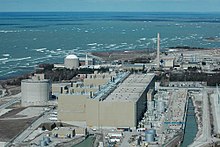
Bruce Nuclear Power station, Ontario Canada.

A publicly-owned Crown Corporation of the Province of Ontario wants to build a "deep geologic repository" right beside the Bruce Power nuclear complex. They are proposing a relatively shallow set of caves - in limestone! That's not like granite or even salt. Limestone is relatively porous.

There is already a waste storage facility there. Now they want to truck in all the "low-level" and "intermediate level" waste from Ontario's 20 reactors. "Intermediate level" is still highly radioactive. It's just everything except the nuclear fuel rods themselves. So it might include things like the filters used to gather radionuclides from the cooling pools. Or parts of old or refurbished reactors. It's very hot stuff.

All of this will just go into limestone caves in their original shipping containers. That's not much protection for the millions and millions of people who live down-lake and downstream in the Great Lakes.

People in Michigan and even Illinois (listening Chicago) could find their water radioactive after a leak. Ditto for the whole Great Lakes coast of Ohio, Pennsylvania, and New York State (Cleveland, Buffalo). On the Canadian side, the millions living in Toronto and Montreal are downstream. It's super risky, and hardly known to the world.

The Bruce Power nuclear power station is scary enough by itself. Two of the reactors were shut down for safety reasons for 17 years. Now they are back online, after being refurbished, making eight reactors running. That is supposedly the largest number of reactors in a single site anywhere in the world. The design for these Candu reactors is straight out of the 1960's. They've had problems, and then more problems, all along. Why is Ontario still counting on these antiques for nuclear power, after what we saw at Fukushima? It is crazy.

Brennain Lloyd tells us the Province of Ontario, the most populous in Canada, has plenty of alternative energy projects on the go. One of the world's largest solar power facilities just opened in Ontario. Some of those green projects are stopped by the giant subsidies governments pour into these old reactors. Just think what those billions of dollars could go with alternative energy.

[Brennain interview]

I lived in Ontario for years. We were always nervous one of these plants was going to go. The Candu reactors were designed in the 1960's and haven't changed since. The giant Pickering reactor sits right beside the millions of people living in Toronto. It’s been plagued with problems and shutdowns. The Darlington Reactor complex was upwind from my country retreat. You couldn't get away from nuclear worry. I had to move away from all that.

Find out more, and how to help stop this nuclear madness here.

And read this fantastic article "Deep trouble: Nuclear waste burial in the Great Lakes basin", published: Friday, October 12, 2012 by Jim Block, reporter for "the Voice" "Serving northern Macomb & St. Clair counties".

It will curl your hair.

NO TIME FOR DESPAIR

So Hurricane Sandy is just a metaphor for our current condition, to the state we are in. Right now, we are the storm. Someday, when the black clouds clear, maybe we'll all be the rainbow. Don't despair. We need you, each and every one.

One mind awake can become stronger than a thousand zombies sleepwalking in a dying civilization.

I'm Alex Smith. Thank you for listening to Radio Ecoshock, and thank you - really - for caring about your world.