Weekly Radio Ecoshock show - Description, production notes and extra info - for non-profit rebroadcasters (college & community stations, low power FM, repodcast services..) Sign up for podcast to receive 1 hour program weekly, set up for radio. Find instructions on timing for your Station ID, announcements etc for each show in this Blog.
SHOW SUMMARY: Thomas Peterson from World Meteorological Assoc. and NOAA on science of extreme weather events hitting us. Jonathan Bates, co-author of "Paradise Lot" on permaculture on a small lot in New England.
Whether you are freezing in North America, drowning in Britain, or roasting in Australia, extreme weather is hard to miss.
Thomas Peterson leads a team of scientists studying the role of climate change in messing with our weather. We talk about the drought of 2012 in the States, Hurricane Sandy, wild rainfall in Britain and N. Australia, and more.
Then to solutions. Jonathan Bates and his co-conspirator Eric Toensmeier turned an unpromising small lot in Holyoke Massachusetts in "Paradise Lot". It's famous small-scale homestead of permaculture. You could do it too.
Plus new music from Neil Young, "Mother Earth" recorded live on his recent Honour the Treaties" tour, against the Tar Sands and damage to First Nations people.
You'll also hear a short remix by Alex of "Into the Blue", sung by Lokka.
Troubles and solutions: it's Radio Ecoshock.
Download/listen to this Radio Ecoshock show in CD Quality (56 MB) or Lo-Fi (14 MB)
THOMAS PETERSON - EXPERT ON EXTREME WEATHER
Can scientists finally say "this extreme weather event, that flood, this storm, was caused by climate change"? Not so fast. Nothing is simple about the way this Earth works.
The planet's top weather agency, the World Meteorological Organization, set up a special branch looking into this. Dr. Thomas C. Peterson is President of the WMO Commission for Climatology. He's also the Principal Scientist for the National Climactic Data Center at NOAA, the National Oceanic and Atmospheric Administration, in Ashville, North Carolina.
For the past two years, Dr. Peterson helped gather up scientists to examine the links between human influences on the climate, and the extreme weather events that dominate the news and millions of lives.
The 2011 version of this paper was among the most read articles in the American Meteorological Society Bulletin.
Download/listen to this interview with scientist Thomas Peterson in CD Quality or Lo-Fi.
We talk about Hurricane Sandy, the U.S. drought of 2012, floods in Northern Australia and England, extreme weather in China, and their connection to climate change. In some cases scientists concluded warming made the event worse or more likely. In other cases, they were unable to find a link, chalking it up to "natural variability".
I want to add a footnote to my conversation with Dr. Peterson. He explained it's early days trying to narrow down the climate influence on crazy weather events. It's also hard to find scientists who can devote more time to short-term projects like the WMO annual survey of extreme weather.
Still, I came away from that report with some doubts. Too many times, the authors decide climate change was not an important factor.
For example, the paper on the record wet summer of 2012 in Britain concluded there was no link to the concurrent record melt back of Arctic Sea Ice. The paper was titled: "Are recent wet northwest European summers a response to sea ice retreat?" ed by F.B. Simon. Their conclusions that melting sea ice was not a factor directly contradicts other published science. I'm hoping to interview a British expert with a different opinion.
The case of extreme rainfall in Northern Australia in 2012 was even more bizarre. First that paper says climate change models show only a 10 to 15% influence on rainfall in that region. Since the 2012 rains far exceeded that, the authors say it must be natural variation, and not climate change. If it doesn't fit the models, or is more extreme than we expected, that's not climate change?
Remember none of the climate models predicted the early melt-back of Arctic sea ice in the first decade of this century either.
Other papers find climate had little influence, whereas the real causes were things like higher ocean surface temperatures. But why were the oceans so hot? That falls beyond the study.
I think there are just too many loose end in this WMO report. That's partly because this project is so new, and doesn't have massive funding that is needed, perhaps with a full-time team of experts. Like the volunteer IPCC project, we only get part of the picture.
No doubt, as this WMO extreme weather survey becomes better known, it will get more support, and get better at attributing and predicting extreme weather. We need that.
Before we go to our New England permaculture guest, let's hear rocker Neil Young. This song "Mother Earth" was performed live in December 2013, as part of the Honor the Treaty tour, which highlighted severe problems with the Canadian Tar Sands.
Chances are you are not living on an ideal homestead of 20 acres, ready to feed yourself and your family, come what may. What if you are on a normal city lot, maybe even in a northern climate? What can you do?
Quite a bit. We're going to visit with Jonathan Bates. With fellow permaculturalist Eric Toensmeier, Johnathan has turned his one tenth of an acre yard in Holyoke Massachusetts into what they call "Paradise Lot". That's the title of Eric's best-selling homestead book telling you what works, and what doesn't. The blog for Paradise Lot is here.
As it happens, I've seen a video tour of this yard, with Permaculture promoter Geoff Lawton. The place really looks fantastic, stacked with greenery and food.
Download/listen to this Radio Ecoshock interview with Jonathan Bates in CD Quality or Lo-Fi
Jonathan and Eric also figured out a way to supplement their income from their project, which is important. We are not going to home-stead without any income. In addition to the books, Jonathan has specialized in his nursery, called Food Forest Farm. That started when people wanted cuttings from the many perenial hardy plants grown on their property. Why cast out the cuttings as "weeds" when they could be sold? Find that home business here.
Paradise Lot has also branched out into tours, workshops and community education.
We also discuss Northeast Permaculture, the informal network of permaculture people in and around New England. Pretty well every state there is represented. Find out more here. This may also give you some ideas on how to organize in your region, if that isn't happening yet.
Eric also has a really useful book out entitled "Perennial Vegetables" (check out
http://perennialvegetables.org/) and is currently writing a new book on "Carbon Farming: A Global Toolkit for Stabilizing the Climate with Tree Crops and Regenerative Agriculture Practices".
MORE ON "CRASH ON DEMAND" WITH DAVID HOLMGREN
I got a lot of emails and comments about our last show with permaculture leader David Holmgren, and his
new essay "Crash on Demand". Some of his long-time followers say David has not changed his basic position: we need to create a permanent culture that does not depend on fossil fuels, and is compatible with the long-term survival of the ecosystems.
I wrote David to clarify whether he was really calling for a mass effort to crash our economic system.
Holmgren has published a condensed version of "Crash on Demand" (see link below) which confirms he is sticking with the original version of permaculture. If enough people leave the industrial death system, and it crashes, that is
just a side effect of doing the right thing, he says.
Keep up to date on this discussion on David's web site. There is lots going on, including this:
"In the follow up email exchanges, Alex Smith from Ecoshock Radio raised a further question which was not covered in his interview.
Is David saying that the system will crash anyway and by scaling up permaculture activities will fasten the inevitable, or is he really calling for non-violent efforts to crash the economic system, to save the planet, or is not calling for that? To answer that, he has compiled what could be termed as a concise summary of “Crash on Demand”. You can download the text here. We recommend you to read the whole essay first, though."
If you missed the original interview with David Holmgren, download this .mp3
Or you may want the whole 1 hour program which includes a very insightful response by Nicole Foss.
Download the show here.
Other listeners question whether such a passive approach can possibly save us from the developing climate
catastrophe, much less a severe energy crunch. Personally, I don't see permaculture growing fast enough to tip us into survival mode. It will help those involved, people like you and I.
But it seems the death culture can go on for a long time, consuming the planet even while billions of people drop off the wealth machine. The minority will still emit more greenhouse gases, kill off more species, drag more out of the sea and land.
The real answer is.....[drum roll] [splat]. OK, I don't have a good answer for our future. That is why I keep calling up the best I can find, searching for clues. I hope that is why you keep listening.
Lately our situation feels surreal. All over the web and social media, people call this the Wylie Coyote moment. It's that impossible time when the coyote has run off the cliff, and is still suspended in mid-air, before he plummets into the canyon below.
Outside a tiny conference in December at the Tyndall Institute in Britain, there is practically nothing going on about climate change. The cold winter in North America may persuade people this isn't a problem. But that same cold means we are burning a record amount of fossil fuels, adding still more to the blanket that will eventually burn us out. It doesn't matter what we think about climate change. It only matters how much we change the atmosphere.
Find the videos for that Tyndall conference here. I specially recommend the 15-minute presentation by scientist Kevin Anderson. Hats off to Chris for that tip.
It's the same with the economy. Everyone from top bankers, some of them committing suicide, - to the person in the street, afraid to invest in the rigged stock markets - everyone knows we're living on borrowed time. The giant ponzi scheme of debt and derivatives will tumble. We just don't know when.
We are living in deep fog now.
YOUR HELP AND SUGGESTIONS APPRECIATED
If you have suggestions of people you want me to interview, guests with vision even in darker times, please send me an email. The address is radio at ecoshock.org
I value your input, even if I can't answer each and every email. Your support for Radio Ecoshock has been essential, thank you.
Don't forget to educate yourself, to arm yourself with knowledge, from our years of past programs, all available as free mp3 from my web site, ecoshock.org
MUSIC! MUSIC!
Music is going to play a greater role in Radio Ecoshock, speaking to the heart instead of the brain. If you are getting this program as a Lo-Fi podcast, why not switch to the CD Quality podcast instead? Subscribe to the high quality podcast here. You'll get the full sound package, free as always.
I composed the music for the introduction in this show. My new hobby is combining royalty-free music loops
with synthisizer music that I write. We'll head out with another short sample, where I completely remix audio
with a vocal fragment by Lokka, called Into The Blue. Find her original on this page, by playing the first
sample under the title "Vocals with Lokka 3".
Listen to my short version (2 min 30 seconds) here on Soundcloud
Along those lines, I want to thank John "Skippy" Lehmkuhl, the "Plug-in Guru" for his help. John answers emails, and has a series of great free videos, and cheap courses, to help anyone wanting to make your own music. I've bought several plug-in packs for synthesizers like Massive from John. He's really got a handle on the sound we want for dance music.
I also got some help, and some loops from the folks at producerloops.com. The Swedes produce some killer dance tunes. Check out the Swedish Pop series here. Press the arrow for the demo - it's happiness in one little tune.
Finally, props to Steve at ADSR Massive in Hong Kong. On You tube, Steve gives out tons of free training on the Massive synthesizer. I get his weekly newsletter with free training videos here.
Be your own band! We can do it now. Be happy, make music. I do it, for Radio Ecoshock, and for my own sanity.
The biggest climate-driven extreme weather event since Katrina - Boulder's Carolyn Baker reports on fracking leaks, climate, economic hit. Plus Calif. songwriter Dan Imhoff on new album "Agraria".
------------------
Make it rain for those in drought, but make it stop for those in floods, from Colorado to Taiwan and China. I'm Alex Smith.
We open with one of the big stories of 2013, the unbelievable tropical-style rains that flooded Boulder Colorado and points north. More than a foot of rain in 24 hours in some places, in an area that doesn't get that much in the average year.
The Boulder story has everything - climate change, the way higher energy costs to rebuild could break budgets, and lessons in how unprepared we all are. Could the triple punch of climate, economic woes and escalating energy be the pathway toward the collapse of industrial civilization? In just a moment we'll talk with Boulder resident, Carolyn Baker. She's a published expert on collapse and getting ready, inside and out.
Download/listen to this Radio Ecoshock show in CD Quality 56 MB or Lo-Fi 14 MB
No worries. The utility operator, TEPCO had it all under wraps. They tied down the octopus of make-do piping with ropes. Good, good. And they put some weights on the cranes, hoping they wouldn't topple into any of the blown-out reactor buildings, still carrying tons and tons of highly radioactive fuel bundles in their upper stories. That should do it.
It would all be funny if the Fukushima site wasn't so dangerous to the whole Northern Hemisphere. I doubt even their thousand bolt-together tanks holding highly radioactive water could have withstood the 230 kilometers-an-hour, almost 150 miles-per-hour, super winds of Typhoon Usagi that hit Asia later last week.
Both of these typhoons missed hitting the Fukushima plant directly. When will it happen? I think the make-shift badly engineered cover-over by TEPCO will be blown away. At the very least, we can expect one of the buildings to collapse into the already soaked sub-soil. Tons and tons of the most radioactive materials are bound to flow right into the Pacific Ocean, while more will blow over Japan, and possibly the West Coast of North America.
What is your government doing about this world-class disaster risk? Absolutely nothing. Say it again. Absolutely nothing.
Let's run away to beautiful Colorado, a great retreat zone, where mother nature is always kind.
CAROLYN BAKER REPORTING FROM BOULDER AND THE FLOOD ZONE
The recent flash floods around Boulder Colorado have been compared to a Hurricane Katrina moment for America. No matter where you live, this mega-event tells us so much about climate, energy, and preparedness - or lack of it. There's nobody better to cover all this than Boulder resident Carolyn Baker, author of "Navigating the Coming Chaos", and a new book coming out in November titled "Collapsing Consciously, Transformative Truths for Turbulent Times".
Listen to/download this 38 minute interview with Carolyn Baker in CD Quality or Lo-Fi
Regarding the impacts on our society and economy, I think Boulder will turn out to be more significant than just another disaster. I'm hearing comparisons to Katrina already. The Governor says "we will rebuild" as they always do. But like New Orleans, some things will not be, and cannot be "rebuilt". Like the treed stream banks, now turned into unstable, undercut sides. Like places that are obviously set to flood again.
Let's talk about the energy involved. all that infrastructure, including mundane buildings, roads and bridges, were built with oil that cost between $15 and $35 a barrel. Now oil is over $100 a barrel, meaning everything costs 3 to 6 times more, just for the energy. Ditto steel and other components. Events like this will eventually break many cities, states, and even countries.
Keeping with energy, the group East Boulder County United published photos of fracking tanks full of God-Knows-What sitting in flooded fields, tipped over, and even floating down swollen rivers. This fracking equipment was never designed for floods.
I've seen photos in Colorado of fracking towers right beside suburbs, school yards, and even kids playgrounds. We all know fracking operations vent tons of noxious gases. How is that possible?
The Colorado floods also showed the world the unpreparedness of the average citizen. I saw news footage of people desperately being air-lifted away from completely undamaged homes after just four days. It was early September in Colorado. They were in no danger of freezing to death. Didn't they have some food and water stored for emergencies?
Boulder is among the more advanced communities in Transition, or at least a progressive place. We talk about some of the positive things that are going on there.
For one thing, the main folks in the Transition Colorado movement decided their main emphasis had to be on developing local food production and consumption. So they began a new organization now found at localfoodshift.com.
This case of sudden floods in Colorado also reminds us there can be knock-on effects from climate-driven mega weather, a year or years later. In New Jersey, officials are now saying the huge fire that burned down the rebuilt boardwalk was likely caused by electrical systems damaged by Hurricane Sandy in 2012. You have a similar delayed impact in Colorado.
Carolyn explains how last year's giant fires in Colorado added to the flood damage this year. There was no vegetation to soak up the rains, or to hold on to the river banks. Parts of the landscape have been changed never to return.
The widespread damage, and the nearly impossible cost of rebuilding, also point us to a pathway of economic collapse. In this scenario, we just keep getting hit with climate-driven disasters, until we are far too broke and broken to rebuild. Roads don't get rebuilt, bridges stay out, some communities are abandoned.
Everybody should read Carolyn's article "All Dress Rehersals Are Over" published from Boulder on September 16th, 2013. It's powerful and inspired many of the things we talked about today.
Get Carolyn's newest stories and her news service at carolynbaker.net
Listen to/download this interview with Dan Imhoff, complete with song samples, in CD Quality or Lo-Fi (but CD quality is recommended, since you'll get the best sound for Dan's music.)
We interviewed Dan Imhoff about the book he edited on CAFO, the Tragedy of Industrial Animal Factories. Listen to/download that 2010 interview with Dan here. Sadly it's all still happening, and we talk about that again in this show.
But there is a whole other side and talent to Dan Imhoff. He's been a musician for years. Now Dan got together with a hugely talented crew all from Sonoma County California. It sounds so good there I want to move to Sonoma Country, the way Dan tells it.
The Agraria Facebook page is here. You can sample the tunes and buy them here.
Or try out this You tube video of Dan's modern re-write (complete with GMO's) of "Cluck Old Hen".
COMING UP ON RADIO ECOSHOCK!
We've got some great guests coming up, including Nicole Foss (a.k.a. "Stoneleigh"), Richard Heinberg, J.B. MacKinnon (co-author of the 100-Mile Diet). Plus some exciting interviews with young people just starting out on the road to battle climate change, and heading to the Powershift 2013 conference this October in Pittsburg.
From U. of Arizona, Gary Nabhan growing in hotter drier times. Ecoshock correspondent Gerri Williams on getting out of town. From Boulder, Carolyn Baker on the flash floods. Radio Ecoshock 130918 1 hour. Plus Voices for Climate Change from Jamaica.
Ready for climate change? Ready or not, it's here.
Maybe you are dreaming of leaving the city for a more sustainable life. We'll talk with our Radio Ecoshock correspondent Gerri Williams about her adventure leaving Washington D.C. for the Mid-West. What does it take to really get out of town?
We'll also touch base with Carolyn Baker, from her home in Boulder Colorado. That's the scene of the latest amazing extreme rainfall event. Last year it was fire. This year floods.
Download or listen to Radio Ecoshock in CD Quality or Lo-Fi.
Gary's book about adapting to a hotter, drier world comes out of a combination of his writing and his own practical experience growing. He tells us about their experimental farm.
A few years ago, James Lovelock released a map of the world in 2100. It was based on climate projections made by the Tyndall Centre in the UK. Giant bands of deserts appeared around the world in the sub-tropics. Southern European countries like Spain and Italy became more like North Africa. China's deserts expanded, as did the dry hot weather of the U.S. South West, and Mexico.
Do you see Arizona growing conditions becoming more prevalent in the world? Gary cautions not all places will become hotter and drier. Some will become much wetter. But those people will also have to adapt their growing conditions.
He hopes to see a network of grass-roots food producers sharing information about what plants survive extreme weather and climate the best. Part of that is ensuring the widest possible biodiversity. Nabhan suggests we could start by saving the hundreds of thousands of varieties of seeds and seedlings found in all the catalogs, before they disappear. We never know which we will need.
What kind of things can we do to adapt for food production in uncertain times?
The big issue in the Southwest is water. But that's huge in northern India, the whole Middle East, and North Africa.
Gary Nabhan, did research in the Middle East. He raises the solutions used by farmers around an oasis in the desert. Air temperatures can be up to 140 degrees Fahernheit, and soil temperatures even hotter. And yet there are layers of plants, from the high palms or date trees, down through layers of shade and cooling, perhaps to low berries at the bottom.
That gave me some hope. We can grow food, if less of it, in a hotter world.
The Saudi's were using lots of oil to desalinate sea water, and them pumping vast amounts into fields to grow their own wheat. That is hardly a sustainable path.
Sticking with the Middle East for a minute, it's one of the world's population hot spots. At least half the population are kids under 21. Can those countries feed themselves in the future without fossil fuel revenues? If we go off oil to save the climate, what happens to those places and peoples?
Gary Nabhan sounded the alert about seeds - not just farm seeds, but plants we need to stabilize the soil and the ecosystem. Gary co-founded a non-profit devoted to saving seeds. And we talk about the pollinators who help us produce fruits, nuts and vegetables.
I ask Gary about food forests. What are they?
One big problem that concerns me is when the temperature gets too hot for the needs of our food plants. Hot nights in the spring can prevent fruit setting, or the recent flash-drought in the mid-West reduced crop yields. How serious is this?
At what temperatures do plants stop growing and start dying? You'll be hearing more about this on Radio Ecoshock.
Some scientists worry we could see a quick jump in temperatures. For example, flipping to an El Nino cycle could release more heat from the ocean, or we could get a methane burst from the Arctic. What would happen to our food production? Gary sees this as a real possibility, and a major risk which demands we become more prepared, if we can. His book can help.
And I ask Gary: What changes can we make as a society to help us get food production ready for climate change?
When you think of how deeply invested we are in agri-business, and the tools of the mid-1900's, we have to consider some harsh questions. Do you think humans can avoid a period of mass starvation in the coming decades?
Before we talk with Gerri Williams, who left the busy capital of America - let's look at the latest climate-on-steroids rainfall event in Boulder Colorado.
Extraordinary extreme rainfall events are popping up all over the world. The latest was an astounding dump of water and severe flooding in Boulder Colorado.
"An all-time 24-hour record rainfall of 9.08” (as of 6 p.m. 9/12 MT--almost double the previous record) has deluged the city of Boulder, Colorado resulting in widespread flash flooding and the deaths of at least three people so far. 12.27" has accumulated since Monday 5 p.m. (September 9th). Needless to say, these are numbers that surpass most tropical storm events. Other locations in the Boulder and Rocky Mountain Front Range have picked up over 11” of precipitation in just the past 24 hours.
According to the Western Regional Climate Center’s historical data set, Boulder’s former 24-hour precipitation record was 4.79” on July 31, 1919. The September record was 3.05” on September 4, 1909. Records began in October 1893 with some months missing.
Boulder is the most at-risk city for flooding in Colorado, due to it's position. There have been at least a dozen major floods over the past 100 years. This was rated as a 1 in 100 year flood by the National Weather Service. Still, the rainfall was DOUBLE the previous record for 24 hours."
End quote from Chris Burt.
And this wasn't just Colorado. One place in the New Mexico's Guadalupe Mountains got 11 inches of rain in 24 hours. Incredible.
"Devastating flash floods swept though numerous canyons along the Front Range of Colorado's Rocky Mountains Wednesday night and Thursday morning, washing out roads, collapsing houses, and killing at least three people. The flood that swept down Boulder Creek into Boulder, Colorado was a 1-in-100 year event, said the U.S. Geological Survey. A flash flood watch continues through noon Friday in Boulder.
According to the National Weather Service, Boulder's total 3-day rainfall as of Thursday night was 12.30". The city's record rainfall for any month, going back to 1897, is 5.50", so this week's rainfall event is truly extraordinary. Some other rainfall totals through Thursday night include 14.60" at Eldorado Springs, 11.88" at Aurora, and 9.08" at Colorado Springs.
These are the sort of rains one expects on the coast in a tropical storm, not in the interior of North America! The rains were due to a strong, slow-moving upper level low pressure system to the west of Colorado that got trapped to the south of an unusually strong ridge of high pressure over Western Canada.
This is the same sort of odd atmospheric flow pattern that led to the most expensive flood disaster in Canadian history, the $5.3 billion Calgary flood of mid-June this summer. The upper-level low responsible for this week's Colorado flood drove a southeasterly flow of extremely moist tropical air from Mexico that pushed up against the mountains and was lifted over a stationary front draped over the mountains. As the air flowed uphill and over the front, it expanded and cooled, forcing the moisture in it to fall as rain."
CAROLYN BAKER FROM BOULDER
We just have time for a quick check in with a favorite Radio Ecoshock guest, Carolyn Baker from Speaking Truth to Power, based in Boulder Colorado. Carolyn is an experienced news person, with her own private need-to-know news service.
She was right at ground zero for this extreme rainfall event and reported as the rain continued to fall, with the number of dead and the total damage still unknown. We get a quick glimpse of this major weather event and tragedy for the residents of Boulder and Colorado.
Carolyn will be back next week. I think this extreme event is close to Hurricane Katrina in New Orleans for it's local damage, but also the international implications. The Governor promises to rebuild everything. We'll talk about what can be replaced, and what is changed forever.
GERRI WILLIAMS - LEAVING THE BIG CITY
Then we talk with long-time Radio Ecoshock and Earthbeat correspondent and volunteer Gerri Williams. Gerri has left Washington D.C. for the Mid-West. She left a job at a local college, with good roots into alternative agriculture. Why?
What does it take to leave the big city? Many of us dream about it. We'll be hearing from those who do. Gerri does a great job of raising the difficult issues - both personal and social, involved in changing our lives toward sustainability and survival.
I should be out of Vancouver by October 1st. Radio Ecoshock will continue from the mountains.
We finish up with a bit of Jamaica. This climate music is from a You tube video posted by undpjamaicatv. It's called Voices for Climate Change with various Jamaican artists, directed by Robin Chin.
I'm Alex Smith, that's it for Radio Ecoshock. Let's meet again next week.
American author of Aquaponic Gardening Sylvia Bernstein on union of fish and veggies. Publisher of Mother Earth News Bryan Welch's optimism of
non-partisan activism. Canada's oil capital shut down by climate change. Radio Ecoshock 130626 1 hour.
Get ready for your new food source: aquaponics. But first...
HOW THEY SHOULD HAVE REPORTED THE ALBERTA FLOOD NEWS
In Canada, an extreme rainfall event, made worse by a stalled weather system likely powered by an unstable Arctic and climate change, has closed down the country's oil trading capital.
In Calgary Canada, nature accomplished what politics could not. The largest oil company headquarters, including suncor Energy, Imperial Oil and Shell saw their head offices closed, as downtown Calgary was evacuated and left without power for days. Trading in Canadian crude oil stopped.
Alberta towns more than a hundred years old were evacuated, flooded, and wrecked. At least 75,000 people in the major oil-trading capital of
Calgary were ordered out of their homes. Most of them do not have any flood insurance, as "over-land" insurance is no longer sold in Canada
following the previous record flood of 2005. Billions of dollars of damage to homes, businesses, roads, bridges and all kinds of infrastructure occurred.
The TransCanada highway connecting to the West Coast was shut down for days.
The oil-promoter in Chief, Canadian Prime Minister Stephen Harper flew to his hometown of Calgary, clearly shocked that climate change could
affect Alberta itself.
"I’ve seen a little bit of flooding in Calgary before,” he said. “I don’t think any of us have seen anything like this.”
Perhaps if Harper had not shut down climate research facilities, including the Polar research station, and muzzled Canadian climate scientists, he might have heard about research from Rutgers University (Jennifer Francis) showing Jet Stream patterns were stalling due to melting Arctic sea ice. Extreme precipitation events are happening all over the world. Even in Alberta.
The Premier of the Canadian province of Alberta, Alison Redford flew back from New York, where she was promoting the Keystone XL pipeline to
ship polluting Tar Sands oil to the United States. She too was shocked at the devastation. Who could have guessed an over-heated atmosphere
could hold so much water?
WHY CAN'T THEY TELL THE PEOPLE ABOUT CLIMATE CHANGE?
Canadian television anchors and reporters were unable to utter the words "climate change" or "extreme precipitation event" - even as similar floods hit Europe and India. The CTV network reported the strange "blocking high" heating Eastern Canada with summer, while keeping a swirl of storms and extreme rain in the West. The stalled Jet Stream appeared on the map, without explanation.
I'm Alex Smith. This is Radio Ecoshock telling it like it is.
Later we'll hear one brief radio clip, the only major media report I could find, telling Canadians the real cause of the "weird weather" that strikes again and again, now as the new normal.
But first, let's get back to basic solutions for right living.
We'll start with my interview with one of the North American pioneers of a brand new method of clean food production, aquaponics. It has just arrived in North America. I predict within ten years you will be buying organic local produce and fresh fish from neighborhood fish and veggie operations. Or maybe you'll grow it all yourself in your own back yard. Sylvia Bernstein, author of Aquaponic Gardening tells us how.
Later we'll talk with the driving force behind the world's largest outlet for sustainable living: Bryan Welch. He's the CEO of Ogden Publications, publisher of The Mother Earth News, the Utne Reader, and Grit. Bryan explains his optimism in dark times, and why we need it to change the world into the lives we want.
FREE AUDIO DOWNLOADS FOR THIS PROGRAM
Listen to/download this Radio Ecoshock Show in CD Quality or Lo-Fi
Listen to/download my interview with Sylvia Bernstein on aquaponics in CD Quality or Lo-Fi
Listen to/download my interview with Bryan Welch, publisher of Mother Earth News in CD Quality or Lo-Fi
Please go ahead and share, Facebook or Tweet these links to anyone you think would be interested!
LISTEN DO THIS PROGRAM RIGHT NOW (Courtesy of archive.org)
SYLVIA BERNSTEIN: FISH AND FOOD TOGETHER
Sylvia Bernstein in her aquaponic greenhouse in Colorado.
A Google search for "aquaponics" brings about 3,380,000 results. And yet the field is less than five years old in America, maybe 15 years in North America.
Of course, as listener and song-writer Smokey Dymny points out "Chapter 13 of Bill Mollison's Permaculture, A Designer's Manual (1988) laid this methodology out in detail. Permaculture magazines and teaching institutes have followed up with up to date developments in the years since." The permaculture folks used ponds and planting together.
But aquaponics adds a new methodology, growing plants in media like gravel, rather than soil ("hydroponics") and delivering the fish effluent directly to the plant roots in a systematic way.
Here are a few informal notes on the History of Aquaculture from my talk with Sylvia Bernstein, author of Aquaponic Gardening - the premiere book on the subject in North America.
NOTES ON THE HISTORY OF AQUACULTURE
Fish have been feeding land plants since time immemorial, especially when we consider floods. Perhaps the Hanging Gardens of Babylon was an
example of the earliest civilized aquaponics. Wiki suggests the Aztecs or people of South China and Thailand practiced a form of aquaponics.
"The development of modern aquaponics is often attributed to the various works of the New Alchemy Institute and the works of Dr. Mark McMurtry et al. at the North Carolina State University.[10] Inspired by the successes of the New Alchemy Institute, and the reciprocating aquaponics techniques developed by Dr. Mark McMurtry et al., other institutes soon followed suit. Starting in 1997, Dr. James Rakocy and his colleagues at the University of the Virgin Islands researched and developed the use of deep water culture hydroponic grow beds in a large-scale aquaponics system.[9]"
- Wikipedia
THE CANADIAN CONNECTION - AQUAPONICS IN ALBERTA
"The first aquaponics research in Canada was a small system added onto existing aquaculture research at a research station in Lethbridge, Alberta. Canada saw a rise in aquaponics setups throughout the ’90s, predominantly as commercial installations raising high-value crops such as trout and lettuce. A setup based on the deep water system developed at the University of Virgin Islands was built in a greenhouse at Brooks, Alberta where Dr. Nick Savidov and colleagues researched aquaponics from a background of plant science. The team made findings on rapid root growth in aquaponics systems and on closing the solid-waste loop, and found that owing to certain advantages in the system over traditional aquaculture, the system can run well at a low pH level, which is favoured by plants but not fish.
The Edmonton Aquaponics Society in Northern Alberta is adapting Dr. Savidov's commercially sized system to a smaller-scale prototype that can be operated by families, small groups, or restaurants. They intend to further develop the closed solid waste loop.[11]"
- Wikipedia on Aquaponics
We didn't have time to go into the important role Australians played in developing aquaponics. The Aussies experimented and really made it
happen. I doubt we'd have current results without the Australian role. But the real founder of aquaponics is...
JAMES RAKOCY
The modern practice really began from research starting only 30 years ago, principally by Dr. James Rakocy at the University of the Virgin Islands. Rakocy was an aquaculture specialist who looked at ways to use plants to filter water for fish. "Waste in a contained aquaculture system is a big problem" says Bernstein. People had used water hyacinths to filter fish waste, but Rakocy thought why not grow food instead, like lettuce or tomatoes? That innovation started modern aquaponics.
His system was commercially oriented, called deep water raft-based production.
Rakocy is now retired, after a 30 year career. In the meantime, there was grass-roots experiments in Australia about home and back yard aquaponic gardening. That was more focused on using gravel. Modern aquaponics developed mainly in Australia around 2001 - and became popular in the United States only in the past 3 or 4 years.
Wiki lists ten key principles of aquaponics developed by Dr. Rakocy:
"Ten primary guiding principles for creating successful aquaponics systems were issued by Dr. James Rakocy, the director of the aquaponics
research team at the University of the Virgin Islands, based on extensive research done as part of the Agricultural Experiment Station aquaculture program.
“Use a feeding rate ratio for design calculations
Keep feed input relatively constant
Supplement with calcium, potassium and iron
Ensure good aeration
Remove solids
Be careful with aggregates
Oversize pipes
Use biological pest control
Ensure adequate biofiltration
Control pH"
- Wikipedia
SYLVIA BERNSTEIN - TRAILBLAZER
Sylvia Bernstein's 2009 book was first widely available book about aquaponics. It is called "Aquaponic Gardening, A Step-By-Step Guide To
Raising Vegetables And Fish Together." Find it on Amazon here.
Sylvia Bernstein runs this helpful site with lots of aquaponics info.
Sylvia also plays a pivotal role in a new organization, the Aquaponics Association, founded just about 2 years ago.
They have held conventions for "aquapons" as they call themselves. The next is the 2013 Conference in September 20-22nd in Tucson Arizona, with Joel Salatin as lead speaker.
It is rare for aquaponic practitioners to meet in person. Most of the development and skill sharing for this new field was developed on the Internet. It's an amazing hybrid of high tech communication enabling a new type of safe food production at a time we need it badly.
Their first conference was in Orlando Florida 2 and a half years ago, leading to the founding of this association. They have almost 500 members now and still growing.
In our interview, we also discuss recycling an "IBC Tote" to make fish tanks on the cheap. IBC stands for Intermediate Bulk Container. One whole IBC tote can be made into a 275 gallon fish tank. Or cut it in half to make two grow beds out of it.
But Bernstein warns to check carefully what was stored in that tote before - it must be food stuffs, and not toxic chemicals! Also, the PH of the fish water/plant solution is very important, and so the tote cannot have carried high or low PH chemicals. You can also use blue plastic storage barrels.
Some fish will grow bigger and faster than others, so they don't all mature as a single crop like veggies (at least that's true with tilapia). We also discuss other fish that are more tolerant of cold water, like cat fish and trout, for folks living further north. In Colorado, Sylvia brings her fish tank indoors, from her outdoor greenhouse, during the winter months.
The fish do not smell, just as any other aquarium does not smell. You could do the whole operation indoors, say in a basement, with grow-lights for the plants.
BEYOND THE FISH
The fish are intriguing (and tasty!) - but don't forget the fantastic results aquaponic growers get with fast-growing production in the plant side of things.
The plant roots are not always submerged in water, but are flooded with nutrients and then drained for air, automatically in repeating cycles - assuming you are using a media like gravel, and not a raft-based deep water culture.
Because the plants get lots of oxygen, water, and abundunt food - they don't have to focus energy on developing large root systems. Their roots may be quite small, and that energy goes into the leaves or fruits we want.
Sylvia adds composting red worms to her media.
There is a wave of interest in America in aquaponics for several reasons - chief among them being food security and food sovereignty. The government is not protecting our food supplies from GMO's, pesticides, hormones and toxic chemicals. Aquaponic production guarantees real
organic food safety.
Sylvia is worried about climate change and it's impacts on mass food production. Aquaponics lets her produce her own supply of safe food. Plus...it's fun and good for the mind. Her greenhouse is so alive - with water flowing, fish, plants growing. Also, aquaponics is fantastic teaching tool for neighbors and children to learn biology and natural ecosystem interdependence.
When Sylvia studied agricultural economics at UC Davis, there was no sense of this delicate balance of natural systems. They learned to add
chemicals, but never the consequences, like impacts on groundwater, rivers, and dead zones in the oceans.
Her site theaquaponicsource.com has plenty of free info and a community board. But they also have a store where they sell parts, or even a
complete turn-key system if you are not the do-it-yourself kind of person, or do not have the time to set one up from scratch.
OTHER NOTES AND SOURCES ON AQUAPONICS
Find lots of photos of aquaponics experiments at the University of Arizona here.
Note lack of phosphorus in aquaponics system leads to use of greens like lettuce.
"Plant crops in aquaponics are usually limited to lettuce and other leafy crops, since they readily use the nitrogen available as a waste in aquaculture systems but don't need phosphorus (which is not present in aquaculture systems) as many fruiting plants do."
- U of Arizona
But Rakocy grew tomatoes as well... he added calcium, potassium and iron.
... and just search for "aquaponics" on You tube to watch hours of people just like yourself, setting up this new form of food production. It's very educational, and very possible.
MORE ON THE CALGARY FLOODS - I WAS THERE
Before we continue with our drive toward a sustainable world, let's take another quick moment to reflect on the dying path of fossil fuel destruction. Perhaps you've heard the Calgary, the oil-capital of Canada, was more or less shut down by flash flooding and over-flowing rivers.
As fate would have it, I was in Calgary on the night of Wednesday June 19th, as the black skies filled with thunder for almost a dozen hours. Sheets or rain, torrents of rain drenched the city. All the foothills let loose, creeks became rivers, rivers became fast-running lakes filling streets, homes, entire neighborhoods and towns. Fearing the water supply would become contaminated, there was panic buying of bottled water, until the shelves ran dry. As always, few were ready for an extreme rainfall event in the dry prairie.
Alberta is rich with wealth from the oil wells and the Tar Sands. But even that economy will reel from the billions of dollars of uninsured losses. The famous Calgary Stampede looked doubtful, as major stadiums, parks, and the downtown core flooded. Apartment towers stood empty in the dark.
The ruling party of Canada, the party of climate denial, was due to convene their annual conference in Calgary the next week. That was postponed.
Here is a brief clip from the government-supported Canadian Broadcasting Corporation, the program Current Events hosted by Anna Maria
Tremonti. It's possibly the only report from a climate scientist in the days of non-stop coverage of the Alberta floods. The speaker is Robert Sandford, the EPCOR Chair supporting the United Nations "Water for Life" Decade.
[Excerpt from podcast interview with Bob Sanford and host Anna Maria Tremonti from the The Current, episode "Severe flooding in southern Alberta" from June 21, 2013. Find it here.]
That was Robert Sandford, explaining the science behind extreme rainfall events due to climate change. Even he did not have the courage to
suggest we must reduce our emissions of fossil fuels as a solution, speaking instead of adapting to wilder climate swings.
Enough. The same madness of denial goes on all over the world. In my opinion, all we can do as individuals who know that physics and nature will not be denied, is to keep pushing the movement toward a sane sustainable society. We are about to talk to an optimist driven by the vision it can be done.
BRYAN WELCH - PUBLISHER OF MOTHER EARTH NEWS
Bryan Welch, publisher and editorial director of Ogden Publications.
This is my second interview with Bryan Welch, the powerhouse behind the Mother Earth News, Mother Earth Living, the Utne Reader and Grit. In addition to his active editorial role in the Mother Earth News, Bryan is CEO of the parent company Odgen Publications. He's right to say that company is the largest media force for sustainable living in the world.
Our first interview was about his book "Beautiful and Abundant, Building the World We Want". It's done very well - but to be honest, I had a hard time agreeing with his positive message, given the flood of bad news I cover on Radio Ecoshock. Plus, as a green, selling "abundance" to the American people seemed like a bad idea. We didn't end on a happy note.
This time, I was in a better space, and understood what Bryan is really trying to say.
As an example: who is reading Mother Earth News? Surely it's mostly liberals, Democrats, environmentalists? Not really Welch tells us in this interview. People who want better food and more self reliance may very well be Conservative, even Republicans. Welch feels he can get the message of sustainability out to a much wider audience if the politics are left out of the mix. That's my take anyway.
As to the idea of abundance, he's not talking about more useless shopping for stuff. It may well be abundance of community relations, of innovation. But we can't have that abundance, he tells us, unless we control population.
I raise the caveat that is we also demand beauty, there should be no dark, ugly holes hidden in the process of our society. For me, that means no destructive strip mining in the Tar Sands or Appalachia, or dangerous tanks of radioactive waste, behind our production and consumption. There should be beauty all the way.
Bryan explains why, despite the flow of negative reports in the media, we may be living in one of the better times for humanity.
This interview was less of a wrestling match, I felt, and better communication of Bryan's vision - which does lead to so much good information and alternative community action in his various publications. Bryan explains his philosophy here, and of course in his book.
Do I agree with everything Bryan Welch, or any of my guests say? Maybe you will disagree with some things. Radio Ecoshock is not a show where guests express my own personal state of mind. It is a platform, your platform, supported by you the listener, to hear the visionary voices, and the real do-ers, helping you make your own life choices.
This is a thought-provoking interview, well worth your time.
Visit Bryan Welch's blog on Mother Earth News here.
THANKS FOR LISTENING - AND PLEASE SUPPORT THE PROGRAM
Thank you for listening, and being part of Radio Ecoshock. Find out how to support this program at our web site ecoshock.org. Your donations and memberships keep me going.
It also helps me pay for the tons of green audio files we offer on our web site, and from this blog. Downloads cost money, and we get thousands of shows downloaded every week.
I'm Alex Smith. If anything you hear on Radio Ecoshock makes you part of the solution, my job is done. Let's meet again next week.
Barney has a fascinating story. He came from an extremely wealthy family, and could have made his own fortune in the family business. Instead, he was lured into Rock and Roll. Not only did Bentall make many of his own hits, and play concerts around the world, he has appeared as a back-up musician for many of the world's most famous artists. Barney Bentall has also supported many non-profit and fund-raising events around Vancouver - so he really does have a "legendary heart".
Storms in the Emergency Room - Hurricane Sandy, coal & nukes - it's not pretty. From D.C. as storm hits, Earthbeat's Daphne Wysham on the climate connection. From Australia, Greenpeace's Georgina Woods on huge coal expansion. Then a Canadian plan to dump nuclear waste right next to Lake Huron & world's biggest running reactor. Radio Ecoshock 121031 1 hour
This one is really about what happens after a big solar flare knocks out the electric grid behind civilization. It's all in the You tube video. I did a Radio Ecoshock feature on this possible catastrophe on November 5th, 2010, 15 minutes of audio here. But this time I played it for the millions without power on the U.S. east coast and Canada, thanks to Hurricane Sandy.
=======================
Welcome to Radio Ecoshock - the world's emergency room. At least that's what it feels like lately, as we begin to taste the high carbon future on Planet Earth.
North Americans are bragging about pumping out more oil from dirtier sources, even as drought kills off the crops, and now a humongous record Hurricane spins up the East Coast. We talk with green radio reporter Daphne Wysham just as the storm hits in the American capital, Washington D.C.
How is the brand new climate spiking these storms with steroids? I'll tell you what top scientists are saying.
At the other end of the world, following fires and floods of their own, the Australians are straining to break their own dismal carbon record. My head hurts trying to understand why such nice people want to double their coal exports. Australia is already the biggest coal exporter in the world, keeping black smokestacks in Japan, Taiwan, China, and now India pouring out more and more carbon dioxide into the overloaded atmosphere. We get the goods down under from Greenpeace Pacific Atmosphere and Energy Campaigner Georgina Woods.
You get to breathe that pollution, and we all get hit with the climate damage.
I'll wrap up with another story with warning sirens all over it. Canada is already building its own "Yucca North" - a porous hole where they'll dump nuclear waste. The best they can do is the worst they can do: the supposed deep geologic deposit is just limestone caves right beside the Great Lakes - up water from millions of people in Chicago, Cleveland, Buffalo, Toronto and Montreal. Brennain Woods of NorthWatch tells us how the aging Bruce Nuclear plant - the largest running nuclear complex on the planet, threatens the whole world.
I'm Alex Smith. Take a deep breath. We're all heading into a state of ecological shock.
SANDY: CLIMATE STORM OF THE CENTURY?
Let's start with the story covered by every network, with the part they leave out: global climate disruption makes deadly and costly storms like Hurricane Sandy much more violent. More than two decades ago, scientists told us this would happen. Now it's here.
How does it work? First, you need to know: we've created far more heat on this planet than we feel on land. The world's great oceans are absorbing more than half the heat held in by greenhouse gases in the atmosphere.
The Gulf Stream, that great ocean current running off North America's East Coast, until it warms Britain and Northern Europe, is heating up.
According to the UK Met Office, the government body measuring such things, there is a huge area off the mid-Atlantic coast that is 2.3 degrees Fahrenheit, or 1.3 degrees hotter than average. That doesn't sound impressive, but that much heat over a giant expanse of ocean is tremendous.
But it gets worse. The Gulf Stream itself is currently 5 degrees Fahrenheit above normal. Hurricane Sandy cruised up this Gulf Stream, gathering up both energy and extra water moisture in her half-continent sized clouds. As meteorologist and former storm chaser Jeff Masters tells us, the Atlantic was unusually warm right to the end of October, making Sandy stronger and wetter.
Did the record amount of open ocean in the Arctic this summer help the Atlantic stay warmer longer? Scientists aren't sure yet. Jennifer Francis of Rutgers, a recent guest on Radio Ecoshock, says the blocking weather in the last two weeks is consistent with what her team observed from the melting of sea ice in the Arctic. Kevin Trenberth of the National Center for Atmosphere Research agrees the Atlantic currents are 5 degrees Fahrenheit warmer than normal, and he attributes 1 degree of that is directly due to global warming. But he doesn't believe the Arctic melt this summer and fall contributed to it. The jury is still out on that - but the vast majority of scientists agree mega-storms like Sandy are more likely to become the new normal, due to climate disruption by human-induced emissions of greenhouse gases.
Of course there are skeptics, some of them well-paid by the fossil fuel lobby.
For example, Patrick J. Michaels of the Cato Institute, who we know has received lots of money from the Koch Brothers and others in the powerful oil and coal lobby, says a storm like Sandy could have happened on a cooling planet as well.
He writes Andy Revkin of the New York Times:
"I predict confidently that we will survive Sandy, which should not be a tropical cyclone at landfall."
Another ploy used by the climate deniers is to find papers showing there were big storms hundreds of thousands or millions of years ago. In many of those cases, carbon dioxide was high then too, and there was a "hothouse" world. And anyway, so what? We're dealing with now, and humans have ramped up the odds of getting a lot of big storms in a short period of time....
Meanwhile, on the ground, what was it like? On Monday night, as the big storm landed in Washington D.C., I spoke with Daphne Wysham. As the cell phone towers swayed, she called for calm.
DID CLIMATE CHANGE MAKE HURRICANE SANDY WORSE?
FROM WASHINGTON, AS THE STORM HIT, DAPHNE WYSHAM, long-time host of "Earthbeat" on Pacifica radio.
It's official. Hurricane Sandy is the largest storm ever to have crossed north of Virginia, greater even than the famous Nor’easter of September 1938, known as "The Long Island Express".
The mainstream media is delivering the news while keeping up the great American silence about the role of climate disruption in this unprecedented storm. That's what we're going to talk about with Daphne Wysham, host of the long-running green radio show "Earthbeat" and now a Fellow at the Institute for Policy Studies in Washington.
I reached Daphne in her home in D.C., just as Hurricane Sandy washed ashore on Monday. We talk about what it's like to live it out.
You can find links to Daphne Wysham's article about growing past the pat TV coverage of storms, and our need to be frightened. Instead, we need to look at the deep recurring patterns in these disasters, augments by a warming world. Read that at Firedog Lake here.
With Daphne, I mentioned the recent study by Munich Re - the insurance company that sort of insures smaller insurance company. This is the company that sees the big bills after weather disasters. They report that North America in particular has been hit by violent weather, and they think climate change is a big part of that picture.
"A couple of weeks ago, Munich Re, one of the world’s largest reinsurance firms, issued a study titled “Severe Weather in North America.” According to the press release that accompanied the report, “Nowhere in the world is the rising number of natural catastrophes more evident than in North America.”
The number of what Munich Re refers to as “weather-related loss events,” and what the rest of us would probably call weather-related disasters, has quintupled over the last three decades. While many factors have contributed to this trend, including an increase in the number of people living in flood-prone areas, the report identified global warming as one of the major culprits: “Climate change particularly affects formation of heat-waves, droughts, intense precipitation events, and in the long run most probably also tropical cyclone intensity.”
Another good read: "Climate Change Sandy says to US, 'Take That, Idiots!'" in the Huffington Post.
Daphne and I briefly discuss the on-going argument in scientific circles: did the huge Arctic sea ice melt of 2012 help make Sandy larger? Jennifer Francis of Rutgers says "probably yes" while Kevin Trenberth thinks not. You can find more on that in this blog entry by Joe Romm from Climate Progress.
"The sea surface temperatures along the Atlantic coast have been running at over 3C above normal for a region extending 800km off shore all the way from Florida to Canada. Global warming contributes 0.6C to this. With every degree C, the water holding of the atmosphere goes up 7%, and the moisture provides fuel for the tropical storm, increases its intensity, and magnifies the rainfall by double that amount compared with normal conditions.
Global climate change has contributed to the higher sea surface and ocean temperatures, and a warmer and moister atmosphere, and its effects are in the range of 5 to 10%. Natural variability and weather has provided the perhaps optimal conditions of a hurricane running into extra-tropical conditions to make for a huge intense storm, enhanced by global warming influences."
Andy Revkin's Dot Earth blog has more input from scientists, both pro and con, about the link between Hurricane Sandy and climate change.
Jeff Masters, one of the most dependable storm writers on the Net, at wunderground.com, explains the connection between warming ocean waters and bigger storms in this post.
Jeff writes:
"Sandy to feed off near-record warm waters off the mid-Atlantic coast
During September 2012, ocean temperatures off the mid-Atlantic coast in the 5x10° latitude-longitude box between 35 - 40°N, 65 - 75° W were 2.3°F (1.3°C) above average, according to the UK Met Office. This is the 2nd greatest departure from average for ocean temperatures in this region since reliable ocean temperature measurements began over a century ago (all-time record: 2.0°C above average in September 1947.)
These unusually warm waters have persisted into October, and will enable Sandy to pull more energy from the ocean than a typical October hurricane. The warm waters will also help increase Sandy's rains, since more water vapor will evaporate into the air from a warm ocean. I expect Sandy will dump the heaviest October rains on record over a large swath of the mid-Atlantic and New England.
Hurricane rains and climate change
Hurricanes are expected to dump 20% more rain in their cores by the year 2100, according to modeling studies (Knutson et al., 2010). This occurs since a warmer atmosphere holds more water vapor, which can then condense into heavier rains. Furthermore, the condensation process releases heat energy (latent heat), which invigorates the storm, making its updrafts stronger and creating even more rain. We may already be seeing an increase in rainfall from hurricanes due to a warmer atmosphere.
A 2010 study by Kunkel et al. "Recent increases in U.S. heavy precipitation associated with tropical cyclones", found that although there is no evidence for a long-term increase in North American mainland land-falling tropical cyclones (which include both hurricanes and tropical storms), the number of heavy precipitation events, defined as 1-in-5-year events, more than doubled between 1994 - 2008, compared to the long-term average from 1895 - 2008. As I discussed in a 2011 post "Tropical Storm Lee's flood in Binghamton: was global warming the final straw?", an increase in heavy precipitation events in the 21st Century due to climate change is going to be a big problem for a flood control system designed for the 20th Century's climate.
A lot of us have wondered what it will take to get American politicians and media to finally admit climate change is here, and we need to act fast to salvage a livable climate. Some frustrated scientists and green activists think only a major disaster will force this change in thinking. Apparently the big drought of 2012 didn't do it. Even when the Arctic sea ice melts, that doesn't change our plans to drag even more fossil fuel out of the ground. Do you think Hurricane Sandy will help people wake up to climate disruption?"
During the Republican National Convention, presidential candidate Mitt Romney scoffed at efforts to stop rising seas. Now that the storm surge from Hurricane Sandy is threatening the American North East as never before, Bill McKibben of 350.org suggested Romney might want to rethink that. Find the best Bill McKibben article on Sandy here.
Even if we discount the role of global warming in this particular storm, this is a prime example of what the future will look like, as rising seas contribute ever higher storm surges along the U.S. East Coast.
We're also seeing how small our grid-dependent system becomes, when nature starts to roll out her awesome power. I can picture a future when the U.S. economy, and people around the world, just aren't going to be able to recover from being battered by climate disruption.
Of course, some of the scenes from the East Coast, from closed down transportation to empty food shelves and dark homes, will just fuel the growing myth of a Mayan or Christian end-of-days. There is a risk that mythology will grow instead of public acceptance of climate science.
SHOVEL OUT MORE COAL FROM AUSTRALIA!
You might think humans would learn from disasters like this. Apparently not yet.
Australia suffered a terrible drought for years, ending farming in parts of the country. The Black Saturday bushfires of 2009 killed 173 people. Then torrential rains flooded out coastal cities and towns.
No matter mate. Australia is steaming full ahead to expand their coal exports into world climate-wrecking status equal to Canada's infamous Tar Sands. Here is what you haven't heard.
Let's tune in to what is happening "down under", with Georgina Woods, Senior Climate and Energy Campaigner for Greenpeace Australia Pacific.
[Woods interview]
Australia is already the world's largest exporter of climate-killing coal. When you add up the thermal coal (for electricity and heat) and the coking coal (to make steel) it's been around 300 million tons of coal a year. Australia is keeping Japan going. Japan is a huge coal importer. But Australian coal also powers Taiwan, more of China every year, and now India.
An Indian company GVK Group just bought into one of the biggest coal conglomerates, run by the climate denier billionairess, Gina Rinehart. Rinehart buys newspapers and TV stations, and then installs deniers like Andrew Bolt into prime time. I feel sorry for the Aussies as this coal-powered media creates a big fog about climate change science.
The other big commercial competitor in Australian media is Rupert Murdoch. His Fox News outlets in America continually shout down climate change. It's obvious the Australian media has been polluted by coal smoke.
What shocks me about the rapid expansion of coal and climate denial in Australia. It seems like such an insult to all those who lost their lives in the horrible fires, big floods, and agricultural droughts that have struck Australia time and time again in recent years. How can anyone doubt the climate is changing after all that?
Then we have the simple fact that the Great Barrier Reef, a treasure to Australia and the world, is bleaching and dying mainly due to global warming. Are Australians ready to let these great coral reefs die, to provide more short-term jobs in the coal mining industry?
They want to set up nine new coal mines there. Currently the biggest coal mines in Australia churn out about 30 million tons a year. Just two Galilee coal mines will produce twice that, 60 million tons a year.
Of course they'll need 5 new coal ports to ship it all out. Several of them are located right in the World Heritage Area allegedly protecting the Great Barrier Reef. These coal ships will navigate the coral reefs, and if there is an accident, it all goes into the coral. Blighty!
Greenpeace Australia has just released a new report "Cooking the Climate and Wrecking the Reef". Find it here.
Greenpeace writes:
"If these mines proceed, when they reach maximum production, the emissions from burning the coal would be 705 million tonnes of carbon dioxide per year. If the Galilee Basin were a country, it would be the seventh biggest emitter of carbon dioxide pollution from burning fossil fuels in the world.
And apart from becoming a key driver in global warming, these mines will also exact a terrible cost on farms, water supplies and coastal communities."<br>
If all that Australian coal gets burned, that alone could take the carbon dioxide in the world's atmosphere from the current 394 parts per million, to 550 parts per million. We'd be back to the dinosaur climate, with sea level rise over 100 meters!
Find out more on the Greenpeace campaign to stop the coal disaster in Australia here.
That just can't be allowed to happen. The Australian farmers are gathering up to stop their fields from becoming open pit coal mines. Their alliance is called "Lock the Gate." They are also trying to stop coal seam gas.
Australians are getting used to coal revenues in their economy, and to fund everything from hospitals to opera halls. Meanwhile, they can kiss the Great Barrier Reef goodbye, and get ready for the fires and floods to come, produced by that very same coal. It's a dirty business. Australia has limitless solar energy - time to convert to clean, mates!
CANADA'S DIRTY SECRET: MAKING "YUCCA NORTH" TO STORE NUCLEAR WASTE - RIGHT ON LAKE HURON!
We started out this program with sirens wailing, as Nature is wheeled into the emergency room. We'll go back to Canada, to Ontario, where nuclear madness is in full bloom. It's only a matter of time until the Great Lakes are irradiated, with millions of people downstream and downwind. And the radioactive trucks are already rolling down the public highways all over North America.
They are calling it "Yucca Mountain North" except it's even worse than that. Canada's most populous Province of Ontario has a dangerous plan to bury radioactive waste from 20 giant nuclear power plants. They want to toss it in limestone caverns right beside one of the Great Lakes. We've reached Brennain Lloyd of the non-profit group "Northwatch" to find out more.
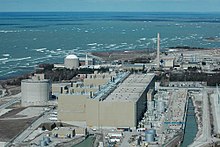
Bruce Nuclear Power station, Ontario Canada.
A publicly-owned Crown Corporation of the Province of Ontario wants to build a "deep geologic repository" right beside the Bruce Power nuclear complex. They are proposing a relatively shallow set of caves - in limestone! That's not like granite or even salt. Limestone is relatively porous.
There is already a waste storage facility there. Now they want to truck in all the "low-level" and "intermediate level" waste from Ontario's 20 reactors. "Intermediate level" is still highly radioactive. It's just everything except the nuclear fuel rods themselves. So it might include things like the filters used to gather radionuclides from the cooling pools. Or parts of old or refurbished reactors. It's very hot stuff.
All of this will just go into limestone caves in their original shipping containers. That's not much protection for the millions and millions of people who live down-lake and downstream in the Great Lakes.
People in Michigan and even Illinois (listening Chicago) could find their water radioactive after a leak. Ditto for the whole Great Lakes coast of Ohio, Pennsylvania, and New York State (Cleveland, Buffalo). On the Canadian side, the millions living in Toronto and Montreal are downstream. It's super risky, and hardly known to the world.
The Bruce Power nuclear power station is scary enough by itself. Two of the reactors were shut down for safety reasons for 17 years. Now they are back online, after being refurbished, making eight reactors running. That is supposedly the largest number of reactors in a single site anywhere in the world. The design for these Candu reactors is straight out of the 1960's. They've had problems, and then more problems, all along. Why is Ontario still counting on these antiques for nuclear power, after what we saw at Fukushima? It is crazy.
Brennain Lloyd tells us the Province of Ontario, the most populous in Canada, has plenty of alternative energy projects on the go. One of the world's largest solar power facilities just opened in Ontario. Some of those green projects are stopped by the giant subsidies governments pour into these old reactors. Just think what those billions of dollars could go with alternative energy.
[Brennain interview]
I lived in Ontario for years. We were always nervous one of these plants was going to go. The Candu reactors were designed in the 1960's and haven't changed since. The giant Pickering reactor sits right beside the millions of people living in Toronto. It’s been plagued with problems and shutdowns. The Darlington Reactor complex was upwind from my country retreat. You couldn't get away from nuclear worry. I had to move away from all that.
Find out more, and how to help stop this nuclear madness here.
And read this fantastic article "Deep trouble: Nuclear waste burial in the Great Lakes basin", published: Friday, October 12, 2012 by Jim Block, reporter for "the Voice" "Serving northern Macomb & St. Clair counties".
It will curl your hair.
NO TIME FOR DESPAIR
So Hurricane Sandy is just a metaphor for our current condition, to the state we are in. Right now, we are the storm. Someday, when the black clouds clear, maybe we'll all be the rainbow. Don't despair. We need you, each and every one.
One mind awake can become stronger than a thousand zombies sleepwalking in a dying civilization.
I'm Alex Smith. Thank you for listening to Radio Ecoshock, and thank you - really - for caring about your world.
Three nuclear facilities in the United States hovered on the brink of catastrophe in the last month of June 2011 - due to climate change.
Nuclear reactors and labs depend upon a relatively stable climate. A single accident could permanently withdraw a large area of the United States from safe human use.
Nuclear technology, instead of being a solution to climate change, is becoming a victim of it.
The nuclear power plant at Fort Calhoun Nebraska was within feet of a 100 percent chance of meltdown, according to the Nuclear Regulatory Commission. The Cooper Nuclear Station, also on the Missouri River in Nebraska, was also surrounded by flood waters.
In the very same week, a wall of fire raged toward the Los Alamos National Weapons Lab - the nuclear weapons testing facility hosting many thousands of barrels of plutonium waste, old dumps, and the most dangerous nuclear materials on the planet.
A chorus of authorities said over and over, repeated like a mantra in every news report, that everything was completely safe. Just like the government did in Japan before and even after four nuclear reactors blew up and three melted down. It's always declared safe, until it isn't.
I'm Alex Smith. This is Radio Ecoshock.
Later in this program you will hear something completely different from every political promise and every business plan. Scientists, peak oil specialists, environmentalists, and a new breed of financial realists all say the same thing: the age of economic growth is over.
To cope with declining resources, and an eco-system tilting toward a death-spiral, we don't need more growth. We need to shrink our economies. They call it "de-growth."
This new movement argues our financial system, and the whole scheme of human population and every more consumption is an unsustainable Ponzi scheme. We can wait for the grand collapse, or we can plan ways to shrink the human imprint on the planet.
Only on Radio Ecoshock, you will hear two panelists from a recent De-Growth conference in Vancouver, Canada. Our speakers are Conrad Schmidt from the Work-Less-Party, and Dr. Bill Rees, the co-inventor of the ecological footprint concept. What your mainstream media won't tell you. NUKE TECHNOLOGY UNSTABLE IN CHANGING CLIMATE
But first, we go to the nuclear threats hanging over America. Why there will be more events, perhaps a melt-down and spread of radiation, due to climate change.
You'll also hear who owns America's second largest nuclear company, the corporation behind the disputed Vermont Yankee reactor, the Indian Point plant hanging over New York City, and operator of the now flooded Fort Calhoun reactor in Nebraska.
No, it's not Mr. Burns.
Then we'll go to Los Alamos, the belly of the nuclear weapons beast. Despite what you think, it wouldn't be a good thing if that burned down. Unless you want a side-order of plutonium with your lunch.
FORT CALHOUN
Fort Calhoun hasn't been a military fort since 1827. Now it's a village of 856 people, on the very Eastern side of Nebraska, more or less in the Center of North America.
The Fort Calhoun nuclear generating station is located nearby, right on the Missouri River, which snakes through the U.S. Midwest for 2300 miles, or 3700 km until it dumps into the Mississippi River, just North of the major city of St. Louis. There is a lot downstream from this reactor site, right down to New Orleans and the Gulf of Mexico, should the deadly radioactivity get washed away in a flood.
The reactor is one of the smallest in America, just under 500 megawatts. It is the old GE Mark I design, a clone of the reactors that blew up in Japan after only a few hours without electrical power.
In late June 2011, record snow-falls in the Rocky Mountains combined with extreme rainfall events to raise the Missouri River to dangerous levels. Both the deep snowfall, and the extreme rain can be attributed to climate change. Burning fossil fuels has warmed the world enough to change the amount of water in the atmosphere, raising it by 4% since 1970, according to the IPCC, and confirmed by several top American scientists, including Dr. Kevin Trenberth.
This year, the run-off was so strong the U.S. Army Corp of Engineers had to open every available floodgate on six flood control dams upstream of the Calhoun Nuclear plant. The Engineeers were aware of the danger, but had no choice. Two of the dams are built out of earth only. If just one dam breaks, the whole lot could go. If just one dam breaks, the Calhoun Nuclear plant would almost undoubtedly flood, and could have parts of the plant washed away, in an inland tsunami.
The Chair of the NRC, Gregory Jaczko did not mention this risk when he visited Fort Calhoun on JUne 27th. The operators, a big company called Entergy, don't talk about it, declaring there is no risk of any radiation release or melt-down. The final owner of the plant is the State of Nebraska, through the Omaha Public Power District, the OPPD.
The flooding of the nuclear plant, the the extreme stress on upstream dams is expected to continue until early August. This is an on-going risk, even if the peak water appear to have passed.
At the time of broadcast, a water-filled berm called an Aquadam, was punctured by a plant worker and collapsed. The Aquadam was promoted as the main line of defense for the reactor buildings, until it failed. The officials dismissed it as unnecessary. The fall-back was apparently just sand-bags at the doors. We might expect the National Guard would have flown in heavy sand bags in a hurry. That didn't happen. In fact, the whole response has been much smaller than the risk warrants.
Water leaked into the main electrical transformers. Stand-by generators had to be fired up to cool the fuel, even though the plant had been shut down for maintenance. The spent fuel pool, which is loaded, also has to be cooled, as we learned from the radiation pouring out of the spent fuel pool at Fukushima Dai-Ichi reactor four. That one was also closed down for refueling when the Tsunami hit.
Power was restored. All the power lines are running through what looks like a slow moving lake. It is the Missouri River, eating away at everything.
When water started to pour into the turbine building, again officials said that was nothing unexpected.
Funny, nobody predicted that.
We know from Fukushima that nuclear power plants are riddled with basements, trenches, and pipes carrying wires. Is the wiring in the turbine building designed to be underwater? Can they keep the electrical system, and the cooling pumps going? Has water started leaking through all the connections into the main reactor building? None of that information is coming out. It's all safe, that is what we are told.
And who could have predicted any of this?
Was it a secret that the mountains were buried under record snow? Does the Nuclear Regulatory Commision know climate change means more extreme rainfall events?
At least the NRC did slightly improve the flood chances at the Fort Calhoun plant last year, in one of their rare attempts to get companies to follow safety. Otherwise, NRC documents show, there was a 100 percent chance of reactor core damage if the water reached 1010 feet above sea level. And that still could happen, if a dam bursts.
According to Dave Lochbaum, one of the few nuclear engineers we can trust, the NRC inspected the Fort Calhoun plant, and gave it a yellow safety flag for flood protection problems. Yellow is the second most serious, with only two given by the NRC in 2010 for the whole country.
The operators, Entergy - and we'll hear more about them soon - contested the NRC findings, and tried to avoid upgrading their flood protection. The NRC won that small battle, which may have so far saved the plant.
Was the NRC asking for a 50 foot wall to surround the facility, to protect it permanently? No, Entergy was protesting building a few small berms, getting their staff to practice what to do in a flood, and other minor adjustments. It wasn't nearly enough. The electric transformers and the turbine building have aleady experienced leaks. Perhaps more, that we haven't been told about.
None of this is a surprise. Floods in 1993 endangered the Fort Calhoun plant. The State government, the federal regulators, and the operators had 18 years to plan out their response for the next big one. And opted for quaterly profits instead. The operator, a company called Entergy, is famous for regular quarterly profits.
Entergy is the second largest nuclear operator and owner in the United States, behind Exelon. They operate the old Vermont Yankee reactor in New England. Entergy promised the State they would not continue past 2012 without permission of a state board, but applied for and got another 20 year license fron the NRC, even after the Vermont Senate voted against continuing the plant operation. Entergy is suing the State, to keep the old reactor going, despite huge public opposition in Vermont.
New York City residents have lots to fear from Entergy's operations of a reactor at Indian Point, just 35 miles north of the mega-city. Believe it or not, the plant is too near a seismic zone. It has a string of safety problems and leaks.
Now we find Entergy at Fort Calhoun, with mickey-mouse safety preparations for the big flood, which was predictable months ago. The New York Times reports a line of staff hand-passing orange fuel cans on catwalks over the flood waters, trying to keep dozens of small pump engines going, trying to keep up with leaks all over the facility. It's frantic, and it's not what we were told about safety in the nuclear industry.
Who is the operator, Entergy? Their Board of Directors is a snap-shot of the American nuclear industry today. Most outstanding to me is the number of former high level government officials, and elected politicians, who end up as highly paid directors in a nuclear company.
Like Ms Alexis M. Herman, an Entergy Director since 2003. She's also a Director of Coca-Cola, Cummins, the engine people, and MGM Mirage, the entertainment and gambling giant. MS. Herman was the U.S. Secretary of Labor from 1997 to 2001. She was also a White House Assistant to the U.S. President. She got $136,000 as an Entergy Director in 2010.
Or how about this for political power for your Board. Entergy is a southern-based company. They have banking connections in Ohio, but really they are from the South. In January 2011 they scored another big politician: Blanche Lambert Lincoln. She was Congresswoman for Arkansas, and then a U.S. Senator for the State of Arkansas right up to 2011, when she went on the Entergy Board.
Blanche Lincoln was in a position to oversee some parts of the nuclear industry, in her position as a Member of the U.S. Senate Committee on Finance, Committee on Energy and Natural Resources. Now she'll get her 120 something thousand dollars or more from the big nuclear company, as a Director. Straight from the Senate Floor to the industry Board Room.
W.J. "Billy" Tauzin is on the Board with her. Billy was a United States Representative for the State of Louisiana until 2005. He served as Chairman of the U.S. House Committee on Energy and Commerce. You can't get more plugged in that that.
That's the revolving door of nuclear politics. Candidates get campaign money while the serve, and then a directorship, often just a few meetings a year, when they leave. ENTERGY AND THE ENVIRONMENT
Entergy has a mixed record on the environment. The current Chairman of the Board of Directors of Entergy is J. Wayne Leonard. He helped arrange a joint-venture with the infamous climate deniers, the Koch Brothers. Entergy-Koch LP, a gas and commodities trading company, was sold to Merrill Lynch in 2004.
Leonard is also connected to the oil industry. He is a Director of Tidewater Inc. That company prides itself on providing services to the offshore oil industry, including, quote: we’re serving customers who are operating in more remote, deeper and increasingly hostile environments in order to meet the world’s energy demands."
End quote. They serve the most risky plays for oil and gas.
On the other hand, J. Wayne Leonard took the Entergy Board of Directors into endorsing Cap and Trade as a way to control climate change emissions. The nuclear industry saw climate change as a way to become the "good guys", since their reactors, once built, hardly emitted carbon. There might even be a future for new reactors, which would be good for the construction company Directors on Entergy's Board. The rare big industry support for cap and trade, and even admission that global warming was happening, more or less collapsed with the failure of climate legislation in the United States.
At least they tried.
But for all the power of this Entergy Board, none of them are the owners of the company. In fact, company insiders own less than 1 percent of the stock. Who is the Mr. Burns behind it all?
It could be you, via the big Wall Street Institutional holders who have up hold billions of dollars worth of share. Here is a short list of the biggest Entergy owners. The two biggest are Franklin Resources and Price T. Rowe Associates, with three quarters of a billion dollars worth each. State Street Corp and Evercore Trust Company come in at half a billion.
Then some names you know, like Barclays, Blackrock, Goldman Sachs, Lazard, Bank of New York Mellon, and many more.
These are the institutions who fund risky nuclear power. They could lose big if even one reactor is permantly shut down, or blows up like Fukushima. They make big money every quater, partly by fighting off costs imposed by the Nuclear Regulatory Commission, or by re-licensing agains the will of States and local populations.
Your pension fund may have bought into nuclear power. Find out. Get out. Because nuclear power is dying after Fukushima, and now these near misses in the United States. We hope they are near misses. That drama is not over yet.
LOS ALAMOS LAB
The Los Alamos National Laboratory is the site of many black nuclear doings. The bombs dropped on Japan were made there. A lot of early nuclear testing at Los Alamos put Strontium 90 into the bones of a generation in the 50's and 60's.
There are old dumps on the site, some of them badly marked. I doubt anyone really know where all the nuclear materials are.
We do know, through the Christian Science Monitor, and the Concerned Citizens for Nuclear Safety: there are between 20 and 30 thousand barrels of nuclear waste sitting in flamable tents, above ground at the Los Alamos site. A raging forest fire was 3.5 miles, that is 5.6 Kilometers, away.
The Lab was forced to close, and turn off the gas, with the fire clearly visible. Fifteen thousand people work there, mostly on nuclear weapons technology. There are around 2,000 buildings in the complex, making it the equivalent of the old Soviet "secret cities".
A spot fire appeared on lab property but was put out. That was at Tech Area 49, where underground tests with radioactive materials were undertaken in the early 1960s.
All around, 44,000 acres, 176 square kilometers of forest and brush burned violently. Despite that, all we get from government officials at the lab is that everything is completely safe from fire. They can't say anything more, because the whole site is a national security secret. Except from the Chinese spies who penetrated everything there a few years ago.
The nuclear materials at Los Alamos lab have the potential to poison the entire U.S. South West, and perhaps the Northern Hemisphere.
Again, the risk of fire was entirely predictable. There was a serious fire in 2000. The Cerro Grande fire burned another 48,000 acres, destroying some Los Alamos Lab buildings.
According to the Christian Science Monitor, increased radiation levels were measured after that fire, including plutonium, cesium, and strontium. A Lab employee claimed the source was natural radon from the forest, augmented by fall-out still present from the nuclear testing years. Yes, plutonium will last for hundreds of thousands of years. But can we trust this source? Or was radiation released by the fire in 2000, when Lab buildings went up in smoke?
It's all a big secret. We don't know then, and we won't be told now, even though the public could be exposed to increased numbers of cancers down the road. CLIMATE CHANGE DRIVES BOTH FIRE AND FLOOD
Scientists say the amount of water in the atmosphere has risen measurably. That extra water has to come from somewhere. Perversely, it is drawn from those regions already hot and dry. Wet place become saturated, dry regions are sucked drier. That's how warming works.
Since 2000, a long-lasting drought, brought on by climate change, according to dozens of scientists, including those in Arizona - the drought weakend most tree-life in the American West. It opened the forests to boring beetles, and set the stage for a decade or more of devastating wild fires. Just like the wild-fires in the Russian heat wave in 2010. A fire there wiped out power lines to a secret nuclear facility. Russian troops were called in to fight the flames before they could sweep over whatever secret nuclear horrors were stored there. A radioactive fire plume was narrowly averted.
All around the world, climate disruption has made the use and storage of nuclear materials impossibly dangerous. It's a spin-off of climate change that was predicable, and still we didn't see it, until these three threats in the United States. Record flooding in Nebraska, with two reactors surrounded by running river waters, and drought-driven fire nipping at the edges of vast quantities of the most deadly nuclear elements, in a weapons lab.
Toss in rising seas for the reactors at ocean side, and the picture of an industry past it's due date becomes complete. The nuclear industry cannot survive the great warming already in process.
I'm Alex Smith. Find all our reports at the web site, ecoshock.org.
FUKUSHIMA UPDATE - WHY JAPAN'S NUCLEAR DISASTER COULD BANKRUPT THE UNITED STATES
Many of you have asked for an update on the Fukushima nuclear disaster in Japan. After all, three out of control reactors continue to melt-down.
It is difficult to communicate the big picture of the Japanese nuclear accident, or the strange collusion of the American government. They play down the severity of the exposions and radiation.
Here is a discussion, Plato-style.
Kate: This is Kate Smith.
ALEX: ...and I'm Alex Smith for Radio Ecoshock.
Kate: We're here to bring you critical information on the triple melt-down of nuclear reactors in Fukushima, Japan
ALEX: and questions about the failure of the American government to protect its own citizens from radiation.
Why did the Nuclear Regulatory Commission fail to warn Americans about the surge of radiation in early March of 2011?
Kate: Why did the government announce it was withdrawing radiation monitors from the West Coast?
ALEX: Why did Secretary of State Hillary Clinton announce the U.S. would support sales from Japan, despite popular concerns about radiation?
Is it possible America is downplaying the world's most serious nuclear accident, to avoid its own economic collapse? Details to come.
Kate: Alex, where do we start?
ALEX: Everyone needs to recognize the Japanese authorities and plant owner Tepco are not trying to stop radiation into the sky and the sea. They are not engaged in "cleaning up" the reactors. Their official announcements make clear their first priority is to cope with tons of highly radioactive water already poured over melting reactor fuel. The contaminated water threatens to flood the site, and leak even more radiation into the groundwater and the ocean.
The operator has brought in two devices designed to remove enough radioactivity to recycle water back into the ruins of the reactor, to cool the lava-like melted cores. The machines quickly become clogged with such large amounts of radioactive particles, they had to be shut down after very short runs.
The filter devices cannot keep up with cooling needs, much less deal with 110,00 tonnes of radioactive water hovering near overflow levels in several locations around the site. Officials admit highly radioactive water reached the water table. It is still flowing into the sea around Fukushima.
Samples taken at the end of June from the ocean bottom three kilometers from the reactor site show Strontium 90, a radioactive metal known to lodge in bones, and to cause leukemia. Plutonium has also been found on the sea floor.
The operator Tepco is overwhelmed with radioactive water. It is falling behind every announced timetable to cope with it.
Kate: On June 23rd, Bloomberg news reported Tepco is running out of nuclear workers. 3500 workers have been exposed to radiation at Fukushima Dai-ichi. Staff on site has dropped from a high of about 2,000, to just over 1,000 people.
Banri Kaieda, the Japanese Minister of Economy, Trade and Industry verbally approved a new plan to use senior citizens as volunteers to help the emergency work at Fukushima. Workers as old as 72 say they have formed a volunteer brigade to go to the reactors, to help fix guages and clean up radioactive debris. In the summer heat, with heavy breathing masks and protective clothing, nobody is certain these seniors can cope with the work.
Radiation in some places at Fukushima Dai-ichi is deadly with just half an hour exposure. But the volunteers deny this is a "kamakaize" mission.
ALEX: Yes, and this is exactly what the famous Japanese-American physicist Michio Kaku has been saying for months in the mainstream media, and on Democracy Now. Kaku predicted Tepco would run out of workers. In early April, he called for the deployment of Japanese troops to Fukushima-Daichi.
The model is what the Soviet Union did when the Chernobyl nuclear plant blew up in April of 1986. Hundreds of thousands of soldiers were sent in, some for as little as 15 minutes each, to shovel, install pipes, pour a little concrete. Then each man or woman was withdrawn, given a medal, and sent back to barracks, so the next person could step up. This was the only way to work in such a highly radioactive environment, in the huge task of burying the reactor in concrete.
Kate: But the core of the Chernobyl reactor did not manage to reach the ground water. Plus the new Chernobyl reactor did not generate as many tons of stored waste as Fukushima. Would burying the reactor work?
ALEX: It seems doubtful, and yet may be the only solution, if there is any solution. We are talking about four reactors here at least, maybe six. It could take a decade or more to build such a giant silo, the largest construction project in history. It means hundreds of thousands of workers exposed.
Kate: What is the financial impact of the Fukushima melt-down.
ALEX: The total cost of this accident is entirely unknown. Nuclear industry executive Arnie Gundersen suggests the direct liability to the Japanese government might reach a quarter of a trillion dollars.
That doesn't count the damage to Japanese trade, from countries who suspect radioactive products. It doesn't count down-time to big companies, like electronics and car makers who must run part-time shifts of production, due to lack of power. The loss of part of Japan to radiation, lasting hundreds of years or more, is incalculable.
Even the direct costs could bankrupt the Japanese government.
Kate: The Japanese are already the most indebted country in the world, in relation to their Gross Domestic Product. The government owes at least 200 percent of the GDP. They have run giant deficits for years, making countries like Greece look prudent and conservative by comparison.
How can they afford new billions for compensation, buying liquified gas from abroad, the loss of the tax base, while supporting citizens made homeless by the earthquake and tsunami?
ALEX: The government cannot afford it - unless they withdraw money from their huge bank account in the United States. Japan is the world's second largest holder of U.S. debt, mostly U.S. Treasuries. Japan has over seven hundred billion dollars banked in America. But if they withdraw that, selling their holdings, the collapse in value of U.S. treasuries could plunge America into bankruptcy.
Kate: America is already close to bankruptcy. The debt limit was reached by June. Congress fought over whether to allow more borrowing, or slash government services, possibly including pensions and support for the poorest citizens.
In the last big debt sale, the U.S. government-supported agency, the Federal Reserve, bought most of the debt offered. It was called "quantitative easing". How is that affected by the nuclear accident in Japan?
ALEX: To explain the connection, we have to look at a buried story. Nobody wants to talk about Tokyo.
Tokyo is the capital of Japan, and likely the world's largest city, with somewhere around 35 million people. It is only 140 miles, or 225 km south of the Fukushima accident site.
In March, after the explosions at all four Fukushim Dai-ichi reactors, clouds of radioactivity fell on Tokyo. The drinking water was declared unsafe. There was a run on bottled water. The government delivered water to pregnant women and day-care centers.
Then the government and the tightly controlled-Japanese press went silent about the radiation of Tokyo.
Until late April. Then the story came out that most Tokyo sewage plants were overwhelmed with radioactivity. These sewage treatment centers were burning the sludge, further distributing more radioactive particles, which are not destroyed by incineration. Hot ash went out over parts of Tokyo again.
Even though the authorities knew the remaining slag after incinceration was highly radioactive, they permitted it to be sold to cement companies. Again, radioactivity was spread, this time through construction with contaminated cement. They are just redistributing radioactive particles, which remain dangerous in the environment for a very long time.
The government set up a few radioactive testing sensors in Tokyo. These were 18 meters high, almost 60 feet above the ground. The authorities said radiation levels were very low.
Citizens, and people from the University began to test radiation at ground level. They found many radioactive hot spots all around Tokyo. They were using cheap hand-held geiger counters. The truth got out over the Internet, by You tube videos showing high readings.
That forced the government to admit background radiation in Tokyo was three times the previous level. It won't go down, these elements last for decades, even centuries. More radioactivity continues to arrive from the Fukushima site itself, especially now that the winds have shifted, blowing South from the plant toward the capital. The Russian media quoted a government inside source saying the Japanese had a plan to move the government from Tokyo to somewhere less radioactive, like Osaka. The government denied it.
Major financial newspapers in the United States said national embassies, and even the headquarters of some multinational companies, were moving out of Tokyo, some to Osaka.
Kate: This is a dialog on the Japanese nuclear accident and the American response. I'm Kate Smith, with Radio Ecoshock host Alex Smith.
Kate: Alex, how does radioactivity in the capital Tokyo tie in with finance?
ALEX: We need to understand the current financial position of Japan, to understand their fear of a big fall. Not only is the Japanese government holding world-record debt, the big banks in the country actually became insolvent in the early 1990's when the property bubble collapsed. It was the same process now going on in America. The banks gave out giant real estate loans, with a lot of collateral based on the alleged value of Tokyo property.
When Tokyo real estate dropped sharply in the early 1990's, banks pretended to be solvent, by keeping the previous high values on their books. The biggest American banks are doing the same thing now.
So the Japanese banks managed to keep going for two decades, known as "zombie banks" -because they were actually dead in financial reality.
They could continue this pretense by saying "Well, the value of Tokyo real estate might go up again, and then our books would be more balanced."
Now, with this radiation, everybody knows Tokyo real estate is never coming back to it's record high levels. It may even decline, as some people move out due to nuclear concerns. This Fukushima radiation could reveal the true bankrupt state of both the banks and the Japanese government.
Kate: Does this affect Americans?
ALEX: Yes, if the Japanese decided to withdraw their billions, America could also go bankrupt.
The Obama government realized the risk soon after the accident. On April 17th Hillary Clinton went to Japan, making public appearances to show American support for the Japanese. Meetings of officials of both countries went on behind the scenes. Secretary of State Clinton returned to Japan at the end of April. On April 29th, Foreign Minister Takeaki Matsumoto said the U.S. agreed to help Japan dispel "rumors" about radioactivity and fight import bans based on safety. The announcement surprised Americans concerned about possibly radioactive food and other products from Japan.
Kate: Japan admitted the radiation going into the ocean from Fukushima was triple the amounts announced earlier. The government confirmed the ocean was poisoned with radioactivity along the coast for 300 kilometers. That is 186 miles. With in their ship the Rainbow Warrior, Greenpeace found radioactivity in seaweed 12 miles out to sea.
It seems incredible the U.S. government would agree to not test sea food products from Japan.
ALEX: The Obama administration did some very strange things, some of them questionable for the safety of it's citizens. The EPA loudly and publicly announced they were withdrawing radiation testing stations from the American West Coast. Even though three reactors continue to melt down across the Pacific, with unknown results. More explosions and releases are possible.
According to Kyodo June 26th, the Japanese are now proposing to ship unsold sea food to developing nations.
Despite the clouds of radioactivity that continue to blow over much of Japan, at times going as far as Korea, China and the Russian coast, the U.S. military has not announced any base closings there. In mid-March, the military did withdraw thousands of dependents in a mass air operation. But the soldiers and airforce are still there. Why is America risking the health of 47,000 troops in Japan?
Soon after the accident, the U.S. Nuclear Regulatory Commission was warned the only possible outcome after cooling stopped was three melt-downs. Why didn't the government warn the American public about the radiation that fell over the whole country a week later?
Kate, my question is: to prevent a run on U.S. Treasuries, to stop the Japanese from endangering the economy by withdrawing billions, did the Obama administration make big concessions to the Japanese?
Kate: Alex, can you prove these negotiations took place?
ALEX: No. At this point it is just a theory that explains the behavoior of the U.S. government in this affair. It is based on facts well-known in the financial world, about insolvent banks and governments. I think agreements made by the American administration will come out eventually.
That is just part of a complicated history between the two countries, of war, occupation, and a lot of trade. Plus, America wants to hide its own nuclear risks. We can't discount the current economic crisis as a reason why the American government is so anxious to support Japan, even while risking the safety of it's own citizens.
Kate: You are tuned to a special program on the Japanese nuclear accident and the American response. I'm Kate Smith, with Alex Smith from Radio Ecoshock.
I think we need to hear more about the local situation in Japan. There are still some 290,000 people in Fukushima City, 37 miles,or 60 kilometers away from the plant. Fukushima City was highly irradiated by explosions at the reactors. Like Tokyo, their sewage systems and waterways are radioactive.
Even school yards and public parks have hot zones. The municipal government ordered a limit of one hour only in the parks. On June 6th they lifted those restrictions. On June 7th Greenpeace technicians found a pile of leaves in a park measuring 4.2 microsieverts per hour. Even the leaves qualified as radioactive waste that needed special handling and disposal for 30 years. The leaves cannot be burned. That would just spread the radiation.
Radiation is everywhere. Fukushima City, and many other towns and cities in that region, are now the world's biggest experiment in living within a radioactive zone. There is no where to evacuate all the people.
ALEX: That's true. The Japanese government tried to raise the permissible levels for radiation of children to 20 millisieverts - the same level previously set for workers inside a nuclear plant. Parents made a rare protest, the government pulled back to 1 millisievert.
Now they are issuing bracelets to 34,000 school children to measure radioactivity. These dosimeters don't warn children if they approach a hot spot, they just collect the data, to be assessed later by the secretive Japanese government. It is likely no child or family will ever be told how much radiation they have been exposed to, or how many hot particles they have ingested. As you said Kate, it's a big experiment - a whole population living in a nuclear disaster zone in Japan.
Kate: I'm Kate Smith.
ALEX: and I'm Alex Smith, reporting for Radio Ecoshock, at ecoshock.org. Thank you for listening.
Host of syndicated weekly Radio Ecoshock Show - the cutting edge with top scientists, authors & activists.
Eight years on the air. Previously a researcher for global environment group, print journalist, homesteader, world-traveler, musician, and private investigator.