Showing posts with label acidification. Show all posts

Tuesday, October 15, 2013

I Have A Confession To Make

Emerging threats analyst and author Robert Marston Fanney on new frontiers of climate change. Dr. Alex Rogers of Oxford: State of the Oceans 2013. Radio Ecoshock 131016 1 hour.


Illustration by Marek Okon for Luthiel's Song by Robert Marston Fanney.

Download/listen to this Radio Ecoshock show in CD Quality (56 MB) or Lo-Fi (14 MB)

WE ARE IN TROUBLE

Yes, we are in trouble. Last week, in this interview with Nicole Foss, we peered into the impending crash of the economy. It may dance on for a while using funny money from the Federal Reserve and other central banks. But fall it will.

A mere Depression would be good news, if the climate could stay the same for humans and all creatures. But even during hard times, we'll keep on dragging more and more dirty fossil fuels out of the ground. It's a burning party, maybe a funeral pyre.

Coming up we'll talk it all through with emerging threats analyst and author Robert Marston Fanney. You'll also hear an interview with a top marine biologist from the UK. Alex Rogers is the co-lead author of the new State of the Oceans 2013 report.

Alex reminds us that global warming is more a story of the oceans than our experiences of floods, fires, and storms on land. Most of our excess carbon is going into the sea, changing its chemistry, temperature, and the basis of the food chain. The ocean is where it's happening, and the ocean is a news nowhere land where reporters don't go, and humans don't care.

Going through the emerging science, I'm also alarmed to discover big changes in Antarctica can reshape our world. Climate change is like the many-headed Hydra. We think we know it, but we don't. The Earth is re-arranging in all the places humans don't look: at sea, at the poles, deep in the melting permafrost, and in the farthest forests and mountain tops.

In our opening show this Fall of 2013, climate scientist Paul Beckwith suggested warming could come very suddenly, even in a decade or two. A new paper by Morgan Schaller and James Wright of Rutgers finds, as Joe Romm writes, "When CO2 Levels Doubled 55 Million Years Ago, Earth May Have Warmed 9°F In 13 Years". It's a shocking example of what could happen.

The helpful Rutgers press piece on this study is here.

Business and political leaders have already announced they expect, or will tolerate a doubling of CO2 levels from the pre-industrial level of 270 parts per million to over 600 parts per million. We are already on our way, touching 400 parts per million this year, and adding more carbon faster every year, as the fossil fuel party expands around the world.

Canada, Australia, the UK, Europe, Brazil, and every country who can is promising to develop more fossil fuel resources. We are investing billions, possibly trillions, into more mega-coal mines, more fracked gas and Liquid Natural Gas plants, bigger tar sands and shale oil projects. Humans seem intent on fossil suicide.

Next week we'll talk with Morgan Schaller to find out what can happen in a mere 13 years on this fragile planet.

2047: WHEN OUR HOTTEST YEARS BECOME OUR COLDEST YEARS

Look at it another way. Another paper released this week says that by 2047 the coldest years will be hotter than the warmest years of the last two decades. We've already set new temperature records, and those will be the old years we look back on.

This paper was published in the Journal "Nature", by a team of post-grads at the University of Hawaii, led by Dr. Camilo Mora.

In an article by Justin Gillis of the New York Times, Dr. Mora says: quote

Go back in your life to think about the hottest, most traumatic event you have experienced.” “What we’re saying is that very soon, that event is going to become the norm.

Do it. Remember the heat wave you prayed would end. The day the sun seemed to be the enemy. You waited impatiently for the cooler darkness. That's the new day in 2047. Just 34 years from now. How old will you be then? How about your kids or grand-kids?

Other scientists suggest a concerted effort to kick the fossil fuel habit, going with reduced energy from renewable resources, could delay that heating by at least 25 years. That's more precious time for humans to move away from the rising seas on the coast, to re-think the whole food supply system, to work out ways to survive the coming heat. We must at least give our children that time.

WHY THERE WILL BE MASS EXTINCTIONS AROUND THE EQUATOR

That climate hydra pops out of this new paper again. I thought, and many scientists have suggested, that climate change would be less stressful around the equator. Most models suggest the extra heating will be the most extreme in temperate areas, and even more closer to the Poles. Certainly that's where we see the big news stories, about storms and fires in North America, Europe and Russia. Plus those crazy heat waves developing around the Arctic.

Dr. Mora says it only takes a small change in the tropics to create major damage. Why? Because the plants and animals there developed into a stable climate that doesn't change much during the year. Even a degree or two, combined with some changes in ocean or atmospheric currents, could bring down the rainforests, wreck the coral reefs, and cause mass extinctions of species. Tropical plants and animals are less able to adapt.

We simply haven't thought it through. Our unintentional geoengineering of the Earth has created a maze of cascading changes beyond our imagination. We are heading to a different world, if we survive to see it.

I'm asking for your help. I'm asking you to use every engine of communication, and every link to all the people you know, to raise the alarm. Join with me in this pledge I make for Radio Ecoshock: say it. We will speak the truth about what we are doing.

Our political and corporate leadership is bankrupt and dangerous. They don't know what they are doing, or their short-term gain seems worth risking the whole future. We let them, because we are comfortable and most of us too well fed. Geared to hunt and migrate as a species, now we have super powers to travel and kill. All of us have a thousand energy slaves to serve us delicacies every day. We're addicted to fossil fuels.

I don't know what twelve-step program can break us out of this master complex. I don't know if we will survive the fossil trap. But we have to try.

Nobody want to hear this. Your friends and family don't. But honestly, when we add up the science and our experiences in the real world, when we look the unstable weather in the face, there is no choice but to speak up.

Forget the envy of a better car or truck. Forget chasing paper wealth. Look at the young innocents and the other un-knowing species, the other passengers on this planet. Even in small steps, whatever changes we can make in our own lives matters most. Whatever sign we can make, whatever we can do, matters now.

Become a climate activist. Start with this interview with Robert Marston Fanney.

ROBERT MARSTON FANNEY ON EMERGING CLIMATE THREATS


Download/listen to this Robert Fanney 34 minute interview in CD Quality (31 MB) or Lo-Fi (8 MB)

We begin with Robert Marston Fanney reading from the introduction to his new book "Growth Shock, Tragedy and Hope at the Limits of a Finite World".

"I have a confession to make. One that is not easy to vocalize. One that is equally difficult to listen to. My confession is not one of a personal nature. I am not revealing my own, petty, individual sins. Instead, I’m making a confession for us all. A revelation of the ongoing and maturing tragedy of our race. One we will each need to be made aware of soon if we are to effectively act. For the age of excess is rapidly coming to a close and we are now entering a difficult and hard to manage age of consequences.

My confession is simply this: we are in trouble...
"

We'll get to the book, but that isn't why I called Robert. He captured my undivided attention with his searing analysis into large-scale patterns of climate change, based on real-time events happening around the world, right now. That's in his blog called "robertscribbler" at wordpress.com.

There it is, the scientific maps and satellite shots of extreme weather events and danger, brought together in ways we can all understand. Then Robert tops it off with analysis that I think raises whole new questions about our future together.

Maybe that's Fanney's previous training as an intelligence analyst, and years gathering scientific and technical assessments, as Editor for Jane's Information Group's emerging threats books, magazines, and electronic publications.

But there's another side to Robert Fanney that helps him imagine the future. He's the author of the science fiction series Luthiel's Song, which attracted a cult following, including many artists. You heard a few snippets written for the book "Luthiel's Song: Dreams of the Ringed Vale" by multi-media artist Ethan Jackson.

Details on composer Ethan Jackson here.

STATE OF THE OCEANS 2013


We humans have always believed the sea is so vast we can't seriously damage it. A new report warns this isn't so. It's called "The State of the Ocean 2013: Perils, Prognoses and Proposals". We've reached one of the lead authors, Professor Alex Rogers of Somerville College, Oxford, and Scientific Director of IPSO, The International Programme on the State of the Ocean.

The informative press release about this State of the Ocean is here. It contains a fast summary of the gravest concerns.

Copies of the report can be found here.

The United Nations' latest climate report concludes most of our carbon pollution is falling into, and damaging, the oceans rather than the land.

Download/listen to my 16 minute interview with Alex Rogers in CD Quality (14 MB) or Lo-Fi (4 MB)

HELP RADIO ACTIVISM

That's it this week for radio activism. Download our past programs and help the cause at our web site, ecoshock.org. Next week, the climate scientists speak freely.

Our opening music was DANCE Live at the Labyrinth at Shambhala Music Festival 2011. That closes the show as well.

Monday, October 8, 2012

FOOD AND REVOLUTION

Three guests. Rob Stewart, Director of movie "Sharkwater" and now his latest "Revolution" - is the ocean dying? An international media briefing by Lester Brown of Earth Policy Institute about rising food prices & his new book "Full Planet, Empty Plates". Wes Regan on urban farming in the poorest neighborhood in Canada. Radio Ecoshock 121010

Download/listen to this Radio Ecoshock show in CD quality 56 MB.

Download/listen to this Radio Ecoshock show in Lo-Fi 14 MB. Coming up this week: an interview with Rob Stewart, Director of movie "Sharkwater" and now his latest "Revolution" - is the ocean dying? What can we do?

You can see food prices going up. It's happening around the world, stressing budgets and leading to foodless days for millions of the world's poor. You'll find out why in an international media briefing by Lester Brown of Earth Policy Institute about rising food prices & his new book "Full Planet, Empty Plates". Only on Radio Ecoshock.

We finish up with as Wes Regan of Vancouver tells us about urban farming in the poorest neighborhood in Canada.

ROB STEWART'S REVOLUTION

Rob Stewart blew into world consciousness with his award-winning indie film "Sharkwater". Sharkwater was one of the biggest selling Canadian films ever. It ricocheted all around the world. We start with the latest developments in saving the sharks.

As a result of that movie, and Stewart's unrelenting campaign, over a hundred countries and many more cities have banned shark fin soup - the alleged delicacy wiping out the ocean's top predator. Shark fin soup is banned at all Chinese government functions.

Now Stewart is back for a much bigger fight, the fight of our lives: how to steer a death-wish civilization in a better direction. His new movie, four years in the making, was released at the Toronto International Film Festival and again at the Vancouver Film Festival. It's called "Revolution".

The film has experts saying coral reefs could be mostly dead in 40 years or less. I've just seen a You tube lecture by Professor Alexander Tudhope, a geoscientist and climatologist from the University of Edinburgh. He seemed less certain of the coral fate, suggesting they could die off, but it's still possible they may adapt enough to survive.

Stewart cites Charlie Veron, aka John Veron, a heavily awarded Australian scientist who warns on current path, the Great Barrier Reef will be dead in 20 years... and Katharina Fabricius, lead scientist at the Australian Institute of Marine Sciences.

These scientists are also part of the "Coral Triangle Initiative"

WHY SAVE SHARKS IF THE OCEAN IS DYING?

A key moment in the movie is when Stewart should have been celebrating his moment of triumph. Sharkwater was finally being showed in China, in Hong Kong, where shark fin soup is served. Its possible 100 million Chinese people will see it. But an audience question stumped him, almost invaliding his years of work: why struggle to save the sharks, if scientists say most big fish in the world could become extinct as early as 2048.

That extraordinary prediction is published science coming from a team led by Dr. Boris Worms at Dalhousie University in Eastern Canada. Radio Ecoshock covered that in 2006. Find my blog and the audio here.

Outfield Productions from Pakistan turned it into a You tube video found here.

Stewart was tossed into the much larger problems which threaten the world's oceans. The largest of all, not just for the great coral reefs (nurseries of the sea), but for all creatures which form either shells or skeletons, is ocean acidification. He sets out on a journey to find out more.

The need for "revolution" comes from the inability of world governments to do anything at all to save the oceans. Only a major change to the system, Stewart concludes, can save the oceans, and us. The only group he can find that isn't invested in the present system is youth and children. They are the best hope.

There is a hugely moving scene with Felix Finkbeiner, age 13, founder of the group Plant for the Planet. Finkbeiner is organizing youth to plant hundreds of millions of trees.

In some ways Stewart needed the same underground film techniques so successful in "Sharkwater". Why do we still need to slink around without permits, to document the greatest threat to humanity and all species?

PAUL WATSON

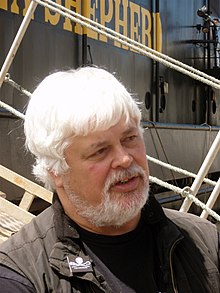
We also discuss his relationship with another ocean defender, Captain Paul Watson of the Sea Shepherd Society. Watson is currently a wanted man, living on one of his ships in an undisclosed location. Costa Rica issues an international arrest warrant, claiming Watson had endangered a fishing vessel that was finning sharks, part of the research done for Stewart's film. German acted on that warrant, even though it is doubtful Watson would receive a fair trial in Costa Rica, and despite widespread German support for his actions to save marine species.

Paul Watson skipped out on a $300,000 bail bond, and went out into international waters, in the open sea.

MONEY DISAPPEARS IF YOU SEEM TO "RADICAL"

Even though "Sharkwater" was phenomenally successful, Stewart still had trouble financing the movie "Revolution".

Rob was painted green for Fill the Hill C-Day for Powershift in Ottawa Canada in 2009, just prior to the Copenhagen talks. Suddenly his funding promises dropped from 5 million dollars (he planned a 3-D underwater spectacular) to just $150,000. Rob packed his bags and cameras and went out on his own to film.

We learn Stewart has just published a book as well. It's called "Save the Humans". The book takes us into the back story of making both Sharkwater and Revolution, being partly biographic.

As Stewart works insane hours getting his message out, traveling the world, he has started a new environment group, the United Conservationists.

You can find the film web site at therevolutionmovie.com

I loved the movie. It's deep and necessary. I hope it storms the world.

LESTER BROWN - FULL PLANET EMPTY PLATES

Lester Brown is one of the world's treasures and truth-tellers. Decades ago he founded the World Watch Institute, which issued comprehensive annual State of the World reports.

One of Lester's specialties has always been monitoring world food supplies, crop production, and the growing catalog of threats to the global food supply. He went on to found the Earth Policy Institute.

On September 27th, Brown held a briefing for world media about our current situation, and his new book "Full Planet, Empty Plates, the New Geopolitics of Food Scarcity." I recorded it, and got permission to broadcast it to you.

Our situation is not good. The world's largest food exporter, the United States, has just gone through a record drought (which still continues into October). Crop production is down, and world food reserves are far below what they should be.

Food prices, especially for grains, have risen around the world. Usually when that happens, there is political instability as well.

In North America and Europe, the consequences are not so grave. We spend much less of our total income on food, and most of the cost of food is actually in processing.

In the developing world, more than a hundred million people actually schedule "foodless days" (you can call it a "fast" is you want) because there isn't enough for the table. In parts of Asia and Africa, at least 75% of all income goes directly for that day's food. There isn't any room for price increases.

Lester Brown goes on to catalog the many challenges we face in trying to feed 80 million more people every year. For example, many countries are already over pumping their aquifers. They have to go deeper and deeper, burning expensive diesel fuel for pumps. Some wells are going dry, and some rivers are going dry.

Add in climate change, with missed monsoons, droughts, storms wiping out crops, and you see the potential for a very unstable world.

This press briefing is loaded with facts mainstream media doesn't bother to tell you. Don't miss it.

There are lots of links and related downloads there, including the complete set of data sets.

WES REGAN - URBAN FARMING IN CANADA'S POOREST NEIGHBORHOOD

Find a bio of Wes Regan here.

There are mysterious gardens appearing in Canada's poorest urban neighborhood - Vancouver's downtown East Side. And why is a business group pushing local food?

Some Downtown East side residents have seen their share of problems. Along with the newly arriving condo owners, there is a mix of alcoholics, drug addicts, the disabled, the unemployed, and people who have been disadvantaged or abused. Some are First Nations.

Our guest is Wes Regan, Executive Coordinator of the Hastings Crossing Business Improvement Association in Vancouver, Canada. Wes toured internationally as an actor and musician, before becoming an urban geographer. He's a founding member of the Vancouver Urban Farming Network, and the Urban Aqua-Farm Society.

We start with a little patch of vacant land in an area known for poverty and drug abuse. Squeezed between two old buildings, this lot on Hastings Street in Vancouver's Downtown East Side used to be covered in garbage. Now it's covered with food. It is a new urban garden.

Too often, we think of business being hostile to green initiatives. But Regan coordinates the local Business Improvement Association. It is an unlikely marriage, but works well when progressive business is involved.

Wes tells us about the Vancouver Urban Farming Society, and Sole food farm.

This is community supported agriculture, the CSA model. But there is a new wrinkle: people can pick the amount of food they need that week. That works especially well for the poorest people, many of whom live in government-subsidized rooming houses with no kitchens.

Some of the workers in these gardens earn a little money, even though they could likely not hold a 9 to 5 job. It's an important green job supplement. Other gardens have been set up specifically to help recovering people heal. There is much more to these urban farms than just the economics and production.

Wes Regan is also part of the Urban Aqua-Farm Society. Are there really aquaculture operations in the city of Vancouver? No large ones yet. There are some experimental ponds and barrels.

Urban farming tends to focus on raising greens and other veggies. But if we want true self-sufficiency, we need proteins as well. Some of that can come from beans, but raising fish or other marine life in our cities could fill the protein gap.

Many of us picture urban farming as a pass-time for yuppies, people with money. We talk about urban farming as part of the solution to poverty. It is working in Detroit and many other U.S. cities as well, where empty housing was bull-dozed, and tractors are now at work.

Don't hungry people, drunks, or vandals just steal the food or wreck the gardens? Wes can't recall any such incident of vandalism. It seems just trying to cope with extreme poverty, the area has built up its own community rules and spirit. People support these gardens, and other guerilla planting.

Vancouver Mayor Gregor Robertson and his Council are supportive. They want to make Vancouver the "greenest city in the world". How could we make the same case to less sympathetic municipal governments? Wes says a straight case of economics can be made, and explains how.

Regan co-authored the 2010 report "Advancing Urban Farming in Vancouver" which you can find here.

------------------- That's it for Radio Ecoshock this week. Find us on Facebook and you can share each and every program with your friends. We need to get the word out fast to save what is left of the natural system. You can help. Feel free to download our show from the web site ecoshock.org Pass them around as mp3's or CDs.

I'm Alex Smith. I appreciate the helpful emails, tips, and links sent in by listeners. Just click on the "Contact" button on our web page to send your message. Thank you for listening and caring about our world.

Thursday, February 28, 2008

Our Dying Oceans - the New Science

Latest awful science on climate's impact: dead zones, acidification, extinctions.

3 original interviews by Alex Smith, of top scientists, with news from the Boston meeting of the American Academy for the Advancement of Science.

1. From the AAAS in Boston - Ben Halpern has new global maps of ocean damage.

2. the Smithsonian's Nancy Wilson ("Code Red") - super biologist on climate's impact on ocean, new science, and the sad fate of corals.

3. from Norway, Dr. Christian Nellemann, author of UNEP report "In Dead Water" - the frightening warning from the United Nations, that mainstream media in North America ignored.

Plus: a reading from John Timmer, science editor at Ars Technica: the real deal on ocean acidification, in a way we can all understand it.

and - "the new Stern report" from Australia. Prof. Garnaut says we all must cut emissions by 90%, by 2050 - and even then, our chances are only 50-50. Stunning wrap up of new science, since last IPCC, plus projections of the Asian economies, as China, India - and even Vietnam, head toward super-economy status. Australia will take the worst beating from climate change, says this government report.

1 packed hour Ecoshock Show 080229 CD quality 56 MB or Lo-Fi 14 MB

Production Notes: 30 sec music bed for station ID at 26:44; two good insertion points at 13:40 & 48:19 Cut end song for more time, if needed. Song: "Mother Earth" Shane Philip Cdn content