Showing posts with label farming. Show all posts

Wednesday, June 25, 2014

Climate Change - We Don't Want It

SUMMARY: Dr. Bill Miller, author of "The Microcosm Within" on climate & new diseases. From Wales, Lloyd Jones' new "cli-fi" work, and "Victory Gardens" Vancouver co-founder Lisa Giroday on urban farming.

INTRODUCTION:

There's lots to do and hear in this edition of Radio Ecoshock. I start out asking Dr. Bill Miller about climate change and disease. But we dig into humanity's weak spot - the balance of immune systems which can wipe out any species quickly - or help us evolve. Miller says the microcosm rules all.

Then we're off to a tiny village in Wales, tucked into the United Kingdom. From his family farm, author Lloyd Jones tells us about his cli-fi book, a tale of the unwinding of our good times as climate change grinds things down.

The finale is a bright young voice from Vancouver, Canada. Lisa Giroday explains her Victory Gardens workers co-op, and the ways to create green jobs deep in the city.

Off we go.

Download or listen to this show in CD Quality or Lo-Fi

Or listen on Soundcloud right now!


THE MICROCOSM DETERMINES HOW WE EVOLVE OR GO EXTINCT

Dr. Bill Miller has been a radiologist for decades. That brought him out of any specialty, and into the world of tiny things within our bodies. He realized the human DNA, recently discovered, hardly covers what we are as an organism.

In fact we are a confederation of tiny beings. At least 9 out of 10 cells found in the human body are not ours! We host other organisms on every part of us, from eyelashes to toe-nails. There is far more foreign DNA and tiny organisms in our blood, guts, - everywhere. This conglomeration of co-dependence would total a much larger DNA picture, something Miller labels the "Hologenome".

Science shows that each of these organisms, from bacteria on up, have a type of cognition. They solve problems. Miller gives the example of an organism that enters our bodies, but seeks and finds our bones as the only place to live. There's a kind of spooky recognition that we don't know who we are at all, and our daily consciousness doesn't reflect decisions made all over our bodies without our knowledge.

Miller writes:

"Current research has unexpectedly revealed that all cells and microbes have elemental cognition and a previously unappreciated capacity for discrimination and awareness. From these faculties, cooperative natural genetic engineering is enabled; and it is from this starting point that biological complexity evolves. The Microcosm Within illuminates how immunological factors dominate evolution and extinction."

This vision of the multi-self, if you will, led Miller to realize that the immune system is key to both evolution and extinction. Sure Darwin's slow process of natural selection of the fittest takes place. But there are also sweeping changes of biota due to changes in the immune landscape.

On the larger human scale, we can see this in the great plagues of the Middle Ages, or the decimation of the aboriginal people in the Americas, once European diseases arrived. There was no immunological resistance. Scientists recently found evidence of an "end-of-the-world" class disease in Ancient Egypt.

That's the great fear behind things like SARS, the Bird Flu, or the Middle Eastern disease MERS.

Bill Miller adds a new disease to our radar: Chikungunya. This tropical disease has spread in the CariBbean, and is now showing up in the US South and Latin America. With proper medical care (which is not available in many countries) you can survive Chikungunya. But then years later you suffer painful after-effects which can be disabling. Check out this recent article in Wired magazine about the disease.

The point is with climate change, the range of formerly "tropical" diseases is moving north (or south in the Sounthern Hemisphere). We're seing Dengue Fever in Florida and Texas. Nile Fever has spread as far north as Canada. Malaria has moved into the highlands of Africa which used to be safe.

Miller suggest it may be disease which determine our fate, personally and as a species. Not just our diseases, but diseases of our food animals and plants as well. The Koala Bear is threatened by a new disease, as are bananas and many other crops. Perhaps, says Miller, we should spend less on massive projects like Carbon Capture and Storage, and more on the study of the immune system which protects - or fails to protect, all of us.

Extreme weather can also affect disease. When we get those torrential downpours, a sewage plant can flood out, or mosquitos thrive - just when the human community has been weakened, possibly by homelessness or lack of food. Extreme heat also weakens us.

It's a stimulating take not just on climate change, but what life really is. I found our talk eye-opening.

You can find a lot more in his book "The Microcosm Within, Evolution and Extinction in the Hologenome" and at his website. http://www.themicrocosmwithin.com/


Download or listen to this interview with Dr. William B. Miller Jr. in CD Quality or Lo-Fi

LLOYD JONES: CLIMATE CHANGE, WALES, AND OUR FRAGILE CIVILIZATION


Sometime we can see things better from the edge. Our guest, the Welsh wanderer and cli-fi novelist Lloyd Jones reports back from his personal edge.

Lloyd Jones discusses his relationship with the land and his concerns about global warming - the catalyst for his magnificent novel, "Y Dwr" (Water). We start with the moving audio in a short film on the farm in north Wales where he grew up. The film was created by Sara Penrhyn Jones for Wales Literature Exchange.

The farm is near the village of Abergwyngregyn, near Bangor Wales. The short film on Vimeo, about his life and work, touched me on several levels. In some ways, it captures a bit of my own journey, and this program.

As Jones says in his Vimeo presentation, it's not like Wales can affect this path toward a new and unknown climate. Can people in Wales really picture this coming future? Is there anybody left who knows how to survive without plenty of cheap oil and gas from abroad?

I asked hopefully if Lloyd, in his travels, encountered people organizing to live differently, say in Transition Towns, co-operative farms, or with self sufficiency? Sadly, he replied "No". In fact, during his walks, most often people are locked away each in their own homes watching television. We talk about what modern agribusiness has done to food and farms.

The novel "Y Dwr" (the Welsh word for Water) is set in rural Wales in a world changed greatly by global warming. Civilization has not been able to cope with the blows, and the cast of characters must re-learn how to survive directly from the land around them, as Lloyd's parents did on their farm. It's not easy, and in fact Jones does not provide a stock happy ending. The story of climate change may not end well for most humans.

The novel is available on Amazon in the UK (and so anywhere in the world). It is listed as a Kindle edition as well. Be warned: the novel is written in Welsh, not English!

Y Dwyr should not be confused with Llamhigyn Y Dwr, the mythological Welsh creature also called "the water leaper". That one looks like a cross between a bat and a frog.

There's a real charm about Lloyd Jones. It's hard to describe, but I think you'll like the interview, as I did.

Listen to or download this interview with Lloyd Jones in CD Quality or Lo-Fi.

A tip of the hat to journalist Dan Bloom in Taiwan for steering me to Lloyd Jones. Dan coined the term "cli-fi" for the new genre of climate-based fiction.

VICTORY GARDENS AND URBAN FARMING IN VANCOUVER, CANADA


As soon as you start to grow food, whether in your own yard or a community garden, you'll find a network of humans comes along too. Barely a day goes by, when someone doesn't show up at our door with extra tomato plants, an arm-load of rhubarb, or a tip on where to find wild-growing cilantro.

A team of urban gardeners-for-hire in Vancouver Canada is taking that spirit to the world. It's called Victory Gardens and you can expect their video tips to show up on Youtube.

Joining us from Vancouver is one of those Victory Gardeners, Lisa Giroday.

I see urban farming as a terrific way to create a lot of green jobs. I ask Lisa for tips for people who want to start out doing this.

Listen to, or download this can-do interview with Lisa Giroday here.

Here are more links to learn about the Victory Garden project, for ideas you could apply in your own city. Their groovy web site is here. Find them on Facebook here. And check out this first Victory Garden You tube video.

I learned about the Victory Garden project from this excellent article in the Vancouver Sun newspaper.

IT'S MY CONTINUING PLEASURE...

You can download any of our years of past programs as free mp3's at our web site ecoshock.org. Or try us at radioecoshock on Soundcloud.

It's my continuing pleasure to make these programs for you. I'm Alex Smith. Tune in next week for Radio Ecoshock.

We leave the program with a snippet from a new climate song I'm working on. It's called "Climate Change - We Don't Want It." That could involve you at your next climate action, or even a rave dance. This is the chorus to chant:

Climate change

We don't want it

Climate change

We can't stand it

Climate change

Don't let it happen!

I'd love to see that chant spread around the world. If you can have a choir sing that, or record a crowd chanting it - I'd like to add that to my song.

May of 2014 was the hottest May on Earth since humans learned how to keep records of temperatures. This may end up as the hottest year ever. And those records will be broken as long as you live. Let's use music to spread the word about the challenge of global warming!

Wednesday, March 5, 2014

California Drought: Is this the big one?

RADIO ECOSHOCK SPECIAL ON CALIFORNIA DROUGHT Despite recent rains, California's reservoirs are near empty, snow-pack light, and groundwater depleted. Four experts on a drought that really started in 2006, impacts on economy, food, farming, and nature. Guests: Dr. Peter Gleick, Dr. Jay Famiglietti, David Schroeder, Dr. Reagan Waskom

http://tinyurl.com/lrqaxqe

THE CALIFORNIA DROUGHT IS NOT OVER!

Rainstorms finally arrived in California, after a 14 month drought with no significant rain. But the big reservoirs are still pitifully low, and snow pack is less than a quarter of normal. Hundreds of thousands of acres will not be planted, and food bills will likely go up in North America, and possibly around the world.

This is the Radio Ecoshock special on the California drought, as a case study of what we can expect in many parts of the Earth. I've lined up 4 experts all with something new for you.

Dr. Peter Gleick is a climate and water specialist who has been warning this could happen for years.

Dr. Reagan Waskom is another water and agriculture expert from Colorado.

We connect with boots-on-the ground water conservation specialist David Schroeder in Montclair, right on the edge of thirsty Los Angeles.

Finally, we get back to the big picture, as Professor Jay Famiglietti at University of California Irvine warns of depletion of the ground water under one of the world's biggest food producing areas. That's a trend all over the world, as we race toward peak water.

Download/listen to this Radio Ecoshock show in CD Quality or Lo-Fi

PETER GLEICK: Is the drought climate change?


Our first guest is Dr. Peter Gleick. He's president of the Pacific Institute in Oakland, California, one of the world's leading independent think tanks on water issues. Peter is also a scientist known around the world.

Peter introduced the term "Bellwether Drought" for this event. We know climate change threatens the water cycle. Scientists believe the wet areas (like the UK!) will get wetter, and the dry areas like California, will get dryer. So the dice are loaded for more droughts to occur in this major food producing area.

Dr. Gleick points out we could say this drought started in at least 2006. There have been several drier-than-normal years since then. Scientists have found records showing California has experienced droughts lasting more than a hundred years in the past, in the 1100's for example.

So we may be asking if human-induced climate change has triggered this drought cycle. The causes of regional weather events are complex. We have ocean currents, natural cycles like El Nino and El Nina, and changes to the Jet Stream. All of those, especially the Jet Stream (as shown by the work of Jennifer Francis et al at Rutgers) can be influenced by climate change.

It's a Bellwether event because whether or not we can nail down direct causation by climate disruption - it's a sure test of what is likely during the coming decades. As in Australia, it is possible Euro-humans arrived in California during a cyclical wet spell that was bound to end. But have we hastened that process?

I also talk with Peter about desalination, it's promises and obstacles. A new desalination plant has been build to feed the San Diego water system. But really, it's so energy intensive and expensive that desalination cannot save the whole California agricultural system.

Peter Gleick is an influential scientist in many places. He talks about the global work his institute is involved in, and it's heavy-duty stuff. It's cool he Tweeted this program link out to his 11,000 plus followers.

You can download or listen to this 18 minute interview with Dr. Peter Gleick in CD Quality or Lo-Fi.

DR. JAY FAMIGLIETTI: Looking at the drought from space.


When the rains don't fall in California, every one checks their wallet for rising food prices. But rain or not, cities and farmers are pumping out California groundwater at an alarming rate. Thanks to new satellite science, now we know how much of that unseen wealth has been depleted. It's a problem for farmers and all humans all over the world, as we grab water stored over the ages, to keep us alive right now. At some point, the water runs out.

Dr. Jay Famiglietti is a Professor of Earth System Science, and Director of the Center for Hydrologic Modeling at the University of California, Irvine. He's an expert's expert.

When the federal government, and state agencies cut off water supplies, as they did just this past month, farmers don't just roll over and die. All those who can start pumping up groundwater furiously. They've been doing that for decades, always at an increasing level. You may think ground water gets replenished with rains, but some of it was captured and contained over millions of years. When I have a glass of water in my village, that water is 100,000 years old.

So just like oil, ground water is a limited resource. When you run out, that's it.

Amazing to tell, scientists can measure the rate of groundwater depletion in California from space. The twin GRACE satellites have shown the loss of mass in Greenland as the glaciers melt. Now scientists at the University of California Irvine report that California is setting new records for groundwater loss. The state is literally getting lighter.

Find out about the GRACE satellites here. Oh, and by the way, one of their top stories is the discovery that climate change is causing the Earth's poles to migrate. Don't believe that? Read about it here.

One result is the land starts to sink, once the water below is removed. That's serious in the Sacramento delta, where so much of North America's fruits and vegetables are grown. Once it goes too low, a rush of salt water, say from a storm surge, can take thousands and thousands of prime acres out of production.

Jay Familietti describes what we know. He says the average of prediction of when California will run out of groundwater at current rates is 60 years from now. After that, the glory days of big populations and big cities may be done. Some experts say it will come sooner than that.

That same story is being repeated, even worse, in countries like China and India. India is pumping out the water tables at an alarming rate. In both countries, as thousands of wells go dry, they drill deeper, and burn even more energy with bigger pumps, just to keep up. Some places are already out of water, and out of production.

Keep this story in mind as you build the big picture: peak groundwater. It's coming.

By the way, I ask Dr. Famiglietti what happens to all the water we pump out for our fields and cities. Some of it goes into the ocean, to become salt water. The warmer atmosphere can hold 4% more water vapor already, since 1970, and that's a huge amount. Other water ends up falling in those places that are already wet.

Don't miss this 12 minute interview with Jay Famiglietti. It's short but powerful. Listen or download in CD Quality or Lo-Fi

Read a key article by Dr. Famiglietti "Epic California Drought and Groundwater: Where Do We Go From Here?". And check out his LA Times Op-Ed from 2013, "California's water house of cards".

DR. REAGAN WASKOM - Feeding the western food supply


I was referred to Dr. Waskom by Michael Cohen of the Pacific Institute. Even though Waskom is the University of Colorado in Fort Collins, he's one of the country's wisemen when it comes to water supplies and our food system.

Reagan Waskom is the Director of the Colorado Water Institute, and Chair of the Colorado State University Water Center.

It turns out Colorado supplies much of the water to Southern California. We are not talking about the big food production areas, but more the heavy populations in places like Los Anglees. So what happens in Colorado matters a lot to California.

The good news is there is a heavy snow pack this year in Colorado. How useful that is depends on how fast the snow melt is, among other factors.

I ask Dr. Waskom what happens if California really is in a long-term drought. Could we replace all that food with farming somewhere else in the country?

Dr. Waskom has also been studying the big use of water by the fracking industry. We touch on that.

My final question is more personal: "You've taught a lot of students, and graduate students. Do you think young people are more disconnected from natural reality than when you were growing up?"

I learned a lot just talking with the man. You probably will too. Download this 17 minute interview in CD Quality or Lo-Fi.

DAVID SCHROEDER on the ground outside of LA

I wanted to get you some reporting from right on the ground in southern California. Acting on a tip from a Radio Ecoshock listener, we've reached David Schroeder. He's a Water Conservation Specialist with the Chino Basin Water District. That's based in Montclair California, right on the edge of one of America's biggest cities, Los Angeles.

We talk about where water for southern California comes from, and what to do when it doesn't. Dave specializes in getting the public involved in tearing up grass to install natural vegetation, to use less water in the home, and so on. There isn't much farming left in the south of the state. Now the challenge is huge cities and endless suburbs.

Dave lives in the mountains that used to be white with snow in winter, when I lived in L.A. many moons ago. No snow there this year he reports. That's not good news for the coming fire season, for anything.

Download/listen to this 10 minute interview with David Schroeder in CD Quality

WRAP UP

That wraps up my Radio Ecoshock special on the California drought, 2014. I hope you learned, as I did, about where our water comes from, where it's going, and the dangerous tightrope we walk trying to feed a growing world population during climate disruption.

Radio Ecoshock is provided free to more than 75 non-profit radio stations. I depend on your financial help to keep going. Find ways to support this program in this blog, and at the show archive and web site, ecoshock.org

I'm Alex Smith. As always, thank you for listening, and caring about your world.

Tuesday, November 26, 2013

Cool Solutions for a Hot Planet

It's a quick one-two punch this week. Later we'll hear from the and only Albert Bates on the wonder of biochar and how it might save the world climate. But first, an Australian expert explains how humans die off in a hotter world.

Download/listen to this Radio Ecoshock show 131127 in CD Quality (56 MB) or Lo-Fi (14 MB)


HOW WILL OUR ECONOMY COPE WHEN IT'S TOO HOT TO WORK OUTSIDE?

For example, people dream of moving to tropical Darwin in Northern Australia. Some do, but then move back when they can't handle heat and humidity. With even Melbourne suburbs hitting almost 50 degrees C. - what will happen to Australia when the world warms more than 2 degrees C? What about Spain, or the Southern U.S.?

Dr. Elizabeth Hanna ANU

Here to help us is Dr. Elizabeth Hanna. She's a nurse with a doctorate, and National Convenor of the Climate Change Adaptation Research Network for Human Health, at Australian National University.

Some scientists, and authorities like the International Energy Agency, warn humanity is headed for a world 3.5 degrees C. hotter in as little as 25 years. More is possible. Hanna says a rise of 4 to 6 degrees C is "not compatible with human existence."

Perhaps you think we will just turn up the air conditioner. But much of the world's work is done outside. Can humans cope with those kind of temperatures?

Did you know more Australians already die of heat than from automobile accidents? That in places like Darwin, 80% of violence, both male to male and domestic abuse, happens during hot, humid spells?

Big corporations talk a lot about worker productivity. Worker safety - not so much. The military found out the hard way (through dead troops) the limits to exercise in heat. But miners, farmers, electric system workers, and even public nurses are under threat during heat waves.

Hospital admissions soar during heat waves. You may not even realize you are approaching a fatal event, as dehydration lowers intellectual judgement. Learn what the limits are in this Radio Ecoshock interview, done while Dr. Hanna was in Warsaw at the COP 19 climate talks.

Download/listen to this 20 minute interview with Dr. Hanna in CD Quality or Lo-Fi.

ALBERT BATES: BIOCHAR IS REAL - PLUS ECOVILLAGE UPDATE


From America's original back-to-the-land, The Farm in Tennessee, this is alternative guru Albert Bates. His keynote speech at the Bioneers Chicago Great Lakes 2013 conference was recorded for Radio Ecoshock by Kelly Pierce of the Chicago Independent Media Center.

Download/listen to this keynote address by Albert Bates in CD Quality or Lo-Fi

It's hard to summarize this fine speech. It's loaded with facts, insight and ideas. One principal theme: the original inhabitants of South America had a more fully developed civilization in the Amazon than we have been told. They used a type of agriculture which continually enriched the soil, instead of depleting it, as European-style farming does.

This matters a lot. Albert explains the many benefits of biochar. That's vegetative material burned without oxygen. It forms a carbon that can last in the soil for hundreds of years.

Biochar, Albert explains, is porous - full of cavities which become enriched with fungi and bacteria the ecosystem and our gardens require. Even more, if we made biochar in a large way, we could sequester massive amounts of carbon taken out of the atmosphere.

Even Dr. James Hansen has said biochar on a big scale could help delay or even avert the worst of climate change. The soil holds massive amounts of carbon.

We've been releasing it for thousands of years through our farming methods. We can recapture it by using the wisdom of the aboriginal people of the Amazon.

During his talk, Albert Bates also gives us an update on the astonishing growth of eco-villages around the world. There are thousands in Sri Lanka, more in Japan, the UK, Scandinavia, and of course North America. It's almost enough to give a person hope.

Find out more about the many works of Albert Bates here.

WHAT ALBERT SHOWED IN A FILM

During the speech, Albert show a film which could not be broadcast. Here are my summary notes of the part of the presentation:

The film describes projects for soil nutrients. It begins with how to create a large "tea bag" to infuse water with super nutrients. First, the chlorine must be removed from the water. They bubble it for 24 hours, and then added a product called "Micromate" from Mesa Verde which locks up any remaining chlorine.

They add things like different soils, worm castings, bat guanao. Soak the bag in water for 24 hours, trying to get at least 1/3 of bag contents to exit into water. They added "fish hyrolosate", ground up fish in a liquid form, as a micro-meal for fungi and bacteria. You can add kelp, or ground feathers (feathermeal). You can also use biochar, providing that is ground up very finely. After getting your liquid plant food out of teabag, plant the teabag in a compost pile or other area you want stimulated.

Albert also demonstrates an area torn up and compressed by a construction project. It was barren, full of gravel, and soil-less. They sprayed the compost tea, seeded grass and mulched that with straw. They got a lot of growth, in just one month.

The film further explored how to keep carbon in the ground, instead of releasing it as a greenhouse gas. It "is agriculture that builds rather than mines the soil."

HOT GARDEN TIP

Bates cautions against adding biochar straight into the garden. You might actually see a decrease in production the first year. Why? Because the biochar needs to fill up with fungi and bacteria - which are taken from the garden soil. It's like a hotel for micro-nutrients.

The answer is to add you biochar to the compost pile, or a fallow area, for a year or so. Then put that into the garden, for super results.

You won't want to miss this important talk by Albert Bates!

WRAP UP

Don't forget, you can download all our past programs as free mp3's at our web site, ecoshock.org. You'll also see information on how to support the program here.

I'm Alex. Thanks for listening.

Tuesday, March 5, 2013

Growing Food Indoors Under Lights

From herbs to food under new high tech, low-energy lighting. Inventor Philip Be'er. We can lower emissions by growing our own. Plus small scale farmer, author & anthropologist Walter Haugen. Song by Australian band Pagan Love Cult. Radio Ecoshock 130306


Part of doing right, is cutting out the big agri-food machine that is killing people, the soil, and the atmosphere. In this week's program, we'll consider a late winter remedy: growing food under lights. Our guest is Philip Be'er. We start with a show and tell experiment right here in the Radio Ecoshock studio. Later I'll pass on tips from my own career under the lights, plus a conversation with small-scale, low-tech farmer, and anthropologist, Walter Haugen.

We begin with a slice from an ode to the beat poet Neil Cassady, from the Australian band Pagan Love Cult. At the end of this show, you'll bet their full song "Everything I Know".

Sun glasses on. Flick the switch. This is radio that grows.

FREE MP3 DOWNLOADS FOR THIS PROGRAM

Download/listen to the Radio Ecoshock show "Growing Indoors Under Lights" 1 hour in CD Quality (56 MB) or Lo-Fi (14 MB)

Download/listen to the conversation between inventor and Home Harvest Farms owner Philip Be'er (34 min) in CD Quality or Lo-Fi

Download/listen to my interview with low-energy small-scale farmer Walter Haugen (11 minutes) in CD Quality or Lo-Fi

PHILIP BE'ER

My opening guest in the studio is Philip Be'er, owner of Home Harvest Farms in Vancouver, Canada. His company makes durable and portable container garden equipment. Philip also teaches sustainability, so we go beyond business, to talk about our general food supply, and why learning to grow your own makes so much sense these days.

The web site is homeharvestfarms.com.

I ask Philip to describe some of the products he sells, many of which he invented. You see, Philip began as a technical support person on a Kibbutz farm in Israel. As an aside, his farm developed a technique for pasteurizing vegetables (not milk, veggies!) using only hot water. It keeps them alive much longer, but Philip says although the technology is widely used and successful in Israel, it has not emerged in Europe or North America yet. That may be an opportunity for someone.

Be'er has developed stainless steel growing boxes that are deep enough to get good roots. These can be mounted on carts he provides, so you could wheel your plants out when it's sunny and warm enough, and then indoors at night, or during cold weather. Supplement the outdoor light with fluorescent grow lights that use very little energy (see my notes below). I bought the mini model, suitable for a condo table-top garden for kitchen herbs and lettuce.

In another suprising development, Be'er found that many urban gardeners end up having to move their planting area within three years. Perhaps that free lot is being built-over, or the person moves to another part of the city. Rather than losing all the work they put into developing soil, Philip offers portable growing boxes. These can be moved on a pickup truck for example. You could even move your whole growing box, plants and all, to a new location.

The idea of portable gardens has been taken to new extremes in Vancouver, where Sole Foods has several acres of raised boxes temporarily installed on a giant outdoor parking lot near the arena downtown. Sole Foods has hired some of the poor of Vancouver as workers, folks who might not otherwise get a job. The produce is sold to local restaurants, and gets out in other ways. It's been a real winner in Vancouver, and could be applied anywhere. Find it here (warning, this site may be slow to load, but is worth the slight wait.)

You can watch Philip Be'ers new video on You tube "One billion news jobs ... what we are not being told!" right here. And here is his Facebook page.

LISTEN TO THIS RADIO ECOSHOCK PROGRAM RIGHT NOW...


ALEX'S NOTES ON GROWING INDOORS (with helpful links)


The kitchen grow-box I bought from Philip Be'er. Note the home-built light stand, with the duller flourescent in the background. You can't see much of the brighter new T5 fluorescent - because the reflector is pointing all that light straight down at the plants. You can see the basil and oregano in front, with a new planting of two cilantro plants in the back. These are transplants, just 5 days in the box.

In my mind there is a hierarchy of home agriculture. First and foremost, we do most of our gardening under the sun, as Nature intended it. That's where most of your growing should happen, whether it's on your city lot, or pots on the patio.

Second, we grab the harvest when it's there. Get the book "Putting Food By" to find out how in detail, for every kind of food. Freezing has it's place, especially for the berries, but I still prefer drying food, and canning the rest. That way we don't depend on the grid, or use still more fossil fuels, just to keep our food over the winter. For the root crops, anybody with a yard can build a root cellar, or use a basement to store that harvest plenty, when prices are cheap, and local food abounds.

Only after that, or in unusual circumstances, would I supplement the real solar harvest with food and herbs grown indoor under lights.

FORGET WHAT YOU KNEW ABOUT OLD FLUORESCENT GROW LAMPS

It's super legitimate to get seeds and seedlings started early in the spring under a few fluorescent bulbs. Speaking of that, I dragged out my old 24 inch two bulb fluorescent grow lamp from 15 years ago, to compare it to the new model Philip Be'er brought me. There has been a ton of progress in fluorescent grow lamps, mainly due to stimulation from the multi-billion dollar pot industry.

My old fluorescent lamp is big, it has a ballast noisy with a hum, but the main difference is the lack of pure sun-like brightness. The old fluorescents, with 8 watts per bulb, look pale and pasty, compared to the T-5 Sumblaster I got from Philip. That's a single bulb, 24 watts in the 24 inch model. It doesn't hum, is slim and light weight. The T5 comes from a company called "Future Harvest Development" which has a web site here. FHD only sells wholesale, you have to look up your local dealer for their products.

Adding the optional "Nanotech T5 Reflector" forces all the light downward toward the plant. Just eye-balling it, this unit is far brighter, in the spectrums that count, than the old fluorescent grow tubes you may have seen a few years ago. It runs cool too, meaning you can get it closer to the leaves, where it needs to be. One 24 inch light, with an on-off switch, sells for $32 in Canada.

The reflector is another $20. You could make your own out of aluminum foil, but I like the reflector that fits the unit well.

My only beef with the low-end unit I got from Philip at Home Harvest Farms is the wire supports meant to hold up the light aren't reliable. They are just poked into the soil, and when that soil shifts, the light can fall down. I built a light stand using one 2 by 2 and a 1 by 1, both eight feet long, plus 8 screws and one metal "L" bracket. That way I can use cheap chain to raise and lower the lights as the plants start out or grow. Future Harvest also sells a light stand for the T5. It looks better, but I don't think it would extend high enough for the deep trays Philip provided.

My first intention was simply to have some fresh herbs for the kitchen when cooking. In that scenario, you hope the herbs will grow enough that you can pick them without killing the plant. You are NOT trying to get them to flower, and you don't want them to go to seed.

What if I did want to grow some lettuce, and then save the seed? Or even a small bush mini-tomato plant? When the plants were mature enough, I would have to change the light-bulb in the fluorescent. Most plants depend on subtle light signals to fruit or bloom - the kind of redness in the sky that happens later in the season. The normal "vegetative" bulb in my unit is rated at 6400 K. That's "K" stands for Kelvin. It's a standard way of measuring the mix of light waves, known as the color temperature.

Look it up in Wiki.

To stimulate fruit and bloom, I would change to a color temperature of 2700 K. That's more reddy orange. You would have to order that from a local dealer.

DIFFERENT TYPES OF BULBS - SOME HANDY VIDEOS AND RESOURCES

LED grow lights are storming into the scene. There's a lot of debate among indoor growers about how well they work, but some swear by them. I haven't tried LED grow lights (yet) but apparently just red and blue lights will grow plants. You can end up with strange science-fiction-like scenes, where plant leaves under lights look rather black, and the whole room looks like a bad acid trip. Remember, plant leaves only look green because that is the frequency they DON'T need, the color they reject. Green lights wouldn't grow anything.

Still... as you can see in the videos below, LED grow lights work, and have several advantages: (1) they run much cooler, reducing the need for a lot fans, ventilation and noise (2) the bulbs are not cheap, but last for years and (3) they use far less electricity (and so produce fewer greenhouse gas emissions). Plus, there is no mercury or heavy metal problem with this lighting system, as there is with CFL's (compact fluorescents).

Good video on growing cucumbers using an LED light You tube

Here is a description of the lights used in this video

Here is a handy article about an operation in the Netherlands using red and blue LED's to grow vegetables indoors

For absolutely weird ferris-wheel growing check out this video

Yep, its the "Volksgarden" (truly "revolutionary") a rotating hydroponic system. Yes, lettuce and tomatoes grow with their roots upside down and moving! It's $2600! From Omega Garden, in Qualicum Beach, British Columbia.

Want to get reallyt technical: this video compares LED light waves to Metal Halides and High Pressure Sodium

But its a sales video - read the comments below too!

Using their lighting type comparison, the LED's use far less power than a standard HID big bulb (say 600 Watts). If run continuously over a year, their 400 Watt LED would use almost $400 less power (at 12 cents a KWH in B.C.) instead of a 600 Watt HID (which issues comparable light).

There are also compact fluorescent grow lights (CFL). Use 2700 Kelvin for flowering. They run very cool, can even be touched by hands. Or just try the 6400 K "daylight" bulbs for vegetative growth, like lettuce or herbs. Note one blog comment: these CFL lamps only emit plant-growing light from the SIDE of the bulb. Hanging them upside down over the plants will deliver very little useful light to the leaves. The CFL bulbs need to be mounted horizonally.

BACK TO MY STUDIO EXPERIMENT

As soon as I set up my little grow box in the studio, I noticed other changes. When you transplant basil, its aroma fills the room for several days, until it settles down. I hope you like basil.

Next the cat showed up. She did not nibble any leaves, these were not on her menu. But kitty likes to lay down in front of the planter, under the fake sunlight, on a dreary day. Sooner or later some unwelcome insects will find my kitchen garden. They always do. I'll have to have some non-toxic insecticidal soap on the ready for the aphids.

Of course having some extra sunlight in the room adds some cheer. I've got the lights on a timer, running 16 hours, with 8 hours of darkness. That has worked well for me in the past, but if you have better info, let me know.

More than a dozen years ago, I did some indoor gardening for about a year. That was therapy really, as I recovered from two operations on my spine. I couldn't get outside, but still wanted to "get my hands dirty" (without growing pot!).

Due to my disability, we had to rent in a poorer part of town. A neighbor pot grower suddenly had to leave his set up, and was selling off grow lights very cheaply. I bought three: two 1,000 watt metal halide lamps (huge growing power!) and one 600 watt lamp. We painted a spare room white and set it up to grow veggies and even a few ornamentals. It was a lot of fun, and good for my health. Therapeutic gardening is a whole other topic - we could spend an hour just on that!

But now I'm looking at vegetative plants, like herbs and salad fixings. I bought some small herbs in tiny pots, already growing, to stock up: two of cilantro (we are Pesto fans here), a basil plant, two oregano, and one thyme. The rest of the planter will go to heirloom lettuce, likely with either very dark or colored leaves, started from seed.

We've already harvested some basil for a home-made pizza - it was really flavorful.

But what if I want more, like the holy grail of indoor gardeners, the tomato. Frankly, tomato plants are over-rated for the watts they consume. Why not plant things like beets, where you can eat the roots and the tops, instead of throwing out most of the plant?

If you want tomatoes, you need more serious lights, in my opinion. A 600 watt bulb would do one plant, or maybe a 330 watt LED light. A thousand watt bulb would grow several large tomato plants. Again, you would have to buy a thousand watt fruiting bulb, at 2700 K, to make it happen.

The electricity expense will never justify the cost of those tomatoes. But you can get fresh heirloom tomatoes when they are ripe, in December or any time. Perhaps if we subtract all the fossil-based fertilizers and insecticides you didn't use, the tractor fuel, and the trucking emissions to bring them north, the carbon cost might even out. If you know anyone who has done these calculations, please write me. The address is radio at ecoshock.org.

As I said, I wouldn't take on the big lights at all if your electricity comes from coal or nuclear fuel.

Could you grow with solar power? Certainly you could, using these modern high-powered fluorescents. The four foot long bulbs put out 54 watts of power. That's twice as bright, without using a lot of juice. You might still need either wind power, or the grid to back you up after a week of cloudy, rainy weather. Growing plants indoors requires dependeable light, every day. Otherwise the plants can stall, and you lose more than just a day or two of growth. Commercial greenhouses use the lights every day without fail.

It mainly depends on where you live. If you are in a sunny region, I'll be you could be growing, even during the cold times, using a combination of a skylight or greenhouse, supplemented with fluorescent grow lights. Please let me know your experiences.

HELP ME PREPARE A GOOD SHOW ON SEEDS

Before we get to our next guest, Philip Be'er brought up one scary point. The real bottleneck to the new local food movement might be seeds. What if we are too successful? Could the non-GMO seed houses keep up? What if a stock-market crash convinces millions of people to tear up their lawns and plant. Will there be enough seeds?

I posed this question to Chris at The Incredible Seed Company, a Canadian outfit the provides heirloom seeds. Chris doesn't sell so-called "Survival Packs", even though he could make some extra money at it. Instead, he recommend you start planting, anything, anywhere, and buy a book on how to save seeds. You can't save the seeds from things your grow from Home Depot seeds or Walmart. Unless it says "heirloom" and "non-GMO" right on the package, they will be hybrid seeds that won't grow true to the form you expect the next year. Your seed-saving will be wasted.

Chris isn't afraid we'll have a sudden seed shortage. He suggests the big seed companies would just divert seeds from farm sales (where bulk sales profits are low) to individual buyers, where profits are higher. That might be tougher for farmers though, and then we'd all pay later?

Just a note to my Canadian and overseas listeners. Many governments have regulations about what seeds can be imported. Some of the most popular American seed companies (like Mypatriotsupply.com) don't ship to Canada at all. Others must make substantial substitutions when shipping to Canada. Make sure you know what you will get. I don't know about rules for shipping seeds to the UK or Australia - if my listeners there know, please tell us!

I need to do a whole program on seeds, the survival packs, saving your own, and the various societies like Seed Saviours, and the Seedy Saturday events put on by an outfit called "Seeds of Diversity". You can help. Please send me your experiences, your recommendations for products or companies that worked for you. Or guests I should interview about seeds, for Radio Ecoshock. Send all tips to my email box: radio @ ecoshock.org With your help, we can do a good program on seeds.

WALTER HAUGEN

It's fun and helpful to talk with small alternative growers around the country, and around the world.

We're going to pay a short visit to a man I'll call the spread-sheet farmer. His new book is "The Laws of Physics Are On My Side" but he's no physicist, with training in anthropology instead. Walter Haugen is an educated wanderer, and former field worker turned food grower.

As always, I also ask Walter about how we can produce food even when the climate becomes unstable.

Listeners, you can find a new paper published in February 2013 by Tufts University titled "Climate Impacts on Agriculture: A Challenge to Complacency?" It's by Frank Ackerman and Elizabeth A. Stanton. I found that in Walter's blog.

Here is NYT blog article about this paper.

This is where a surprising chapter in Walter's book comes in handy. Walter grows so many different kinds of plants (including nut and fruit trees) that it's hard to keep track of what is actually growing well, when it was planted, how much produce resulted, and all that. So Walter keeps careful track in a common spread sheet.

Haugen learned during his university studies, direct data from the field, carefully noted, is quite important. For example, he weighs his produce every day as harvested, and notes the variety, planting time, and more. His spreadsheet revealed the farm work became more efficient in 2012. What took 2,000 hours of work in 2011 was done in just 1500 hours in 2012.

As Walter says, his book is about one third analysis (including an overview of the history of agriculture) and two thirds "how to" (including really useful tips on a wide variety of specific crops). Haugen spent more than a decade as an itinerant farm worker, helping harvest American crops. Then he went back to University. So he literally offers an educated hands-on perspective that few people have.

Here is the contact info you need to learn more from Walter Haugen. The web site, Walter says, is useful but fairly static. Find out more about his book here. But most of Walter's active writing happens in the Whatcom Country Transition news. Find that here.

MUSIC FROM PAGAN LOVE CULT

Thanks to a listener from Australia, I've discovered Pagan Love Cult, ""The only cult in the world that tries to brainwash its members to think for themselves."

paganlovecult.com

Visit that web site and for a limited time only, hear their inspiring song "You Are Here". We opened the program with a quick clip from their ode to beatnik Neil Cassady. We finish up with a full tune, complete with corporate angst and common folk rising. It's called "Everything I Know". That tune has been stuck in my brain for several days now.

Thanks to all those who donated to Radio Ecoshock this week, from this blog, or from out web site! Please keep it coming, so I can keep the Radio Ecoshock coming your way.

Alex Smith

Monday, December 10, 2012

Victory Gardens Past and Future (with Lamanda Joy)


Food prices are rising due to climate, peak oil & poor economy. Best time to start your city on Victory Gardens. Speech by LaManda Joy to Great Lakes Bioneers tells how. With intro on food prices in Canada, UK, Australia, USA, clips from WWII garden propaganda. Radio Ecoshock 121212 1 hour in CD Quality (56 MB) or faster downloading Lo-Fi (14 MB)

If you eat food, maybe you've noticed groceries costs more and more. Well stock up now, food inflation is just ramping up.

It's not just the extra 200 million mouths to feed on the planet next year. Climate change is already re-arranging your food bill.

In North America, and around the world, one big driver is the record drought in the prime crop production areas of the United States this year. Many meat producers gave up, selling off their herds, temporarily keeping meat prices lower. The current cattle herd is the smallest since 1973. Once that sell-off goes through the supply chain, the high cost of corn and other grains will accelerate meat prices from 5 to 10% higher, according to one Canadian report.

Here is Peter Mansbridge of host of "The National" on Canadian Broadcasting Corporation on December 6, 2012.

"If you are buying extra groceries for the holidays, some experts suggest you also might think about stocking up for the coming year."

Next comes CBC Consumer Affairs reporter Aaron Saltzman [with a report from Canada's premier agricultural university in Guelph, Ontario]:

"According to the University of Guelph's annual food forecast, just about every basic staple will cost more next year. Dairy up as much as 3%; bread up as much as 4%; eggs up as much as 5%; but likely the biggest hike... 'We would expect meat, particularly beef and pork to go up more significantly. We are saying probably as much as 4 and a half to 6%.' The price of pork in particular expected to jump by as much as 10%.

According to the report the main driver behind most of these price increases is climate. The drought across North America this past year was one of the worst in recorded history. Among the hardest hit areas, the Great Plains states in the U.S. - America's bread basket. That drove up grain prices and in turn, the cost of feed and livestock." ...

...For those unwilling to go vegetarian, 'Fill the freezer now, because it's going to get tougher going forward.'


And, he says, if you are wondering how accurate the University's predictions are, last year the forecast was bang on."

FOOD PRICES WAY UP SINCE 2002

Host Peter Mansbridge: "So some predictions there about food prices in the future. What about the prices we've already seen? Here are some numbers to consider. According to statistics Canada, the cost of meat has risen more than 30% in the past decade. Egg prices have risen by 50%. Bakery products are up by nearly 60%. By comparison, fresh vegetables cost about 1% less than 10 years ago."

Don't be thrown off by comforting reports from the United Nations Food and Agricultural Organization. Their early December report says basic food prices fell by 1.5% in November. That was partly caused by a massive drop in the price of sugar.

But as the World Bank reports, food prices are currently "stable" but still very high. In fact, expensive food hovering near the record 2008 levels is the new normal. Unlike the UN, the World Bank food price index finds food prices are 7 percent higher than in 2011. Grains are 12 percent higher already from the previous year.

In the United Kingdom, the November Shop Price Index shows food prices up 4.6% from a year ago. Fresh fruits and vegetables are particularly high, causing what the Guardian newspaper calls "a nutrition recession" in Britain.

A series of reports in the Australian press say food prices there will hit a new record high in 2013. The cost of rice, wheat, pulses, edible oils, sugar and vegetables, are all rising in India.

Bloomberg business finds American meat prices are set to go much higher. Quote from Bloomberg: "The drought in the Midwest and Great Plains drove corn yields to a 17-year low and may last at least through February. U.S. consumers will pay 3 percent to 4 percent more for food next year, a half-percentage point above this year’s expected increase, according to the USDA."

It's not just the drought. A weird bout of summer-like weather in March of 2012 caused many fruit trees to bloom early. The return of cold weather killed off the flowers, leading to a drop of the apple crop by as much as 80% in some regions. The world charity Oxfam has a special report on the impact of extreme weather events on the world food supply.

WHERE IS THE GOOD NEWS?

Wait a minute! Didn't I promise you some good news this week?

Sure, if more people can't afford red meat, their health will improve dramatically. Healthy vegetables are still the most affordable option in most places.

But it gets much better than that. We can quickly and cheaply convert most of our major cities into major food production centers. In this program, you will hear how it happened before. And how local urban food production is making a rapid come-back. The kicker is lots of folks are going for more than just the joy of healthy self-grown food. They come for the new sense of community as well.

Most of us can't afford to just kick-off and head to the country. We need some income, at least to make the transition. So like Havana Cuba, after the Soviet empire died and stopped sending oil, we'll have to feed ourselves where we are.

We are going to the City of Chicago, where the American Victory Garden movement was launched during World War Two. And where it is coming back strong. From the Great Lakes Bioneers conference, we have an excellent recording of LaManda Joy, founder of the Peterson Garden Project. She'll tell us about the Victory Garden movement, where MILLIONS of novice growers produced mountains of food for the War effort. How a whole nation can transform into local food production in just one year.

That's not just something that happened in the past. LaManda will tell us how Chicago is organizing once again, to bring back urban food production. Whether you are concerned about economic collapse, climate change, peak oil, or just healthy food - this speech is a message of hope for all of us.

This recording was made by Kelly Pierce of the Chicago Independent Media Center for Radio Ecoshock. Here is LaManda Joy, speaking November 4th, 2012 to the Great Lakes Bioneers.

NOTES FROM THE LAMANDA JOY TALK

Download/listen to just the LaManda Joy talk (as broadcast on Radio Ecoshock, 53 minutes) in CD Quality (48 MB) or Lo-Fi (12 MB)


During World War Two, 200 million people gardened, and 40% of produce consumed in America was homegrown.

TEACHING A CITY TO GROW FOOD

How do you teach an entire city to grow food?

The Mayor of Boston helped plow up the Boston Commons.

Movie stars became part of the program. Veronica Lake changed her hair from swept over one eye to keeping hair back and out of the way - better for women munitions workers and gardening. The campaign was called "Hair wins the war".

Cartoon characters and superheroes were used to further gardening message.

Popular culture was drafted into the gardening movement - beer drinkers showed having a drink after sweaty gardening. Fashionable gardening clothes were sold from department stores.

Children were brought into the movement by their parents and their schools. Chicago held well-attended harvest festivals and garden parades.

Corporations got involved. Sears started 24,000 Victory Gardens in the Los Angeles area. International Harvester provided the plows in Chicago.

To keep that food year round, there was a mass program of canning. Five billion pints of produce were canned by volunteers every summer during the war. "Pressure cookers and canning supplies were in such high demand that their production was overseen by the government."

"Gardens began sprouting behind sign posts, on railway embankments, in school yards and church yards and in window boxes." Vacant lots and parks were also used - any spare space.

The Office of Civilian Defense was put in charge, with Fiorello La Guardia. His "assistant" was the President's wife, Eleanor Roosevelt - the last person to plant a food garden on the White House grounds until Michelle Obama. Could the Department of Homeland Security start thinking about real food security, and help found local gardens instead?

90% of the participants had never gardened before. This required a massive public training effort through: community groups, film nights on how to plant, educational brochures, talks by experts, newspaper articles. They mounted Kiosks near gardens and in public places to post notices and articles, a kind of social media of the day.

The City of Chicago was broken up into 7 regions, then down to block captains. Each official garden received a decal. There were many more gardens in private yards, and people who didn't want to register of keep the paperwork. 75,000 of these decals were posted in the first year in Chicago, 1942.

In 1942, Chicago had 12,000 community gardens on over 500 plots, covering 290 acres. That doesn't include private or non-registered gardens. By 1942 it was 53,000 gardens on 1500 plots. 14,000 children were gardening.

The first Victory Gardens were in Chicago, and it became a national model. The largest garden there was 32 acres, with 800 families participating.

Chicago passed an ordinance against damaging or stealing from Victory gardens. The fines were $50 to $200, which would be $650 to $2,600 in today's currency.

You can find some of the Victory Garden propaganda on You tube. She also recommends the book "The Twenty Five Dollar Victory Garden" which has an interactive format using the Net. Find You tubes on the $25 Garden here, or follow Joe's blog here. The best way to learn to garden is still from a family member, neighbor or friend. In 2009, Joy tells us, the Internet surpassed books as the second most sought out way to get gardening information.

It's interesting to note that the food shortage and poverty during the Depression of the 1930's was so severe that 35% of the men drafted for World War Two could not be accepted due to malnutrition. LaManda wonders if the numbers might be any different today, perhaps because of obesity and poor diets?

How did Chicago do it? "We had government support. There were overarching organizational structures. There was a donation of space and equipment. There was mass education, promotion, corporate and individual commitment, and recognition."

VICTORY GARDENS IN CHICAGO TODAY

Inspired by all this, LaManda Joy and her community set out on a campaign of "one percent". The aimed to achieve just 1% of the accomplishments of the World War Two Victory garden movement in Chicago. She found donated space, and got municipal support. Her first organizing meeting was attended by over 50 people. Since then, the "Peterson Garden Project" has grown into a network of Chicago community gardens. Last year in Chicago there were 2600 community gardeners on 690 plots.

The Peterson Garden uses the square foot method. Because there was an old building foundation at the site, there was no topsoil. The gardeners hauled in tons of mulch and soil building materials. It's all organic gardening, and the produce tastes fabulous. Most people remark how different and good the food tastes, versus agribusiness products.

LaManda also praises the Seed Savers Exchange. The Peterson gardeners use a lot of heritage seeds to get the best veggies and fruit.

Meanwhile, the Obama Administration has helped a bit. Michelle Obama planted a food garden at the White House, and then partnered with Wal-Mart in announcing the addition of fresh fruits and vegetables to their line.

The head of the USDA ordered the 30,000 USDA agricultural stations world-wide to either plant a food garden or participate in one.

LaManda Joy finds that many people show up to garden because they are also seeking a way to build community and relationships. With fewer attending Church, and many spending time home alone with electronic entertainment, getting outdoors to garden works well for them. Five percent of the new Victory Garden produce goes to support the homeless and other charities.

Wasn't that a great speech? So much to learn, about how it was, and how it could be now. LaManda Joy is the founder of the Peterson Garden Project in Chicago USA. Find out more at petersongarden.org. Find LaManda's blog here.

You can also watch a LaManda Joy speech at the Library of Congress, recorded May 13, 2011 "Chicago Victory Gardens: Yesterday and Tomorrow" here. It's one hour long. The high quality recording from the Great Lakes Bioneers Chicago conference November 4th, 2012 was made for Radio Ecoshock by Kelly Pierce of the Chicago Independent Media Center. Thanks Kelly, you've set an example for how we all can share important audio.

I'm Alex Smith. I'll be back next week with more food for action. Dig in at our web site, ecoshock.org. And find links to this week's program in the Radio Ecoshock show blog at ecoshock.info. Contribute to our fundraising drive if you can.

Thank you for growing your brain this week.

MUSIC FROM EWALDY ESTIL


In our one hour version, we go out with a song by Ewaldy Estil from Haiti. He's a coordinator there for Heifer International, the charity that provides a cow to alleviate hunger. The song is called "911 Trees". Ewaldy says he was inspired by "Plan B" from Lester Brown of Earth Policy Institute.

More videos of Ewaldy Estil here.

Monday, October 8, 2012

FOOD AND REVOLUTION

Three guests. Rob Stewart, Director of movie "Sharkwater" and now his latest "Revolution" - is the ocean dying? An international media briefing by Lester Brown of Earth Policy Institute about rising food prices & his new book "Full Planet, Empty Plates". Wes Regan on urban farming in the poorest neighborhood in Canada. Radio Ecoshock 121010

Download/listen to this Radio Ecoshock show in CD quality 56 MB.

Download/listen to this Radio Ecoshock show in Lo-Fi 14 MB. Coming up this week: an interview with Rob Stewart, Director of movie "Sharkwater" and now his latest "Revolution" - is the ocean dying? What can we do?

You can see food prices going up. It's happening around the world, stressing budgets and leading to foodless days for millions of the world's poor. You'll find out why in an international media briefing by Lester Brown of Earth Policy Institute about rising food prices & his new book "Full Planet, Empty Plates". Only on Radio Ecoshock.

We finish up with as Wes Regan of Vancouver tells us about urban farming in the poorest neighborhood in Canada.

ROB STEWART'S REVOLUTION

Rob Stewart blew into world consciousness with his award-winning indie film "Sharkwater". Sharkwater was one of the biggest selling Canadian films ever. It ricocheted all around the world. We start with the latest developments in saving the sharks.

As a result of that movie, and Stewart's unrelenting campaign, over a hundred countries and many more cities have banned shark fin soup - the alleged delicacy wiping out the ocean's top predator. Shark fin soup is banned at all Chinese government functions.

Now Stewart is back for a much bigger fight, the fight of our lives: how to steer a death-wish civilization in a better direction. His new movie, four years in the making, was released at the Toronto International Film Festival and again at the Vancouver Film Festival. It's called "Revolution".

The film has experts saying coral reefs could be mostly dead in 40 years or less. I've just seen a You tube lecture by Professor Alexander Tudhope, a geoscientist and climatologist from the University of Edinburgh. He seemed less certain of the coral fate, suggesting they could die off, but it's still possible they may adapt enough to survive.

Stewart cites Charlie Veron, aka John Veron, a heavily awarded Australian scientist who warns on current path, the Great Barrier Reef will be dead in 20 years... and Katharina Fabricius, lead scientist at the Australian Institute of Marine Sciences.

These scientists are also part of the "Coral Triangle Initiative"

WHY SAVE SHARKS IF THE OCEAN IS DYING?

A key moment in the movie is when Stewart should have been celebrating his moment of triumph. Sharkwater was finally being showed in China, in Hong Kong, where shark fin soup is served. Its possible 100 million Chinese people will see it. But an audience question stumped him, almost invaliding his years of work: why struggle to save the sharks, if scientists say most big fish in the world could become extinct as early as 2048.

That extraordinary prediction is published science coming from a team led by Dr. Boris Worms at Dalhousie University in Eastern Canada. Radio Ecoshock covered that in 2006. Find my blog and the audio here.

Outfield Productions from Pakistan turned it into a You tube video found here.

Stewart was tossed into the much larger problems which threaten the world's oceans. The largest of all, not just for the great coral reefs (nurseries of the sea), but for all creatures which form either shells or skeletons, is ocean acidification. He sets out on a journey to find out more.

The need for "revolution" comes from the inability of world governments to do anything at all to save the oceans. Only a major change to the system, Stewart concludes, can save the oceans, and us. The only group he can find that isn't invested in the present system is youth and children. They are the best hope.

There is a hugely moving scene with Felix Finkbeiner, age 13, founder of the group Plant for the Planet. Finkbeiner is organizing youth to plant hundreds of millions of trees.

In some ways Stewart needed the same underground film techniques so successful in "Sharkwater". Why do we still need to slink around without permits, to document the greatest threat to humanity and all species?

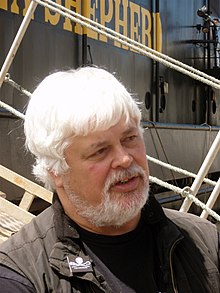
PAUL WATSON

We also discuss his relationship with another ocean defender, Captain Paul Watson of the Sea Shepherd Society. Watson is currently a wanted man, living on one of his ships in an undisclosed location. Costa Rica issues an international arrest warrant, claiming Watson had endangered a fishing vessel that was finning sharks, part of the research done for Stewart's film. German acted on that warrant, even though it is doubtful Watson would receive a fair trial in Costa Rica, and despite widespread German support for his actions to save marine species.

Paul Watson skipped out on a $300,000 bail bond, and went out into international waters, in the open sea.

MONEY DISAPPEARS IF YOU SEEM TO "RADICAL"

Even though "Sharkwater" was phenomenally successful, Stewart still had trouble financing the movie "Revolution".

Rob was painted green for Fill the Hill C-Day for Powershift in Ottawa Canada in 2009, just prior to the Copenhagen talks. Suddenly his funding promises dropped from 5 million dollars (he planned a 3-D underwater spectacular) to just $150,000. Rob packed his bags and cameras and went out on his own to film.

We learn Stewart has just published a book as well. It's called "Save the Humans". The book takes us into the back story of making both Sharkwater and Revolution, being partly biographic.

As Stewart works insane hours getting his message out, traveling the world, he has started a new environment group, the United Conservationists.

You can find the film web site at therevolutionmovie.com

I loved the movie. It's deep and necessary. I hope it storms the world.

LESTER BROWN - FULL PLANET EMPTY PLATES

Lester Brown is one of the world's treasures and truth-tellers. Decades ago he founded the World Watch Institute, which issued comprehensive annual State of the World reports.

One of Lester's specialties has always been monitoring world food supplies, crop production, and the growing catalog of threats to the global food supply. He went on to found the Earth Policy Institute.

On September 27th, Brown held a briefing for world media about our current situation, and his new book "Full Planet, Empty Plates, the New Geopolitics of Food Scarcity." I recorded it, and got permission to broadcast it to you.

Our situation is not good. The world's largest food exporter, the United States, has just gone through a record drought (which still continues into October). Crop production is down, and world food reserves are far below what they should be.

Food prices, especially for grains, have risen around the world. Usually when that happens, there is political instability as well.

In North America and Europe, the consequences are not so grave. We spend much less of our total income on food, and most of the cost of food is actually in processing.

In the developing world, more than a hundred million people actually schedule "foodless days" (you can call it a "fast" is you want) because there isn't enough for the table. In parts of Asia and Africa, at least 75% of all income goes directly for that day's food. There isn't any room for price increases.

Lester Brown goes on to catalog the many challenges we face in trying to feed 80 million more people every year. For example, many countries are already over pumping their aquifers. They have to go deeper and deeper, burning expensive diesel fuel for pumps. Some wells are going dry, and some rivers are going dry.

Add in climate change, with missed monsoons, droughts, storms wiping out crops, and you see the potential for a very unstable world.

This press briefing is loaded with facts mainstream media doesn't bother to tell you. Don't miss it.

There are lots of links and related downloads there, including the complete set of data sets.

WES REGAN - URBAN FARMING IN CANADA'S POOREST NEIGHBORHOOD

Find a bio of Wes Regan here.

There are mysterious gardens appearing in Canada's poorest urban neighborhood - Vancouver's downtown East Side. And why is a business group pushing local food?

Some Downtown East side residents have seen their share of problems. Along with the newly arriving condo owners, there is a mix of alcoholics, drug addicts, the disabled, the unemployed, and people who have been disadvantaged or abused. Some are First Nations.

Our guest is Wes Regan, Executive Coordinator of the Hastings Crossing Business Improvement Association in Vancouver, Canada. Wes toured internationally as an actor and musician, before becoming an urban geographer. He's a founding member of the Vancouver Urban Farming Network, and the Urban Aqua-Farm Society.

We start with a little patch of vacant land in an area known for poverty and drug abuse. Squeezed between two old buildings, this lot on Hastings Street in Vancouver's Downtown East Side used to be covered in garbage. Now it's covered with food. It is a new urban garden.

Too often, we think of business being hostile to green initiatives. But Regan coordinates the local Business Improvement Association. It is an unlikely marriage, but works well when progressive business is involved.

Wes tells us about the Vancouver Urban Farming Society, and Sole food farm.

This is community supported agriculture, the CSA model. But there is a new wrinkle: people can pick the amount of food they need that week. That works especially well for the poorest people, many of whom live in government-subsidized rooming houses with no kitchens.

Some of the workers in these gardens earn a little money, even though they could likely not hold a 9 to 5 job. It's an important green job supplement. Other gardens have been set up specifically to help recovering people heal. There is much more to these urban farms than just the economics and production.

Wes Regan is also part of the Urban Aqua-Farm Society. Are there really aquaculture operations in the city of Vancouver? No large ones yet. There are some experimental ponds and barrels.

Urban farming tends to focus on raising greens and other veggies. But if we want true self-sufficiency, we need proteins as well. Some of that can come from beans, but raising fish or other marine life in our cities could fill the protein gap.

Many of us picture urban farming as a pass-time for yuppies, people with money. We talk about urban farming as part of the solution to poverty. It is working in Detroit and many other U.S. cities as well, where empty housing was bull-dozed, and tractors are now at work.

Don't hungry people, drunks, or vandals just steal the food or wreck the gardens? Wes can't recall any such incident of vandalism. It seems just trying to cope with extreme poverty, the area has built up its own community rules and spirit. People support these gardens, and other guerilla planting.

Vancouver Mayor Gregor Robertson and his Council are supportive. They want to make Vancouver the "greenest city in the world". How could we make the same case to less sympathetic municipal governments? Wes says a straight case of economics can be made, and explains how.

Regan co-authored the 2010 report "Advancing Urban Farming in Vancouver" which you can find here.

------------------- That's it for Radio Ecoshock this week. Find us on Facebook and you can share each and every program with your friends. We need to get the word out fast to save what is left of the natural system. You can help. Feel free to download our show from the web site ecoshock.org Pass them around as mp3's or CDs.

I'm Alex Smith. I appreciate the helpful emails, tips, and links sent in by listeners. Just click on the "Contact" button on our web page to send your message. Thank you for listening and caring about our world.

Tuesday, January 31, 2012

Forever Planting (for Peak Oil & Climate Change)

We depend utterly on fossil fuels, especially to grow our food. From natural gas comes the millions of tons of fertilizers. Oil provides herbicides and pesticides. All is planted and harvested with oil power, driven, shipped or flown to your table.

For now. Until fossil fuels become too expensive, too rare, too polluting to use. We only have a short time to find other ways.

Wes Jackson offers some answers, for our food supply during peak oil and climate change. Raised on a Kansas farm, Jackson is a biologist, a geneticist, and botanist. In 1976 he left university life to found "The Land Institute", which he still heads. He's going to explain "natural systems agriculture", in a powerful speech given to the Association for the Study of Peak Oil USA. Recorded in Washington D.C. November 4, 2011 by Gerri Williams for Radio Ecoshock.

Then we'll hear a different assessment of the potential for sequestering carbon in the soil, and biochar, from carbon cycle expert Dr. Michael Raupach of the Australian national science agency, CSIRO.

This Radio Ecoshock program is part of our "Big Picture" solutions series.

Wednesday, November 30, 2011

CLIMATE SOLUTION: FROM AIR TO SOIL


READ THE NEW ALEX SMITH INTERVIEW IN GRIST MAGAZINE.

Please pass that link, or this short link http://bit.ly/rxc5lj to all your email contacts, or post it in blogs. Add it to comment sections. Help get the word out, so we can get more listeners and more stations. Radio Ecoshock is broadcast on over 50 stations now. I'm working on extending it further, with more news in coming weeks. If you pass around this Grist interview you can really help!

THIS WEEK'S PROGRAM: CLIMATE SOLUTION: FROM AIR TO SOIL

No this isn't another Radio Ecoshock program of doom! Instead, we are going to look at one of several large-scale solutions available. This new/old technology can grab carbon out of the air, and store it back in the soil.

Short Description:

"Desperately looking for a clean way to remove dangerous carbon from the atmosphere, Alex interviews Allan Savory of the Savory Institute. His project to capture carbon into the soil, using intelligent herd management in Zimbabwe, is on the short-list for the Virgin Earth Challenge. We follow up with Abe Collins, a carbon farming leader in Vermont, USA. Plus organizing for local food in North Carolina (even in hard times) - Aaron Newton at ASPO 2011. "

More detail, starting with ALLAN SAVORY AND THE SAVORY INSTITUTE

In 2007, billionaire Richard Branson announced the Virgin Earth Challenge. He offered a 25 million dollar prize to the best method to remove greenhouse gases from the atmosphere, with no harmful impacts. Out of 2600 submissions, Allan Savory and the Savory Institute survived to the current short-list of 11 technolgies to do it.

We talk with Allan Savory, the 76 year old pioneer biologist and agriculturalist from Zimbabwe.

Savory is an fascinating interview. He also won the 2010 Buckminster Fuller Challenge, for a world-changing technology.

Plus, futurist Seth Itzkan (who went to Zimbabwe to see for his own eyes) tells me old Allan went out into the African night with a large rifle, to protect the camp from a pride of lions that had taken a big cow the night previous. That's character.

Seth's Africa blog here.

Wanna know what it's like to sit out in lion country without a gun? Check out this short video with Seth and "Knowledge the lion chaser."

Yet, as you hear in this interview, Savory absolutely insists we need all the predators, from lions through hyenas to wild dogs.

The behavior of herd animals changes when predators exist. The herd bunches up, fertilizes the ground and works it in with their hooves, and then move on in a tigher group. This benefits the land, as Savory shows repeatedly on his large experimental farm in Zimbabwe, near Victoria Falls. The vegetation roars back, where neighboring lands experience hard packed soil and desertification. Even the ground water comes back, with year-round ponds appearing. His knowledge could literally transform the landscape of the world, if applied.

Forget what you know about animals and land management. Desertification is not what you think. A very old relationship between animals and grass lands could reverse the damage.

It may even be a mega-solution for climate change. In a classic interview, I talk with a world-recognized pioneer in natural land management, Allan Savory, founder of the Savory Institute.

Allan Savory was born into white-ruled Rhodesia. He became a biologist, a game manager, a member of Parliament. Savory resigned and went into exile over the racist policies of that government. Now the country is called Zimbabwe, and Savory has returned often, to teach and to test his methods of restoring water, life, and carbon to the land.

His best known book is "Holistic Management: A New Decision Making Framework" written with his wife Jody Butterfield.


In 2003, Savory won the Banksia International Award, quote "to recognise extraordinary individuals or organisations that have made, or are making a significant contribution to improving our environment on a global level."

Allan Savory & the Africa Centre for Holistic Management was the 2010 Buckminster Fuller Challenge Winner. "Operation Hope" showed a way for permanent water and food security for millions of Africa's poor.

In November 2011, Allan Savory topped over 2500 others to place in the top 11 finalists in the Virgin Earth Challenge. His project not only reverses desertification, but offers a global technique to removed vast amounts of carbon dioxide out of the atmosphere. It may be a low-tech way to stop runaway climate change.

Here is the Savory Institute You tube channel.

But if you read or look at only one thing about Savory's plan for the soil and the climate, this short paper is it. "A Global Strategy for Addressing Global Climate Change" It opened my eyes.

In 2007, I spoke with Peter Donovan, the publisher of a book by the Australian author Allan J. Yeomans. That book is "Priority One, Together We Can Beat Global Warming." Peter Donovan is now on a road tour promoting the Soil Carbon Challenge. The idea is to get farmers to measure their current carbon in the soil, so they can know what works to capture and keep more of it.

Then I got an email from a remote outpost in Zimbabwe, in lion country. It's amazing to connect with someone so far back in the bush. That's the new world we live in.

It was none other than Massachussetts futurist Seth Itzkan. Seth is and analyst and advocate for sustainable economic development. He's the CEO & Founder Planet-TECH
Associates. Itzkan went to Zimbabwe to see Savory's claims with his own eyes.
Seth was amazed by what he found. As claimed new water sources were appearing where the Savory management technique was used. Properly managed land was rich with
vegetation, in an area generally blighted by on-going encourachment by the desert. Hard, hard soil with a few scrubby bushes can be converted back to moist rich grasslands by natural herd management. Savory mimiced nature to recapture the land, and the carbon from the sky. It works.

SURE, I HAVE QUESTIONS ABOUT THIS...

The limitations to this technique are several. The main problem: humans need to change their conceptions of agriculture, their opposition to herd management, and the inate social demand to rid the planet of dangerous animals. And we'd have to re-educate millions of poor farmers. I'll consult a leading climate expert on the role of soil carbon in a coming program.

I have to overcome personal resistance too. I've been taught, as millions have, that over-grazing by animals is turning the world into deserts. Now we learn that is due to our unnatural way of raising animals, and killing off predators and the wild spaces they require.

Personally, I'm trying hard to become a vegetarian. North American meat is poisoned with anti-biotics and other chemicals. Red meat is know to raise cancer risks, especially of the bowels. The feed-lot meat production chain is just a giant prison for animals and their suffering.

But that is not at all what Allan Savory, and our next guest, are promoting. Their solution to climate change does involve animals, and meat eating - but it is the most Nature-based geoengineering plan out there.

Here is what these new agriculturalists are telling us: we don't need to darken the Sun. We need to manage grasslands, to use cover crops when growing grains and vegetables, and we need the help of animals and their predators to restore the carbon cycle.

My thanks to Karl Thidemann for pushing me to learn about Savory and soil. Karl's been gently emailing me for years, telling me to look into it. It only took four or five years Karl! I just wasn't ready, or I'm a slow learner.

I'm just glad we got Allan Savory on the air on Radio Ecoshock. You can download or listen to that 24 minute Allan Savory interview here.

I should just add the importance of grass fires when it comes to climate change. In the interview, Savory clearly explains how damaging slash and burn agriculture is. All over Africa, and all over the world, subsistence farmers burn the fields over to clear them. This releases more carbon than millions of cars. Some of it is recaptured by new growth, but the overall
impact of the black carbon, and the burst of carbon during fire season, further damages both the climate and the soil. I haven't said it as well as Allan does. Please listen to the interview.

PRACTICING CARBON FARMING IN VERMONT - ABE COLLINS

Then to Abe Collins, a farmer in St. Albans, Vermont. He uses methods to capture carbon with agriculture. Collins started out working with the Navajo in Arizona, applying techniques learned from Allan Savory, to reverse the deterioration of Navajo land. They all learned together how to use animals to reclaim desert land, rather than creating more of it.

Collins returned to Vermont, and converted a former dairy farm to a beef operation. He measures soil depth, and carbon content, to see improvements as they develop.

It takes nature about one thousand years to create an inch of soil. The modern farmers hope to do it a lot faster, without using a lot of fossil fuels.

The extra soil also helps with flood control. Vermont surely needed that, when tropical storm Irene flooded towns and wiped out roads. We discuss how proper soil managment can help with extreme rainfall events accompanying climate change.

We also talk about the "Keyline" system developed by P.A. Yeomans in Australia. His son, Allan Yoemans published a book in 2007 on ways to save the climate using agriculture. It's called "Priority One". You can order the book, or download it from this site.


Collins was part of a crew, including Peter Donovan, who attempted to get "carbon farming" recognized in the New England carbon trading scheme. Why pay big companies to off-set emissions, or even worse, fake green geoengineering, when farmers can capture carbon - AND feed us sustainably?

At the end of October 2011, Abe Collins kicked off "the Soil Carbon Challenge" in Vermont. Video here.

Or check out this: Part One of a five part You tube presentation by Abe Collins: "Presentations from the Quivira Coalition's 9th Annual Conference, November 10-12, 2010, in Albuquerque, NM "The Carbon Ranch: Using Food and Stewardship to Build Soil and Fight Climate Change". The rest of the talk will pop up on the right side of the You tube screen.

To keep up with the whole discussion of carbon farming, Abe recommends this site: managingwholes.com

Download the Abe Collins interview (17 minutes) here.

A MODEL FOR LOCALIZING FOOD, AARON NEWTON FROM NORTH CAROLINA

The program wraps up with a new presentation from the Association for the Study of Peak Oil and Gas conference in Washington D.C. in November 2011.

Aaron Newton is the Local Food System Program Coordinator for Cabarrus County, North Carolina. He tells us how to develop your local food-shed, even in hard times. And why the most important crop may be... new farmers.

It's a really helpful short presentation from Aaron. The ways the County used the tax structure to both keep farmers, and to fund community organizing around local food. Lots of good tips for localizing your own community. The Newton talk is dead-on for how to create a local food-shed getting ready for Peak Oil.

Our D.C. correspondent Gerri Williams was at the ASPO conference, and sends this recording. My thanks to ASPO USA for sharing the audio, and for getting localization on the Peak Oil menu.

Listen to/download the Radio Ecoshock broadcast of Aaron Newton at ASPO 2011 here.

------------------

We'll be doing a second show on sequestering carbon in the soil in two weeks time. Next week, we look into a different sort of growing: winter gardening (and why extreme climate change may make you do it...)

Alex
Radio Ecoshock
http://www.ecoshock.org