Showing posts with label poverty. Show all posts

Wednesday, March 23, 2016

HEAT JOLT

SUMMARY: Global heat Jan & Feb hits hard, worries scientists. Bob Henson from Weather Underground explores the loss of normal. Australian scientist Ben Hankamer on new study: world will warm faster than you think. Radio Ecoshock 160323

The jolt. That's what scientists are calling the absolute heat records set around the world in January and February of 2016. Expert meteorologist and climate science writer Bob Henson takes us on a tour of the new normal.

But hang around too for our second interview, with Australian scientist Ben Hankamer. He's co-author of a new peer-reviewed paper that says warming will happen much faster than you think.

Hankamer tells us:

"If what the models suggest are correct, then by 2020 we might have to have about emissions reductions of 50% if we want to stay below a 1.5 degree climate change level. And if we want to stay below 2 [deg C] it might be 50% by 2030. And it really depends if you want to go with this pro-growth strategy or whether you want to carry on with business as usual... Of course you can say 'we're not going to do that' but then you have to also make the assumption that you will keep people in poverty."

A fifty percent cut in emissions needed by 2020! That's a call for crisis-level action. Sure, we can continue to splurge on fossil fuels in the developed world, but keep in mind (a) we need almost half the world's population to keep living in desperate poverty (less than $2.50, a day) and (b) we accept a rapid transition to a ruined state of nature for all coming generations.

That's coming up in our second half hour. First, let's get past the weather porn, to explore another step up the staircase to climate catastrophe.

Download or listen to this Radio Ecoshock show in CD Quality (56 MB) or Lo-Fi (14 MB)

Or listen on Soundcloud right now.


THE NEW HEAT JOLT - WHAT DOES IT MEAN? BOB HENSON

"February Smashes Earth's All-Time Global Heat Record by a Jaw-Dropping Margin" That's the headline at wunderground, the influential Weather Underground blog. What does it mean? Is the new carbon-loaded atmosphere stretching it's muscles? Is this the new normal, or the end of normal?

Joining us to talk about all this is a seasoned meteorologist, journalist, and one-time storm chaser, Colorado's Bob Henson. Bob co-wrote one of the most widely used college textbooks on weather, "Meteorology Today" - now out in it's 11th edition this year. For more than a decade Bob had a front row seat as writer and editor for AtmosNews, from the National Center for Atmospheric Research. His articles are published all over the world, and his latest book is "The Thinking Person's Guide to Climate Change." Bob often teams up with Wunderground's Jeff Masters to bring out all the facts and figures about the strange changes we see today.


Bob Henson, Weather Underground

Let's be clear, we are talking about a global average temperature that in February almost reaches the 1.5 degrees C the supposed "safe" level raised at the Paris climate talks in December. Not in 2100, or 2050, but almost right now. NASA released their report forFebruary temperatures - the world is 1.35 degrees C above the baseline, which they choose as the period from 1951 to 1980.

But that's a recent baseline that minimizes real warming! There was at least a half degree warming from pre-industrial levels (say 1850). So we are already above the 1.5 deg temps agreed as really safe at the Paris climate talks.

Even taking the low-ball NASA starting point, as the Guardian newspaper reports, global temperatures in February 2016 broke all records not a little but, but by "a shocking amount".

The only good news is that we still have the rest of the year to go, which might cool down. Experts think the current El Nino is winding down over the next few months. For all we know, 2017 might be a La Nina year, and cooler. Henson says it takes a few years steady at 1.5 or 2 degrees above pre-industrial levels to qualify as permanent warming. He thinks we are several decades away from that point. I disagree.

It's also important to note that CO2 levels, as measured at the Mauna Loa lab in Hawaii, go up during an El Nino year, and never come back down. The reasons for that are complex. For example, drought during El Nino, coupled with climate-driven heat, causes more forest fires, which releases more CO2 into the atmosphere.

But the essential point is we are now well over 400 parts per million CO2, and much higher if we count the more realistic CO2 equivalent (which includes ever-increasing methane, plus rarer but more powerful greenhouse gases).

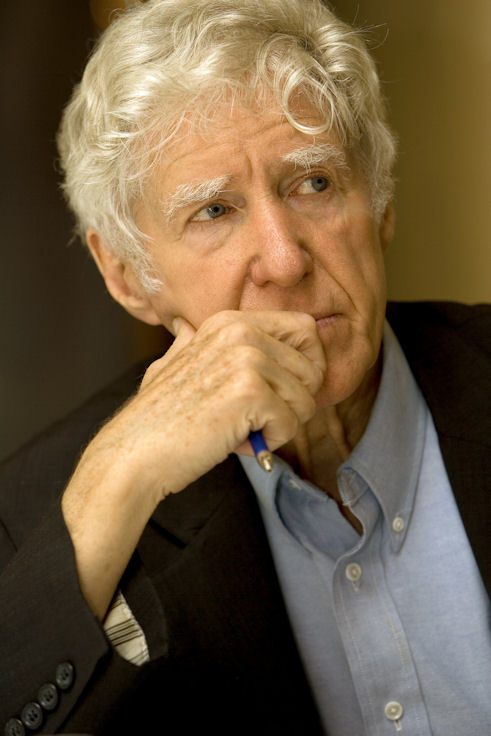
I remember the late Dr. Albert A. Bartlett of Colorado spent a lifetime teaching how important and threatening exponential math can be. That's where we get an increase on the increase. Is that happening now with greenhouse gas emissions? Sort of. Henson tells us CO2 was going up about 1 part per million a year during the 1960's. It became 2 parts per million annually during the early 2000's, and since 2015 has been hitting 3 parts per million increase. So yes, that is exponential, and ever-more dangerous.

Here's one of my worries. Every time the Earth takes another jump in temperature, a great number of irreversible feed-backs get a push. So we might be going up a stair-case, step-by-step, which only goes up. For example, what is the condition of the Arctic sea ice this winter? Yes, it is the lowest on record for February. The extent is low, and the ice is thin.

However, that does not necessarily mean we will hit a new record low sea ice level in the Arctic this summer, Henson says. The main factor that can break that record is whether it is cloudy in the Arctic during the key months of June and July, when the polar sun is strongest, or wide open and sunny. So we'll have to wait and see.

It's been just plain weird in the Arctic. It rained at the Pole in the December darkness, and there's been a lot of open ocean north of Scandinavia. Henson tells us about conditions around Svalbard for example. North of Norway, where the ice should be surrounding Svalbard, it the sea is open. And that northernmost city in the world (at 78 degrees latitude) has been strangely warm. Some days it was 20 to 40 degrees Fahrenheit warmer than usual. That's a huge jump!

Mark Sereze of the U.S. National Snow and Ice Data Center says this past winter is the strangest he's ever seen in the Arctic. For example, Anchorage Alaska had the warmest weather ever, with the least snow ever.

DID EL NINO BREAK THE CALIFORNIA DROUGHT? YES AND NO.

Did this El Nino manage to break the long California drought, as advertised? It did not go as expected. The big deluges from El Nino tracked hundreds of miles north of California, hitting Oregon and Washington State. At least there has been some snow in California mountains, which should ease water supplies somewhat. Water supplies for Sacramento and San Francisco have half recovered.

But it's an "ominous sign" Henson says, that this El Nino did not fully break the California drought this year. That's partly because projections are for the U.S. Southwest states, including California and Arizona, to get drier and drier as this century rolls on.

HEAT RECORD IN LOWER ATMOSPHERE

We've talked about heat records set on land. But it's not just there. Dr. Roy Spencer at the University of Alabama in Huntsville has persistently talked down the threats of global warming. He often interprets satellite data to find the lowest estimates. But even he reports the lower atmosphere is hotter than ever.

SEVERE IMPACTS ALREADY THIS YEAR

As Bob and Jeff Masters picture in their blog, there have been severe impacts of this combined El Nino and a jolt in climate-induced heating. Extreme drought has cost Vietnam and Zimbabwe at least 10% of their Gross Domestic Product. That has not been reported in mainstream news at all. We did hear about the strongest typhoon ever recorded hitting the Pacific island of Fiji. That country has continued it's state of emergency for another month, as thousands of people remain in temporary shelters. Their homes and businesses were demolished.

As Henson blogs: "For comparison, nine nations had their most expensive weather-related natural disasters in history in all of 2015, and only one did so in 2014."

Henson tells us scientists predict with the warming of the Pacific Ocean, there is a better chance we will get more El Nino heat years in the coming decades. You can guess what that means, from what happened this year. Our guest predicts we will see dramatic rises in temperatures, and surprising extreme weather, in this coming decade.

On another front, Australia's Great Barrier Reef Marine Authority has just issued an alert about widespread coral bleaching. Coral guru Thomas J. Goreau has been privately warning this could be another huge coral die-off.

Bob Henson is that rare combination of meteorologist and journalist. He's been published all over the world, but my favorite spot to find him is at the Weather Underground blog, at wunderground.com. His Twitter handle is @bhensonweather.

PROFESSOR STEFAN RAMSTORF - "CLIMATE EMERGENCY"

Professor Stefan Rahmstorf, from Germany's Potsdam Institute of Climate Impact Research, told Australian newspapers "We are in a kind of climate emergency now." In the show, I run a few minutes from a short interview of Stefan Ramsdorf done by by Phil Stubbs of theenvironmentshow.com

FASTER AND SOONER - BEN HANKAMER

Look out. The world may warm much faster than we thought. That could create an energy-squeeze. It's all in new a big-picture study from Australian researchers. Let's peer into a real future, with Professor Ben Hankamer from the Institute for Molecular Bioscience at the University of Queensland, near Brisbane Australia.


Dr. Ben Hankamer

Now we know the choices. Let half the world's people live in poverty, and keep up our energy-intensive lifestyles for an extra ten years. Then we all struggle to survive with rising seas, heat waves, drought, fires, and weather so unstable crops and species are doubtful. OR the world's leaders and people somehow wake up from the fog, to begin the war on carbon emissions, to make the transition to a low-energy, all-renewable world. We have four years to cut our emissions in half. It's beyond the days of worry,now. It's do or die.

The title of this new paper suggests giant topics: "Trading Off Global Fuel Supply, CO2 Emissions and Sustainable Development". It was published in the open access journal PLOS one. Anyone can read the full paper, and please do.

In the interview, we look more deeply into this concept of personal energy use. Here in North America, we like to think personal energy use is going down, as cars become more fuel efficient, bike use increases, and things like LED light bulbs slash utility bills. Is that assumption wrong? Yes and no. It's true many appliances, cars and stuff are becoming more energy efficient. But it appear we are using the saved money to buy still more appliances, cars and stuff.

One of the paper authors, Dr. Wagner says "“Simply put, as we get more efficient at manufacturing, goods get cheaper and we buy more." That sounds to me like a restatement of the classic Jevons Paradox, which was originally applied to coal. So it's still true.

I'm also assuming that a huge portion of demand for personal energy use will come as billions of people in the "developing world" get motorbikes, electric appliances and all the things we take for granted.

So here is one thing new in this study: previous studies did not include the relationships between energy use, climate and poverty. Add in population, and the amount of carbon left to safely burn takes a nose-dive. In my opinion, we don't have much of a chance of staying below 2 degrees C warming in the next 20 years. So buckle up your seat belts for world-changing extreme weather, and the relentless rise of the seas.

But Ben Hankamer is much more positive. He thinks there is plenty of solar energy to power the world. If global leadership recognizes the crisis in time, and organizes us all to act, maybe we can pull out before a real climate catastrophe is inevitable.

Again, most of our fossil fuel use is in liquid form, especially for transportation, I wonder how much renewable energy can really replace that? That is exactly the question being investigated at the Solar Biofuels Research Centre in Queensland Australia. It's co-ordinated by the University of Queensland, with major corporate partners. They are testing algae that grows in the sun, which can then be converted to a number or widely recognized liquid fuels.

Large-scale projections by necessity assume a future economy similar to what we have now. But I worry that the economy will slide into a Depression, where wealth shrinks instead of grows. That may come from unsustainable debt levels, and all countries will be buffetted by increasing costs of replacing infrastructure and crops damaged by an unstable climate. Most studies do not include that possibility.

THE WORST PREDICTION: ALMOST 4 DEGREES OF WARMING (OR MORE!) BY 2026

The most dire prediction comes from Sam Carana.

The post in Arctic News is not a scientific paper, but a blog with some scientific contributors. This blog is sometimes too extreme, and sometimes spot on. I don't have the expertise to say what is right or wrong with Sam's calculation of 3.9 degrees C warming by 2026, shown in the graphic, part way down in this post. Sam Carana draws on a number of warming factors which I've seen listed separately in scientific papers, but which are too seldom brought together. I ask our guest Ben Hankamer if he thinks a warming of 3.9 degrees C by 2026 is possible. Ben says it could be possible!


Graphic by Sam Carana of Arctic News blog.

And that is Carana's low end number. His worst case scenario is so bad we can hardly conceive of it.

Mind you, one of the original climate change scientists, Dr. James Hansen, has just released a paper with a gang of other scientists warning that heating is coming, and seas rising, faster than anyone thought possible!

THANKS!

I'm Alex Smith. My thanks to everyone who has helped get this radio message out through social media, and especially the non-profit radio stations who tell the truth.

I also want to shout out my thanks to the supporters who donate $10 a month to keep this program going. You really do make it possible for me to continue doing these key interviews, and getting it out to a global audience.

And thank you for listening.

Monday, October 8, 2012

FOOD AND REVOLUTION

Three guests. Rob Stewart, Director of movie "Sharkwater" and now his latest "Revolution" - is the ocean dying? An international media briefing by Lester Brown of Earth Policy Institute about rising food prices & his new book "Full Planet, Empty Plates". Wes Regan on urban farming in the poorest neighborhood in Canada. Radio Ecoshock 121010

Download/listen to this Radio Ecoshock show in CD quality 56 MB.

Download/listen to this Radio Ecoshock show in Lo-Fi 14 MB. Coming up this week: an interview with Rob Stewart, Director of movie "Sharkwater" and now his latest "Revolution" - is the ocean dying? What can we do?

You can see food prices going up. It's happening around the world, stressing budgets and leading to foodless days for millions of the world's poor. You'll find out why in an international media briefing by Lester Brown of Earth Policy Institute about rising food prices & his new book "Full Planet, Empty Plates". Only on Radio Ecoshock.

We finish up with as Wes Regan of Vancouver tells us about urban farming in the poorest neighborhood in Canada.

ROB STEWART'S REVOLUTION

Rob Stewart blew into world consciousness with his award-winning indie film "Sharkwater". Sharkwater was one of the biggest selling Canadian films ever. It ricocheted all around the world. We start with the latest developments in saving the sharks.

As a result of that movie, and Stewart's unrelenting campaign, over a hundred countries and many more cities have banned shark fin soup - the alleged delicacy wiping out the ocean's top predator. Shark fin soup is banned at all Chinese government functions.

Now Stewart is back for a much bigger fight, the fight of our lives: how to steer a death-wish civilization in a better direction. His new movie, four years in the making, was released at the Toronto International Film Festival and again at the Vancouver Film Festival. It's called "Revolution".

The film has experts saying coral reefs could be mostly dead in 40 years or less. I've just seen a You tube lecture by Professor Alexander Tudhope, a geoscientist and climatologist from the University of Edinburgh. He seemed less certain of the coral fate, suggesting they could die off, but it's still possible they may adapt enough to survive.

Stewart cites Charlie Veron, aka John Veron, a heavily awarded Australian scientist who warns on current path, the Great Barrier Reef will be dead in 20 years... and Katharina Fabricius, lead scientist at the Australian Institute of Marine Sciences.

These scientists are also part of the "Coral Triangle Initiative"

WHY SAVE SHARKS IF THE OCEAN IS DYING?

A key moment in the movie is when Stewart should have been celebrating his moment of triumph. Sharkwater was finally being showed in China, in Hong Kong, where shark fin soup is served. Its possible 100 million Chinese people will see it. But an audience question stumped him, almost invaliding his years of work: why struggle to save the sharks, if scientists say most big fish in the world could become extinct as early as 2048.

That extraordinary prediction is published science coming from a team led by Dr. Boris Worms at Dalhousie University in Eastern Canada. Radio Ecoshock covered that in 2006. Find my blog and the audio here.

Outfield Productions from Pakistan turned it into a You tube video found here.

Stewart was tossed into the much larger problems which threaten the world's oceans. The largest of all, not just for the great coral reefs (nurseries of the sea), but for all creatures which form either shells or skeletons, is ocean acidification. He sets out on a journey to find out more.

The need for "revolution" comes from the inability of world governments to do anything at all to save the oceans. Only a major change to the system, Stewart concludes, can save the oceans, and us. The only group he can find that isn't invested in the present system is youth and children. They are the best hope.

There is a hugely moving scene with Felix Finkbeiner, age 13, founder of the group Plant for the Planet. Finkbeiner is organizing youth to plant hundreds of millions of trees.

In some ways Stewart needed the same underground film techniques so successful in "Sharkwater". Why do we still need to slink around without permits, to document the greatest threat to humanity and all species?

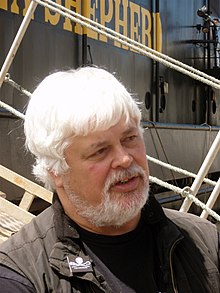
PAUL WATSON

We also discuss his relationship with another ocean defender, Captain Paul Watson of the Sea Shepherd Society. Watson is currently a wanted man, living on one of his ships in an undisclosed location. Costa Rica issues an international arrest warrant, claiming Watson had endangered a fishing vessel that was finning sharks, part of the research done for Stewart's film. German acted on that warrant, even though it is doubtful Watson would receive a fair trial in Costa Rica, and despite widespread German support for his actions to save marine species.

Paul Watson skipped out on a $300,000 bail bond, and went out into international waters, in the open sea.

MONEY DISAPPEARS IF YOU SEEM TO "RADICAL"

Even though "Sharkwater" was phenomenally successful, Stewart still had trouble financing the movie "Revolution".

Rob was painted green for Fill the Hill C-Day for Powershift in Ottawa Canada in 2009, just prior to the Copenhagen talks. Suddenly his funding promises dropped from 5 million dollars (he planned a 3-D underwater spectacular) to just $150,000. Rob packed his bags and cameras and went out on his own to film.

We learn Stewart has just published a book as well. It's called "Save the Humans". The book takes us into the back story of making both Sharkwater and Revolution, being partly biographic.

As Stewart works insane hours getting his message out, traveling the world, he has started a new environment group, the United Conservationists.

You can find the film web site at therevolutionmovie.com

I loved the movie. It's deep and necessary. I hope it storms the world.

LESTER BROWN - FULL PLANET EMPTY PLATES

Lester Brown is one of the world's treasures and truth-tellers. Decades ago he founded the World Watch Institute, which issued comprehensive annual State of the World reports.

One of Lester's specialties has always been monitoring world food supplies, crop production, and the growing catalog of threats to the global food supply. He went on to found the Earth Policy Institute.

On September 27th, Brown held a briefing for world media about our current situation, and his new book "Full Planet, Empty Plates, the New Geopolitics of Food Scarcity." I recorded it, and got permission to broadcast it to you.

Our situation is not good. The world's largest food exporter, the United States, has just gone through a record drought (which still continues into October). Crop production is down, and world food reserves are far below what they should be.

Food prices, especially for grains, have risen around the world. Usually when that happens, there is political instability as well.

In North America and Europe, the consequences are not so grave. We spend much less of our total income on food, and most of the cost of food is actually in processing.

In the developing world, more than a hundred million people actually schedule "foodless days" (you can call it a "fast" is you want) because there isn't enough for the table. In parts of Asia and Africa, at least 75% of all income goes directly for that day's food. There isn't any room for price increases.

Lester Brown goes on to catalog the many challenges we face in trying to feed 80 million more people every year. For example, many countries are already over pumping their aquifers. They have to go deeper and deeper, burning expensive diesel fuel for pumps. Some wells are going dry, and some rivers are going dry.

Add in climate change, with missed monsoons, droughts, storms wiping out crops, and you see the potential for a very unstable world.

This press briefing is loaded with facts mainstream media doesn't bother to tell you. Don't miss it.

There are lots of links and related downloads there, including the complete set of data sets.

WES REGAN - URBAN FARMING IN CANADA'S POOREST NEIGHBORHOOD

Find a bio of Wes Regan here.

There are mysterious gardens appearing in Canada's poorest urban neighborhood - Vancouver's downtown East Side. And why is a business group pushing local food?

Some Downtown East side residents have seen their share of problems. Along with the newly arriving condo owners, there is a mix of alcoholics, drug addicts, the disabled, the unemployed, and people who have been disadvantaged or abused. Some are First Nations.

Our guest is Wes Regan, Executive Coordinator of the Hastings Crossing Business Improvement Association in Vancouver, Canada. Wes toured internationally as an actor and musician, before becoming an urban geographer. He's a founding member of the Vancouver Urban Farming Network, and the Urban Aqua-Farm Society.

We start with a little patch of vacant land in an area known for poverty and drug abuse. Squeezed between two old buildings, this lot on Hastings Street in Vancouver's Downtown East Side used to be covered in garbage. Now it's covered with food. It is a new urban garden.

Too often, we think of business being hostile to green initiatives. But Regan coordinates the local Business Improvement Association. It is an unlikely marriage, but works well when progressive business is involved.

Wes tells us about the Vancouver Urban Farming Society, and Sole food farm.

This is community supported agriculture, the CSA model. But there is a new wrinkle: people can pick the amount of food they need that week. That works especially well for the poorest people, many of whom live in government-subsidized rooming houses with no kitchens.

Some of the workers in these gardens earn a little money, even though they could likely not hold a 9 to 5 job. It's an important green job supplement. Other gardens have been set up specifically to help recovering people heal. There is much more to these urban farms than just the economics and production.

Wes Regan is also part of the Urban Aqua-Farm Society. Are there really aquaculture operations in the city of Vancouver? No large ones yet. There are some experimental ponds and barrels.

Urban farming tends to focus on raising greens and other veggies. But if we want true self-sufficiency, we need proteins as well. Some of that can come from beans, but raising fish or other marine life in our cities could fill the protein gap.

Many of us picture urban farming as a pass-time for yuppies, people with money. We talk about urban farming as part of the solution to poverty. It is working in Detroit and many other U.S. cities as well, where empty housing was bull-dozed, and tractors are now at work.

Don't hungry people, drunks, or vandals just steal the food or wreck the gardens? Wes can't recall any such incident of vandalism. It seems just trying to cope with extreme poverty, the area has built up its own community rules and spirit. People support these gardens, and other guerilla planting.

Vancouver Mayor Gregor Robertson and his Council are supportive. They want to make Vancouver the "greenest city in the world". How could we make the same case to less sympathetic municipal governments? Wes says a straight case of economics can be made, and explains how.

Regan co-authored the 2010 report "Advancing Urban Farming in Vancouver" which you can find here.

------------------- That's it for Radio Ecoshock this week. Find us on Facebook and you can share each and every program with your friends. We need to get the word out fast to save what is left of the natural system. You can help. Feel free to download our show from the web site ecoshock.org Pass them around as mp3's or CDs.

I'm Alex Smith. I appreciate the helpful emails, tips, and links sent in by listeners. Just click on the "Contact" button on our web page to send your message. Thank you for listening and caring about our world.

Thursday, November 11, 2010

The Trouble with Billionaires

Welcome to Radio Ecoshock.

I've got two tasty speeches for you: why the billionaires are taking over, and what we can do about it.

A quick note on this week's program. More than half of Radio Ecoshock listeners are American. Although we do have people grabbing the podcast from all over the English-speaking world, and beyond.

Our topic this week: a new book ""The Trouble with Billionaires, Why Too Much Money at the Top Is Bad for Everyone." You'll hear directly from the authors, tax Professor Neil Brooks, and journalist Linda McQuaig.

Some of the following speech is about Canada. But wait! Most of the examples of billionaires, and studies of what people really want, are American. You'll hear plenty about Wall Street, the greedy Hedge Funders, and why Bill Gates doesn't deserve his billions.

That is because many developed nations suffer the same disease: a collection of billionaires have taken over the financial system, the political system, and social discourse via the mainstream media - which is also controlled by billionaires. As we'll hear, it's an unannounced coup. Welcome to the Plutocracy, where Democracy used to be.

You'll also hear how other countries, like Sweden, deal with the same problems, to create a fair society. Horrors!

The event at the Vancouver Public Library November 3rd, 2010 was sponsored by the Canadian Centre for Policy Alternatives. This recording is by Alex Smith of Radio Ecoshock.

The whole event went way beyond what I can broadcast in a one hour show. For the radio program, I've zoomed in on the part of Neil's speech where he outlines the seven premises of the book. Then I've picked out "the best of" from Linda McQuaig's speech. I hope you'll agree I've picked the most important parts of the speech, but if you'd like the whole thing, find it in these two files:

#1 Speech by Neil Brooks with introduction by Seth Klein of the CPPA - 43 minutes, 10 megabytes

#2 Speech by Linda McQuaig, plus their responses to audience questions - 52 minutes, 12 megabytes

Should society be more equal, more fair in the distribution of wealth, created by a civilization in which we, and all of our ancestors, have built? Or should billionaires run the whole show?

Neil Brooks has been teaching tax law at the Osgood Hall school, part of the University of Toronto, for the past 35 years. In the speech, he begins admitting the book is another failure in a long string of failures. Brooks has been trying to get the Canadian government to introduce a more just society by taxing the wealthy more. Instead, the government has reduced taxes on the wealthy, and got rid of the estate tax, otherwise known as the Death Tax, altogether. This favors the concentration of wealth at the top.

Ironically, much of what Brooks teaches enables lawyers to go out and get even more tax breaks for big corporations. Neil says that at least one third of the wealth by the top 1 percent is never taxes or even calculated, as it moves through various loop-holes and off-shore tax havens. His book has a remedy for that.

In the radio segment, Brooks gives a quick overview of the general health of our society since the 1920's. That was the gilded age, when "Robber Barons" were well known. The 1930's Depression, followed by World War II, reduced the overwhelming fortunes of the very rich, and brought about a larger Middle Class. That balance stayed until around 1980's - when the return of Neo-liberalism, Reganism, and the alleged "trickle down effect" got money trickling upwards, and then rushing upward, into the very top one percent of the population. Poverty returned to more people, especially in America.

Actual experience, in North America and in other countries shows that taxing the wealthy less ends up creating a less just, and a poorer society overall. The economy suffers when wealth concentrates. There is much more to it, some of it shocking, but you need to listen to the Radio Program.

The second speaker was co-author Linda McQuaig, the long-time business columnist, author of a string of Canadian best-sellers, and social critic. She questions why Bill Gates, or any billionaire, should have money worth many lifetimes of work by the average person. And why have the rich taken over since the 1980's? Isn't it a coup?

In the radio program, we cut in as McQuaig talks about the former media baron Conrad Black, who once suggested Linda should be, quote, "horsewhipped." Black later hired McQuaig as a financial journalist at his newspaper the National Post. She currently writes for The Toronto Star.

That is the thorn in the side of wealthy, journalist and author Linda McQuaig. She was speaking at the Vancouver Public Library, with tax Professor Neil Brooks to announce her new book "The Trouble with Billionaires, Why Too Much Money at the Top Is Bad for Everyone." McQuaig is feisty, lively, and one of the best informed about the wealthy.

There is much more detail in the book, with names named. I could say the author's suggestions for higher taxes for the rich are spot on, but just a part of the solution. (No, tar and feathering is not the other part...)

Just look at the social disruption caused by Meg Whitman's pouring $143 million of her own money into the election for California Governor. Democracy bought out. Or the multi-billionaire Koch brothers pushing their right-wing agenda, and the Tea Party, in the U.S. While fighting off any action to limit climate disruption. Billionaires are a much great threat than we know. And we don't know, because they control the mass media.

Now, thanks to Neil and Linda, you know. And knowing is half the battle. The other half is to reclaim our Democracy, and social justice.

My thanks to the Canadian Centre for Policy Alternatives, for organizing this event, and allowing me to record it. Find them out more at policyalternatives.ca.

You can download the full speeches by Brooks and McQuaig, plus the Question and Answer period, as free mp3 files. Look for the "Economy" in our Audio on Demand menu, at our web site, ecoshock.org

I'm Alex Smith. Thank you for caring about our world.

RADIO ECOSHOCK

Thursday, February 11, 2010

Buying Into A Dying World

Attics, basements, and garages are loaded with the plunder of past shopping. Some people rent storage lockers just to hold all their extra stuff. Dumps are filling up with brand new items, never used, but tossed out. There's even a TV show called "Hoarders" - a reflection of the national preoccupation. Do all these THINGS really make us happier?

In this Radio Ecoshock program, we examine the two extremes of consumption: the Americans who use up more of the world's resources than any other people; and the slum dwellers who use practically nothing.

The World Watch Institute has released it's annual report. "State of the World 2010, Transforming Cultures: From Consumerism to Sustainability" is 262 pages of solutions from around the world. You can buy it from worldwatch.org for $19.95 as a paperback, or $9.95 as a downloadable ".pdf" file (requires the free Adobe Reader).

I interview the project director, Erik Assadourian. We start by noting the total disconnect between governments and economists encouraging consumers to get out and buy to save the economy - versus the plain facts that resources are getting harder to find, the forests and land are being devastated, and the atmosphere is damaged by all the useless spending.

Why do we do it? We were raised to shop. Kids grow up with millions, if not billions of ads everywhere we look. Why do we wear corporate logos on our clothes, like walking billboards? Why do we need walk-in cupboards, multiple shoe racks, garages full of big-boy toys seldom used?

Rush Limbaugh nearly had a heart attack when the sacred advertisers were threatened by this rather brave World Watch report. It didn't help when the British Guardian newspaper came out with the headline "US cult of greed is now a global environmental threat, report warns."

The sub-head was "Excessive consumption has spread to developing countries and could wipe out efforts to slow climate change, Worldwatch Institute says."

Assadourian replied, saying the report wasn't trying to blame Americans - who were simply indoctrinated into a culture developed since World War II. The answer isn't blame, but a willing shift, a transformation to a survivable way of life.

Here is the Earthscan blog entry where Assadourian (sort of) agrees with Rush.

In our Radio interview, Erik and I discuss a little of the psychology, and the horrible statistics. But we spend longer looking at key institutions that could help us move away from shop-till-the-planet-drops lifestyles.

These include the greening of world religions, early childhood education (keep those toddlers away from TV!), the way Universities groom us to accept corporate symbols as self expression, the role of media, and so on.

But Worldwatch goes further, with chapters on things like converting agriculture to Permaculture (with Albert Bates), and a lot of other good ideas from all over.

Counter-consumerism hasn't exactly caught on, but there are some examples we can try. Of course, our previous week's guest Keith Farnish says this is all window-dressing for a civilization that has to collapse to save the biosphere. You decide.

Incidentally, Keith's blog entry for February 9th is titled "Monthly Undermining Task, February 2010: Time To Break The Ads." Whether is straight sales, or "green" products, Farnish says it's time to end advertising, before it ends us.

IS IT THEM, OR IS IT US?

Then we look at the other part of the world, the 3 billion people who create hardly any carbon emissions. Most of them live in "illegal settlements", with no government services, no police, no fire, no hospitals, no schools, and little hope.

Except, as our next guest David Satterthwaite tells us, the so-called "slum dwellers" are self-organizing to improve their lot, in many parts of the world.

Dr David Satterthwaite is a senior urban planner for the International Institute for Environment and Development, a non-profit based in the UK. He's traveled to the poorest parts of cities all over the world. He's the editor of the Earthscan Reader in Sustainable Cities, and co-author of many other books, including "Adapting Cities to Climate Change: Understanding and Addressing the Development Challenges."

Satterthwaite has also researched the role of consumerism, in the developed versus developing world. If you were wondering, when it comes to climate change is it "them" (increasing population in the "Third World") or is it "us" (Western-style consumers) - the verdict is in: it us!

Here is a link to a press release from the IIED "Study shatters myth that population growth is a major driver of climate change."

Here are a few factoids from that press release:

"Dr David Satterthwaite of the International Institute for Environment and Development analyzed changes in population and in greenhouse gas emissions for all the world’s countries and found that between 1980 and 2005:

* Sub-Saharan Africa had 18.5% of the world’s population growth and just 2.4% of the growth in carbon dioxide emissions

* The United States had 3.4% of the world’s population growth and 12.6% of the growth in carbon dioxide emissions

* China had 15.3% of the world’s population growth and 44.5% of the growth in carbon dioxide emissions. Population growth rates in China have come down very rapidly – but greenhouse gas emissions have increased very rapidly

* Low-income nations had 52.1% of the world’s population growth and 12.8% of the growth in carbon dioxide emissions

* High-income nations had 7% of the world’s population growth and 29% of the growth in carbon dioxide emissions.

* Most of the nations with the highest population growth rates had low growth rates for carbon dioxide emissions while many of the nations with the lowest population growth rates had high growth rates for carbon dioxide emissions."

Asked about the human failure (so far) to tackle either carbon emissions or urban poverty, Satterthwaite said we have a duty to keep on trying, even when facing apparently hopeless situations. I agree.

WHY ARE GREENS AFRAID TO TACKLE POPULATION?

Almost every question and answer period I record, on climate change, has at least on guy (and it's always a man) who stands up and says (somewhat angrily):

"Why don't the Greens every tackle population growth. That's what is causing climate change. Why are the enviro's always afraid to tackle the real cause of it all?"

Well, angry guy, now you know. That's just a slick denial in the West, to avoid taking responsibility for our own role. Blame the brown person on the other side of the world for our climate-wrecking, planet-draining need to shop.

Or check out this column by the UK journalist George Monbiot, titled "Stop blaming the poor. It's the wally yachters who are burning the planet."

It's the rich bastards that do the most damage, with those multiple monster houses, big SUV's, flying around the world. What about limiting the rich? There's a campaign you won't find in mass media - even if it has to happen.

Alex Smith

Thursday, September 10, 2009

ECOCIDE OR ACTIVISM?

Obviously it's pointless. We are doomed.

Or it that just a frightened voice inside, knowing what we know?

Social failure rears it's ugly head, as half million more Americans, and countless millions more around the world, head home, if they have one. You are no longer valued. Kiss consumerism, and your future plans, good-bye.

That's all good for nature, who needs a break, but still heartless to see it in motion, with real people - people who will work hard, who want a role.

All this breakup of the fraudulent financial system takes place against a backdrop of climate pessimism. The bad news keeps piling up, and you'll hear in a series of interviews coming up on Radio Ecoshock this Fall.

What to do?

After I have my mandatory weekly nervous breakdown - we get a report from Europe, as I chat with UK radio host Phil England. We hear about climate camps in Britain, and around the world. In the U.S., they may be called "convergence camps", and Greenpeace Canada has their own series of actvist training going. These instant meetings, with hundreds of workshops, are popping up all over.

Then, despite my admitted apathy, we wonder whether political negotiators at the Copenhagen climate conference this December - will they really have the guts to do the right thing? Will they set a carbon limit that could preserve the Arctic, for example - or will they hand all the hard work off to the next generation (when it's too late)??

There is one way you and I can push these old-school energy hustlers, so they know we are awake and watching. Bill McKibben is the center of a world-wide day of action, coming up October 24th. You can find out what is going on in your area by going to 350.org. Use that as a tool to wake up all your friends. You can join an existing parade, or dream up some creative attention-getting action of your own.

I've peppered this week's show with quotes from a speech McKibben gave April 30th, 2009 in Dunedin, New Zealand. The version I used came from this great program (12 MB 53 min Lo-Fi) edited by the legendary Pacifica host C.S. Soong. I admire his "Against the Grain" program, and his contributions to other shows, like Terra Verde.

If you live through all that - the reward is one of my favorite interviews ever. I chew over our dim prospects with one of America's really witty authors and social commentators: Joe Bageant.

Joe's best seller was "Deer Hunting With Jesus" - a kind of personalized, slightly gonzo investigation into the poor underclass of America. I read every essay Joe posts on his blog. We delve into ecocide, and the ticklish problem of whether a heavily brainwashed American public has the tools to understand the damage around us.

Joe Bageant makes people laugh, makes them angry, makes them think. That kind of writer/thinker is very valuable. Enjoy the interview. I did.

Music this week: in honor of Phil England - "London Calling" by the Clash. "London calling" used to be the call signal for the BBC World Service, back in the day. But I couldn't find a clip of those words, in the old empire voice for the show! Not on youtube, not on the BBC archive site, not on archive.org. Surely those classic words have not disappeared! If you know where to get an audio clip of the "London calling" opening to the old BBC, like 1950's or before, please drop me a line at:
radio [at] ecoshock.org.

Also: a small clip from "Get Off Your Ass" by Gene Burnett, found on youtube. A theme of this show, I suppose. It's time to get going, or die off.

I'll be asking you - what are you going to do October 24th? We need to make "350" an international sensation, right quick. While there's still time to draft a climate treaty - a treaty with nature, peace with the atmosphere.

Alex Smith
Radio Ecoshock

Thursday, March 26, 2009

VOICES FROM BELOW

Radio Ecoshock moves from Washington and Wall Street all the way to tent city. We’ll hear from the homeless – and from the new breed of independent citizen reporters who will replace the dying newspapers and gutted TV newsrooms.

The financial news is so depressing, I couldn’t make the program without coming up with “Four Solid Tips for Surviving Bad Times”. That’s in this program and blog as well.

This week we're going to take a quick cruise through the battered economy. Like economist Paul Krugman in the New York Times says, the latest news and government moves almost left me in utter despair. I didn't want to make this program - until I realized, as I waded through, there was another stream developing in the back of my mind. Things to learn, personal solutions that I could share with you. An antidote to the poison economy.

So you'll get all the desperation a mind can stand, but I've also got four solid tips for you, tiny ways out that might make you better prepared for the hard times to come. Stay tuned for that.

We have an interview - a new take on the "Will Work for Food" sign, and two radio reports from Independent journalists. George from California takes us on a tour of people living in their cars, while CKUT radio brings out powerful voices from a tent city in Nashville Tennessee. It's an example of how we get news without newspapers, in the digital democracy.

READ MORE with all the links to original articles...

Production Notes: Song "Everything Has A Price" by Remo Cino, unemployed Hamilton steel worker (Canadian content). Plus "Hey Paul Krugman" by Jonathan Mann at rockcookiebottom.com, bits of "Gamma Ray" by Beck, report on unrest in France from the Wayne Madsen Report, quick clip from Fox News Sacramento & CHCH TV Hamilton. Others too numerous to mention.