Showing posts with label community. Show all posts

Wednesday, December 24, 2014

WE CAN'T ALL GO BACK TO THE LAND (or we'll kill what's left)

SUMMARY: A journey to the "Ecoreality" post-peak-oil community, with UBC Campus Radio. Plus rap star Baba Brinkman's new album "The Rap Guide to Wilderness".

We begin with a slice from the new album "The Rap Guide to Wilderness." It's called "Tranquility Bank" with guest artist Aaron Nazrul. But the genius rapper behind the whole project is Baba Brinkman. I'll be talking with Baba from New York, a little later in the show.

Baba suggests we can't all head to the wilderness, without killing what's left. Along those lines, I'm going to play you a radio documentary which takes up where the film "Escape from Suburbia" left off.

Long-time listeners may remember my interview with the Director Gregory Greene.

Download or listen to this Radio Ecoshock show in CD Quality (56 MB) or Lo-Fi (14 MB)

Or listen on Soundcloud right now!


A JOURNEY AWAY FROM CIVILIZATION...

In this radio documentary by Gordon Katic, we find Jan Steinman. If the film, Jan and his wife sold their suburban home in Portland, Oregon, and travelled to British Columbia. They were seeking a safe haven to prepare their lives to live without oil, after peak oil threatened a decent from civilization. How did that work out?

We find out, in this program called "The Terry Project", which broadcasts on radio station CiTR on the campus of the University of British Columbia, in Vancouver Canada.

We are going to travel to the "EcoReality" intentional community on Salt Spring Island, a mild climate spot in the Strait of Georgia near Vancouver.


Our host at the station is co-producer Sam Fenn. Our tour guide is journalism student Gordon Katic, a dedicated environmentalist who seldom leaves the big city.

In this interview we hear the song "The Mary Ellen Carter" by Stan Rogers, 1979. It's classic. Watch it on You tube here.

That's real radio. The producers were Sam Fenn and Gordon Katic. As you heard, you can get more of this program, "The Terry Project" at www.terry.ubc.ca.

Find more photos of the EcoReality intentional community here.

THE RAP GUIDE TO WILDERNESS

A listener sent me a link to something called the "Rap Guide to Wilderness". I was dubious, but I listened, and I was astonished. Where did such high quality lyrics - and music - come from?

The artist and possible founder of a whole new branch of green rap is a Canadian, Baba Brinkman. While planting over a million trees in British Columbia, he got a Masters of Arts Degree. That was partly by writing a rap version of "The Canterbury Tales" by the medieval author Chaucer. He's performed at the Edinburgh Fringe Festival, on "The Rachel Maddow Show" and at the Sydney Opera House.


The conservation group "The WILD Foundation" asked Baba to create an album, and it's here.

I reached Baba in New York, where he is touring with his off-Broadway show, a complete one-man show, called "The Rap Guide to Evolution".

Frankly, after listening to so much bad rap from somebody's You tube, I was stunned at the quality of Baba's work. Check it out!

For me one of the biggest stories in the world continues to be the way humans are creating a more sterile world. There are only 5 Northern White Rhinos left on the Planet, after a 44 year-old creature died in a zoo this December. Where is "the WILD Foundation" on the need for nature to survive?

The Wild Foundation is advocating the "half for nature" concept promoted by the famous biologist E.O.Wilson. OK, we are going to take up vast amounts of the planet for our cities and our agriculture, but to protect ourselves and biodivesity we need to plan to leave half for nature. Imagine if a developer proposes to pave over 300 acres for a new suburb. The law should require 150 acres to be left in its natural state. Who wouldn't want to live there?

Find out more from the Wild Foundation web site.

Baba Brinkman isn't just a rah-rah green cheerleader. His lyrics take us deeper into the problems environmentalists must wrestle with. In just one example, Baba finds we shouldn't try to promote a big back-to-the-land movement. Dense cities actually allow more room for nature. There's several controversial issues in his rap music - including the idea that science should use DNA tech to revive some extinct species, like the carrier pidgeon and more. Not everyone will agree that humans should tinker with species creation, or recreation (especially since the original biosphere conditions supporting those creatures may be gone now...)

In our interview, I also asked Baba why he didn't do more on climate change. I know you are tired of hearing my complaint there isn't enough good climate change music. In this case, Baba takes climate change seriously, and hopes to find a sponsor or venue to help him present a whole new rap album and show just on climate change. I'm thinking the Paris climate negotiations in 2015 would be perfect. Now we just need to find a big green group to help fund the development and staging of a new "climate rap" show!

Find Baba Brinkman at his web site, on Facebook, and Twitter.

I'M HONORED BY THE SUPPORT FOR THIS PROGRAM

My holiday thanks to a ton of people who send in news links, tweet about Radio Ecoshock, write in with guests and generally keep this program going. N. in Boston, I got your letter and your ideas.

Hello to my listeners in Zurich and Sweden.

To my Australian correspondents, keep it coming. I love the feed-back from the UK.

I appreciate all my online friends in California, Arizona and New England. Carl, you saved the Ecoshock web site.

Hello to my informers in Colorado, and my friends in India and Pakistan. And of course, all the Canadians who gave birth to the show, and Kelly who keeps it on the air in Vancouver. My gratitude and best wishes to all.

Alex Smith

Radio Ecoshock


Wednesday, October 3, 2012

Tough Transition

From "The Farm" in Summertown, Tennessee, deep green thinker and activist Albert Bates on Tough Transition. Then one of the pioneers of localization and sustainable community, Dr. Mark Roseland. Alex reports on new ocean/climate movie to save... us. Rob Stewart's film "Revolution". Radio Ecoshock 121003.

Download 1 hour program in CD Quality (56 MB)

or faster download/lower quality Lo-Fi (14MB)

Radio Stations: Ecoshock 121003 Part 1 29 min and Part 2 29 min

This week we're still talking about social change to save the environment and ourselves. From "The Farm" in Summertown, Tennessee, deep green thinker and activist Albert Bates on Tough Transition - how to make a local community work - even if people can't agree on why it must.

Then we're going to one of the fathers of movements like Transition and localization, Dr. Mark Roseland in his 1992 book "Toward Sustainable Communities" became a handbook for local and regional politicians, non-profits, and citizen groups. Now it's out in a Fourth Edition, with a goal of providing, quote "Solutions for Citizens and Their Governments."

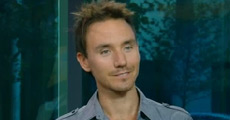
We'll get a call for Revolution from the maker of the movie Sharkwater. Rob Stewart says the species we need to save now is us. I've just seen his new film "Revolution". It's the ultimate challenge, literally our do or die time to save ocean life, and all life, from mass extinction. Our coverage of the dying oceans continues.

All coming your way this week, on Radio Ecoshock. I'm Alex Smith.

ALBERT BATES - TOUGH TRANSITION

Just like organisms, there are simple people. Others, like Albert Bates, are complex. He's a former attorney, a designer, bio char expert, author, speaker, and an international and local organizer. Albert has lived at the famous intentional community called "The Farm" in Summertown, Tennessee since 1972. His book "Climate in Crisis" was published back in 1990, with more following, like "The Post-Petroleum Survival Guide and Cookbook" in 2006, and "The Biochar Solution" in 2010.

In last week's program, we heard from successful Transition Towns in New England. That's easy enough with progressive voters. Albert, can it be done in a conservative "Red State" like Tennessee?

I've called up Albert to ask him about forming a Transition community in the rural Republican South.

When "The Farm" began in 1971 - it was part of the hippie movement. Bates tells us when the collection of school buses arrived from Haight-Ashbury in San Francisco, in rural Tennessee - to local residents it seemed like Martians landing. Over the course of a generation, there has been a general acceptance and interaction between The Farm and its surroundings.

You can learn more about "The Farm" in Albert's book "Voices from The Farm" (1998) co-authored with Rupert Fike.

TRANSITION IN A RED STATE

One sign of that was when Hohenwald Tennessee became the 25th Transition Town in America. That was accepted by all the local politicians, County Commissioners and so on - even though, as Bates tells us, practically none of the locals accepted the human-induced climate change or Peak Oil.

So how did they do it? The Farm organized a regular film and speaker night. Sure they showed "An Inconvenient Truth", but one of their most successful nights (garnering 130 people from a population of 4,000) was about "Financial Permaculture". In a very hard economy, people wanted to know how to improve their financial situation, and learned about permaculture almost as a side subject.

In fact Hohenwald had many Swiss settlers from the late 1800's. The Transition organizers were able to draw on a common community value of "frugality". It's frugal not to waste things, and so recycling and other ways to avoid waste are acceptable. It's a fantastic lesson: find out what your community values, and help deliver that as a road to transition.

In a bit of humor, one of their speakers was David Bloom, who explains how to make your own alcohol for energy and other uses. That was quite popular in rural Tennessee, where moon-shining is traditional. But the Transition group also brought in the Republican speaker Catherine Austin Fitts, who is quite aware of things like the energy decline.

Albert wrote an excellent book on the subject "The Post-Petroleum Survival Guide and Cookbook".

In Lewis County Tennessee the Transition group set up a community kitchen and a business incubator. Bates suggests it's better to fund local small business with funds raised in the area, instead of depending on big banks headquartered far away. They initiated their first local currency, namely "Chamber Bucks" which could be spent at any business that was a member of the Chamber of Commerce.

Now with Peak Oil and a rotten economy, we're seeing a surge of very different folks, some with guns and deep basements. Is "the great change” going to work with such different actors? Even the publishers of Mother Earth News have noticed an increase of survivalists and preppers in their readers. They want to grow their own food and make things themselves, in preparation for collapse.

ECOVILLAGES VERSUS TRANSITION TOWNS

I ask Albert Bates about the relationship between the Eco village Network, where he has been a leader, and Transition Towns.

First, let's look at what Wiki says about Albert and the Eco village Network:

"Bates has played a major role in the Eco village movement as one of the organizers of the Global Eco village Network (GEN), and served as GEN's chairman of the board (from 2002 to 2003) and president (from 2003 to 2004). He was also the principal organizer of the Eco village Network of the Americas and served as its president (from 1996 to 2003). In 1994 he founded the Eco village Training Center, a "whole systems immersion experience of Eco village living."[1] He has taught courses in sustainable design, natural building, permaculture and technologies of the future to students from more than 50 nations."

Bates is one of the teachers in Eco village training at The Farm, as well as teaching at Gaia University.

Essentially Bates suggests the Eco villages are like living laboratories. People experiment with ways to live together, sharing skills, learning how to produce locally. Some of the valuable lessons from those social experiments are applied more broadly in Transition Towns.

THE ZOMBIE APOCALYPSE

Albert is one of the first to point out there are no islands of security, even in an intentional community. If the rest of the society is falling apart, or even suddenly starving, they will come to take what you've got. It's a long-time point of discussion, which Bates labels the "Zombie Apocalypse" problem.

When I lived in a community of back-to-the-landers in the early 1980's, we often talked about what to do with starving city refugees. One local intentional community - a group of Russian Catholic nuns, decided they would put away lots of extra food and clothing, to welcome people who arrived.

For what it's worth, the historic record in Soviet Russia in the early 1930's, when the cities were starving, didn't work out that way at all. Instead, the army sent out trucks to take away all the grain, including the seed stock for the following year, plus any livestock and food they could find, hauling it back to the cities. The farmers and rural communities starved to death by the millions. It's in the Robert Conquest book "The Harvest of Sorrow: Soviet Collectivization and the Terror-Famine" published in 1986.

Anyway, unless there is a massive solar flare knocking out the grid, I don't expect Western civilization to collapse that quickly. It's far more likely our over-extended system will decline more slowly.

THE FARM AND CLIMATE CHANGE

As Bates knows all too well, the American South is experiencing record numbers of super-hot days, and recurring droughts. I ask what is the The Farm doing to prepare for a changed climate?

Albert describes the various ways they are collecting water, and more importantly, preparing their soil to hold more water and use it intelligently. This includes experiments with the Keyline system of agriculture, and using bovines to enrich both soil and water following the ideas of Allan Savory. It's also called "Mob Grazing". To learn more, listen to my 24 minute interview with Allan Savory in 2011 here.

The Farm is expecting 50 or more days where the temperature climbs above 100 degrees each summer - the range where plants stop growing and just go into a defensive dormancy. In the future, the Farm may see 5 or 6 months without rain. They are trying to get ready for all that, for the plants, the animals, and themselves.

Bates does travel around. He speaks at a lot of green fairs, to conferences, and international gatherings. Albert learned about global warming when he was researching deep injection of chemicals into the ground, in his former incarnation as an attorney. He spoke to his young Senator for Tennessee, one Al Gore, and then published his book "Climate in Crisis" in 1990, making Bates another of the pioneers of climate change.

To offset some of the carbon produced in traveling, way back in 1985 he established The Albert Bates Forest.

GETTING MORE BATES

In general, Albert thinks the Transition Town movement in America has been held back by media fog and mistaken ideas of making everything "American" instead of learning from other parts of the world. There are many more Transition Towns and Eco Villages in Europe, Asia, and the rest of the world than in the U.S. It appears Sri Lanka alone has more Eco villages than the U.S.A.

Follow Albert Bates on Twitter @peaksurfer and his blog is peaksurfer@blogspot.ca.

You can find a lot more Albert Bates links, including some of his fascinating past writing and interviews, here.

--------------------------------

TOWARD SUSTAINABLE COMMUNITIES - DR. MARK ROSELAND

We've been talking about Transition, from Europe through New England to the American Deep South. There is more to come, we can't stop talking about what to do, except to get busy doing it.

This wave has been building since at least 1992. As we'll hear, the few expert pioneers have become a big network of community builders, around the world. I'm going to challenge you to tune in, with a slightly different language, with new ears, to one of the pioneers of localization and sustainable community, Mark Roseland.

It's a messy world. We are bombarded by negative stories. Big governments fail to make our lives better, or save us from threats like climate change.

Many of our Radio Ecoshock guests say only local governments are worth your political attention. That's why you need to hear Mark Roseland. He's been advising local governments how to build on a human scale, for cities that can keep going through many challenges.

Dr. Mark Roseland is Director of the Simon Fraser University Centre for Sustainable Community Development, and he is a Professor in the Resource and Environmental Management Program.

Roseland came to world attention back in 1992 with the release of his best-selling book, "Toward Sustainable Communities: Resources for Citizens and Their Governments." That book is being released in a Fourth Edition by New Society Publishers in September 2012.

Mark Roseland on You tube

RIO +20 ROSELAND PROJECTS

IS ROSELAND PART OF A U.N. PLOT FOR WORLD DOMINATION?

We talk for a minute about the strange resistance to becoming more sustainable. Unbelievably, in rural America, and even a few people in the Occupy movement in the United States, are afraid any move toward sustainability is just part of a United Nations plot to take over the world. They think everything is part of "Agenda 21" which came out of the first Rio Conference in 1992.

I ask Dr. Roseland point blank: "Are you part of a plot to take over the world?"

Then we both laugh. It's such a weird distortion. The United Nations has hardly managed to do anything, except a lot of good charitable work in the poorest countries. There is no U.N. army ready to conquer the world. In fact, in some U.N. sanctioned military actions, it's the U.S. Armed Forces in command.

That doesn't stop fringe talk show hosts like Alex Jones from drumming it into weak minds that the U.N. is out to take their liberties and the environmentalists and "sustainability" is out to take away their freedom.

One of the alleged villains is something called the ICLEI - the International Council For Local Environmental Initiatives. That is a vehicle where local governments can talk to one another to find out what works. Perfect for localization, and yet some Americans who allegedly want independence have convinced their governments to stop paying for membership!

I think some paranoid Americans are missing a chance at their best allies. They attack Transition Towns as a communist plot. But the same people call for local action, participation in local governments, and prepping for disasters.

Roseland knows where this attack on sustainable communities is coming from: the Tea Party movement (partly funded by the notorious fossil fuel billionaires the Koch brothers) and the Republican Party itself. Back in January 2012 the Republican Party targeted ICLEI as villains to be defunded and fought off if they are elected. It's a political ruse, working against the best interests of America and Transition.

SUSTAINABILITY IS NO LONGER A PIONEER MOVEMENT

When Roseland published his book "Toward Sustainable Communities" back in 1992, it quickly became THE handbook for local governments, NGO's and interested citizens. There were only a few academics and institutes working on sustainability.

Now in unstable economic times, topped up with rampant energy costs and climate disruption, there are literally thousands, if not hundreds of thousands, of non-profits, local governments, academics, college-level courses, and resources of all kinds on making sustainable communities.

Roseland realized the movement was so big, and growing so fast, no resource book could hope to keep up. That is partly why at the Rio+ 20 Conference he announced PANDO. That's a kind of combined database and network for the sustainable community movement. Find it here.

PANDO is named after a giant community of aspen trees in Colorado that are all linked as one big organism by their joint root systems. It may be the largest single organism on land, and it's quite resilient.

UNIVERcity

As a long-time Professor at Simon Fraser University, in Burnaby Canada (part of Greater Vancouver) - Mark Roseland has been a guiding light in the redevelopment of the mountaintop where that university is situated. Amid some controversy, the University decided the system of staff and students living elsewhere, requiring giant parking lots, needed to be converted to a livable and sustainable community.

Now there are residences, a school, and other services right around the University, called "Univercity". Mark tells us about one day-care center which is not just net zero, but actually contributes more to the environment than it takes. Is that more expensive? No, it cost less than a conventional building.

There is a lot more to this interview. It's not in the usual activist language you hear on Radio Ecoshock, but it cuts exactly to what we are all really trying to accomplish in the real world: creating sustainable communities.

Look for Mark's new Fourth Edition of his classic "Toward Sustainable Communities: Solutions for Citizens and Their Governments." from New Society publishers.
REVOLUTION - THE FILM

During this show I play brief clips from Neil Young's song "Rumblin'" that's from his 2010 album "Le Noise", and earlier clips from Brian Eno's instrumental "The Big Ship", in the album "Green World".

There is a rumbling'. That kind of low noise of something big coming, but we can't quite tell what. The mass media news is one big distraction. As the headlines scroll by, I have this creepy feeling there are big stories not being told.

One of them is pretty simple. We have built a consumer machine that is chewing up the planet, spitting out toxic waste. Most of the greenhouse gases we pour into the sky are being sucked back into the ocean. Radio Ecoshock guests like paleoclimatologist Peter Ward have made one thing clear. The ocean makes the oxygen we breathe, the ocean determines the weather, and in the big picture, the state of the ocean dictates the big biological clock of abundance or mass extinction.

FROM SHARKWATER TO REVOLUTION

Today, I saw more graphic evidence the ocean is far more disturbed than our weather. Rob Stewart set out to save the sharks from the lunacy of shark fin soup. His audience, and then the ocean experts, told Stewart he's missed the big story.

Despite the success of his first film "Sharkwater" Stewart had to battle to make his second. He spent another four years travelling to the biological hot spots of the ocean, and to the dead zones. What he learned inflamed him. Stewart found out what we all know in our hearts: we need a big fast change in our economy, culture, and hearts to save not the sharks, not the polar bears, but ourselves. He's calling for nothing less than Revolution. That's the title of his new film.

The movie has just been released at the Toronto Film Festival, and again at the Vancouver Film Festival. It's a full-length bundle of astounding underwater photography, followed by a quest to find out who can stop our civilization from self-destructing.

We are introduced to creatures hidden below the waves. Like a relative of the Octopus that is smarter than your house cat. Crazy and adorable animals that only Nature could dream up.

Their world is dying. The ocean is becoming acidic. It's getting hotter, and it's filling up with plastic and chemicals. The single biggest threat to all sea life, greater even than deforestation, is the way we dump fossil carbon into the atmosphere. Estimates range from 33 up to 50% of all the carbon dioxide we emit goes into the ocean. Everything that makes a skeleton, from tiny plankton through coral to all fish and sea mammals, are endangered by ocean acidification. If we can't control our emissions, quickly, we can't save life in the sea.

Stewart rediscovers what I found out in 1990: the oceans campaign is the climate campaign is the oceans campaign.

So the shark man ends up at two U.N. climate conferences. Both fail miserably. Dependent on consensus, with a negotiations wrecker like Canada, out to promote the dirty Tar Sands oil, the talks go nowhere.

You and I aren't changing much either, even though we know. Stewart glumly tallies up his own carbon pollution, and it's too much. Just like me.

Who isn't invested in the climate death machine? The children. They will bear the ruined climate. Child activists are springing up all around the world. Stewart tirelessly reaches out to them, informing, warning, inspiring youth as our best hope.

COMING UP NEXT WEEK ON RADIO ECOSHOCK

Next week I'll bring you a full interview with Rob Stewart underground film-maker, and unlikely revolutionary.

We'll also hear from Lester Brown of the Earth-Policy Institute. He's got the facts on rising food costs at home, and food-less days abroad.

And we'll continue our Transition series, as guest Wes Regan describes food localization in the poorest neighborhood.

We opened Radio Ecoshock this Fall with Gareth Renowden. He and co-host Glenn Williams have managed a new edition of "The Climate Show" bridging the time gap between London and rural New Zealand. Check out the new program at theclimateshow.com

Another tip from the film Revolution: only you can educate yourself. Sorry, whatever school you went to didn't teach what we all need to know. The government won't tell you. Media plans to distract you.

As the hard facts roll away the delusions of a mass suicide pact, I encourage you to dig, dig, dig. You can get college level knowledge free in You tube and Google lectures. Watch the TED talks. Bulk up your list of blogs that tilt toward natural reality.

You can find every back show of Radio Ecoshock on our web site at ecoshock.org. Please tune in, and spread it around. Use those links, Facebook, Twitter, everything. Hand out copies to neighbors or on the street. Talk it up.

Some of the world's best experts teach us. We have to strip away layers of ignorance and greed. We need to know the truth, and then we need to act on it. Nothing else will save a livable future for our descendants. That IS the big story.

I'm Alex Smith. This has been Radio Ecoshock. Join us next week.

Wednesday, September 26, 2012

Transition Yourself - Part One

Ideas from America on starting a Transition Town. Ruah Wennerfelt, Steve Chase & host Mark Helpsmeet in live stage conversation. Plus Greg Pahl, author of "Power from the People, How to Organize, Finance, and Launch Local Energy Projects." Max Keiser & Stacy Herbert on corporate corruption. Music: "In Your Eyes" by Peter Gabriel. Radio Ecoshock 120926 1 hour.

The climate has gone rogue, energy prices are threatening, and the economy sucks. You know the elections aren't going to make it better. Why wait for government? You can protect your community and yourself by helping your town withstand the shocks.

Download/listen to Radio Ecoshock for September 26, 2012 in CD quality (56 MB) here.

Or use the faster downloading, lower quality 14 MB version here.

RADIO STATIONS Two 29 minute segments allow time for station ID and announcements.

Radio Ecoshock 120926 Part 1 and Part 2

This program is about the Transition Town Movement and local power.

We begin with a half of an hour-long dialog with Ruah Swennerfelt and Steve Chase on the Transition Town movement in New England.

It's a rebroadcast of "Sprouts", radio production by independent community media. Last July, host Mark Helpsmeet of "Spirit in Action" hosted a live event Transition Town dialog in Rhode Island at the University of Kingston. It was originally broadcast on WHYS-LP in Eau Claire, Wisconsin, as part of Northern Spirit Radio. WHYS also broadcasts Radio Ecoshock.

MUSIC:

The opening of the Sprouts segment contains part of the song "The Turning of the World" performed by Sara Thomsen (written by Ruth Pellam) & "I Have No Hands But Yours" by Carole Johnson.

The show closes with the Peter Gabriel classic "In Your Eyes" (this You tube from a live concert from the 2003 Growing Up Tour in Filaforum, Milan, Italy. Or try this live classic recording Papa Wemba & Peter Gabriel

TRANSITION IN NEW ENGLAND

Our discussion of Transition in New England and Europe was recorded in front of a live audience, in early July, in Rhode Island at the University of Kingston.

One guest speaker is Ruah Swennerfelt, former long-time General Secretary of Quaker Earthcare Witness. She is currently involved with the Transition Town implementation in Charlotte, Vermont. Find her Transition US blog here.

Both our guests are involved in Quakers in Transition.

Steve Chase is Director of Advocacy for Social Justice and Sustainability at Antioch University New England. Steve talks about the Transition Town in Keene, New Hampshire, where their slogan is: "for local people concerned about peak oil, climate change, and a dysfunctional and unjust global economy - who want to respond with vision, courage, and creativity."

Helpsmeet asks how people who have very different political beliefs can work together in a Transition movement. One way is to stress "resilience" rather than the eco word "sustainability".

For the Quakers, the prospect of "energy famine" (as fossil fuels decline, become too expensive, or are taken over by others) can easily lead to resource wars. In this way, Peak Oil can really be a "peace" issue.

In Europe, some Neo-Nazi's took up the name "Transition" applied to their town. Partly in response to austerity in some European countries, this group agreed we have to learn to live on less, and so there is a need to keep immigrants out, using racist rhetoric.

In response, Transition US posted some core values, including posting local group constitutions on the Transition US web site.

It's ironic, because unlike the Nazi leadership cult, Ruah says success comes because Transition is a leaderless movement. Leadership is shared as well.

Having fun together is "a really core principle" says Ruah. Have fun, not long dreary meetings.

TRANSITION KEENE (NEW HAMPSHIRE)

Keene New Hampshire had a ground-breaking for a new food coop in mid-2012. It already has a thousand members in a town of 25,000.

They have around 20 community-supported agricultural projects in their area, which allows for more local food production. They now have a farmers' market and a winter farmers' market.

AS IN PERMACULTURE, THE SOLUTION IS FOUND WITHIN THE PROBLEM ITSELF

What's the hurry? asks host Mark. Is it just concern with oil supplies?

There are many reasons, says Ruah, but she doesn't think of it as all doom and gloom. In permaculture, she says, the solution is found in the problem itself.

Ruah still has a car, but is always aware of her pollution, that she is helping cause more global warming. She wants a group to help develop less harmful local transportation schemes. Like biking to a collector bus van, which leads to a larger bus to the city of Burlington, Vermont.

Central is the idea that we will have to learn to live well on less. Perhaps much less. Fossil fuels will be less available, cost more, and the damage they cause will become more and more apparent. But also, the idea of global equity, which is central to global peace, demands Western people use fewer resources, allowing the poorest people to get the basics.

In most cities, there is only 3 to 5 days’ worth of food. After that, if the trucks don't roll in, people run out of food. Local food production increases the ability to absorb coming shocks in the food production and delivery system, for whatever reason.

BOOKS TO GET YOU GOING

Ruah describes how to start a Transition Town. There are three books now available to help: the first one was "Transition Handbook" by Rob Hopkins. You'll have to get that one used from online services, as it is out of print. The Transition Culture blog now advocates buying "Transition Companion" also by Rob Hopkins. There is a third: "Transition Timeline" by Shaun Chamberlin published in 2009.

Here is the description of "Transition Timeline" from transitionculture.org

"The Transition Timeline lightens the fear of our uncertain future, providing a map of what we are facing and the different pathways available to us. It describes four possible scenarios for the UK and world over the next twenty years, ranging from Denial, in which we reap the consequences of failing to acknowledge and respond to our environmental challenges, to the Transition Vision, in which we shift our cultural assumptions to fit our circumstances and move into a more fulfilling, lower-energy world. The practical, realistic details of this Transition Vision are examined in depth, covering key areas such as food, energy, demographics, transport and healthcare, and they provide a sense of context for communities working towards a thriving future.

The book also provides a detailed and accessible update on climate change and peak oil and the interactions between them, including their impacts in the UK, present and future. Use it. Choose your path, and then make that future real with your actions, individually and with your community. As Rob Hopkins outlines in his foreword, there is a rapidly- spreading movement addressing these challenges, and it needs you.
"

Also see Rob Hopkins in a 17 minute presentation "Transition to a World without Oil" at TED, on You tube in 2009.

TRANSITION IS HUGE IN EUROPE (INCLUDING PARIS, LONDON, AND BARCELONA)

In 2011, Ruah visited Transition communities in 10 different European countries, as well as a "Transition France" conference and a "Transition UK" conference. All the communities took different steps, or in different order, to adapt to where they lived.

There is even Transition Paris. They broke down into smaller transition communities within the larger city. They had a central hub to serve these smaller groups.

They do the same thing in Transition Los Angeles and Transition Barcelona.

Find Transition Barcelona in Spanish or in English.

One group in England had members map out where food trees, like peak and apple trees, were accessible and perhaps not harvested. They asked homeowners for permission to harvest the fruit, rather than let it be wasted.

In Charlotte, Vermont they have an "Asset Directory". They took a survey of community skills, to allow skill-sharing. It also hooks up people who want to learn skills, whether it's canning, small scale farming or whatever.

Steve Case points out that social movements are not like corporate franchises. You don't buy a license to become a Transition Town. There are about 1,000 formal transition initiatives around the world.

They have workshops on how to deal with difficult people. We are a "cussed species" and sometimes the culture doesn't help us.

We need an outer transition to reconfigure our communities with resilience, an energy descent plan, to live without damaging the climate, and live on less and less.

"THE THEORY OF ANYWAY"

When Rob Hopkins wrote the Transition Handbook around 2008, he advanced "the theory of anyway". Even if climate change isn't as serious, or oil continues longer than thought, or the economy limps along - we'll still be living and eating better with the transition town, with a more resilient economy. You'll feel better with more local democracy, more skills, and more community involvement - no matter what happens.

The international site for Transition Towns is here.

The local producers and buyers try to reduce food miles, and the use of pesticides and fertilizers which are petroleum based. Like Ruah, Steve Chase says the challenges of energy depletion and economic downsizing also contain the solutions. For example, one water treatment plant in New England was getting swamped by sudden inflows of water. This problem was solved by installing micro-generators on the intake pipes. Now that plant is self-sufficient, generating its own energy from the former "problem".

They plan to have about 12 transition trainers in New England this year, to offer weekend workshops. Beyond this basic training there is a new training workshop called "Transition Thrive" (what to do next, after getting your group going).

Transition groups in Scotland are incorporated to do community business, like community bakeries. Ruah recommends the book "The Town That Food Saved". It's about Hardwick Vermont.

It's important to partner with town or city government. Their local government had one immediate problem: too many parents drove kids to school even though school buses are provided. It caused dangerous congestion, and more climate change. How to make riding the bus cool for kids? Now that's a challenge!

Transition may say "don't wait for government" but groups still work with existing governments to get things done, says Steve Chase.

In Keene, they have awareness raising "Transition Tuesday". One success was showing the film "A Convenient Truth" about Curitiba Brazil. That town transformed itself. See a short trailer for A Convenient Truth here.

People need to see examples of what is possible, Chase says, rather than only hearing the dire consequences if we don't do something. Once you begin to think creatively, all the problems seem like opportunities.

For the second part of this program "Local Power" with author Greg Pahl, click here.

Wednesday, October 27, 2010

Peak Oil Vs. "Pathological Optimism"

RADIO STATIONS: end music is a clip from "End of the Age of Oil" by Dan Rovics.

Here are the extra file links for this program:

Your listeners can download Kathy McMahon's 80 full speech (in two parts) here:

Part 1, 38 min

Part 2 39 min

And this 20 minute interview of Karen McMahon by Alex Smith of Radio Ecoshock.

Also: Radio Ecoshock is available to Radio Stations as two 29 minute segments, allowing you time for Station ID and announcements. Write me (radio [at] ecoshock.org for details.

PEAK OIL VERSUS "PATHOLOGICAL OPTIMISM"

- Alex Smith of Radio Ecoshock - on "the Peak Shrink", Kathy McMahon.

You know the Peak Oil three-step? First you find out our oil-based civilization has a nasty best-before date. Second, your own emotions and worries begin to surface. Then your friends and relatives start avoiding your "Doomer" talk.

As a clinical psychologist. Kathy McMahon has heard it all, through her blog Peak Oil Blues. She's been called "the Peak Shrink." Kathy has some ways to help you - and to fend off what she calls "pathological optimism" all around us.

Now, "The Peak Shrink" is on the road, with a series of speeches in the Pacific Northwest. I recorded the full speech, and an interview with McMahon, for Radio Ecoshock. You can listen in, with links at the bottom of this article.

Meeting Kathy is a relief. We are not crazy. The facade of the dying oil civilization is definitely crazy. Millions of people around the world are waking up to this fact, and sharing solutions.

Here is a quick summary of some points in Kathy McMahon's speech in Vancouver, Canada on October 18, 2010. - topics she explain so well in the audio.

Kathy began with the difference between "problems" (which humans enjoy solving) and "dilemmas" (which we loath). The dilemma has no good solution. We get more problems whatever we try, all options stink.

Peak Oil, amid our totally oil-dependent civilization, is a dilemma. Should we hope for a quick end to oil, to save the Planet's climate? Doesn't that mean a messy, possibly violent collapse, with widespread starvation? We don't know what to wish for.

McMahon reminds us the original Cassandra was the ancient Greek woman given the power to see the future. But the God Zeus adds the kicker - she will never be believed.

One Cassandra candidate in recent American history was 1970's President Jimmy Carter. McMahon reminds us of his correct predictions in a famous energy speech. The people chose Reagan instead.

But Kathy's real gift is to gather new understanding of our reaction to learning about Peak Oil (or climate change, and the crumbling economy). These come from the many letters, sent in from all over the world, to McMahon's blog "Peak Oil Blues" (http://www.peakoilblues.com).

Students are upset to find the promised future disappearing. Housewives who can't convince their husbands to re-evaluate what they may need, to survive wrenching economic and energy changes.

In the Q and A session after Kathy's speech in Vancouver, I was surprised to find the number of women frustrated with husbands unwilling to even look at the facts about oil dependence, shrinking demands, and world competition for the last supplies. The wife is surreptitiously doubling up on long-lasting supplies ("to save money, dear") while hubby clings to a corporate job, and a brand new gas guzzler.

But what about those who take Peak Oil seriously? Kathy says we start out in shock, and then become mini-librarians crossed with a private investigator. Just the facts Mam.

What follows can be isolation from friends and family, who go into strong denial. "I don't want to hear about it" becomes a wall that can lead to loneliness.

Others go into supermarkets, see all the fruit flown in from around the world, but see it gone in the future, as the oil slips away. Ditto the imagined scenes of abandoned cars and vandalized monster houses. We may even reach a state of nostalgia for the present, remembering the good old days, while we live them.

Cases of outright depression can develop, and very rare cases of suicide have been reported. The Peak Oiler, now sure of the facts, goes through a state of shame and guilt, having participated in the gonzo waste of oil that was late 1900's civilization in the West.

Kathy McMahon admits she became a gambler, like all the rest of us. She had a family business selling new appliances into the construction industry, for new homes. As early as 2005, her reading revealed the suburban boom couldn't last. Should she sell the business, or try to get just one more good year out of it?

We all gamble, trying to say in the fossil system, as long as we have a job.

But the real target of the night, reversing labels like "Doomers" for those who dug up the oily facts - are the deniers who McMahon says cling to "pathological optimism".

You'll have to listen to the speech, or visit her blog at peakoilblues.com, to get this funny but true look, at the psychological labels we could give all those folks who say it will all be fine, despite the facts of Peak Oil.

There are 50 ways to deny Peak Oil, beyond those who just close their ears and refuse to hear about it. For example, in Frank Zappaism, otherwise educated people believe in magic. A new unknown technology will fix the problem, they say, so we don't need to worry about anything.

As a clinical psychologist, who works with couples, and sex therapy, when not online with Peak Oil Blues folks - Kathy McMahon sees several trends which make us even more unprepared for energy truth.

For example, new psychological studies are finding children who spend more than two years in front of a screen - any screen from TV's, to gaming, to I Phones - fail to develop in some ways. They are much more likely to suffer from mental illness later in life.

When Kathy visits a family, they must turn off all their electronic gadgets a half hour before the session. Even then, kids are whining to get back online, or gaming. They are addicted, and suffer "Nature Deficit Disorder". All this clouds the judgment needed to respond to Peak Oil, and a civilization under dire threats.

But all of us, Kathy says, have "cognitive maps" built in. These are the expectations the we think necessary to function. She gives the example in one startling statistic: when lost, children six or under are more likely to either return or be found, while older children create untrue ideas about their situation, perhaps from things they have seen on TV.

Likewise, our whole adult culture has many preconceived cognitive maps - that don't include dwindling energy supplies, or the realities of severe climate disruption. We make up new stories, rather than change our preconceptions.

Dr. McMahon has developed common-sense prescriptions for what ails us. We need to get grounded, and relearn how to make local friendships and community.

And - you'll like this - "we need to party more". Partying has dropped off drastically since the 1970's, even taking into account different age groups.

Others may want to form intentional communities, even mildly religious ones. We have to revive those skills.

In a funny part of the speech, McMahon reminds us that some people are annoying. That can't be a reason to quit, and go back to our bunkers. Humanity has always managed to adapt to annoying people.

We get examples of past and present community building efforts, mixed with scary statistics like:

Did you know a poll found that 40% of American women said they would get a divorce, if their husband lost his job?!

Or did you know psychologists and child-care workers are finding kids don't how to play? They can text, but they don't know how to invent things to do, outside.

There are a lot of personal answers in this 80 minute speech, delivered in Vancouver on October 18th, as part of a Pacific Northwest tour by Kathy McMahon. She lives in the country, in the Berkshire hills of Massachusetts, along with some chickens, gardens, and pigs.

You can download Kathy McMahon's 80 full speech (in two parts) here:

Part 1, 38 min

Part 2 39 min

And this 20 minute interview of Karen McMahon by Alex Smith of Radio Ecoshock.


If you have ever been discouraged by the dilemma of Peak Oil, or frustrated with friends and family who shut you down, take heart from Kathy McMahon, and the millions of people all over the world, who do know what is happening. Find them at PeakOilBlues.com

Alex Smith
host
Radio Ecoshock

Thursday, October 1, 2009

HOW COMMUNITIES SURVIVE DISASTER

[Production Note: no copyright music this week]

Everything in the techno-capitalist society forms us into separate atoms. We demand our own space, travel in personal metal boxes, and struggle as individuals.

When disaster strikes, hardly anyone remembers how to respond. How will your community react to a major threat? Will it fall apart, or grow stronger? Is there anything you can do to prepare?

This is Radio Ecoshock. I'm your host Alex Smith.

It's a real shock when those lonely atoms, conversing through electronic screens, realize their real community is endangered, or falling apart.

The cause may be economic. A major employer, or a whole industry like the auto sector, shuts down. Or maybe gas prices collapse real estate prices in a former commuter haven.

Communities can also be hammered by a climatic event: long-term drought, burned over by fire, drowned by super-floods and storm surges, or hit by a devastating storm. The disaster can even be environmental. A nuclear plant or a pesticide plant blows up, or a super-tanker spills it's oily guts.

Not to mention the possibility of a terrorist attack, like a dirty bomb or a biological release. Did I mention earthquakes?

In this program, I'll interview Riki Ott, THE Exxon Valdez spill expert. Her town of Cordova Alaska became an early case study in how a community reacts to disaster. Still fighting the big corporation who ruined their fishing industry, and split the townsfolk, Dr. Ott has developed a program to help damaged communities anywhere in the world. She gives us practical tips you should know BEFORE your community gets hit with the unexpected.

We'll follow up with a speech by Dr. John Helliwell. He's an economist called in to an audience that included mayors of towns experiencing near total loss of employment, after major forest mills shut down. I expected a pep talk about business plans and government rescues. Helliwell surprised us all, with a new way of looking at success - one not based on wealth and more production. Instead, John Helliwell is part of a growing consensus that our economic emphasis is all wrong. We should be aiming for Gross National Happiness. An economist who sees the community links becoming more valuable than business, a voice long overdue.

First, let's talk with Riki Ott.

[Ott interview]

I want to add to Riki's Ott's response about the role of women when communities hit a calamity, whether it's natural or human-made. Riki explained that women took up a leadership role in organizing not just meetings, but the networking and re-organization that helped partly heal the community. Women tend to be experienced in both communication and working co-operatively.

The darker side is this: when things go badly, women can also be further victimized by the despair and rage felt by men. I've lived in a town where the mine closed. I reported on the increased domestic disputes, growing alcohol and drug abuse, and outright beating of women by their spouses. If a factory or a mill closes, or natural events wipe out jobs - the community will have to increase services for women, at the very time when there are fewer municipal resources to go around. A women's shelter, or at least a network of safe-houses, may be needed quickly. Keep that in mind.

In an ideal world, both men and women would find some kind of counseling for the loss of value which accompanies unemployment. Without a job, many lose their sense of self definition and worth. We can't count on higher levels of government to provide this. People need to self-organize to talk to one another.

It's my observation that larger governments are beginning to fail. They spend themselves into bankruptcy, and over-build into huge bureaucracies that are unable to respond in any meaningful way. This is true in the most advanced countries, as the bungled response to Hurricane Katrina in New Orleans and Mississippi showed. If your community is struck, don't wait around for the government to save you. Organize and act locally.

There are also a few cases where the community fails, and nothing can really save it. There are plenty of ghost towns where a big mine closed, and the economy shut down with it. People just moved on.

I can foresee similar situations coming from the developing economic meltdown, coupled with climate disruption. Take the Ohio rust-belt, where heavy industries fled overseas. Former CIBC investment guru Jeff Rubin predicts they will rebuild, because soaring oil prices will make shipping from China too expensive. Others calculate that ocean shipping will remain far cheaper than trucking, so imports of Chinese products will continue.

I say the Ohio and Indiana area will not re-industrialize because they are 95 percent powered by coal. As climate change becomes too obnoxious to deny, and carbon pricing clicks in, new industry will only locate where renewable power is available. The Mid-Western states will either have to enter a crash program to find carbon-free power, or face a permanent loss of population.

Sometimes communities do survive to find new and safer economies. It's happened many times, in many places. In some cases, though, it's better to get out, no matter what your loss in real estate, hopes, or good memories.

Let's get into a different kind of optimism, built from a different kind of economic world view. This speech by Dr. John Helliwell was recorded by film maker Clancy Dennehy on September 17th, 2009 at the Forestry building, University of British Columbia in Vancouver, Canada. While it contains some references to B.C. towns devastated by mill closures - this speech is really about a global movement to redefine what an economy is. Does it produce happiness?

The introduction is by Jack Saddler, Dean of the UBC Faculty of Forestry.

[Helliwell]

You have just heard the 2009 Forestry Lecture in Sustainability, presented by economist Dr. John Helliwell. The speech was organized by the University of British Columbia Faculty of Forestry on September 17th, 2009.

The lecture was followed by an eminent panel including two top government officials, Doug Konkin, Deputy Minister of Environment, and Dana Hayden, Deputy Minister of Forests and Range. Plus Don Roberts, Managing Director, CIBC World Markets, offering a business critique.

You can download a full one hour presentation, which includes the panel comments, from the Brownbagger radio show archive, located at ecoshock.org. That's a free mp3.

My thanks to Clancy Dennehy for his recording. Look for Clancy's upcoming art film simply titled "Vancouver".

So what have we learned?

If a major disaster strikes your community, at some point you have to decide whether it's time to pitch in and rebuild - or to leave. There's an old saying, which is only true half the time: "The strong give up and move on. The weak give up and stay." I'm just saying.

If you decide to fight on - don't wait for an outside savior. Big government can't create community. Lawsuits can take 20 years before they let you down.

Big corporations can leave or fail. Build a local economy.

Redefine who you are, and include everybody. Listen to each other. Organize. And if you can, ...do it before disaster strikes.

I'm Alex Smith for Radio Ecoshock. Write me any time. The address is simply radio at ecoshock.org.

Thank you for listening this week.