Wednesday, February 27, 2013

How Will We Power the Future?

In-depth interview with Nobel Laureate Robert B. Laughlin on his book "Powering the Future: How We Will Eventually Solve the Energy Crisis and Fuel the Civilization of Tomorrow." Dr. Rose M. Cory's new science on positive feedback loop discovered in the melting Arctic. Plus song "No Such Thing As Waste" by Australia's Formidable Vegetable Sound System. Radio Ecoshock 130227

FREE MP3 DOWNLOADS FOR THIS PROGRAM

Download/listen to Radio Ecoshock 130207 "How Will We Power the Future?" in CD Quality (56 MB) or Lo-Fi (14 MB)

Download/listen to the Robert B. Laughlin interview (38 min) in CD Quality (34 MB) or Lo-Fi (9 MB)

Download/listen to the Rose Cory interview (17 min) in CD Quality (15 MB) or Lo-Fi (4 MB)

Worried about prices at the pump? Or is it still way too cheap to save a livable climate? Even big fossil fuel executives wonder if we'll find enough energy, or retain an economy to pay for it. In just a minute, we'll encounter a powerful mind who drove through the options and calculations, to arrive at surprising conclusions about powering the future.

I'm Alex Smith. Later in this program, we'll talk with Dr. Rose Cory, lead author of a newly published paper. She found another surprise agent whipping up the production of greenhouse gases in the far North. It's yet another positivie feedback loop in the rapidly changing Arctic. About 24% of exposed land in the Northern Hemisphere is frozen under the surface. That empire of permafrost is disappearing quickly. Scientists estimate ten to twenty percent will melt in this century alone. The latest research says just 1.5 degrees Centigrade over pre-industrial levels will tip the permafrost into a vast melting process, unleashing more carbon dioxide than we have in the atmosphere now.

That is a recipe for climate disaster unseen for millions of years. We are already half way there.

I'll also play you a new song, from an upcoming tour of North America and Britain, by a hot new Australian band. It's good green music for your ears.

But first, this in-depth conversation with a surprising mind, about your energy future.


Listen to this Radio Ecoshock program right now.

ROBERT B. LAUGHLIN
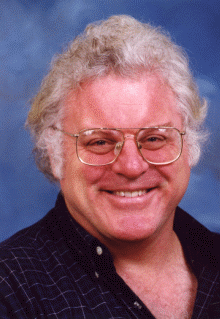


Everone knows our civilization is doomed and our kids will be digging through the rubble, for cans of dogfood.

Apparently Nobel Laureate Robert B. Laughlin missed the memo. He wrote the book "Powering the Future: How We Will Eventually Solve the Energy Crisis and Fuel the Civilization of Tomorrow". Laughlin is the Bass Professor of Physics at Stanford University, where he's taught since 1985. In 1998 he shared the Nobel Prize for Physics. His previous books are "Crime of Reason" and "A Different Universe".

This is Alex Smith for Radio Ecoshock. I read the book. I called Robert up to argue with him, and that's a big mistake, because he's smarter than I am. Anyway it's a trap. Robert Laughlin wants us to argue with him.

The old saying is "Don't jump to conclusions." But that is exactly what Lauglin did in writing this book. He presumed humans will find the energy needed in the future, and then figured out how. I stewed over this book, thinking "well he hasn't counted on an economic crash" or "where is the climate damage?"

Laughlin says he expects both. There could be an economic collapse, and serious climate damage. But, he says, humans are more or less the same generation after generation. There is no reason to expect out descendants will be very different from ourselves.

When Laughlin addresses student audiences all over the world, he asks them: "Will we still have cars? Will we still fly? Will there be electricity?" Eventually, they say "yes" - because they envision the same basic desire and need to travel, and to power things.

We get into an intriguing insider's look at all kinds of energy. For example, if Germany doesn't want nuclear power, they are saying "yes" to more Russian natural gas. But gas is still a greenhouse gas, it's limited, and supplies may drop quickly if we are depending on fracked gas. The jury is still out on how fast those fracked wells deplete.

Laughlin, who is at the Department of Physics at Stanford University, seems fairly impartial about nuclear power. After admitting he may have worked on classified nuclear programs (weapons?) - Laughlin says "we haven't had the nuclear conversation yet". Those decisions may come AFTER oil, gas and coal become hard to get and ridiculously expensive. New generations of humans may make very different decisions.

By the way, his Stanford students from Kazakhstan say the uranium trains that used to run to Moscow are now going to China. China has NOT backed away from nuclear energy, even after Fukushima.

We talk about the potential and pitfalls of solar energy. Laughlin is excited about the Andasol I project in Spain, where solar reflectors heat up a salt mixture to a liquid state. That acts like a battery which can store the sun's energy, to generate electricity via steam generators, even after the sun has gone down. Laughlin thinks the same technology could be used to store any kind of energy, even wind power. He's involved in a patent and a project to develop that.


Andasol I solar power station, Spain (courtesy of Wikipedia)

If you doubt what Laughlin says, be prepared to follow up through the last 81 pages of the book - his towering collection of end notes. If we just went through those, it should be worth a degree in itself.

The book "Powering the Future" is provocative, and crammed full of useful perspectives. It was a privilege to spend quality time with Robert Laughlin, and I hope you enjoy our talk as much as I did.

SUPPORT RADIO ECOSHOCK

You are tuned to Radio Ecoshock. This is my seventh year producing radio that matters for non-profit college and community stations around the world. You can help keep this big ball of ear waves going, by offering your support at our web site, ecoshock.org. Then share the blog, at ecoshock.info, and our Facebook page at radioecoshock.

Find your local radio station broadcasting Radio Ecoshock here.

NEW SCIENCE FROM THE ARCTIC - HOW SUNLIGHT CAN MAKE GREENHOUSE GASES

Now back to one of our specialties here, keeping you up to date with the latest climate science.

As Robert W. Service wrote: "There are strange things done 'neath the midnight sun." You are about to learn something new going on, powerful but unseen, in the melting far North. This is Radio Ecoshock. I'm Alex Smith.

In the past decade, satellites, scientists, and aboriginals looking at the Arctic find larger areas without snow cover, for longer periods . Arctic heating is greater than anywhere in the lower temperate zones.

A huge portion of planet Earth is frozen, we thought permanently frozen, calling it "permafrost". It's beginning to thaw, and we have fresh science showing new pathways for greenhouse gases to enter the atmosphere.


Dr. Rose Cory

Just out is this paper titled: "Surface exposure to sunlight stimulates CO2 release from permafrost soil carbon in the Arctic" It was published online in the Proceedings of the National Academy of Sciences on January 4, 2013. We have the lead author on the line, Rose M. Cory, Assistant Professor at the University of North Carolina, in Chapel Hill.

In a nutshell, this team of scientists discovered that lack of snow cover is leading to more greenhouse gases releases as sunlight stimulated microbial action on the formerly frozen plant matter of the permafrost.

Vast, I mean vast, Arctic plains in Siberia, the Canadian Arctic, and Alaska, are popping up with new lakes and puddles. These come from a process called "thermokarst" failures. Watch a short video about it here.

Picture a kind of slurry of organic material washing around in streams, run-off and ponds. The real news in this paper is a new actor: the role of sunlight itself. It isn't just the microbes feeding on newly released organic material. Sunlight itself can release greenhouse gases directly. Rose Cory describes how that works.

We knew that exposing more permafrost to the warming Arctic air would result in the release of more carbon dioxide and methane into the atmosphere. We just didn't understand how it worked, how much, or how fast. Now scientists have new figures to work with - including an estimate 40% higher than previously thought. That's a big number. Here is the quote from the paper:

"Our results suggest that photostimulation will rapidly (days to months) increase conversion to CO2 by an additional 40% or more in thawed and released C compared with that remaining in the dark, and that photo-stimulated bacterial use of this C in natural streams may equal or exceed its degradation in the dark alone."

Rose Cory confirms they have found yet another positive feedback loop in the Arctic - home to more than a half dozen feedback loops already. It's serious news we all need to understand, as formerly snow-covered lands become exposed to the warming Arctic sun.

Read about this new science in the New Scientist magazine here.

Rose says its "jarring" to return from the Arctic, where such major and dangerous changes are taking place, to here home in Chapel Hill North Carolina. Most people in the U.S. (and around the world for that matter) have no idea of the big developments in the Arctic. With your help, listeners, we can spread the word. Tell someone about this research, and make more people into "Arctic watchers".

Radio Ecoshock has a number of programs devoted to the melting permafrost, the disappearing sea ice, and loss of glacier ice on Greenland. I recommend our December 19th show, 2012 "Climate: the Arctic Thermostat Blows Up" and also in 2012, our February 15th program with 3 scientists "Arctic Emergency - Global Threat".

I also did a special from the February 2012 meeting of the American Academy for the Advancement of Science, titled "What If the Permafrost Thaws?"

Please listen and pass those links along.

OUR FEATURE SONG THIS WEEK: "NO SUCH THING AS WASTE" by the band Formidable Vegetable Sound System

A sustainability-based electroswing ukulele show all about permaculture called Formidable Vegetable Sound System is touring through Canada from Australia from May-August. Here are just some of the tour dates:

22nd April- U-Mass for Earth Day, Amherst, MA

26 June - Glastonbury Festival, UK

27 July - Secret Garden Party, UK

2 Aug - Bass Coast Festival, BC, Canada

7 Aug - Shambhala Festival, BC, Canada

If you check out this You tube video, the audience is swaying and dancing.

The album will be launched worldwide on April 6 (with a launch party being held at Ceres Community Environmental Park in Melbourne, Australia.)

Anyone interested in buying the album pre-sale can head to permaculturesongs.com or our facebook page (Permaculture Ukulele)

IF ONLY WE COULD SEE IT...

The process that might do our civilization in is happening right in your city or region. If we had eyes to see gases, we'd see the carbon and methane pouring up into the sky, from our streets, homes, factories, and farms. Billowing clouds of climate change in the making, and very little human change on the ground. Check out a camera technology that makes greenhouse gas emissions visible in this ABC News piece.

Still, green nature pops up in the cracks of the sidewalk. In coming programs we'll cover action in the big picture, and ways a million longing hearts can steer in a different direction, including me, including you.


I'm Alex Smith. Thank you for listening to Radio Ecoshock again. Please support the program, spread the word, and join me again next week.

Tuesday, February 19, 2013

Survivor Soul Food

African American culinary historian Michael W. Twitty interviewed by Gerri Williams on black crops, climate change, & safe seeds. K. Rashid Nuri from Truly Living Well urban farm in Atlanta, Georgia. Music by Mavis Staples ("Down in Mississippi") & Memphis Gold ("Mississippi Flatlands"). Radio Ecoshock 1 hour 130220

DOWNLOAD THESE FREE MP3 AUDIO FILES:

All I ask, please help when you can, with a donation or subscription to Radio Ecoshock. The helps pay not just for production, but the tens of thousands of free downloads each month, getting the message out all over the world. Find out more here.

Radio Ecoshock Show "Survival Soul Food" in CD Quality (56 MB) or Lo-Fi (14 MB)

Gerri Williams interviews Michael W. Twitty 26 minutes in CD Quality (24 MB) or Lo-Fi (6 MB)

Alex Smith interviews Rashid Nuri (24 minutes) in CD Quality (22 MB) or Lo-Fi (6 MB)

This is Black History Month in the United States. It started me thinking about justice, for people and the environment.

We open the program with the song "Down in Mississippi". It is Mavis Staples, singing about her own life, from the album "We'll Never Turn Back". The song includes the guitar-work of producer Ry Cooder. You'll hear the whole thing at the end of this program.

We also play a selection from "Mississippi Flatlands" by artist Memphis Gold. He's from Tennessee, but is now living in Washington D.C. I really appreciate his style. The song is from the album "Pickin' in High Cotton" on Stackhouse Records.


Can we learn from the earliest agricultural workers? Are there Southern crops and techniques that we'll need as climate change develops? Yes on all counts. This dig into an unreported scene will work for listeners in every country.

We've got two fabulous guides. Michael W. Twitty is a culinary historian of African and African American foodways. He's just returned from a tour of the former slave states, living and recording those important self-sufficient ways of growing and cooking food, from seeds through open fire cooking.

Our Washington correspondent Gerri Williams, with her own expertise at the College of Agriculture, sits down with Michael Twitty.

Then it's off to Atlanta George with another remarkable mind. I talk with K. Rashid Nuri about everything from the decline of black farming, to the revival of urban agriculture and organic growing.

We can't do better than Rashid. He's a Harvard Grad who worked for decades in the international food industry, all over the world. Nuri was an adviser to the US Department of Agriculture in the Clinton Administration. Now he's come full circle to head up the Truly Living Well urban farm operation in Atlanta, and the Georgia Organic Farmers movement.

Get ready to learn about adapting to climate change, protecting your own food health, southern living, and the struggle for economic justice.

This is Radio Ecoshock.


AFRICAN AMERICAN CULINARY HISTORIAN MICHAEL W. TWITTY


Michael Twitty

When the African American Heritage Seed Collection was begun, organizers turned to culinary historian Michael W. Twitty. Michael has just returned from a tour of the former slave states in the American South. He was seeking his roots - and cooking them!

Michael recently met up with Radio Ecoshock Washington correspondent Gerri Williams. As a Research Associate at the College of Agriculture, Urban Sustainability & Environmental Science at the University of D. C., Gerri is tuned into African American culture, food production, and the environment.


Gerri Williams

I'm betting you don't know about "slave gardens", or the two foods that may move from the bird feeder to your dinner plate, as climate change develops.

Gerri begins by asking Michael Witty about his well-named "Southern Discomfort" tour.

I found this whole interview fascinating and useful. We pick up tips about adapting to climate change, the importance of natural food, and the crops that you might want to discover.

Michael's histories of African American foodways have been published all over, including his own recipes from beans to pork to "Michael Twitty's Heirloom Cowhorn Okra Soup". Find his web site here.

My thanks to Gerri Williams for knowing the right people, and the right questions.

K. RASHID NURI AND THE TRULY LIVING WELL URBAN FARM IN ATLANTA


Rashid Nuri

Why not farm in the city?

Our guest is a Harvard Grad with plenty of big-time qualifications in both industrial and organic agriculture. K. Rashid Nuri worked a dozen years with the world food giant Cargill. He served four years in the Clinton Administration, in the U.S. Department of Agriculture, as the Deputy Administrator of the Farm Service Agency and Foreign Agricultural Service. Right now, in Atlanta Georgia, Rashid leads an inspiring urban food farm called "Truly Living Well".

Right in Atlanta, Truly Living Well farms donated land in various plots. They sell top quality produce to high end restaurants, providing more than a dozen jobs for folks who really need the work. Truly Living Well also supplements food for the needy, either at low cost, or even free to those who need it.

We're learning from the survivors, from the deep south, during Black American History Month 2013. I'm Alex Smith. We all want to be survivors, so let's learn from those who know.

I spent some time doing Google searches about African American farming. Almost all of what I found was about history. In 1920 about 14% of U.S. farmers were African American, but by 2007 that dropped to 2%. What happened to the African American farmer?

According to Will Scott, president of the African American Farmers of California, in that agricultural superstate, out of 81,000 farmers, only 400 are African Americans. Will Scott is seen here at TEDx Fruitvale CA in 2011. The African American Farmers of California run a 15-acre demonstration and education farm to interest African-American kids in agriculture.

It seems pretty obvious there was an ugly twist to farming in the history of African Americans and that was share-cropping. For many, it must have an act of liberty just to get away from those farms.

Then it turns out the U.S. Department of Agriculture was turning down farm loans to thousands of black farmers, while giving them to whites. And that wasn't back in the 1950's. We're talking as recently as the 1980's and 90's. A 1.2 billion dollar settlement was finally agreed in 2011. Rashid Nuri is exceptionally well informed on all this, and says it's not satisfactory. A lot of the money goes to lawyers, and people who lost their farms were not fairly compensated. It is known as the "Pigford" case.

One way this discrimination worked: a "good farmer" (likely white and connected) got their loans for planting the year's new crop in January when it was needed. "Others" (mostly black and hispanic farmers) didn't get their loans processed until it was too late to plant, say in April or May. But they had put their farms up as security, and risked losing the land itself, not to mention the harvest they needed to keep on going.

Rashid Nurispoke at the Black Farmers and Urban Gardeners Conference. Some really shocking statistics came out of that. Let me quote a couple:

"Nearly 50% of African American children will develop diabetes at some point in their lives.

About four out of five African American women are overweight or obese.

In 2007, African Americans were 1.4 times as likely to be obese as Non- Hispanic Whites.

Deaths from heart disease and stroke are almost twice the rate for African Americans as compared to Whites."

Just out in the news this past month, is research showing the so-called "Southern diet" is actually lethal. Getting real fresh veggies into the southern diet can literally save lives.

Michelle Obama planted a garden at the White House. She congratulated Walmart when that company announced they would start selling fresh vegetables. But Nuri wonders how "organic" Walmat food is, when it travels all the way from polluted China.

We also discuss whether drought-resistant varieties, that can take the heat, may be needed further north, as climate change becomes worse. Nuri cautions against using genetically modified organisms (GMO's) saying our digestive system has not evolved to handle them properly.

After a distinguished career in agriculture, in many parts of the world, Rashid returned to Atlanta,Georgia to lead the non-profit urban farming operation called "Truly Living Well." Find that at trulylivingwell.com. I want to thank Heather Gray and Nadia Ali of the "Just Peace" program on WFRG, Atlanta for introducing me to Rashid.

CONTACT INFO AND MUSIC CREDITS

Write me, Alex Smith, any time with your tips or feed-back. The address is radio at ecoshock.org I really appreciate your time and attention listening each week.

We began this program with Mavis Staples. I've been a fan of "Pop" Staples and the Staples Singers since I was a kid, but I always got a special thrill when I heard Mavis open up. Late in life, this famous gospel, soul, and civil rights singer released a kind of musical biography in the album "We'll Never Turn Back".

Staples tells us about the struggle for justice, and the strong, deep hope that moved her through it all. The album was recorded in 2007 produced by another favorite of mine, roots and rocker Ry Cooder. Ry's guitar magic is all through this album. So we'll finish off where we began, "Down in Mississippi" with Mavis Staples.


Watch Ry Cooder and Mavis record this album on You tube!


Tuesday, February 12, 2013

Living on The Edge

Dr. Thomas Lovejoy, is the father of "biodiversity". He advises Presidents and the World Bank. Thomas Lovejoy visits Radio Ecoshock. Next science vs. spirituality with Dr. Carolyn Baker She says: go positive in a negative world. Alex investigates why millions of people in America, Europe & Australia can't come up with $500 (300 Pounds). Song "Mother Nature" by Kukulcan. Radio Ecoshock 130213

Radio Ecoshock, living on the edge.

FREE MP3 DOWNLOADS THIS WEEK

RADIO ECOSHOCK SHOW in CD Quality (56 MB) or Lo-Fi (14 MB)

Thomas Lovejoy interview (18 minutes) in CD Quality or Lo-Fi

Carolyn Baker interview (26 minutes) in CD Quality or Lo-Fi

Our feature song this week: "Mother Nature, Mother Earth" by Kukulcan, from their album "Earth"

Listen to the show right now (courtesy of archive.org)


THOMAS LOVEJOY


Dr. Thomas Lovejoy

Introducing our next guest on Radio Ecoshock is a problem. It can take 5 minutes to list out his posts, awards, and credentials. His time is too valuable, so I'll spare you most of that.

Back in 1980, Dr. Thomas E. Lovejoy introduced the term "biological diversity" to the world. He's currently a professor at George Mason University, and the Biodiversity Chair at the Heinz Center. Dr. Lovejoy has advised the United Nations, the World Bank, and 3 past Presidents. Beyond that, he's a tireless advocate for endangered ecosystems that have no voice of their own.

Here is Lovejoy's George Mason University bio page, but I find the Wiki entry better.

I first came to appreciate Dr. Thomas Lovejoy when listening to his Reith Lectures 2000 series on the living world. Find the full text of that presentation here.

Here is another speech I've collected, as Thomas Lovejoy opens a United Nations event in Paris in 2010, to celebrate the Year of Biodiversity. Lovejoy warns we are entering the sixth great extinction. Don't miss this powerful overview on climate change and the species. Recorded by Stephen Leahy, environmental journalist. Broadcast by Radio Ecoshock.

Download/listen to that 36 minute Thomas Lovejoy speech in Paris in CD Quality here or in faster downloading Lo-Fi here.

Lovejoy is perhaps best known as a champion for the Amazon rain forest and the creatures there. In this Radio Ecoshock interview, I ask him about another very endangered world ecosystem that gets less press: the African Savanna. The true wide open grasslands of Africa, likely our own human homeland, and the wonder of big species from lions to big herds, is down to just 30% of it's original size. That includes the famous Serengeti. Find out more about the Savanna from Blue Planet here.

The population of Africa is growing and needs to feed itself. Beyond that, countries like China are buying up Savanna to farm - to export food back to Asia. It's a renewal of agricultural colonialism. Add in big impact industry like mining, and climate change, and you can see the days of the fabulous Savanna may be numbered.

I ask Dr. Lovejoy whether we are in the sixth Great Extinction event recorded throughout time. He gives me a cautious "yes", saying we can see the shadow of this event already developing. It's not good news.

I know some listeners will be skeptical of a man who advises the World Bank. In fact, Lovejoy tells me he just had a one hour meeting with the new President of the World Bank last week. Lovejoy assures me President Jim Yong Kim really "gets" the immediacy of climate change. We'll see if the Bank can stop funding coal plants!

When I bring up the regrettable role of George Mason University's refusal to pursue the blatant plagiarism in the Professor Wegman report made to Congress, again Lovejoy says there is new leadership at the University. His basic position is that as a concerned biologist, he has to keep warning and informing whatever leadership exists, always trying to fight for a better chance for the planet.

Along those lines, Lovejoy gives us a three point plan he would give President Obama if he had the chance. First among them is this: two degrees of warming is NOT safe. Even then, we lose the coral reefs, and all kinds of species around the world.

We also discuss whether Nature should have her own rights, as Boliva has just granted her in law.

In my opinion, Thomas Lovejoy is one of the fathers of environmentalism, and protector of the species. It's an interview well worth hearing.

CAROLYN BAKER


Dr. Carolyn Baker

"The more rational a culture seems to be, the more irrational will be its underside when the dark times come, the veils lift, and more is revealed than most want to see."

Those are the words of Michael Meade, in his seminal book "Why The World Doesn't End". Watch a You tube of Meade about this book here.

It is also the opening quote in another piece called "The Really Big Transition: Saying Goodbye To The Enlightenment, Saying Hello To Consciousness". The author is a friend of this program, Carolyn Baker. Actually, that is Dr. Carolyn Baker, a former psychotherapist in private practice, and former adjunct professor of history and psychology, now living in Colorado.

I hear from Carolyn every day, through her email update of pithy news about a world in trouble. But at the bottom of the page, Carolyn also sends her solutions links with tips about things you and I can do. She's a thought-leader and writer for Transition Colorado.

I invited Carolyn to Radio Ecoshock because I am wrestling with my own problem. Science is telling us humans are in the process of ruining the world for life as we know it. Very few of us are responding. We just keep wasting the planet, polluting the land, sea, and atmosphere, as though there is no tomorrow. Why is reason failing? As we look for alternatives, how can we avoid the pitfalls of past superstition, not to mention the just plain craziness so prevalent on the Internet?

We also discuss the emails we both receive from people who are very distressed about the collapse of the economy and the environment, especially climate change. One person on my Facebook page said she decided not to have children after hearing my program. Another private mail suggested the writer was contemplating suicide.

Carolyn has good advice on how to handle very bad news. In fact, she feels we can turn these challenging times to our advantage, sharpening our "gifts" to help others. She doesn't offer feel good "candy" type advice. Carolyn is hard-headed but human, willing to help others face difficulty. She uses her past training to help counsel individuals and couples who contact her. She gives speeches and workshops all over the country, particularly to Transition groups. Carolyn Baker is a regular writer and organizer for Transition Colorado, and she tells us how it's going there.

It was well worth having her back on the show. I think Carolyn should have her own radio show, maybe the call-in variety. In the meantime, she offers a low-fee subscription daily headline sheet which I use to help me prepare for Radio Ecoshock. It carries some of the tough news mainstream media glosses over, but Carolyn always has a series of practical solutions coming out ever day as well. Get the details on her daily news service here.

One of Carolyn's most famous books is titled "Sacred Demise: Walking The Spiritual Path of Industrial Civilization’s Collapse." Her newest is "Navigating the Coming Chaos A Handbook for Inner Transition".

THE BALLOON OF DEBT AND THE KNIFE POINT OF POVERTY

- a rant by Alex Smith (with real numbers from the real economy)

You know the rich are literally getting richer, while the poor get poorer. In every developed country, there are millions of people who are just one paycheck away from financial disaster.

I'm concerned about those people. You may be one of them without really thinking about it. Even if you are not, if crowds of people get kicked out on the street, can't afford groceries, or turn to crime to get by, that is certainly going to affect all of our lives.

Last week we mentioned Nicole Foss of the Automatic Earth blog. She started out thinking Peak Oil would collapse the economy, and then wondered if climate change might bring a crash first. Now she's traveling to many countries giving lectures saying the economy will crash even without a push by high energy prices and climate disruption.

Nicole is looking at the very big picture, where governments in the United States, the UK and the rest of Europe, are printing billions of dollars out of thin air. Just a push of a computer button, and $40 billion a month goes to the five biggest American banks to buy up their worst loans. That's just a fraction of the real support for industrial civlization, being billed to some future taxpayers.

WILL THERE BE ANY PENSIONS?

In Canada, payroll taxes are deducted for something called the Canada Pension plan. That money was actually set aside in a pool which has become huge over the years. The money is actually there, unless there is a global crash where everything is worth nothing.

In the United States, the government also deducts payroll taxes, but never did save that money. They rolled it into general revenues, and spent it on crazy things like foreign wars and oil subsidies. The money isn't there to support American seniors. You've heard of "unfunded liabilities" - well that's one for sure.

THE STUDENT LOAN SCAM HIDES REAL UNEMPLOYMENT AND ENSLAVES ANOTHER GENERATION

The other scam in the U.S., but also in Canada, and the UK, is to hide real unemployment numbers by herding people of all ages back into school, allegedly to improve their job prospects and eventual salaries.

Student loans in the United States have now topped 1 trillion dollars. Of this, about 15% of loans are already delinquent. Bankers expect that at least $200 billion of student loans will not be repaid. This education bubble is approaching the crazy levels set by the sub-prime mortgage crisis of 2007-2008. Except those loans at least had a house attached, while student loans have no equity.

The banks don't need to worry. The Federal Government guarantees all these loans. The banks can loan out billions at low interest rates and the taxpayer is on the hook.

You can see how it happens. A person 30 or 40 years old, a good worker, is suddenly out of work. Their job has been automated or sent overseas.

Counselors and the media say that person needs to be retrained for another job. Anyway, getting tens of thousands of dollars or pounds in loans will pay for the mortgage and groceries while they figure out what to do.

Most do not find work in the field they trained for. Many will end up as waiters or other low-paying jobs, unable to repay the loans. Even so, the government can garnishee their pitiful wages, because there is not way to discharge a student loan through declaring bankruptcy in America, thanks to a law passed during the Bush administration.

It's far worse for youth, in Europe and America. When we count inflation, American college students are borrowing almost twice as much as they did just ten years ago. "According to FICO: 'While the delinquency rate is climbing, the average amount of student loan debt is increasing even faster. In 2005, the average U.S. student loan debt was $17,233. By 2012, it had ballooned to more than $27,253 – an increase of 58 percent in seven years.'"

One percent of the U.S. population has student loans over $100,000.

More than half of graduate students in one survey said they intended to move back in with their parents after finishing University.

University is a place where youth hang out when there are no jobs for them. Most of the supposed job growth has been for people over the age of 45.

I won't even go into the rates of youth unemployment in countries like Italy, Spain, and even France. Probably one quarter of people in those countries will never have a good-paying job.

Meanwhile, millions and millions of people in America, Canada, and the UK are really, really broke. They still watch TV ads for expensive pickup trucks. They may even buy a Starbucks every day. But a rude awakening could be just around the corner, with something as simple as a 1% increase in interest rates. Or a collapse of the unreal prices for stocks these days.

40% OF AMERICANS CAN'T COME UP WITH $500!!

At some point in the year, 77% of all Americans are living paycheck to paycheck. One third of Americans are contributing absolutely nothing to retirement savings. They can't. There is nothing to spare.

One survey found that 28% of Americans have nothing at all in savings for emergencies.

Another survey found 40% of Americans have $500 or less in savings.

CANADIANS ARE BROKE

Almost half of Canadians are living paycheck to paycheck. Forty seven percent of Canucks are in big trouble if their paycheck is delayed even by a week. That's actually an improvement. It was 57% in 2011.

As the Canadian government has warned, Canadians hold record amounts of personal debt in 2012. Total average debt - not including a mortgage, is around $27,000.

Those levels are rising rapidly, as Canadians keep spending on consumer items, bought with credit cards, or lines of credit on their houses, spending more than their income every year. The household debt to income ratio stood at 164.6 per cent. According to Statistics Canada, the average household debt is $103,000, and total debt load $1.6 trillion. Is that going to end well?

IT'S WORSE IN THE UK

Do I need to tell you how bad it is for the lower income person in the UK? In December 2012, the Independent newspaper reported one in ten families were forced to default on their household debts. Ten million families are in danger, struggling on the edge of that knife-edge, where a missed paycheck or sudden expense breaks them. Millions of families are already behind in their utility bills or home payments.

AUSTRALIANS HEAD FOR RECORD DEBT LEVELS

You would think Australians are doing much better. In some senses, bouyed by mineral exports and such, they are. But the average Australian has the highest household debt compared to disposable income. Higher than anywhere else in the world, and absolute leaders in the amount of credit card debt. The average Austrlian owes the equivalent of $56,000 America dollars, while Americans average out of $44,000.

Just recently, Australians started spending more than their total gross domestic product. Of course many are counting on their high property values as a piggy bank - but what if the market goes down?

WHEN THE BUBBLE BURSTS?

Everyone has been sold on the Middle Class dream, if not a route to being really wealthy. They want to live it right now, even if the paycheck isn't there to support it.

If that bubble bursts, and simply common sense says the pyramid scheme must fall eventually. It may break at the top with bankrupt governments and big banks. Or at the bottom with huge crowds of disappointed and yes, even hungry people, in the former "First World" countries.

It could break at the top and the bottom at the same time.

Either way, the old system is primed for failure.

One future is severe civil unrest, as we've seen in North Africa. Crowds in the street. Looting, a break down in social services and then government.

We all need to think about how we would supplement our food and fuel supplies. We need to organize local communities now, that can function even during a break down. We need to begin helping one another right now, with more food banks, barter systems and local currencies, markets for locally grown food. Reach out to those on the edge, with comfort and help. Big government is not going to solve this problem!

I'M NOT NOT SAFE EITHER

I'm not preaching from some safe place. Our major breadwinner was out of work for 10 months. My son-in-law was laid off, but fortunately found a good job a few months later. My own small pension was cut in half.

But we've stayed out of the consumer dream for years. Our home is graced with used furniture, and our closets with some used clothes. We save what little we have, and spend less than we bring in. We've lived poor before. We know how to grow food, chickens and all that. We know how to heat with wood.

Most of all, we know how to link up with others, to trade and enrich our lives with home-made music, child-care exchanges, and all the good things community can bring.

Watch out for the coming tsunami of poverty. But instead of digging a bunker for food, dig a lot of holes, to plant food all over your neighborhood and town. Prepare in the big sense of the word.

COMING UP ON RADIO ECOSHOCK

I'm putting together a program on African American food and farming in the South. It's an unreported scene. We can all learn a lot from that past and present - including a super report on urban farming in Atlanta from Rashid Nuri, and lessons from the times of slave gardens, from African American gourmet Michael Witty.

After that I have a show in development about indoor growing of food - under lights. I'll be talking with two entrepreneurs who are doing it, and I'll let loose a little of my own experience growing indoors. Food is key to our future, I think, and this may be one way to get city people started, learning what they need to know.

If you have suggestions or tips, please send them along to: radio [at] ecoshock /dot/ org. Or use the Contact form on our web site.

My special thanks to listeners who donated this past week. Your generosity makes if all worthwhile. Find out how to help me keep making Radio Ecoshock here.

If my voice sounds a little different lately, I've had a bad flu. But the show must go on...

I'm Alex Smith, for Radio Ecoshock.

A couple of weeks ago, I managed to play a clip from a song by Kukulcan called Mother Earth. Then my blog got chopped off in a technical glitch, and the band didn't get the link they deserved. This week in my one hour program I play you the whole thing! Thanks for sending me the song guys!

"Mother Nature, Mother Earth" by Kukulcan, from their album "Earth"

Tuesday, February 5, 2013

Has The World Gone Crazy, Or Is It Just Me?

Journalist and scientist Andrew Freedman: what new science is saying about freaky 2013 weather. Plus Dr. Kathy McMahon "the Peak Oil Shrink." Kathy tells us about Nicole Foss, "sucky collapse", and a surprising turn in her own life. Radio Ecoshock 130206

Remember normal winters? Actually, anyone under the age of 26 has never seen one. Maybe we thought global warming would just add a bit more slush. But January 2013 showed us what "climate disruption" can really do. One January day, people in Chicago were out jogging in 60 degree heat, 15 degrees C, with no snow. Just 30 hours later the temperature dropped 60 degrees F and more, with an Arctic blast for a couple of days.

It's been a strange, strange month in the Northern Hemisphere. Here to help us figure out what is going on, we have Andrew Freedman. He's the senior science writer for the respected blog "Climate Central". Andrew is a professional reporter, published widely, and holds a Masters in Climate and Society from Columbia University.

Then you'll join me for a talk with a shrink. With all the bad news, we sure need one. Kathy McMahon is the "Peak Oil Shrink", a clinical psychologist who specializes in energy, climate, and the recovery that looks more like a Depression every day. Kathy tells us about Nicole Foss, "sucky collapse", and a surprising turn in her own life.

Time on and off the couch, with Radio Ecoshock. I'm your audio companion, Alex Smith.

FREE AUDIO DOWNLOADS THIS WEEK:

The Radio Ecoshock Show February 6th, 2013 1 hour in CD Quality (56 MB) or Lo-Fi (14 MB)

My interview with Andrew Freedman, Senior Science writer at Climate Central (20 min) in CD Quality or Lo-Fi

The Radio Ecoshock interview with "Peak Oil Shrink" Kathy McMahon (37 min) in CD Quality or Lo-Fi

LISTEN TO THE SHOW RIGHT NOW ONLINE:


Music Credit: "Whose World Is This?" Jim Page.

ANDREW FREEDMAN

Andrew Freedman is the senior science writer for the respected blog "Climate Central". Andrew is a professional reporter, published widely, and holds a Masters in Climate and Society from Columbia University.


Andrew Freedman

Freedman tells us Minneapolis, in the Northern State of Minnesota, finally broke a record streak of more than 4 years without going below zero degrees Fahrenheit, or minus 17 degrees C. That stuns me. That is nothing like the northern states winters I grew up with. And it's been really, really strange in Chicago.

People have been enjoying record winter heat, especially in 2012, and then they get battered by weather from some Arctic Hell. In fact, one day the news reported it was warmer at the North Pole than in the northern United States. How could that happen?

We go to the science behind this, starting with something called a "sudden stratospheric warming event". Andrew explains in this great article, which includes a good graphic showing how a dome of warmer air over the Arctic split the cold and pushed it further south.

I picked up on that story January 15th courtesy of this article in the Daily Kos.

Then we discuss one of the big scientific theories out there explaining the strange weather patterns. It was advanced by Dr. Jennifer Francis of Rutgers University. She describes observations connecting the massive sea ice melt in the Arctic with disruptions of the Jet Stream that determine much of our weather.

You can download my September 10th, 2012 interview with Jennifer Francis in CD Quality here, or in faster downloading, lower quality Lo-Fi here.

My blog for that program on the Arctic ice melt, including Francis plus Mark Serreze of the National Snow and Ice Data Center and Arctic specialist scientist Cecilia Bitz (University of Washington) is here.

I've just watched a long video on You tube with Dr. Francis updating her research, at the Climate and Weather conference in Breckenridge, Colorado in early January 2013. She and her team found more evidence that the Jet Stream has changed. If you want to keep up to date with this science, put some time into that video.

More details on that conference presentation by Francis here.

In fact, in my Radio Ecoshock interview with Jennifer Francis, she objected to me calling her paper a "theory". She says it is really just about observations of events already seen.

Here are two important articles about freaky weather science in early 2013, by our guest Andrew Freedman at Climate Central.

1. Not reported by most mainstream news, there was a giant Atlantic storm in January. Andrew reported it here, and the Washington Post Capital Weather Gang did a decent job on it too.

2. Andrew Freedman was also contacted by other scientists who said there could be a tropical link to the strange winter weather. Find that story here, and learn about something called the Madden-Julian Oscillation, or MJO. I didn't know about it until now.

I learned a lot from Andrew, and hope to have him back on Radio Ecoshock.

HELP KEEP RADIO ECOSHOCK GOING!

Listener-supported Radio Ecoshock isn't selling anything. If you've been thinking about helping this program keep going, now is a good time. Find out how, at our web site, ecoshock.org.

KATHY MCMAHON, "THE PEAK OIL SHRINK"


Kathy McMahon

Has Peak Oil been postponed by fracking, the Tar Sands and deep sea drilling? Why does our society seem crazier by the day?

Do millions of people hope this system will collapse? How do they cope when it doesn't? How will any of us live with the never-ending bad news about climate change? How do we really feel inside?

For a way to find answers, it's time to check in with the original Peak Oil shrink.

Dr. Kathy McMahon is a clinical psychologist. She is recognized internationally for her writing about the psychological impacts of Peak Oil, climate change, and economic collapse. In October 2010, I interviewed Kathy about the "pathological optimism" of people who think this fossil economy will just go on forever, like a 1950's TV show.

Here is a description of that speech and interview with Kathy in 2010:

PEAK OIL VS PATHOLOGICAL OPTIMISM Why are we "the Doomers" for thinking oil is limited? Clinical psychologist Kathy McMahon ("the Peak Shrink") finds people all over the world are worried about fossil civilization collapsing. In this hot new speech, get answers for our own sanity, in a crazy world. Recorded by Alex Smith. Ecoshock 101029 1 hour CD Quality 56 MB or Lo-Fi 14 MB. End music "End of the Age of Oil" by David Rovics. Extra 20 min interview Alex and Kathy here.

KATHY'S BLOG

Keep up to date with Kathy McMahon at her Peak Oil Blues blog here!

In this new in-depth Radio Ecoshock interview, we talk about the way aging baby boomers tend to clog up the airwaves and group thinking. Then we look at the plight of young people captured by big student debt. Check out Kathy's excellent article about the stress of student debt here.

Our main topic though is what Kathy calls "Sucky Collapse". It isn't zombies or fighting in the street. It's the slow and tortuous decline of so many things we take for granted. We hear about someone being assigned a second job, with the same pay, and fewer benefits. The cans of soup cost the same, but they are smaller. While we are waiting for some big event, money is worth less, and gas costs more, until the whole system kind of sucks us down.

I first heard Kathy talk about "sucky collapse" on the "C-Realm" podcast by KMO. That's a good place to check, find KMO's interview with Kathy here. Thanks for the idea, KMO!

Nicole Foss, also known as Stoneleigh from the popular financial blog The Automatic Earth just visited Kathy. We get that inside scoop on what Nicole is like, and what she's up to. Kathy will bring out her own personal interview with Nicole soon. And Nicole has a new 4 DVD set of her speeches and more. Check that out here.

Kathy says we need happiness in our individual lives, even if the larger world is grim. Is your own area overpopulated? If not, maybe it's good to have a child. Get it? Dont' confuse your personal life with the global situation. They are related but not the same!

This is your only time on Earth, you have a RIGHT to seek happiness, to live fully as you can, as ethically as you can, but live it! Don't give up when everyone else does.

It's a deep and helpful interview. If any of you have time to create a transcript, I know that would be useful. Email me first, so we don't waste time with duplicate effort. My email address is radio [at] ecoshock.org

NEXT WEEK ON RADIO ECOSHOCK

Next week on Radio Ecoshock, we'll have more science of course. I'll be talking with one of the big brains on biodiversity, Dr. Thomas Lovejoy. He introduced the world to the word "biodiversity", helped found the PBS series "Nature", has advised Presidents, the World Bank and much more.

But we'll also go back to psychology and even (gasp!) spirituality. Why? It seems even when we know the facts, humans don't act. We'll explore those mental blocks, and the people who get past all that, with the popular speaker, author, and adviser Dr. Carolyn Baker.

Thank you for lending your brain toward recognition and real recovery. As Kathy McMahon said, we have but one life to live.

Grab lots of free audio from our web site. Please donate or subscribe to the program if you can. More info

here
. I'm Alex Smith, saying: be kind to yourself, take it day at a time, and find others to help you through the big change.

We go out the way we came in, with Seattle's Jim Page singing "Who's World Is This?"

Tuesday, January 29, 2013

A Warning From the Future

Coming up in this program: leading scientist Dr. David Karoly says record heat and fires in Australia are a warning to the world. But we are not alone in the big change. Insects may adapt or die faster than humans, as told by "the bug guy", University of Maryland's Dr. Michael Raup. Then Steven Davis explains why climate solutions advanced just 9 years ago are no longer possible. A new report says existing technology is not enough to stem the climate tide. Now what?

Welcome to another full load from Radio Ecoshock.

FREE MP3 AUDIO DOWNLOADS THIS WEEK

Radio Ecoshock show 130130 1 hour in CD Quality (56 MB) or Lo-Fi (14 MB)

Interview with Dr. David Karoly, School of Earth Sciences at the University of Melbourne,Australia in CD Quality or Lo-Fi

Interview with Dr. Michael Raupp, University of Maryland Entomologist in CD Quality or Lo-Fi

Interview with Steven J. Davis, Assistant Professor Department of Earth System Science, University of California, Irvine in CD Quality or Lo-Fi

YOUR HELP IS NEEDED

Be part of the program. Get the voices of cutting edge science and activism widely heard. Find out how you can help here.

TOP SCIENTIST SAYS AUSTRALIAN CLIMATE EXTREMES A WARNING TO THE WORLD


Dr. David Karoly

You've heard about extreme heat and fires in Australia at the start of 2013. Is it climate change? We go now to one of that country's leading climate scientists, Dr. David J. Karoly. He's been a lead IPCC author and advises the Australian government through the Climate Change Authority. After a stint teaching Meteorology at the University of Oklahoma, Karoly is now at the School of Earth Sciences, University of Melbourne.

It must have been a bit of culture shock to teach at the University of Oklahoma - a state known for oil and climate denial. But Karoly was invited there to add climate experise, as he taught Meteorology. While there are denialists in Oklahoma, don't generalize! There are plenty of people in Oklahoma who know fossil fuels are damaging the atmosphere.

Listen to the program online with this player:


I called Dr. Karoly to get a top scientists' guage of the extreme weather there in late December 2012, running all through January 2013.

For a taste of Australia's extreme weather lately, try out this video from the Telegraph newspaper in Britain. Australia's Prime Minister says "whether it's bush fires, whether it's floods, we are being challenged by nature."

Karoly tells us heat record after heat record was smashed. The longest run of heat. Many all-time heat record's smashed. And most worrying of all, likely for the first time the whole continent of Australia was under a massive heat dome. Australia is as large as the continental United States, and comparable to the size of Canada. As in North America, it is common to experience very different weather between the coasts, or north to south. California may be cool, while the Mid-Atlantic states roast.

But this time, the whole of Australia was very hot. The country set an all-time record AVERAGE high temperature, indicating it was above 37 degrees C. or 100 degrees F - everywhere on the entire continent. This is new, and it's not good.

Tune into the whole interview with arguably one of the best climate and weather experts in Australia, a fine scientific mind at work.

More here: What's Causing Australia's Heatwave? (written by authors with the Australian Bureau of Meteorology)

The recent report by the Australian Climate Commission, authored in part by David Karoly, is here as a .pdf : "Off the Charts: Extreme Australian Summer Heat".

MICHAEL RAUPP - "The Bug Guy"


Dr. Michael Raupp

Television entertains us with weird weather striking all over the world as the planet warms. We see people coping with drought, flooded out, burned out, or blown away. It's all about us, but we are not alone here. The insects are also responding to climate change.

Here to explain is "the bug guy", University of Maryland Entomologist Dr. Michael J. Raupp.

Scientists studying leaf fossils found greatly increased signs of insect damage during the last great global warming event around 56 million years ago. Is it possible we could see a similar bug explosion in just the next hundred years?

We talk about what insects will thrive as climate change develops, and which ones could be in trouble, just like us. Mosquitoes go to the top of the list, because of the tropical diseases they carry. Are you ready for Dengue Fever?

But agricultural pests are also important. We talk food in the future.

I want to add an alert for all our gardener listeners. Be sure and watch Michael Raupp's You tube videos on pest control, including his useful and fun "CSI Garden Pests". One of Mike's books is "26 Things That Bug Me". And check out Mike's weekly insect update at bugoftheweek.com

STEVEN J. DAVIS - BROKEN SOLUTIONS TO CLIMATE

Way back in 2004, two Princeton scientists, Stephen Pacala and Robert Socolow, wrote in the journal Science, "[h]umanity can solve the carbon and climate problem in the first half of this century, simply by scaling up what we already know how to do". They broke up the problem of greenhouse gas emissions into sections they famously called "wedges". Each represented a sector of pollution with ways to scale that back over 50 years. The authors called it the "wedge stabilization game."

One author, Robert Socolow reaffirmed wedge theory in a 2011 edition of the Bulletin of the Atomic Scientists. Although that same year, Socolow publicly worried that wedge theory made the solutions sound too easy, and so stalled real action.

We didn't do much of anything, except increase emissions. A new article published in the journal "Environmental Research Letters" suggests we've lost that chance, with just those 8 years of delay.

Let's dig into that deeper, with one of the lead authors of the new assessment. Dr. Steven J Davis is an Assistant Professor in the Department of Earth System Science at the University of California, Irvine. He's part of a team of scientists who reassessed the famous wedge theory of solving the climate crisis. Find that article "Rethinking Wedges" in the journal "Environmental Research Letters" published in January 2013.

Or start with this good article by Tim Radford at the Climate News Network.

Radford begins:

"LONDON, 11 January – A nine-year delay in starting systematic carbon emission reductions to stabilise the climate has made the challenge ahead almost impossibly large, US scientists say.

They argue in Environmental Research Letters that a programme of action proposed in 2004 could have been achieved with existing technology. Now it cannot.

'We need new ways to generate the vast quantities of power that we now use worldwide,' says Steve Davis of the University of California Irvine, one of the authors. “Current technologies cannot provide this much carbon-free power quickly enough or affordably enough.”

Ken Caldeira is a climate scientist working for the Carnegie Institution Department of Global Ecology at Stanford University in California. He says: 'It’s not enough to freeze greenhouse gas emissions at current levels. To prevent climate change, we need to stop dumping carbon dioxide into the atmosphere at an industrial scale.'"

ABOUT GIVING UP

Don't. And don't stop living the only life you have. We are all born into a generation with many circumstances beyond our control. While the world seems to ascend, with a positive spirit, it can also descend, with a general malaise or even despair. Within that national or global cycle, individual lives move by their own tides. You might experience happiness, and should, without guilt.

Coming up on Radio Ecoshock, I'll have an extended chat with Dr. Kathy McMahon, the clinical psychologist who helps people rethink their lives, even in times of great social crisis (whether it's peak oil, climate disruption, or a fall of the fake economy.)

Meantime, Kathy cautions me: this is not the time to give up on the great opportunity of being alive. Enjoy, and remember the future is always constructed from the unexpected.

Thank you for listening. Lots more next week. Be sure to tune in and act out.

Alex

Radio Ecoshock

Tuesday, January 22, 2013

Can We Avoid Collapse?

"Population Bomb" author & Stanford University biologist Paul Ehrlich on his Royal Society Paper "Can a collapse of global civilization be avoided?" From Tasmania, forest expert Dr. David Bowman: wild fires drive more global warming. Economist John Talberth suing the U.S. Government over risky ocean oil leases in the Arctic. Three interviews from a world of trouble. Radio Ecoshock 130123

FREE DOWNLOADS FOR THIS PROGRAM

Listen to/download this Radio Ecoshock show in CD Quality (56 MB) or Lo-Fi (14 MB)

Listen to/download the Paul Ehrlich interview (18 min) in CD Quality or Lo-Fi

Listen to/download the David Bowman interview (23 min) in CD Quality or Lo-Fi

Listen to/download the John Talberth interview (19 min) in CD Quality or Lo-Fi

Welcome to another triple-header with Radio Ecoshock. I'm Alex Smith with three interviews with three great guests.

I'll call Tasmania to learn why it burned and why climate-driven fires threaten all of us. Our guest is world-recognized fire expert David Bowman.

Then we'll investigate why the Obama Administration is rushing to sell off oil and gas rights on the dangerous Outer Continental Shelf. Is that fire-sale meant to fatten a Ponzi scheme of big oil stock prices? Economist John Talberth explains why his group, The Center for Sustainable Economy, is suing the government.

But first, But first Stanford's eminent biologist Dr. Paul Ehrlich (author of "The Population Bomb" and a dozen more) on his new scientific paper, published in the Proceedings of the Royal Society. The title of this peer-reviewed paper is "Can a collapse of global civilization be avoided?"


Please don't forget to support Radio Ecoshock. Help pay the bills. Please donate at our web site ecoshock.org, or right here at our show blog at ecoshock.info. PAUL EHRLICH: CAN COLLAPSE BE AVOIDED?


Dr. Paul R. Ehrlich

I'll bet you know who Paul Ehrlich is. But just in case: he's a Professor of Population Studies at Stanford University, and president of Stanford's Center for Conservation Biology. Maybe you know him for the world-famous book co-authored with his wife Anne, the 1968 classic "The Population Bomb". Since then Paul, with Anne and other authors, has published dozens of books. In February 2011 we interviewed Paul for his latest: "Humanity on a Tightrope", written with Robert Ornstein.

Now Paul and Anne ask a rather extreme question, published in the Proceedings of the Royal Society no less: "Can a collapse of global civilization be avoided?" This peer-reviewed paper was published online January 13th, 2013 in the Biological Sciences section of the Proceedings of the Royal Society.

Climate change is on our minds, especially as America comes out of it's hottest year ever, and Australia burns. Yet there are other big threats out there. In fact, I counted nine developing ecological nightmares in Ehrlich's paper, not counting climate change or over-population.

We can't talk with Paul Ehrlich without population. Humans cannot multiply forever. But population is not the focus of this interview.

There is a disaster porn industry these days. But Paul has published in a journal known for science. Is there science behind the possibility civilization collapsing? A couple of dozen scientists reviewed the work and found it solid. Ehrlich notes that 160 different scientific papers were cited. Indeed, if you just followed up on those papers, you would probably develop the equivalent of a college course in the realities of today.

A good part of this Ehrlich paper is devoted to food production. The Ehrlichs have some suggestions on what could be done to avert a crisis. No food crisis for you? There is for more than a billion humans who do not have enough food today. It could get worse, threatening global stability.

I have to pose an inconvenient question. I interviewed Dr. Timothy Garrett from the University of Utah. Two years ago, he published a scientific, peer-reviewed paper showing only a complete collapse of our fossil-based civilization, right now, could avoid crushing climate change. We are a deadly species creating a mass extinction event. Maybe we should help this suicidal system collapse, instead of trying to save it?

Paul replies that for the sake of the people he loves, and the people he knows, he doesn't want to see such a harsh solution.

Paul told Stephen Leahy of the Independent Press Service "We are all scared." The people frightened are not just scientists, but anyone who either has the expertise, or educates themselves, on the various challenges to our civilization, a system which is far more fragile than we want to believe. By the way, I wouldn't have found out about this paper without the independent environmental journalist Stephen Leahy. Please visit his web site, and support his efforts.

There is far too much to this interview, with one of the grand older men of science and popular culture, to list here. Please listen for yourself.

DAVID BOWMAN: FIRE AND GLOBAL WARMING


Professor David Bowman, University of Tasmania

Sydney and Melbourne his more record highs this week, as the Australian super heat wave continues. This is our future friends - so let's tune in for a listen.

The image of kids in the water clinging to a dock, under a fire-red sky, captured the situation. The great Australian heat wave of 2013 also struck the southern-most part of the country, the island of Tasmania. Maybe this is the future anywhere trees grow, as global warming heats the planet.

Professor David Bowman is at the University of Tasmania in Hobart, teaching and researching Forest Ecology. He's a published expert on fire in the earth system.

When Dunalley Tasmania burned, Bowman was out of contact in the bush. He told his research team fire conditions were catastrophic, the worst he'd seen. Just last year Bowman was so concerned about the growing fire risk, he wrote the media a warning (which was ignored).

Listen to the 20 minute Radio Ecoshock interview with David Bowman.

While the public thinks a couple of wet seasons after a drought is a good thing, forest experts around the world know that is the most dangerous time. The rain creates new fuel for bush fires - which are more likely as the planet heats up.

It gets worse when slow-growing tree species get burned over in relatively quick succession. Fires that would normally return in perhaps 75 years come back in 5 years. Bowman says some forest ecologies in the Southern Hemisphere are converting toward super fireweed species. For example the Australian Alps are in danger of an ecosystem change.

The climate impacts from fire soot has also been underestimated in climate models, Bowman suggests. The black particles absorb the sun's heat, raising warming. Fire smoke is a complex mix of chemicals which are also responsible for many deaths around the world. Much more needs to be understood about them.

We also discuss the extreme fire risk of the trend to plant Eucalyptus trees around the world, including in California and the Mediterranean. The Eucalyptus, Bowman thinks, may be a real fire tree.

David Bowman has also been working with an extended family of aboriginal people in Northern Australia over the past 15 years, trying to learn what they know about fire. That relationship is unique, with fire being a part of aboriginal culture. Too bad the colonists didn't learn from them.

Learn a lot in one short interview. This kind of fire becomes a positive feedback effect on the climate. More fires lead to more warming, which leads to more fires.

STOPPING DRILLING ON THE U.S. OUTER CONTINENTAL SHELF - JOHN TALBERTH


John Talberth

John Talberth is the senior economist for the Center for Sustainable Economy, which is based in New Mexico.

In our final interview this week, I bring you a case you probably haven't heard about. The U.S. Federal Government seems permanently on the edge of bankruptcy. The public always wants lower gas prices at the pump. Now the Obama Administration is auctioning off huge tracts of the Outer Continental Shelf to big oil and gas companies. Our guest, economist John Talberth says that's a bad idea, on so many levels. His group The Center for Sustainable Economy has taken the government to court to stop it.

There are many angles to this story. In a nutshell, the Center is suing a branch of the U.S. Government, called the Bureau of Ocean Energy Management, saying their assessment of the risks and benefits of awarding new leases on the Outer Continental Shelf did was not proper. If you haven't heard of the Bureau of Ocean Energy Management, it's the former "Minerals Management Service" (MMS) disgraced by the BP Deepwater Horizon drilling accident (and so renamed).

The Center for Sustainable Economy says the BOEM simply presumed America should sell off huge areas for oil and gas drilling in the Gulf of Mexico and the high Arctic above Alaska, to make a buck and bolster big oil. The BOEM, and the EPA, did not consider the true risks, the suit says. And here is the novel argument: the agencies did not consider the benefits of leaving those fossil fuels in the ground. Just consider the climate costs of burning those fuels for example - $60 billion dollars in damages from Hurricane Sandy alone, with more to come.

The group also wants the government to weigh the advantages of saving these resources for future generations. As though we give a damn about our kids and grandkids, and what they might need, instead of driving around pointlessly now.

IS BIG OIL A PONZI SCHEME?

What I found fascinating was guest John Talberth's calculation these leases might have been awarded in part to bolster the stock price of major oil and gas companies. Even if the resources are not developed for some years, the alleged oil and gas go on the big corporate books as assets, keeping stock prices high.

Oil will end eventually. And public pressure due to climate damage might bring that day sooner than later. But the companies need to keep the fascade that oil exploration and development will go on forever, to keep the Ponzi scheme going.

I also dig up possible corruption by the House leader pushing this oil drilling, none other than former Vice Presidential candidate Paul Ryan. The report by the Congressional Budget Office, and released August 9, 2012, was requested by Ryan analyzed a proposal to open both Outer Continental Shelf areas, but also ANWR (Arctic National Wildlife Refuge).

Look here at Climate Progress blog for the details of Paul Ryan's connections to the dirty fossil fuel industry. And here. By the way, Paul Ryan is also a global warming denier.

Here is the industry's take on this lawsuit, as found in Refinery News.

Keep in mind some of the proposed drilling areas are in the Arctic, in the Chuckchi and Beaufort Seas, where no possible solution could be found for an accident like the Deepwater Horizon. The Arctic would hold on to the oil mess almost forever. The drill sites are shown, in government maps, to be within the ice fields needed by both polar bears and aboriginal Inuit hunting. What could go wrong?

Details of the Bureau of Ocean Energy Management plan are here.

The maps show giant areas for the "Proposed Final Program Areas" - two of which are in the Arctic, including the Chukchi Sea and the Beaufort Sea. All of the proposed drill areas appear to be within the area described as "Polar Bear Critical Habitat - Seaward Extent". Many are also within the area shown as ""Subsistence, High Use" (I presume by aboriginal people).

Join us again next week for more Radio Ecoshock, for more reporting from around the world. Thank you for listening.

Some show music provided by Vastmandana at soundclick.com. We'll go out with a bit of a new song from Kukulcan "Mother Nature, Mother Earth"

Monday, January 14, 2013

Why Is the Economy Shrinking? - Richard Heinberg

Endless growth is a delusion with consequences...The spiral of climate change, peak energy, and economic crisis, with author Richard Heinberg. Fresh interview on giant new book "Energy: Overdevelopment and the Delusion of Endless Growth". Followed by speech to Chicago Bioneers "Life After Growth: Why the Economy Is Shrinking and What to Do About It”. Radio Ecoshock 130116

Download/listen to this Radio Ecoshock show (1 hour) in CD Quality (56 MB) or Lo-Fi (14 MB)

Download/listen to my Radio Ecoshock interview with Richard Heinberg (17 minutes) in CD Quality or Lo-Fi

Download/listen to Richard Heinberg's speech to the Chicago Great Lakes Bioneers conference (42 minutes) in CD Quality or Lo-fi.


Please donate to Radio Ecoshock from our blog, or from our web site. Your financial help keeps me digging and broadcasting the awful truth.

And now, one with the show.


Richard Heinberg, California.

Eye-popping, jaw-dropping, - I'm out of words to describe the tsunami of agencies and experts admitting our troubles are bigger than our brains.

But this week we're going to step back from brink. I want to explore what it means. But who can assemble the currents of climate change, peak energy, and a delusional economy into a big picture? Richard Heinberg, Senior Fellow at the Post Carbon Institute is one of the few who consistently keeps track of all three. He's the author of 10 books including "The Party’s Over", "Peak Everything", and "The End of Growth".

I start by calling Richard up about a very big new book, and then we'll hear his assessment from his keynote speech at the Great Lakes Bioneers Conference in Chicago. I knew some of the facts Richard brings out, but I didn't know how these forces of collapse interact, or when.

THE BIGGEST BOOK I'VE EVER OWNED

I wanted to give Richard Heinberg Hell for wasting resources on an eight pound monster book - about wasting precious resources!

The book "Energy, Overdevelopment and the Delusion of Endless Growth" is so big, I had to clear off my desk just to look at it. But then I got sucked in, by 2 foot photos of the-wide photos of the nasty industrial mess hiding behind our cars and smart-phones. Why didn't I know it's that bad out there?

The book has huge photos of even larger landscapes, places wrecked by our insatiable need for more and more energy. I began to wonder: why don't we see these images in the media, or in our daily lives? Are they censored, or is it because we don't want to look?

For one thing, Richard points out, if you don't have a private plane, you'll never see most of these energy reserves. They are generally in the out back lands. Plus, since 911, most of these energy farms have private security guards and the threat of being labeled a terrorist if you are there taking pictures.

I've seen horrible photos of the Canadian Tar sands oozing across the scarred landscape, as far as the eye can see. But until this book, I didn't realize the vast impact of conventional oil and gas production. Richard and I talk about "energy sprawl".

I was taken by the paper by the former Director of the C.I.A., R. James Woolsey. He says we are ready to spend billions fighting malevolent groups like Al Queda, but we totally unwilling to even talk about what he calls the "malignant threats" like system collapse of things like our electric grid, or the climate. Richard Heinberg has experienced that unwillingness to look, talk, and act for much of his professional life.

Surprisingly, this book includes green favorites like wind energy and solar farms as "blighted industrial landscape". And yet, despite the hard-headed figures on world energy sources and things like return on energy investment, I was surprised by the photos and essays on the importance of wild places and the species that live there. Is this a return to the old environmentalism?

Along those lines, I notice the flagship web site and discussion spot for the Post Carbon Institute has changed from the well-known "Energy Bulletin" to a completely new site, Resilience.org Richard Heinberg explains why, and notes some of the new resources aimed at helping us all relocalize.

He also says you can read some of the essays from the book online at resilience.org as time develops, from luminaries like Wendell Berry, James Hansen, David Orr, Amory Lovins, Sandra Steingraber, Juan Pablo Orrega and just too many more to mention. The essays are also found in the book "Energy Reader", available from the Post Carbon Institute. This Reader, Heinberg says, is already being used in some college classes.

The book "Energy: Overdevelopment and the Delusion of Endless Growth" was published with the help of the Foundation for Deep Ecology, which also spearheaded other activist large format books, including CAFO (Confined Animal Feeding Operations) and a great rainforest book.

Find the Radio Ecoshock coverage of CAFO - Concentrated Animal Feeding Operations The horrible truth about our meat production practices. Interview with Daniel Imhoff, editor of 2 new books on factory farm production. From Ecoshock 101015 Lo-Fi 4 MB 19 min

THE MEETING OF CLIMATE DISRUPTION, ENERGY DECLINE, AND ECONOMIC CRISIS or "Why the Economy Is Shrinking".

How do climate change, energy problems, and the fragile economy interact? And which will hit us worst and first? Let's hear Richard Heinberg add it all up at this keynote speech at the Great Lakes Bioneers Conference in Chicago, on November 2nd, 2012. This was recorded for Radio Ecoshock by Kelly Pierce of the Chicago Independent Media Center. The talk is titled “Life After Growth: Why the Economy Is Shrinking and What to Do About It”. We take you there. Find the links to listen to or download this speech by Richard Heinberg above.

Find Richard at richardheinberg.com. The helpful PCI news and discussion board is resilience.org.

I'm Alex Smith for Radio Ecoshock.

Thank you for listening to the big picture.