Hello wherever you are, and whenever you hear this heat emergency podcast from Radio Ecoshock.
It takes a lot to get me to make an special message like this. The last time I pulled the trigger was on Friday March 11th, 2011 - the very day the Fukushima nuclear reactors blew up in Japan. I knew those reactors had melted down. I knew it was a historic moment of high risk for the Northern Hemisphere, if not the planet. I made five special podcast over the next five days, and then covered Fukushima ever since, including the historic conference in New York in the Spring of 2013.
Now I can't stay quiet about what is obviously one of the first great heat alerts running almost completely around the Northern Hemisphere in this summer of 2013.
Here is a link to the audio podcast. It is 20 minutes long.
Starting in the Far East, Japan suffered absolute record heat with many deaths. The whole society suffered and electricity use neared the breaking point.
Crossing the Pacific to California we find more record heat waves inland, with giant fires reaching even to the coast. You heard about the record-smashing heat in Death Valley, almost reaching the hottest temperature ever recorded on Earth. Nevada, Oklahoma, Arizona and New Mexico went into melt-down mode with no relief for weeks. It's still simmering there.
At the same time, the Eastern half of North America went through a series of extreme precipitation events, mostly rain, but even hail several feet deep in places. There were so many floods the media skipped through a dozen quick photos, never having time to really report on them all. We don't know how many areas flooded. We don't even have a reporting system to calculate it all. This weather is so new, we don't know how to track and describe it.
Then the heat struck the East. All through the mid-West to the East Coast, the temperatures went to 100 degrees Fahrenheit and well above. The humidity stayed so high, it felt more like 45 degrees in Toronto Canada. That is 113 degrees Fahrenheit.
All the major cities of the East, from the Carolinas right up through Ohio, Pennsylvania, and the Canadian Provinces of Ontario and Quebec are stuck under giant domes of particulates - urban smog that clogs the lungs. Children are dying. Masses of elderly people are dying.
The cause of death is often listed as "heart attack" but as I first reported on Radio Ecoshock back in my April 2008 show "Highway to Hell - How Smog Kills" - Dr. Joel Schwatz of Harvard was briefing Congressional staff on the sudden surge of DOA cases, dead on arrival, during these hot smog waves. The victims don't even make it to hospital.
Before we head on around the world, let's take one more look - this time at the Canadian North. There are 85 giant fires in the Yukon Territory alone. The smog is being pulled right across the continent. The fires are burning out of control, un-opposed, and releasing vast amounts of stored carbon into the atmosphere.
Move on to Northern Quebec, where the second largest fire in Canadian history, over a million hectares, is burning in heat running over 90 degrees. And that's just one fire set, of many, many in the Canadian Arctic. NASA can see them in satellite passovers. Your major news networks don't bother to look, to count, to count the carbon cost. It's a direct blast of carbon into the greenhouse.
Check out Jeff Masters Weather Underground blog dated July 13, 2013 for an extensive report on the record smashing fires in northern Quebec, Canada.
Oh, and by the way, I provide a link (here) for the scariest forest fire video I have ever seen. I've witnesses a forst fire fairly close up. I've seen trees "candle" - the jumping of fire ball across the tree tops. But few have ever witnessed one of the new super fires racing over a hillside at more than 20 miles an hour straight for the camera. They have to floor their truck and run to get out alive.
ON THROUGH EUROPE
Now over to Britain. It's so hot in the UK that an estimated 760 deaths are attributed to the heat wave already. Some are the usual: people inexperienced with lakes and rivers are so desperate to cool off they dive in and many drown. The same happened in Russia in 2010 during their continent-sized heat wave. People in North America do not know, and are not told, about the heat wave in Japan or in Britain.
We can keep going across hot Scandinavia, but some parts of Russia, in Siberia, have not yet heated up. The whole circumferance of the globe is not yet involved. It is not yet full circle, an entire hemispheric heat wave. But it's the first sign of such events, and they will come, more and more often.
I used to think once people experienced the extreme heat that climate change is bringing our way, they would turn in a tide of recognition and demand action. That has not happened yet, and may not happen until it is far too late to save the climate we once knew and depended on.
As just one example, the extreme precipitation event in Calgary, Canada's oil capital, has not brought any fundamental calls to reevaluate the Tar Sands. Just a couple of weeks later, Toronto Canada flooded in a freak event. Now it's boiling hot and so soggy, hardly anyone can stand it. There are no visible calls for climate action.
In fact, although Senator Harry Reid of Nevada bravely stated the huge spike in wild fires in the West are made worse by climage change - his voice is drowned out in Congress by an organized collection of climate deniers. People in states devastated by drought, fires, and horrendous storms, continue to vote in climate deniers. That stage may last for a decade or more.
THE PACIFIC HAS BEEN AIR-CONDITIONING THE WORLD - FOR NOW
In my own region of British Columbia, it's been hot, but moderate compared to the rest of the continent. That's likely due to the cooling Pacific. That's a key concept I raised in last week's Radio Ecoshock broadcast. The Pacific Ocean, which you could call the largest "continent" on Earth, has been operating like a planetary air-conditioner, even as we force up the theromstat with ever rising greenhouse gas emissions.
There is a cycle in the Pacific Ocean where the cooler phase, La Nina, can dominate for most years, perhaps for a decade or more. That system then switches to a hot phase, El Nino, as we experienced in the record-setting hot year of 1998. We've had more La Nina lately, and very little El Nino. The Pacific is cooling the world somewhat.
Now imagine the same transcontinental heat waves I've been describing this summer of 2013 - in a period where the Ocean is releasing heat, rather than soaking it up. That's when we'll go over the top into a planetary heat emergency which could last for a decade or more. That's when the crops die, perhaps hundreds of millions of people starve. That's when the economy goes nuts, small wars break out, and society beings to feel the big strain running into every corner of our lives.
CLIMATE IS THE REAL "LONG EMERGENCY"
About 8 years ago, in 2005, James Howard Kunstler wrote the book titled "The Long Emergency". It was based on the limits of oil production, the Peak Oil theory.
The expected drought of oil and gas was delayed however, by new technology. Yes I mean fracking, but also extreme deep-water drilling offshore too. It is possible drilling for oil and gas in the newly melting Arctic could add another decade of fossil fuels to the mix.
In 2006, I tended to agree with Kunstler and others who predicted Peak Oil would crash this civilization long before climate change arrived. But now I've changed my mind for three reasons. First, as I said, new technology has extended the rein of oil and gas. Second, Asia has risen as the world's foremost economic engine, all powered by coal.
But the third reason is the scariest, and the reason for this emergency podcast. I collect climate information daily. I monitor 50 or more climate blogs, plus scientific publications and science journalist alerts. People all over the world send me links to climate news, or describe the weather right where they live. You know I interview scientists for radio, and I talk with still more in private email.
All of these inputs, colliding with the weather news I've describe above, lead me to the unstoppable conclusion that climate change is arriving much sooner, and much harder than anyone thought possible.
This is the beginning. 2013 is the beginning, of the real Long Emergency of climate change. The whole story will unfold over a couple of centuries, but the unstable, unbearable, and often unsafe weather is with us starting now.
That means I need to ramp up Radio Ecoshock in some new ways. Let me talk to you for a couple of minutes about this program, in the privacy of a podcast. This message will not be broadcast on the 71 stations that carry Radio Ecoshock. It is meant just for you, the podcast subscribers and your friends, both local and over the Net.
Why? First of all, I know that podcast subscribers have already made a committment. Many of you have been getting every Radio Ecoshock Show for years. You are a dedicated bunch. Our podcast list grows slowly. The Itunes segment, which is just part of our total downloads, has been over 1100 people for a few months now. Generally somewhere between 5,000 and 10,000 people end up downloading each program, but that takes as long as a year. There is an audience over time as well as space.
SOMETHING REMARKABLE HAPPENED TO OUR AUDIENCE THIS SUMMER
This summer, as the heat rolls in, something remarkable has happened. Usually our listeners fall to about fifty percent during the summer months. Downloads fall.
The podcast numbers go down a few hundred, as people go out, and until they return in September.
Not this summer. The same dedicated people continue to download, and new people are finding the program. Out audience is threatening to grow, not shrink, during the summer. I take this continued interest as another sign that millions of people are beginning to get the reality of climate change, and hunger for more than mainstream media will ever tell them. Radio Ecoshock can deliver the scientists and activists who will tell all. We do that every week on three continents on radio, and around the world on the Net.
So I need to regroup to do two things: first, I need to survive physically. Then I need to survive a possible wave of demand for Radio Ecoshock.
HOW I WILL KEEP GOING
To prolong my own survival, I am right now cleaning up our home in Vancouver Canada. Hopefully we'll sell it and move to a rural village in the interior of British Columbia. We already have the land. The plan is to set up a virtually carbon-free home, highly energy efficient, with space to grow at least some of our food supply.
I can name at least two well-known green radio shows, very well done, that went off the air because their hosts could not survive financially. Non-profit radio station do not pay anything at all for programs like Radio Ecoshock. Nothing. And the non-profit stations discourage fund-raising for any show, partly because it competes with their own constant need to run funds to keep independent radio stations going. Fair enough.
But I will need your help to survive financially. I can provide the home, grow some of my own food, and live on the edge from government pensions and a small bit of interest. Still, I need to raise about $15,000 a year to continue personally, and to devote my life as I have for the past seven years, to producing Radio Ecoshock. How can I do it, without using the non-profit air waves?
During this summer heat emergency, I'd like to ask you, the podcast subscriber, to make a further commitment to the program. All I need is 150 people in this great big world to buy the $10 a month membership available on our site.
I'd like to promise you special broadcasts or even videos just for members. Maybe that will be possible. Or may I can offer members these materials first.
But I have to be honest with you. It takes all I've got to do the research, do the interviews, interact with listeners, and distribute the weekly show. It's possilble the weekly Radio Ecoshock Show is all I can do. We'll see.
That is what I am asking you to subsidize - the radio show! If I can develop a larger core of people who are commited to getting this program out, we can continue for years to come, as the emergency deepens. There is a small hope we can still rescue the future from the worst of climate change. To do it, I hope I have a useful role in continuing to campaign with information, getting the big picture out there.
Most of you, and most of my listeners are communicators. I know this from the emails I receive. Many of my Twitter followers are actually large groups, with thousands of followers themselves. Some journalists listen to this podcast and get ideas. It's small, but powerful. Though I know, in the great Internet, Radio Ecoshock numbers are tiny. Still, somewhere out there on over 70 radio stations, a few hundred thousand people hear what is now the alternative version of reality, but actually the science-based best grasp of reality. We are trying to struggle out of a mass delusion - which has ensnared all of us, including you, including me.
Please do two things for me. Whether you can afford to become part of the base which keeps me going with Radio Ecoshock or not, you can pass on this heat emergency warning to as many people as you can. Second, can you go to the web site at ecoshock.org, click on "About", and become a member? Everyone who does that, gives me more power to keep on going, even during very difficult times.
OK, IT DOES LOOK BLEAK
Frankly, it's looking bleak. A new Swiss study says if we measure all climate impacts/change, not just temperature, the need for rapid carbon reductions double. And our time to act is cut in half. The Swiss are considering things like extreme precipitation events, stronger storms, higher storm surges as sea levels rise, ocean acidification, species extinction - there is so much more to climate change than just temperature! The current heat alert is just part of the picture.
But the killer news comes from James Hansen, the person who first warned the American Congress about climate change in 1988. Hansen just retired as the Chief Scientist at the prestigious Goddard Space Research Center of NASA.
There is a tremendous must-read article by Nafeez Ahmed in the UK Guardian newspaper on July 10th. Here is the title:
"James Hansen: Fossil fuel addiction could trigger runaway global warming. Without full decarbonisation by 2030, our global emissions pathway guarantees new era of catastrophic climate change."
Let me read you the opening paragraphs, which are littered with direct quotes from James Hansen.
"The world is currently on course to exploit all its remaining fossil fuel resources, a prospect that would produce a "different, practically uninhabitable planet" by triggering a "low-end runaway greenhouse effect." This is the conclusion of a new scientific paper by Prof James Hansen, the former head of NASA's Goddard Institute for Space Studies and the world's best known climate scientist.
The paper due to be published later this month by Philosophical Transactions of the Royal Society A (Phil. Trans. R. Soc. A) focuses less on modelling than on empirical data about correlations between temperature, sea level and CO2 going back up to 66 million years.
Given that efforts to exploit available fossil fuels continue to accelerate, the paper's principal finding - that "conceivable levels of human-made climate forcing could yield the low-end runaway greenhouse effect" based on inducing "out-of-control amplifying feedbacks such as ice sheet disintegration and melting of methane hydrates" - is deeply worrying.
The paper projects that global average temperatures under such a scenario could eventually reach as high as between 16C and 25C over a number of centuries.
Such temperatures "would eliminate grain production in almost all agricultural regions in the world", "diminish the stratospheric ozone layer", and "make much of the planet uninhabitable by humans."
That was from the Guardian article by Nafeez Ahmed. In my blog at ecoshock.info, under the title "Global Heat Emergency", published in July 2013, you'll find a link to Hansen's latest paper.
WHAT IS AT STAKE
We are in danger of losing much more than the public can imagine. Even scientists who work non-stop on climate admit they can't imaging a world three degrees hotter, much less 16 degrees hotter. This generation, this time, will decide whether we plunge into a mass extinction, including humans. That may not come for one or two hundred years, but the action time is more or less now or never.
I'm going out to a dry hot place by the cool river. I'll be rearranging my energy for the coming challenge, and driving deeper roots into the community where I hope to ride it out. In September, we'll mount another battle for the next 11 months.
Meanwhile, you can help me get this critical message out on radio in the United States, Canada, Australia and the United Kingdom. You can help me feed our fans in Scandinavia, Europe, Pakistan, India, China the lot.
I'm looking for 150 brave people to put up $10 a month. Is it you? Could it be someone you know?
Do that, and I'll contribute my 30 years of experience in finding the climate dragon, and finding solutions we can live with. I'll do what I always do: I'll give it all I've got to keep it coming, as real as it gets.
Thank you for being part of a select club: the Radio Ecoshock podcast listeners, and the network of supporters following the weekly blog. You keep me going.
Friday, July 19, 2013


Thursday, July 18, 2013
Rising Heat, Rising Seas
State of climate science notes (Richard Alley); feature on rising seas - Francesca Rheannon of "Writer's Voice" interviews Brian Fagan, author of "The Attacking Ocean." Plus Alison Martin from the American Livestock Breeds Conservancy on endangered farm animals. Radio Ecoshock 130717
IMPORTANT NOTE TO RADIO STATIONS GETTING RADIO ECOSHOCK FROM THIS BLOG!
Alex is going on vacation. You can download our "best of Radio Ecoshock" summer replays from our web site, on this page.
Hi there, welcome to another vacation show of Radio Ecoshock. After a few words about a video lecture update on the latest climate science by Richard Alley, you'll hear the awful truth about rising seas around the world. Francesca Rheannon, host of "Writer's Voice" interviews scientist Brian Fagan, author of "The Attacking Ocean". We'll wrap up with my own interview of Alison Martin from the American Livestock Breeds Conservancy. Yep, we'll talk about the Tennessee Fainting Goat and the need to keep up the biodiversity of your food chain.
Download/listen to this Radio Ecoshock Show in CD Quality or Lo-Fi
Listen to this Radio Ecoshock Show right now (courtesy of archive.org)
RICHARD ALLEY REPORTS ON THE STATE OF CLIMATE SCIENCE IN 2013

Dr. Richard Alley
Dr. Richard Alley is one of America's best known and most cited climate scientists. Actually he was trained as a geologist, and teaches at Pennsylvania State University. Alley chaired a U.S. government panel on abrupt climate change, has testified to Congress and written for the Intergovernmental Panel on Climate Change, specializing in melting ice at the poles.
Alley has given an update called "The State of the Climate System 2013" at a special conference of the American Geophysical Union held in Colorado at the beginning of June. It was called the Chapman Conference. I recommend you spend about 45 minutes of your valuable time watching the video of Alley's presentation. Find the link for this important video talk below - or just search for "State of the Climate System" and "Chapman".
I'll just squeeze in a couple of fast observations.
First, Alley does a simple job of explaining the complex relationship between heat in the atmosphere and heating of the ocean. Although our emissions have been increasing exponentially, most of the extra heat held in by the greenhouse gases have gone into the ocean. That is because during the last decade a period of cooler ocean water in the Pacific, called La Nina, has dominated. A cooler ocean surface will soak up more heat from the air. Expect different results when we get more of the hotter ocean in El Nino.
Check out Alley's charts on the heat tolerance of our major food crops, like corn, wheat and rice. We are already above the optimum growing conditions the major crops that feed the world. Actual production figures show that countries hit with just a few very hot days, at critical periods, suffered a loss in food production. That isn't a prediction, that's an observation now. The obvious conclusion: as the earth warms, and hot spells increase, world food production may drop - even as the number of mouths we need to feed increase dramatically.
It's even possible that by the year 2100, according to other research, that parts of the planet may become too hot for unprotected humans and other large mammals to survive. It's also been shown that human productivity, that important economic indicator, drops as the weather becomes hotter. So we'll have less energy to deal with problems of the future.
Alley's speech shines when he enters his field of expertise, the melting polar ice. For once there is a little bit of good news. Those pundits and a few scientists who suggested Greenland's ice cap may quickly slide into the sea are mistaken, Alley says. Yes giant new lakes of melt water are forming in Greenland in Summer. Yes they can rather suddenly drain down to the depths of the glaciers. But the land under the glaciers is not a nice even slope toward the sea. There are mountains and ridges down there which he claims precludes a sudden slide-off of ice, which would jack up sea levels around the world. Dr. Alley suggests it will take at least hundreds, if not more than a thousand, years to melt the Greenland ice cap, almost no matter how hot the climate gets.
The same is not true of the ice sheets of Antarctica. Many of these have spread from the land-based ice-cap out over the sea. There are several unstable areas around the Antarctic peninsula which contain enough ice to add several meters or more to sea levels. The good news is they are melting slowly so far. But that could change, and scientists are monitoring them closely, with real concern.
Richard Alley seems almost optimistic about the next 30 years of so. He wonders if we haven't already seen the worst impacts of climate change for the first half of this century. After that, almost all climate science indicates a rapid deterioration with lots of heating after 2050. If we believe Richard Alley, our children and grandchildren will experience frightening changes, while we continue to coast along in our fossil-powered society.
With all due respect to Richard Alley, I'm not sure I do believe that. Pretty well every prediction that was supposed to happen by 2050, according to bodies like the Intergovernmental Panel on Climate Change, are already surfacing now, way ahead of predictions. We seem to be on a worst-case scenario pathway. Various agencies in Europe, including the International Energy Agency, agree. Perhaps we can't account on a relatively easy ride, if you count extreme drought, fires, floods, and hurricanes as "easy" - for this generation. If the Arctic sea ice melts for example, I'd say all bets are off.
Richard Alley advises governments and the military. So he's less likely to bet on the apocalyptic side. And yet... if you listen closely to this speech at the American Geophysical Union, he describes "The Great Dying" 251 million years ago, and many quite frightening possibilities for the next generations of humanity. Don't miss it. Search for "State of the Climate System" and "Chapman" or find the link below.
June 7, 2013 Richard Alley, AGU Chapman Conference, Colorado
RISING SEAS: BRIAN FAGAN "The Attacking Ocean"
Let's dig deeper into the creeping destabilizer which at least one U.S. military authority thinks is the greatest threat of climate change. Rising seas will remove parts of the world, from Florida to Bangladesh, from the map. Most of the world's major cities, from Shanghai to New York will be flooded, bit by bit, storm by storm.
Francesca Rheannon interviewed Brian Fagan,. the author of a new book "The Attacking Ocean". She's agreed to this rebroadcast of her Writer's Voice program, first broadcast on Pacifica on June 26th, 2013.
My thanks to Francesca for this excellent interview. We all need to know about rising seas.
SEA LEVEL RISE IN THE NEWS
As this interview was broadcast, new science was released by the Potsdam Institute in Germany. It shows that for every degree rise in global average temperature, the sea level will rise more than two meters, or more than about six and a half feet. Just one degree more would take storm surges over large parts of Florida, New York City, Shanghai and most of the world's coastal cities. Some Pacific Ocean countries would cease to exist.
That sea level rise won't happen as fast as the warming. It might take one or two hundred years for the necessary amount of ice to melt. We don't know for sure. What we do know is the amount of sea level rise if we let the world warm even one degree. Now some mis-informed people, often with industry connections, say we can adapt to two or even three degress of global temperature rise. Not with the civilization we know now.
Here is a link to that new sea level science from the Potsdam Institute, and here a good layman's article from Climate News Network explaining the importance of this science to all of us.
SAVING ENDANGERED FARM ANIMALS
Now let's look at another aspect of the environmental scene you may not have considered. When the Irish potato famine struck in the 1800's, millions died. That is partly because the population depended on a single breed of potato, which caught a disease. It turns our we are putting ourselves in the same situation with farm animals. A single breed of milk cow is dominating the supply, for example, and those Holstein's are not reproducing well.
We need to protect our biodiversity of farm animals, exactly as we struggle to preverve the diversity of plant types, from apples to original corn varieties. Plus some of these breeds are engaging and useful animals developed over centuries. They too have a right to live on this Earth.

Alison Martin, ALBC
I caught up with Alison Martin at the Mother Earth News Fair in Puyallup Washington on June 1st, 2012. We talks about efforts in the United States to keep endangered domesticated animals alive. Alison is with the American Live Breeds Conservancy, the ALBC.
Don't miss Alison's description of the Tennessee Fainting Goat (who don't climb fences) and the Choctaw pig.
ALEX IS GOING ON VACATION
That's it for Radio Ecoshock this week. If you can, please support the production of this program. Get the details at our web site at Ecoshock.org.
For the next few weeks, I'll be doing some deeper research, while listening to the voice of my favorite river in the mountains. I've selected some of the most downloaded programs from the past season, to play for the next few weeks as the "best of Radio Ecoshock". Find those listed here at our web site, and load up your mp3 player or computer with lots of key summer listening you may have missed.
New programs will return at the start of September. I'm sure there will be lots to talk about - and I hope you'll be part of the program.
I'm Alex Smith. Thank you so much for listening.

IMPORTANT NOTE TO RADIO STATIONS GETTING RADIO ECOSHOCK FROM THIS BLOG!
Alex is going on vacation. You can download our "best of Radio Ecoshock" summer replays from our web site, on this page.
Hi there, welcome to another vacation show of Radio Ecoshock. After a few words about a video lecture update on the latest climate science by Richard Alley, you'll hear the awful truth about rising seas around the world. Francesca Rheannon, host of "Writer's Voice" interviews scientist Brian Fagan, author of "The Attacking Ocean". We'll wrap up with my own interview of Alison Martin from the American Livestock Breeds Conservancy. Yep, we'll talk about the Tennessee Fainting Goat and the need to keep up the biodiversity of your food chain.
Download/listen to this Radio Ecoshock Show in CD Quality or Lo-Fi
Listen to this Radio Ecoshock Show right now (courtesy of archive.org)
RICHARD ALLEY REPORTS ON THE STATE OF CLIMATE SCIENCE IN 2013

Dr. Richard Alley
Dr. Richard Alley is one of America's best known and most cited climate scientists. Actually he was trained as a geologist, and teaches at Pennsylvania State University. Alley chaired a U.S. government panel on abrupt climate change, has testified to Congress and written for the Intergovernmental Panel on Climate Change, specializing in melting ice at the poles.
Alley has given an update called "The State of the Climate System 2013" at a special conference of the American Geophysical Union held in Colorado at the beginning of June. It was called the Chapman Conference. I recommend you spend about 45 minutes of your valuable time watching the video of Alley's presentation. Find the link for this important video talk below - or just search for "State of the Climate System" and "Chapman".
I'll just squeeze in a couple of fast observations.
First, Alley does a simple job of explaining the complex relationship between heat in the atmosphere and heating of the ocean. Although our emissions have been increasing exponentially, most of the extra heat held in by the greenhouse gases have gone into the ocean. That is because during the last decade a period of cooler ocean water in the Pacific, called La Nina, has dominated. A cooler ocean surface will soak up more heat from the air. Expect different results when we get more of the hotter ocean in El Nino.
Check out Alley's charts on the heat tolerance of our major food crops, like corn, wheat and rice. We are already above the optimum growing conditions the major crops that feed the world. Actual production figures show that countries hit with just a few very hot days, at critical periods, suffered a loss in food production. That isn't a prediction, that's an observation now. The obvious conclusion: as the earth warms, and hot spells increase, world food production may drop - even as the number of mouths we need to feed increase dramatically.
It's even possible that by the year 2100, according to other research, that parts of the planet may become too hot for unprotected humans and other large mammals to survive. It's also been shown that human productivity, that important economic indicator, drops as the weather becomes hotter. So we'll have less energy to deal with problems of the future.
Alley's speech shines when he enters his field of expertise, the melting polar ice. For once there is a little bit of good news. Those pundits and a few scientists who suggested Greenland's ice cap may quickly slide into the sea are mistaken, Alley says. Yes giant new lakes of melt water are forming in Greenland in Summer. Yes they can rather suddenly drain down to the depths of the glaciers. But the land under the glaciers is not a nice even slope toward the sea. There are mountains and ridges down there which he claims precludes a sudden slide-off of ice, which would jack up sea levels around the world. Dr. Alley suggests it will take at least hundreds, if not more than a thousand, years to melt the Greenland ice cap, almost no matter how hot the climate gets.
The same is not true of the ice sheets of Antarctica. Many of these have spread from the land-based ice-cap out over the sea. There are several unstable areas around the Antarctic peninsula which contain enough ice to add several meters or more to sea levels. The good news is they are melting slowly so far. But that could change, and scientists are monitoring them closely, with real concern.
Richard Alley seems almost optimistic about the next 30 years of so. He wonders if we haven't already seen the worst impacts of climate change for the first half of this century. After that, almost all climate science indicates a rapid deterioration with lots of heating after 2050. If we believe Richard Alley, our children and grandchildren will experience frightening changes, while we continue to coast along in our fossil-powered society.
With all due respect to Richard Alley, I'm not sure I do believe that. Pretty well every prediction that was supposed to happen by 2050, according to bodies like the Intergovernmental Panel on Climate Change, are already surfacing now, way ahead of predictions. We seem to be on a worst-case scenario pathway. Various agencies in Europe, including the International Energy Agency, agree. Perhaps we can't account on a relatively easy ride, if you count extreme drought, fires, floods, and hurricanes as "easy" - for this generation. If the Arctic sea ice melts for example, I'd say all bets are off.
Richard Alley advises governments and the military. So he's less likely to bet on the apocalyptic side. And yet... if you listen closely to this speech at the American Geophysical Union, he describes "The Great Dying" 251 million years ago, and many quite frightening possibilities for the next generations of humanity. Don't miss it. Search for "State of the Climate System" and "Chapman" or find the link below.
June 7, 2013 Richard Alley, AGU Chapman Conference, Colorado
RISING SEAS: BRIAN FAGAN "The Attacking Ocean"
Let's dig deeper into the creeping destabilizer which at least one U.S. military authority thinks is the greatest threat of climate change. Rising seas will remove parts of the world, from Florida to Bangladesh, from the map. Most of the world's major cities, from Shanghai to New York will be flooded, bit by bit, storm by storm.
Francesca Rheannon interviewed Brian Fagan,. the author of a new book "The Attacking Ocean". She's agreed to this rebroadcast of her Writer's Voice program, first broadcast on Pacifica on June 26th, 2013.
My thanks to Francesca for this excellent interview. We all need to know about rising seas.
SEA LEVEL RISE IN THE NEWS
As this interview was broadcast, new science was released by the Potsdam Institute in Germany. It shows that for every degree rise in global average temperature, the sea level will rise more than two meters, or more than about six and a half feet. Just one degree more would take storm surges over large parts of Florida, New York City, Shanghai and most of the world's coastal cities. Some Pacific Ocean countries would cease to exist.
That sea level rise won't happen as fast as the warming. It might take one or two hundred years for the necessary amount of ice to melt. We don't know for sure. What we do know is the amount of sea level rise if we let the world warm even one degree. Now some mis-informed people, often with industry connections, say we can adapt to two or even three degress of global temperature rise. Not with the civilization we know now.
Here is a link to that new sea level science from the Potsdam Institute, and here a good layman's article from Climate News Network explaining the importance of this science to all of us.
SAVING ENDANGERED FARM ANIMALS
Now let's look at another aspect of the environmental scene you may not have considered. When the Irish potato famine struck in the 1800's, millions died. That is partly because the population depended on a single breed of potato, which caught a disease. It turns our we are putting ourselves in the same situation with farm animals. A single breed of milk cow is dominating the supply, for example, and those Holstein's are not reproducing well.
We need to protect our biodiversity of farm animals, exactly as we struggle to preverve the diversity of plant types, from apples to original corn varieties. Plus some of these breeds are engaging and useful animals developed over centuries. They too have a right to live on this Earth.

Alison Martin, ALBC
I caught up with Alison Martin at the Mother Earth News Fair in Puyallup Washington on June 1st, 2012. We talks about efforts in the United States to keep endangered domesticated animals alive. Alison is with the American Live Breeds Conservancy, the ALBC.
Don't miss Alison's description of the Tennessee Fainting Goat (who don't climb fences) and the Choctaw pig.
ALEX IS GOING ON VACATION
That's it for Radio Ecoshock this week. If you can, please support the production of this program. Get the details at our web site at Ecoshock.org.
For the next few weeks, I'll be doing some deeper research, while listening to the voice of my favorite river in the mountains. I've selected some of the most downloaded programs from the past season, to play for the next few weeks as the "best of Radio Ecoshock". Find those listed here at our web site, and load up your mp3 player or computer with lots of key summer listening you may have missed.
New programs will return at the start of September. I'm sure there will be lots to talk about - and I hope you'll be part of the program.
I'm Alex Smith. Thank you so much for listening.

Tuesday, July 9, 2013
In These Latter Days
Leave fossil fuels in the ground or roast. But how? Carbon expert Mike Berners-Lee interviewed on his new book "The Burning Question. We Can't Burn Half the World's Oil, Coal and Gas. So How Do We Quit?" Guest host Greg Moffitt of legalise-freedom.com Radio Ecoshock 130710 1 hour.
Welcome to Radio Ecoshock. It's summer: the time on the new planet Earth for more high temperature records in the Northern Hemisphere. Others nearly drown in global wetting. We are all at the mercy of the great stalled waves of the Jet Stream my friends. The new normal is there is no normal.
The high Arctic ice is melting more or less unreported. Canadian cities notice the great clouds of smoke coming from the burning Boreal forests of the north, unquenched, unseen except by satellite. The same in Russia. Deadly super-fires, as predicted on Radio Ecoshock, are already with us, especially in the American West.

It's a perfect time for "The Burning Question. We Can't Burn Half the World's Oil, Coal and Gas. So How Do We Quit?" - a new book by carbon footprint expert, author and Guardian journalist Mike Berners-Lee. His co-author, Duncan Clark, is a consultant editor for the environment section of the UK's Guardian newspaper, and a visiting researcher at the UCL Energy Institute.
The authors conclude the next economic crash may come when the major fossil fuel companies are forced to revalue drastically downward. Why? If the public cannot stomach a climate of extinction, more than half the fossil fuel reserves of the world must stay in the ground.
Only the business community, pushed by a worried public, can force politicians into the global agreements needed to ensure our survival. So far, Berners-Lee and Clark say, neither conferences, energy efficiency or alternative energy have had slowed the year-by-year growth of greenhouse gas emissions.
We find out more in this feature-length interview of Mike Berners-Lee by UK writer and journalist Greg Moffitt. Greg has written for the BBC and other publications.
Now Moffitt has a regular online radio podcast out of the United Kingdom. He calls it "Legalise Freedom".
As I head out to the hills for my summer vacation, let's listen in as guest host Greg Moffitt turns to the burning question.
Download/listen to this Radio Ecoshock Show in CD Quality or Lo-Fi
Listen to this program right now, courtesy of archive.org
This is a Radio Ecoshock edit of Greg's May 27th show, described as follows:
"Mike Berners-Lee – The Burning Question
May 27, 2013
Mike Berners-Lee discusses The Burning Question, a book co-authored with Duncan Clark.
Climate change is the most fascinating scientific, political and social puzzle of our time. Great minds, enthusiastic leaders and green warriors have all tried to tackle the problem, but so far the world’s efforts at reducing global warming have failed.
We do our best to save energy and technologies have made burning fuels more efficient, but the simple fact is carbon emissions are still accelerating upwards, following an exponential curve that goes back centuries. Like squeezing a balloon, reductions in one place lead to increases elsewhere.
The real barrier to action is that the world has far more fossil fuel in its reserves than it can safely burn – at least twice as much and perhaps ten times as much. These reserves are worth tens of trillions of dollars and solving the problem means persuading the world to abandon them.
The Burning Question asks whether that’s possible and what the side effects might be. Would the global economy sink and oil companies crash as the ‘carbon bubble’ bursts? Or could we transition smoothly to a green future? Looking at the whole issue from a fresh perspective, The Burning Question argues that global warming can still be tackled, but only if humankind wakes up to the threat and demands that the fuels stay in the ground."
Greg Moffitt is a freeland writer, editor and broadcaster. Greg has written for the BBC and other publications. Find him at www.gregmoffitt.com
You may also be interested in Greg Moffitt's interview with controversial deep green author Paul Kingsnorth. It's called "The Myth of Progress."
Find it all at Greg's site legalise-freedom.com. Be sure to use the British spelling of "legalise" with an "s". There is a dash between "legalise" and "freedom".
Maybe it is holiday time in the Northern Hemisphere. But the atmosphere keeps on changing, dragging the climate to places humans have never experienced.
Join us for the ride at Radio Ecoshock. Feel free to support our program at the web site, ecoshock.org.
Thank you for listening - and warming up to the idea of a big, big social change.
I'm Alex Smith. This has been Radio Ecoshock.
Welcome to Radio Ecoshock. It's summer: the time on the new planet Earth for more high temperature records in the Northern Hemisphere. Others nearly drown in global wetting. We are all at the mercy of the great stalled waves of the Jet Stream my friends. The new normal is there is no normal.
The high Arctic ice is melting more or less unreported. Canadian cities notice the great clouds of smoke coming from the burning Boreal forests of the north, unquenched, unseen except by satellite. The same in Russia. Deadly super-fires, as predicted on Radio Ecoshock, are already with us, especially in the American West.
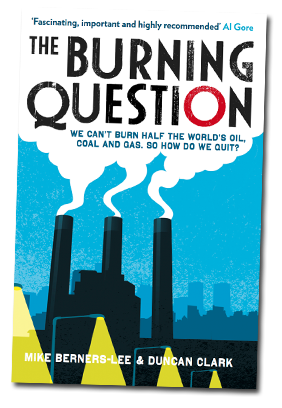
It's a perfect time for "The Burning Question. We Can't Burn Half the World's Oil, Coal and Gas. So How Do We Quit?" - a new book by carbon footprint expert, author and Guardian journalist Mike Berners-Lee. His co-author, Duncan Clark, is a consultant editor for the environment section of the UK's Guardian newspaper, and a visiting researcher at the UCL Energy Institute.
The authors conclude the next economic crash may come when the major fossil fuel companies are forced to revalue drastically downward. Why? If the public cannot stomach a climate of extinction, more than half the fossil fuel reserves of the world must stay in the ground.
Only the business community, pushed by a worried public, can force politicians into the global agreements needed to ensure our survival. So far, Berners-Lee and Clark say, neither conferences, energy efficiency or alternative energy have had slowed the year-by-year growth of greenhouse gas emissions.
We find out more in this feature-length interview of Mike Berners-Lee by UK writer and journalist Greg Moffitt. Greg has written for the BBC and other publications.
Now Moffitt has a regular online radio podcast out of the United Kingdom. He calls it "Legalise Freedom".
As I head out to the hills for my summer vacation, let's listen in as guest host Greg Moffitt turns to the burning question.
Download/listen to this Radio Ecoshock Show in CD Quality or Lo-Fi
Listen to this program right now, courtesy of archive.org
This is a Radio Ecoshock edit of Greg's May 27th show, described as follows:
"Mike Berners-Lee – The Burning Question
May 27, 2013
Mike Berners-Lee discusses The Burning Question, a book co-authored with Duncan Clark.
Climate change is the most fascinating scientific, political and social puzzle of our time. Great minds, enthusiastic leaders and green warriors have all tried to tackle the problem, but so far the world’s efforts at reducing global warming have failed.
We do our best to save energy and technologies have made burning fuels more efficient, but the simple fact is carbon emissions are still accelerating upwards, following an exponential curve that goes back centuries. Like squeezing a balloon, reductions in one place lead to increases elsewhere.
The real barrier to action is that the world has far more fossil fuel in its reserves than it can safely burn – at least twice as much and perhaps ten times as much. These reserves are worth tens of trillions of dollars and solving the problem means persuading the world to abandon them.
The Burning Question asks whether that’s possible and what the side effects might be. Would the global economy sink and oil companies crash as the ‘carbon bubble’ bursts? Or could we transition smoothly to a green future? Looking at the whole issue from a fresh perspective, The Burning Question argues that global warming can still be tackled, but only if humankind wakes up to the threat and demands that the fuels stay in the ground."
Greg Moffitt is a freeland writer, editor and broadcaster. Greg has written for the BBC and other publications. Find him at www.gregmoffitt.com
You may also be interested in Greg Moffitt's interview with controversial deep green author Paul Kingsnorth. It's called "The Myth of Progress."
Find it all at Greg's site legalise-freedom.com. Be sure to use the British spelling of "legalise" with an "s". There is a dash between "legalise" and "freedom".
Maybe it is holiday time in the Northern Hemisphere. But the atmosphere keeps on changing, dragging the climate to places humans have never experienced.
Join us for the ride at Radio Ecoshock. Feel free to support our program at the web site, ecoshock.org.
Thank you for listening - and warming up to the idea of a big, big social change.
I'm Alex Smith. This has been Radio Ecoshock.
Tuesday, July 2, 2013
Preparing Personal Solutions
Are your clothes safe? Alina Bartell, owner of The Natural Clothing Company advises on fabrics, chemicals, and organic clothes. Dr. Joe Alton, MD on learning emergency medicine "when help doesn't come". Woody Tasch helps develop local food with "slow money". Radio Ecoshock 130703 1 hour.
Radio Ecoshock is back with more local solutions for global problems - from the Mother Earth News Fair.
This time I've picked three of the most intriguing interviews. Each seemed at first like a small problem, and each guest - all feature speakers at the Fair - takes us much deeper, into the industrial and financial mess - and out again with practical things we can do.
DOWNLOAD/LISTEN TO THIS RADIO ECOSHOCK SHOW in CD Quality (56 MB) or Lo-Fi (14 MB)
Download/listen to my interview on organic clothes with Alina Bartell in CD Quality or Lo-Fi
Download/listen to Joe Alton, MD on emergency medicine in CD Quality or Lo-Fi
Download/listen to Woody Tasch on "Slow Money" in CD Quality or Lo-Fi
LISTEN TO THIS RADIO ECOSHOCK SHOW RIGHT NOW (courtesy of archive.org)
ORGANIC CLOTHING - ALINA BARTELL

Alina Bartell surprised me. I mean, do we really need "organic clothes"? Our discussion went from the poisoned fields of Asia and Central America through the industrial fashion machine that feeds the store shelves. The Earth and the workers are damaged at every step.
"Organic" clothing means more to Alina than just a lack of chemicals when you buy it, although that's important too. She started her search for safe clothing after her son developed difficulties. Alina and her husband moved to the country, changed to the purist possible foods, and their child improved.
But many Americans suffer from allergies and skin reactions to the chemicals used in clothing manufacturing. There is a residue of pesticides. Did you know that cotton is the most sprayed crop in the world? Alina tells us cotton occupies only 3% of farm land, but uses almost 25% of farm chemicals. It is not uncommon for pesticides to be sprayed on cotton while workers are in the fields below. There are very high disease rates, especially cancers, in some cotton growing areas.
Since the seventeen hundreds, woven materials like cotton have been treated to make the fabric strong enough to handle machine handling. It is called "sizing" and it used to be common starch. Now sizing is a wide-ranging combination of chemicals. That is why we know enough to at least wash a new shirt of dress before wearing it.
Rayon is made out of wood, combined with chemicals to press it out into fabric. Where did that wood come from? Alina says wood fabric like Rayon can come from sustainable forestry. Or you can buy clothes made out of bamboo. I felt a bamboo t-shirt, and it was soft like very fine cotton.
That is preferable to all-oil fabrics like nylon or polyester. These are made straight from crude oil - not a bi-product, but from crude oil. Did you know nylon manufacturing is a major, MAJOR source of greenhouse gas emissions?
We all need clothes, and every type of fabric comes with it's costs and compromises. The best we can do, Bartell says, is find out where the fabric comes from, was it made safely and ethically? Is it chemical-free?
Apparently the market for organic clothing has not yet taken off. There are only a few organic cotton producers left in America, for example. You will pay more for organic clothing - but the earth benefits, and the clothes should last a long time if well cared for.
You can contact Alina Bartell for more information at her web site.
EMERGENCY MEDICINE - WHY IS IS SUCH A SECRET? JOE ALTON MD

Joe Alton MD
I'll be frank. At first I thought Dr. Joe Alton, and his wife "Nurse Amy" were kind of fringe characters. Having met Joe, and listened to his story, I've changed my mind.
Alton and Amy put out a series of You tube videos under the name "Doom and Bloom". The bloom part came from their origins as gardeners. Alton is a Master Gardener in the state of Florida. He's also a genuine surgeon, a fellow of the American College of Surgeons. Amy is a registered practical Nurse, with further training and lots of experience in midwifery.
Their basic premise is our fragile and high-priced medical system (at least in the United States) may not always be there when you need it. Just think of the three days or more in New Orleans after hurricane Katrina. You couldn't call 911. No ambulances were in service, the hospitals were closed. What if a loved one had a huge gash from blown debris? Would you be helpless?
The Altons also worry a financial or political crash could make medical care unavailable. Plus there are homesteaders and farmers who live too far away from a hospital to treat a serious injury.
Now that you think of it, it's a bit strange none of us are taught any health care these days. Schools don't teach it. Maybe as a Scout or a Guide you might learn how to dress a serious wound.
Dr. Joe thinks the medical establishment is holding on to essential information a little too tightly. By all means, he says, if there is a hospital available, seek professional treament from the system. But if not, why no prepare in advance with some training of your own? They have published a handbook called "The Survival Medicine Handbook (2nd edition)."
Here is their You tube video about that book.
As "Dr. Bones" and "Nurse Amy" the pair put out a series of You tubes with basic information we can all understand. Since there has been a heat wave going in the U.S. West, with lots more heat waves to come with climate change, I ask Dr. Joe about the signs and treatment of heat stress and the sometimes fatal heat stroke.
You can learn about that right in this radio interview.
This medical pair also compile lists of equipment you might need to help your family and your neighbors in a disaster. You can complete your own kits, at different levels, using their lists for free. Or you can buy the equipment from them. Some doctors and emergency workers buy their disaster packs to take to developing countries that have been hit with a hurricane, earthquake or other disaster.
My rating: their presentation is quirky but interesting; the information they teach is important. I'm going to take a look at my own medical supplies, and learn what I can from their videos and site materials.
WOODY TASCH AND SLOW MONEY
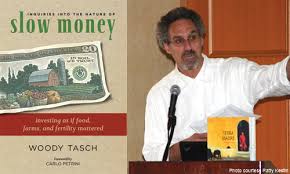
Woody Tasch
Woody Tasch is a man who worked the finance industry, and then reevaluated his life. He longed to find a way to stimulate the growth of local food-sheds, with local finance. That developed into his book "Inquiries into the Nature of Slow Money: Investing as if Food, Farms and Fertility Mattered."
But he didn't stop there. Tasch has crossed the country helping seed slow money organizations. These are non-profits who try various ways to hook up small investors and people in the local food chain. Customers might be a Community Supported Agriculture organization, a small "truck" farmer, an organic dairy, and so on.
The investors are ordinary people who want to put part of their investment money into making sure there is local food that is good to eat. Woody doesn't recommend putting ALL your money into one of these small ventures (he doesn't). He also recommends diversifying, investing in several ventures.
These small loans are kind of the American equivalent to the "Grameen" banks established by Professor Muhammad Yunus in Benglash, and now issuing micro-loans (as little as $50) to people in developing countries all over the world. In the United States a "small loan" might be $14,000 required to buy a used refrigeration truck needed to get produce to the market.
Tasch recommends two different styles of Slow Money. In North Carolina, there is a match-maker linking up investors to food producers needing money. Carol Peppe Hewitt has become a whiz at linking people up. She's written a book "Financing Our Foodshed: Growing Local Food With Slow Money."
At Slow Money Maine, it's a different story. They hold meetings where people looking for small loans make presentations in front of a crowd of possible investors. Slow Money in California does the same, with perhaps a couple of hundred people showing up for a meeting in a tent on a farm.
There has been a national Slow Money conference, where dozens of presenters get five minutes each to make their pitch, hoping to lure the investment money they need.
This isn't a way to get rich. It has risks like any investment - but it's probably no riskier than the stock market. Plus, you are not sending your money to strangers, who may invest in ways to harm the world, on the far side of the Earth. Slow Money investors know exactly who is getting the money, why, and that it will help the local community in eco-safe ways. That's got to be the future of our financial world, if we are going to survive.
Plug in here.
THANK YOU LISTENERS!
My thanks to the listeners who chipped in to pay my gas to the Mother Earth News Fair. We ended up with a bounty of interviews with thought-leaders in the underground movement to found a new and sustainable civilization. All these things are seedlings now, but they will grow into mighty things.
You can support Radio Ecoshock by telling your friends about us. Feel free to share or re-broadcast any part of this program for non-profit use. You can donate at our web site at ecoshock.org or at the top right side of this blog.
I'm also asking you to support your non-profit radio station that takes this message out to three continents. Many stations are struggling to pay their costs, even with few staff, or all-volunteers. You never know how many people your donation to a college or community radio station might reach. Your pledge of support can change minds, and change lives. Please put your money where your ears are. Here are the stations that carry Radio Ecoshock.
My special thanks to all the listeners who send me links and suggestions for Radio Ecoshock. I couldn't do it without you. Write me any time. The address is radio [at] ecoshock dot org.
I'm Alex Smith. Let's meet again next week.
Radio Ecoshock is back with more local solutions for global problems - from the Mother Earth News Fair.
This time I've picked three of the most intriguing interviews. Each seemed at first like a small problem, and each guest - all feature speakers at the Fair - takes us much deeper, into the industrial and financial mess - and out again with practical things we can do.
DOWNLOAD/LISTEN TO THIS RADIO ECOSHOCK SHOW in CD Quality (56 MB) or Lo-Fi (14 MB)
Download/listen to my interview on organic clothes with Alina Bartell in CD Quality or Lo-Fi
Download/listen to Joe Alton, MD on emergency medicine in CD Quality or Lo-Fi
Download/listen to Woody Tasch on "Slow Money" in CD Quality or Lo-Fi
LISTEN TO THIS RADIO ECOSHOCK SHOW RIGHT NOW (courtesy of archive.org)
ORGANIC CLOTHING - ALINA BARTELL

Alina Bartell surprised me. I mean, do we really need "organic clothes"? Our discussion went from the poisoned fields of Asia and Central America through the industrial fashion machine that feeds the store shelves. The Earth and the workers are damaged at every step.
"Organic" clothing means more to Alina than just a lack of chemicals when you buy it, although that's important too. She started her search for safe clothing after her son developed difficulties. Alina and her husband moved to the country, changed to the purist possible foods, and their child improved.
But many Americans suffer from allergies and skin reactions to the chemicals used in clothing manufacturing. There is a residue of pesticides. Did you know that cotton is the most sprayed crop in the world? Alina tells us cotton occupies only 3% of farm land, but uses almost 25% of farm chemicals. It is not uncommon for pesticides to be sprayed on cotton while workers are in the fields below. There are very high disease rates, especially cancers, in some cotton growing areas.
Since the seventeen hundreds, woven materials like cotton have been treated to make the fabric strong enough to handle machine handling. It is called "sizing" and it used to be common starch. Now sizing is a wide-ranging combination of chemicals. That is why we know enough to at least wash a new shirt of dress before wearing it.
Rayon is made out of wood, combined with chemicals to press it out into fabric. Where did that wood come from? Alina says wood fabric like Rayon can come from sustainable forestry. Or you can buy clothes made out of bamboo. I felt a bamboo t-shirt, and it was soft like very fine cotton.
That is preferable to all-oil fabrics like nylon or polyester. These are made straight from crude oil - not a bi-product, but from crude oil. Did you know nylon manufacturing is a major, MAJOR source of greenhouse gas emissions?
We all need clothes, and every type of fabric comes with it's costs and compromises. The best we can do, Bartell says, is find out where the fabric comes from, was it made safely and ethically? Is it chemical-free?
Apparently the market for organic clothing has not yet taken off. There are only a few organic cotton producers left in America, for example. You will pay more for organic clothing - but the earth benefits, and the clothes should last a long time if well cared for.
You can contact Alina Bartell for more information at her web site.
EMERGENCY MEDICINE - WHY IS IS SUCH A SECRET? JOE ALTON MD

Joe Alton MD
I'll be frank. At first I thought Dr. Joe Alton, and his wife "Nurse Amy" were kind of fringe characters. Having met Joe, and listened to his story, I've changed my mind.
Alton and Amy put out a series of You tube videos under the name "Doom and Bloom". The bloom part came from their origins as gardeners. Alton is a Master Gardener in the state of Florida. He's also a genuine surgeon, a fellow of the American College of Surgeons. Amy is a registered practical Nurse, with further training and lots of experience in midwifery.
Their basic premise is our fragile and high-priced medical system (at least in the United States) may not always be there when you need it. Just think of the three days or more in New Orleans after hurricane Katrina. You couldn't call 911. No ambulances were in service, the hospitals were closed. What if a loved one had a huge gash from blown debris? Would you be helpless?
The Altons also worry a financial or political crash could make medical care unavailable. Plus there are homesteaders and farmers who live too far away from a hospital to treat a serious injury.
Now that you think of it, it's a bit strange none of us are taught any health care these days. Schools don't teach it. Maybe as a Scout or a Guide you might learn how to dress a serious wound.
Dr. Joe thinks the medical establishment is holding on to essential information a little too tightly. By all means, he says, if there is a hospital available, seek professional treament from the system. But if not, why no prepare in advance with some training of your own? They have published a handbook called "The Survival Medicine Handbook (2nd edition)."
Here is their You tube video about that book.
As "Dr. Bones" and "Nurse Amy" the pair put out a series of You tubes with basic information we can all understand. Since there has been a heat wave going in the U.S. West, with lots more heat waves to come with climate change, I ask Dr. Joe about the signs and treatment of heat stress and the sometimes fatal heat stroke.
You can learn about that right in this radio interview.
This medical pair also compile lists of equipment you might need to help your family and your neighbors in a disaster. You can complete your own kits, at different levels, using their lists for free. Or you can buy the equipment from them. Some doctors and emergency workers buy their disaster packs to take to developing countries that have been hit with a hurricane, earthquake or other disaster.
My rating: their presentation is quirky but interesting; the information they teach is important. I'm going to take a look at my own medical supplies, and learn what I can from their videos and site materials.
WOODY TASCH AND SLOW MONEY
Woody Tasch
Woody Tasch is a man who worked the finance industry, and then reevaluated his life. He longed to find a way to stimulate the growth of local food-sheds, with local finance. That developed into his book "Inquiries into the Nature of Slow Money: Investing as if Food, Farms and Fertility Mattered."
But he didn't stop there. Tasch has crossed the country helping seed slow money organizations. These are non-profits who try various ways to hook up small investors and people in the local food chain. Customers might be a Community Supported Agriculture organization, a small "truck" farmer, an organic dairy, and so on.
The investors are ordinary people who want to put part of their investment money into making sure there is local food that is good to eat. Woody doesn't recommend putting ALL your money into one of these small ventures (he doesn't). He also recommends diversifying, investing in several ventures.
These small loans are kind of the American equivalent to the "Grameen" banks established by Professor Muhammad Yunus in Benglash, and now issuing micro-loans (as little as $50) to people in developing countries all over the world. In the United States a "small loan" might be $14,000 required to buy a used refrigeration truck needed to get produce to the market.
Tasch recommends two different styles of Slow Money. In North Carolina, there is a match-maker linking up investors to food producers needing money. Carol Peppe Hewitt has become a whiz at linking people up. She's written a book "Financing Our Foodshed: Growing Local Food With Slow Money."
At Slow Money Maine, it's a different story. They hold meetings where people looking for small loans make presentations in front of a crowd of possible investors. Slow Money in California does the same, with perhaps a couple of hundred people showing up for a meeting in a tent on a farm.
There has been a national Slow Money conference, where dozens of presenters get five minutes each to make their pitch, hoping to lure the investment money they need.
This isn't a way to get rich. It has risks like any investment - but it's probably no riskier than the stock market. Plus, you are not sending your money to strangers, who may invest in ways to harm the world, on the far side of the Earth. Slow Money investors know exactly who is getting the money, why, and that it will help the local community in eco-safe ways. That's got to be the future of our financial world, if we are going to survive.
Plug in here.
THANK YOU LISTENERS!
My thanks to the listeners who chipped in to pay my gas to the Mother Earth News Fair. We ended up with a bounty of interviews with thought-leaders in the underground movement to found a new and sustainable civilization. All these things are seedlings now, but they will grow into mighty things.
You can support Radio Ecoshock by telling your friends about us. Feel free to share or re-broadcast any part of this program for non-profit use. You can donate at our web site at ecoshock.org or at the top right side of this blog.
I'm also asking you to support your non-profit radio station that takes this message out to three continents. Many stations are struggling to pay their costs, even with few staff, or all-volunteers. You never know how many people your donation to a college or community radio station might reach. Your pledge of support can change minds, and change lives. Please put your money where your ears are. Here are the stations that carry Radio Ecoshock.
My special thanks to all the listeners who send me links and suggestions for Radio Ecoshock. I couldn't do it without you. Write me any time. The address is radio [at] ecoshock dot org.
I'm Alex Smith. Let's meet again next week.
Tuesday, June 25, 2013
Start Something to Live For
American author of Aquaponic Gardening Sylvia Bernstein on union of fish and veggies. Publisher of Mother Earth News Bryan Welch's optimism of
non-partisan activism. Canada's oil capital shut down by climate change. Radio Ecoshock 130626 1 hour.
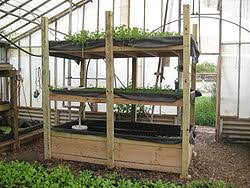
Get ready for your new food source: aquaponics. But first...
HOW THEY SHOULD HAVE REPORTED THE ALBERTA FLOOD NEWS
In Canada, an extreme rainfall event, made worse by a stalled weather system likely powered by an unstable Arctic and climate change, has closed down the country's oil trading capital.
In Calgary Canada, nature accomplished what politics could not. The largest oil company headquarters, including suncor Energy, Imperial Oil and Shell saw their head offices closed, as downtown Calgary was evacuated and left without power for days. Trading in Canadian crude oil stopped.
Alberta towns more than a hundred years old were evacuated, flooded, and wrecked. At least 75,000 people in the major oil-trading capital of Calgary were ordered out of their homes. Most of them do not have any flood insurance, as "over-land" insurance is no longer sold in Canada following the previous record flood of 2005. Billions of dollars of damage to homes, businesses, roads, bridges and all kinds of infrastructure occurred.
The TransCanada highway connecting to the West Coast was shut down for days.
The oil-promoter in Chief, Canadian Prime Minister Stephen Harper flew to his hometown of Calgary, clearly shocked that climate change could affect Alberta itself.
"I’ve seen a little bit of flooding in Calgary before,” he said. “I don’t think any of us have seen anything like this.”
Perhaps if Harper had not shut down climate research facilities, including the Polar research station, and muzzled Canadian climate scientists, he might have heard about research from Rutgers University (Jennifer Francis) showing Jet Stream patterns were stalling due to melting Arctic sea ice. Extreme precipitation events are happening all over the world. Even in Alberta.
The Premier of the Canadian province of Alberta, Alison Redford flew back from New York, where she was promoting the Keystone XL pipeline to ship polluting Tar Sands oil to the United States. She too was shocked at the devastation. Who could have guessed an over-heated atmosphere could hold so much water?
WHY CAN'T THEY TELL THE PEOPLE ABOUT CLIMATE CHANGE?
Canadian television anchors and reporters were unable to utter the words "climate change" or "extreme precipitation event" - even as similar floods hit Europe and India. The CTV network reported the strange "blocking high" heating Eastern Canada with summer, while keeping a swirl of storms and extreme rain in the West. The stalled Jet Stream appeared on the map, without explanation.
I'm Alex Smith. This is Radio Ecoshock telling it like it is.
Later we'll hear one brief radio clip, the only major media report I could find, telling Canadians the real cause of the "weird weather" that strikes again and again, now as the new normal.
But first, let's get back to basic solutions for right living.
We'll start with my interview with one of the North American pioneers of a brand new method of clean food production, aquaponics. It has just arrived in North America. I predict within ten years you will be buying organic local produce and fresh fish from neighborhood fish and veggie operations. Or maybe you'll grow it all yourself in your own back yard. Sylvia Bernstein, author of Aquaponic Gardening tells us how.
Later we'll talk with the driving force behind the world's largest outlet for sustainable living: Bryan Welch. He's the CEO of Ogden Publications, publisher of The Mother Earth News, the Utne Reader, and Grit. Bryan explains his optimism in dark times, and why we need it to change the world into the lives we want.
FREE AUDIO DOWNLOADS FOR THIS PROGRAM
Listen to/download this Radio Ecoshock Show in CD Quality or Lo-Fi
Listen to/download my interview with Sylvia Bernstein on aquaponics in CD Quality or Lo-Fi
Listen to/download my interview with Bryan Welch, publisher of Mother Earth News in CD Quality or Lo-Fi
Please go ahead and share, Facebook or Tweet these links to anyone you think would be interested!
LISTEN DO THIS PROGRAM RIGHT NOW (Courtesy of archive.org)
SYLVIA BERNSTEIN: FISH AND FOOD TOGETHER
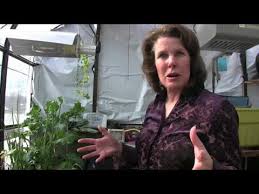
Sylvia Bernstein in her aquaponic greenhouse in Colorado.
A Google search for "aquaponics" brings about 3,380,000 results. And yet the field is less than five years old in America, maybe 15 years in North America.
Of course, as listener and song-writer Smokey Dymny points out "Chapter 13 of Bill Mollison's Permaculture, A Designer's Manual (1988) laid this methodology out in detail. Permaculture magazines and teaching institutes have followed up with up to date developments in the years since." The permaculture folks used ponds and planting together.
But aquaponics adds a new methodology, growing plants in media like gravel, rather than soil ("hydroponics") and delivering the fish effluent directly to the plant roots in a systematic way.
Here are a few informal notes on the History of Aquaculture from my talk with Sylvia Bernstein, author of Aquaponic Gardening - the premiere book on the subject in North America.
NOTES ON THE HISTORY OF AQUACULTURE
Fish have been feeding land plants since time immemorial, especially when we consider floods. Perhaps the Hanging Gardens of Babylon was an example of the earliest civilized aquaponics. Wiki suggests the Aztecs or people of South China and Thailand practiced a form of aquaponics.
"The development of modern aquaponics is often attributed to the various works of the New Alchemy Institute and the works of Dr. Mark McMurtry et al. at the North Carolina State University.[10] Inspired by the successes of the New Alchemy Institute, and the reciprocating aquaponics techniques developed by Dr. Mark McMurtry et al., other institutes soon followed suit. Starting in 1997, Dr. James Rakocy and his colleagues at the University of the Virgin Islands researched and developed the use of deep water culture hydroponic grow beds in a large-scale aquaponics system.[9]"
- Wikipedia
THE CANADIAN CONNECTION - AQUAPONICS IN ALBERTA
"The first aquaponics research in Canada was a small system added onto existing aquaculture research at a research station in Lethbridge, Alberta. Canada saw a rise in aquaponics setups throughout the ’90s, predominantly as commercial installations raising high-value crops such as trout and lettuce. A setup based on the deep water system developed at the University of Virgin Islands was built in a greenhouse at Brooks, Alberta where Dr. Nick Savidov and colleagues researched aquaponics from a background of plant science. The team made findings on rapid root growth in aquaponics systems and on closing the solid-waste loop, and found that owing to certain advantages in the system over traditional aquaculture, the system can run well at a low pH level, which is favoured by plants but not fish.
The Edmonton Aquaponics Society in Northern Alberta is adapting Dr. Savidov's commercially sized system to a smaller-scale prototype that can be operated by families, small groups, or restaurants. They intend to further develop the closed solid waste loop.[11]" - Wikipedia on Aquaponics
AUSTRALIA
Here is a large helpful site based on the back yard experimental movement in Australia.
We didn't have time to go into the important role Australians played in developing aquaponics. The Aussies experimented and really made it happen. I doubt we'd have current results without the Australian role. But the real founder of aquaponics is...
JAMES RAKOCY
The modern practice really began from research starting only 30 years ago, principally by Dr. James Rakocy at the University of the Virgin Islands. Rakocy was an aquaculture specialist who looked at ways to use plants to filter water for fish. "Waste in a contained aquaculture system is a big problem" says Bernstein. People had used water hyacinths to filter fish waste, but Rakocy thought why not grow food instead, like lettuce or tomatoes? That innovation started modern aquaponics.
His system was commercially oriented, called deep water raft-based production.
Rakocy is now retired, after a 30 year career. In the meantime, there was grass-roots experiments in Australia about home and back yard aquaponic gardening. That was more focused on using gravel. Modern aquaponics developed mainly in Australia around 2001 - and became popular in the United States only in the past 3 or 4 years.
Wiki lists ten key principles of aquaponics developed by Dr. Rakocy:
"Ten primary guiding principles for creating successful aquaponics systems were issued by Dr. James Rakocy, the director of the aquaponics research team at the University of the Virgin Islands, based on extensive research done as part of the Agricultural Experiment Station aquaculture program.
“Use a feeding rate ratio for design calculations
Keep feed input relatively constant
Supplement with calcium, potassium and iron
Ensure good aeration
Remove solids
Be careful with aggregates
Oversize pipes
Use biological pest control
Ensure adequate biofiltration
Control pH"
- Wikipedia
SYLVIA BERNSTEIN - TRAILBLAZER
Sylvia Bernstein's 2009 book was first widely available book about aquaponics. It is called "Aquaponic Gardening, A Step-By-Step Guide To Raising Vegetables And Fish Together." Find it on Amazon here.
Sylvia Bernstein runs this helpful site with lots of aquaponics info.
Her main web site is: theaquaponicsource.com
Sylvia also plays a pivotal role in a new organization, the Aquaponics Association, founded just about 2 years ago.
They have held conventions for "aquapons" as they call themselves. The next is the 2013 Conference in September 20-22nd in Tucson Arizona, with Joel Salatin as lead speaker.
It is rare for aquaponic practitioners to meet in person. Most of the development and skill sharing for this new field was developed on the Internet. It's an amazing hybrid of high tech communication enabling a new type of safe food production at a time we need it badly.
Their first conference was in Orlando Florida 2 and a half years ago, leading to the founding of this association. They have almost 500 members now and still growing.
In our interview, we also discuss recycling an "IBC Tote" to make fish tanks on the cheap. IBC stands for Intermediate Bulk Container. One whole IBC tote can be made into a 275 gallon fish tank. Or cut it in half to make two grow beds out of it.
But Bernstein warns to check carefully what was stored in that tote before - it must be food stuffs, and not toxic chemicals! Also, the PH of the fish water/plant solution is very important, and so the tote cannot have carried high or low PH chemicals. You can also use blue plastic storage barrels.
Some fish will grow bigger and faster than others, so they don't all mature as a single crop like veggies (at least that's true with tilapia). We also discuss other fish that are more tolerant of cold water, like cat fish and trout, for folks living further north. In Colorado, Sylvia brings her fish tank indoors, from her outdoor greenhouse, during the winter months.
The fish do not smell, just as any other aquarium does not smell. You could do the whole operation indoors, say in a basement, with grow-lights for the plants.
BEYOND THE FISH
The fish are intriguing (and tasty!) - but don't forget the fantastic results aquaponic growers get with fast-growing production in the plant side of things.
The plant roots are not always submerged in water, but are flooded with nutrients and then drained for air, automatically in repeating cycles - assuming you are using a media like gravel, and not a raft-based deep water culture.
Because the plants get lots of oxygen, water, and abundunt food - they don't have to focus energy on developing large root systems. Their roots may be quite small, and that energy goes into the leaves or fruits we want.
Sylvia adds composting red worms to her media.
There is a wave of interest in America in aquaponics for several reasons - chief among them being food security and food sovereignty. The government is not protecting our food supplies from GMO's, pesticides, hormones and toxic chemicals. Aquaponic production guarantees real organic food safety.
Sylvia is worried about climate change and it's impacts on mass food production. Aquaponics lets her produce her own supply of safe food. Plus...it's fun and good for the mind. Her greenhouse is so alive - with water flowing, fish, plants growing. Also, aquaponics is fantastic teaching tool for neighbors and children to learn biology and natural ecosystem interdependence.
When Sylvia studied agricultural economics at UC Davis, there was no sense of this delicate balance of natural systems. They learned to add chemicals, but never the consequences, like impacts on groundwater, rivers, and dead zones in the oceans.
Her site theaquaponicsource.com has plenty of free info and a community board. But they also have a store where they sell parts, or even a complete turn-key system if you are not the do-it-yourself kind of person, or do not have the time to set one up from scratch.
OTHER NOTES AND SOURCES ON AQUAPONICS
Find lots of photos of aquaponics experiments at the University of Arizona here.
Note lack of phosphorus in aquaponics system leads to use of greens like lettuce.
"Plant crops in aquaponics are usually limited to lettuce and other leafy crops, since they readily use the nitrogen available as a waste in aquaculture systems but don't need phosphorus (which is not present in aquaculture systems) as many fruiting plants do."
- U of Arizona
But Rakocy grew tomatoes as well... he added calcium, potassium and iron.
Here is a You tube video of Sylvia explaining aquaponics, created by thedailycamera.com
For three bucks you can get a .pdf download with tons of links for aquaponics, from the National sustainable Agriculture Information Service, here.
... and just search for "aquaponics" on You tube to watch hours of people just like yourself, setting up this new form of food production. It's very educational, and very possible.
MORE ON THE CALGARY FLOODS - I WAS THERE
Before we continue with our drive toward a sustainable world, let's take another quick moment to reflect on the dying path of fossil fuel destruction. Perhaps you've heard the Calgary, the oil-capital of Canada, was more or less shut down by flash flooding and over-flowing rivers.
As fate would have it, I was in Calgary on the night of Wednesday June 19th, as the black skies filled with thunder for almost a dozen hours. Sheets or rain, torrents of rain drenched the city. All the foothills let loose, creeks became rivers, rivers became fast-running lakes filling streets, homes, entire neighborhoods and towns. Fearing the water supply would become contaminated, there was panic buying of bottled water, until the shelves ran dry. As always, few were ready for an extreme rainfall event in the dry prairie.
Alberta is rich with wealth from the oil wells and the Tar Sands. But even that economy will reel from the billions of dollars of uninsured losses. The famous Calgary Stampede looked doubtful, as major stadiums, parks, and the downtown core flooded. Apartment towers stood empty in the dark.
The ruling party of Canada, the party of climate denial, was due to convene their annual conference in Calgary the next week. That was postponed.
Here is a brief clip from the government-supported Canadian Broadcasting Corporation, the program Current Events hosted by Anna Maria Tremonti. It's possibly the only report from a climate scientist in the days of non-stop coverage of the Alberta floods. The speaker is Robert Sandford, the EPCOR Chair supporting the United Nations "Water for Life" Decade.
[Excerpt from podcast interview with Bob Sanford and host Anna Maria Tremonti from the The Current, episode "Severe flooding in southern Alberta" from June 21, 2013. Find it here.]
That was Robert Sandford, explaining the science behind extreme rainfall events due to climate change. Even he did not have the courage to suggest we must reduce our emissions of fossil fuels as a solution, speaking instead of adapting to wilder climate swings.
NASA in America, hardly a radical source, confirms we can expect more extreme rainfall events due to climate change. And in this third warmest May recorded since temperature records were kept on planet Earth, flooding in Central Europe cost $22 billion dollars! The Alberta flooding will cost billions of dollars, being likely the most expensive "natural" disaster in Canada's history. Read this story of Calgary's "Manhattan moment" by Andrew Nikiforuk.
Enough. The same madness of denial goes on all over the world. In my opinion, all we can do as individuals who know that physics and nature will not be denied, is to keep pushing the movement toward a sane sustainable society. We are about to talk to an optimist driven by the vision it can be done.
BRYAN WELCH - PUBLISHER OF MOTHER EARTH NEWS

Bryan Welch, publisher and editorial director of Ogden Publications.
This is my second interview with Bryan Welch, the powerhouse behind the Mother Earth News, Mother Earth Living, the Utne Reader and Grit. In addition to his active editorial role in the Mother Earth News, Bryan is CEO of the parent company Odgen Publications. He's right to say that company is the largest media force for sustainable living in the world.
Our first interview was about his book "Beautiful and Abundant, Building the World We Want". It's done very well - but to be honest, I had a hard time agreeing with his positive message, given the flood of bad news I cover on Radio Ecoshock. Plus, as a green, selling "abundance" to the American people seemed like a bad idea. We didn't end on a happy note.
This time, I was in a better space, and understood what Bryan is really trying to say.
As an example: who is reading Mother Earth News? Surely it's mostly liberals, Democrats, environmentalists? Not really Welch tells us in this interview. People who want better food and more self reliance may very well be Conservative, even Republicans. Welch feels he can get the message of sustainability out to a much wider audience if the politics are left out of the mix. That's my take anyway.
As to the idea of abundance, he's not talking about more useless shopping for stuff. It may well be abundance of community relations, of innovation. But we can't have that abundance, he tells us, unless we control population.
I raise the caveat that is we also demand beauty, there should be no dark, ugly holes hidden in the process of our society. For me, that means no destructive strip mining in the Tar Sands or Appalachia, or dangerous tanks of radioactive waste, behind our production and consumption. There should be beauty all the way.
Bryan explains why, despite the flow of negative reports in the media, we may be living in one of the better times for humanity.
This interview was less of a wrestling match, I felt, and better communication of Bryan's vision - which does lead to so much good information and alternative community action in his various publications. Bryan explains his philosophy here, and of course in his book.
Do I agree with everything Bryan Welch, or any of my guests say? Maybe you will disagree with some things. Radio Ecoshock is not a show where guests express my own personal state of mind. It is a platform, your platform, supported by you the listener, to hear the visionary voices, and the real do-ers, helping you make your own life choices.
This is a thought-provoking interview, well worth your time.
Visit Bryan Welch's blog on Mother Earth News here.
THANKS FOR LISTENING - AND PLEASE SUPPORT THE PROGRAM
Thank you for listening, and being part of Radio Ecoshock. Find out how to support this program at our web site ecoshock.org. Your donations and memberships keep me going.
It also helps me pay for the tons of green audio files we offer on our web site, and from this blog. Downloads cost money, and we get thousands of shows downloaded every week.
I'm Alex Smith. If anything you hear on Radio Ecoshock makes you part of the solution, my job is done. Let's meet again next week.
THEME SONG FOR THIS PROGRAM
We end the program with the hit song "Something To Live For" by Vancouver's own Barney Bentall and the Legendary Hearts.
Barney has a fascinating story. He came from an extremely wealthy family, and could have made his own fortune in the family business. Instead, he was lured into Rock and Roll. Not only did Bentall make many of his own hits, and play concerts around the world, he has appeared as a back-up musician for many of the world's most famous artists. Barney Bentall has also supported many non-profit and fund-raising events around Vancouver - so he really does have a "legendary heart".
Get ready for your new food source: aquaponics. But first...
HOW THEY SHOULD HAVE REPORTED THE ALBERTA FLOOD NEWS
In Canada, an extreme rainfall event, made worse by a stalled weather system likely powered by an unstable Arctic and climate change, has closed down the country's oil trading capital.
In Calgary Canada, nature accomplished what politics could not. The largest oil company headquarters, including suncor Energy, Imperial Oil and Shell saw their head offices closed, as downtown Calgary was evacuated and left without power for days. Trading in Canadian crude oil stopped.
Alberta towns more than a hundred years old were evacuated, flooded, and wrecked. At least 75,000 people in the major oil-trading capital of Calgary were ordered out of their homes. Most of them do not have any flood insurance, as "over-land" insurance is no longer sold in Canada following the previous record flood of 2005. Billions of dollars of damage to homes, businesses, roads, bridges and all kinds of infrastructure occurred.
The TransCanada highway connecting to the West Coast was shut down for days.
The oil-promoter in Chief, Canadian Prime Minister Stephen Harper flew to his hometown of Calgary, clearly shocked that climate change could affect Alberta itself.
"I’ve seen a little bit of flooding in Calgary before,” he said. “I don’t think any of us have seen anything like this.”
Perhaps if Harper had not shut down climate research facilities, including the Polar research station, and muzzled Canadian climate scientists, he might have heard about research from Rutgers University (Jennifer Francis) showing Jet Stream patterns were stalling due to melting Arctic sea ice. Extreme precipitation events are happening all over the world. Even in Alberta.
The Premier of the Canadian province of Alberta, Alison Redford flew back from New York, where she was promoting the Keystone XL pipeline to ship polluting Tar Sands oil to the United States. She too was shocked at the devastation. Who could have guessed an over-heated atmosphere could hold so much water?
WHY CAN'T THEY TELL THE PEOPLE ABOUT CLIMATE CHANGE?
Canadian television anchors and reporters were unable to utter the words "climate change" or "extreme precipitation event" - even as similar floods hit Europe and India. The CTV network reported the strange "blocking high" heating Eastern Canada with summer, while keeping a swirl of storms and extreme rain in the West. The stalled Jet Stream appeared on the map, without explanation.
I'm Alex Smith. This is Radio Ecoshock telling it like it is.
Later we'll hear one brief radio clip, the only major media report I could find, telling Canadians the real cause of the "weird weather" that strikes again and again, now as the new normal.
But first, let's get back to basic solutions for right living.
We'll start with my interview with one of the North American pioneers of a brand new method of clean food production, aquaponics. It has just arrived in North America. I predict within ten years you will be buying organic local produce and fresh fish from neighborhood fish and veggie operations. Or maybe you'll grow it all yourself in your own back yard. Sylvia Bernstein, author of Aquaponic Gardening tells us how.
Later we'll talk with the driving force behind the world's largest outlet for sustainable living: Bryan Welch. He's the CEO of Ogden Publications, publisher of The Mother Earth News, the Utne Reader, and Grit. Bryan explains his optimism in dark times, and why we need it to change the world into the lives we want.
FREE AUDIO DOWNLOADS FOR THIS PROGRAM
Listen to/download this Radio Ecoshock Show in CD Quality or Lo-Fi
Listen to/download my interview with Sylvia Bernstein on aquaponics in CD Quality or Lo-Fi
Listen to/download my interview with Bryan Welch, publisher of Mother Earth News in CD Quality or Lo-Fi
Please go ahead and share, Facebook or Tweet these links to anyone you think would be interested!
LISTEN DO THIS PROGRAM RIGHT NOW (Courtesy of archive.org)
SYLVIA BERNSTEIN: FISH AND FOOD TOGETHER
Sylvia Bernstein in her aquaponic greenhouse in Colorado.
A Google search for "aquaponics" brings about 3,380,000 results. And yet the field is less than five years old in America, maybe 15 years in North America.
Of course, as listener and song-writer Smokey Dymny points out "Chapter 13 of Bill Mollison's Permaculture, A Designer's Manual (1988) laid this methodology out in detail. Permaculture magazines and teaching institutes have followed up with up to date developments in the years since." The permaculture folks used ponds and planting together.
But aquaponics adds a new methodology, growing plants in media like gravel, rather than soil ("hydroponics") and delivering the fish effluent directly to the plant roots in a systematic way.
Here are a few informal notes on the History of Aquaculture from my talk with Sylvia Bernstein, author of Aquaponic Gardening - the premiere book on the subject in North America.
NOTES ON THE HISTORY OF AQUACULTURE
Fish have been feeding land plants since time immemorial, especially when we consider floods. Perhaps the Hanging Gardens of Babylon was an example of the earliest civilized aquaponics. Wiki suggests the Aztecs or people of South China and Thailand practiced a form of aquaponics.
"The development of modern aquaponics is often attributed to the various works of the New Alchemy Institute and the works of Dr. Mark McMurtry et al. at the North Carolina State University.[10] Inspired by the successes of the New Alchemy Institute, and the reciprocating aquaponics techniques developed by Dr. Mark McMurtry et al., other institutes soon followed suit. Starting in 1997, Dr. James Rakocy and his colleagues at the University of the Virgin Islands researched and developed the use of deep water culture hydroponic grow beds in a large-scale aquaponics system.[9]"
- Wikipedia
THE CANADIAN CONNECTION - AQUAPONICS IN ALBERTA
"The first aquaponics research in Canada was a small system added onto existing aquaculture research at a research station in Lethbridge, Alberta. Canada saw a rise in aquaponics setups throughout the ’90s, predominantly as commercial installations raising high-value crops such as trout and lettuce. A setup based on the deep water system developed at the University of Virgin Islands was built in a greenhouse at Brooks, Alberta where Dr. Nick Savidov and colleagues researched aquaponics from a background of plant science. The team made findings on rapid root growth in aquaponics systems and on closing the solid-waste loop, and found that owing to certain advantages in the system over traditional aquaculture, the system can run well at a low pH level, which is favoured by plants but not fish.
The Edmonton Aquaponics Society in Northern Alberta is adapting Dr. Savidov's commercially sized system to a smaller-scale prototype that can be operated by families, small groups, or restaurants. They intend to further develop the closed solid waste loop.[11]" - Wikipedia on Aquaponics
AUSTRALIA
Here is a large helpful site based on the back yard experimental movement in Australia.
We didn't have time to go into the important role Australians played in developing aquaponics. The Aussies experimented and really made it happen. I doubt we'd have current results without the Australian role. But the real founder of aquaponics is...
JAMES RAKOCY
The modern practice really began from research starting only 30 years ago, principally by Dr. James Rakocy at the University of the Virgin Islands. Rakocy was an aquaculture specialist who looked at ways to use plants to filter water for fish. "Waste in a contained aquaculture system is a big problem" says Bernstein. People had used water hyacinths to filter fish waste, but Rakocy thought why not grow food instead, like lettuce or tomatoes? That innovation started modern aquaponics.
His system was commercially oriented, called deep water raft-based production.
Rakocy is now retired, after a 30 year career. In the meantime, there was grass-roots experiments in Australia about home and back yard aquaponic gardening. That was more focused on using gravel. Modern aquaponics developed mainly in Australia around 2001 - and became popular in the United States only in the past 3 or 4 years.
Wiki lists ten key principles of aquaponics developed by Dr. Rakocy:
"Ten primary guiding principles for creating successful aquaponics systems were issued by Dr. James Rakocy, the director of the aquaponics research team at the University of the Virgin Islands, based on extensive research done as part of the Agricultural Experiment Station aquaculture program.
“Use a feeding rate ratio for design calculations
Keep feed input relatively constant
Supplement with calcium, potassium and iron
Ensure good aeration
Remove solids
Be careful with aggregates
Oversize pipes
Use biological pest control
Ensure adequate biofiltration
Control pH"
- Wikipedia
SYLVIA BERNSTEIN - TRAILBLAZER
Sylvia Bernstein's 2009 book was first widely available book about aquaponics. It is called "Aquaponic Gardening, A Step-By-Step Guide To Raising Vegetables And Fish Together." Find it on Amazon here.
Sylvia Bernstein runs this helpful site with lots of aquaponics info.
Her main web site is: theaquaponicsource.com
Sylvia also plays a pivotal role in a new organization, the Aquaponics Association, founded just about 2 years ago.
They have held conventions for "aquapons" as they call themselves. The next is the 2013 Conference in September 20-22nd in Tucson Arizona, with Joel Salatin as lead speaker.
It is rare for aquaponic practitioners to meet in person. Most of the development and skill sharing for this new field was developed on the Internet. It's an amazing hybrid of high tech communication enabling a new type of safe food production at a time we need it badly.
Their first conference was in Orlando Florida 2 and a half years ago, leading to the founding of this association. They have almost 500 members now and still growing.
In our interview, we also discuss recycling an "IBC Tote" to make fish tanks on the cheap. IBC stands for Intermediate Bulk Container. One whole IBC tote can be made into a 275 gallon fish tank. Or cut it in half to make two grow beds out of it.
But Bernstein warns to check carefully what was stored in that tote before - it must be food stuffs, and not toxic chemicals! Also, the PH of the fish water/plant solution is very important, and so the tote cannot have carried high or low PH chemicals. You can also use blue plastic storage barrels.
Some fish will grow bigger and faster than others, so they don't all mature as a single crop like veggies (at least that's true with tilapia). We also discuss other fish that are more tolerant of cold water, like cat fish and trout, for folks living further north. In Colorado, Sylvia brings her fish tank indoors, from her outdoor greenhouse, during the winter months.
The fish do not smell, just as any other aquarium does not smell. You could do the whole operation indoors, say in a basement, with grow-lights for the plants.
BEYOND THE FISH
The fish are intriguing (and tasty!) - but don't forget the fantastic results aquaponic growers get with fast-growing production in the plant side of things.
The plant roots are not always submerged in water, but are flooded with nutrients and then drained for air, automatically in repeating cycles - assuming you are using a media like gravel, and not a raft-based deep water culture.
Because the plants get lots of oxygen, water, and abundunt food - they don't have to focus energy on developing large root systems. Their roots may be quite small, and that energy goes into the leaves or fruits we want.
Sylvia adds composting red worms to her media.
There is a wave of interest in America in aquaponics for several reasons - chief among them being food security and food sovereignty. The government is not protecting our food supplies from GMO's, pesticides, hormones and toxic chemicals. Aquaponic production guarantees real organic food safety.
Sylvia is worried about climate change and it's impacts on mass food production. Aquaponics lets her produce her own supply of safe food. Plus...it's fun and good for the mind. Her greenhouse is so alive - with water flowing, fish, plants growing. Also, aquaponics is fantastic teaching tool for neighbors and children to learn biology and natural ecosystem interdependence.
When Sylvia studied agricultural economics at UC Davis, there was no sense of this delicate balance of natural systems. They learned to add chemicals, but never the consequences, like impacts on groundwater, rivers, and dead zones in the oceans.
Her site theaquaponicsource.com has plenty of free info and a community board. But they also have a store where they sell parts, or even a complete turn-key system if you are not the do-it-yourself kind of person, or do not have the time to set one up from scratch.
OTHER NOTES AND SOURCES ON AQUAPONICS
Find lots of photos of aquaponics experiments at the University of Arizona here.
Note lack of phosphorus in aquaponics system leads to use of greens like lettuce.
"Plant crops in aquaponics are usually limited to lettuce and other leafy crops, since they readily use the nitrogen available as a waste in aquaculture systems but don't need phosphorus (which is not present in aquaculture systems) as many fruiting plants do."
- U of Arizona
But Rakocy grew tomatoes as well... he added calcium, potassium and iron.
Here is a You tube video of Sylvia explaining aquaponics, created by thedailycamera.com
For three bucks you can get a .pdf download with tons of links for aquaponics, from the National sustainable Agriculture Information Service, here.
... and just search for "aquaponics" on You tube to watch hours of people just like yourself, setting up this new form of food production. It's very educational, and very possible.
MORE ON THE CALGARY FLOODS - I WAS THERE
Before we continue with our drive toward a sustainable world, let's take another quick moment to reflect on the dying path of fossil fuel destruction. Perhaps you've heard the Calgary, the oil-capital of Canada, was more or less shut down by flash flooding and over-flowing rivers.
As fate would have it, I was in Calgary on the night of Wednesday June 19th, as the black skies filled with thunder for almost a dozen hours. Sheets or rain, torrents of rain drenched the city. All the foothills let loose, creeks became rivers, rivers became fast-running lakes filling streets, homes, entire neighborhoods and towns. Fearing the water supply would become contaminated, there was panic buying of bottled water, until the shelves ran dry. As always, few were ready for an extreme rainfall event in the dry prairie.
Alberta is rich with wealth from the oil wells and the Tar Sands. But even that economy will reel from the billions of dollars of uninsured losses. The famous Calgary Stampede looked doubtful, as major stadiums, parks, and the downtown core flooded. Apartment towers stood empty in the dark.
The ruling party of Canada, the party of climate denial, was due to convene their annual conference in Calgary the next week. That was postponed.
Here is a brief clip from the government-supported Canadian Broadcasting Corporation, the program Current Events hosted by Anna Maria Tremonti. It's possibly the only report from a climate scientist in the days of non-stop coverage of the Alberta floods. The speaker is Robert Sandford, the EPCOR Chair supporting the United Nations "Water for Life" Decade.
[Excerpt from podcast interview with Bob Sanford and host Anna Maria Tremonti from the The Current, episode "Severe flooding in southern Alberta" from June 21, 2013. Find it here.]
That was Robert Sandford, explaining the science behind extreme rainfall events due to climate change. Even he did not have the courage to suggest we must reduce our emissions of fossil fuels as a solution, speaking instead of adapting to wilder climate swings.
NASA in America, hardly a radical source, confirms we can expect more extreme rainfall events due to climate change. And in this third warmest May recorded since temperature records were kept on planet Earth, flooding in Central Europe cost $22 billion dollars! The Alberta flooding will cost billions of dollars, being likely the most expensive "natural" disaster in Canada's history. Read this story of Calgary's "Manhattan moment" by Andrew Nikiforuk.
Enough. The same madness of denial goes on all over the world. In my opinion, all we can do as individuals who know that physics and nature will not be denied, is to keep pushing the movement toward a sane sustainable society. We are about to talk to an optimist driven by the vision it can be done.
BRYAN WELCH - PUBLISHER OF MOTHER EARTH NEWS
Bryan Welch, publisher and editorial director of Ogden Publications.
This is my second interview with Bryan Welch, the powerhouse behind the Mother Earth News, Mother Earth Living, the Utne Reader and Grit. In addition to his active editorial role in the Mother Earth News, Bryan is CEO of the parent company Odgen Publications. He's right to say that company is the largest media force for sustainable living in the world.
Our first interview was about his book "Beautiful and Abundant, Building the World We Want". It's done very well - but to be honest, I had a hard time agreeing with his positive message, given the flood of bad news I cover on Radio Ecoshock. Plus, as a green, selling "abundance" to the American people seemed like a bad idea. We didn't end on a happy note.
This time, I was in a better space, and understood what Bryan is really trying to say.
As an example: who is reading Mother Earth News? Surely it's mostly liberals, Democrats, environmentalists? Not really Welch tells us in this interview. People who want better food and more self reliance may very well be Conservative, even Republicans. Welch feels he can get the message of sustainability out to a much wider audience if the politics are left out of the mix. That's my take anyway.
As to the idea of abundance, he's not talking about more useless shopping for stuff. It may well be abundance of community relations, of innovation. But we can't have that abundance, he tells us, unless we control population.
I raise the caveat that is we also demand beauty, there should be no dark, ugly holes hidden in the process of our society. For me, that means no destructive strip mining in the Tar Sands or Appalachia, or dangerous tanks of radioactive waste, behind our production and consumption. There should be beauty all the way.
Bryan explains why, despite the flow of negative reports in the media, we may be living in one of the better times for humanity.
This interview was less of a wrestling match, I felt, and better communication of Bryan's vision - which does lead to so much good information and alternative community action in his various publications. Bryan explains his philosophy here, and of course in his book.
Do I agree with everything Bryan Welch, or any of my guests say? Maybe you will disagree with some things. Radio Ecoshock is not a show where guests express my own personal state of mind. It is a platform, your platform, supported by you the listener, to hear the visionary voices, and the real do-ers, helping you make your own life choices.
This is a thought-provoking interview, well worth your time.
Visit Bryan Welch's blog on Mother Earth News here.
THANKS FOR LISTENING - AND PLEASE SUPPORT THE PROGRAM
Thank you for listening, and being part of Radio Ecoshock. Find out how to support this program at our web site ecoshock.org. Your donations and memberships keep me going.
It also helps me pay for the tons of green audio files we offer on our web site, and from this blog. Downloads cost money, and we get thousands of shows downloaded every week.
I'm Alex Smith. If anything you hear on Radio Ecoshock makes you part of the solution, my job is done. Let's meet again next week.
THEME SONG FOR THIS PROGRAM
We end the program with the hit song "Something To Live For" by Vancouver's own Barney Bentall and the Legendary Hearts.
Barney has a fascinating story. He came from an extremely wealthy family, and could have made his own fortune in the family business. Instead, he was lured into Rock and Roll. Not only did Bentall make many of his own hits, and play concerts around the world, he has appeared as a back-up musician for many of the world's most famous artists. Barney Bentall has also supported many non-profit and fund-raising events around Vancouver - so he really does have a "legendary heart".
Tuesday, June 18, 2013
Growing the Life You Want To Live
From the Mother Earth News Fair, we hear about Life on the "Farmstead." Lisa Kivirist turning your dreams of small scale food into a living in Wisconsin. Lisa has tips for us all. Then we go solar with author and speaker Dan Chiras, plus solar electrician Brad Burkhartzmeyer - the questions you would ask are answered.
Download/listen to this Radio Ecoshock Show in CD Quality or Lo-Fi
Download/listen to my interview with Lisa Kivirist in CD Quality or Lo-Fi
Download/listen to my interview with Dan Chiras in CD Quality or Lo-Fi
Download/listen to my interview with Brad Burkhartzmeyer in CD Quality or Lo-Fi
Listen to this Radio Ecoshock right now (courtesy of archive.org)
LISVA KIVIRIST "ECOPRENEUR"

Lisa Kivirist and John Ivanko
Let's meet Lisa Kivirist.
There were so many useful angles to this interview. For one thing, we learn about the transition out of the city. But what will you do there to survive and pay the bills? Lisa and her husband John Ivanko managed a balance of food production, local business, and book writing - successful for the past 17 years.
They've developed and then written about "ecopreneurship" - developing an income from what you love to do - and what is good for the Earth. Oh and by the way, Lisa and John run a "carbon negative business". They soak up more carbon than they emit. Isn't that the only way to a future?
Their latest book is "Rural Renaissance: Renewing the Quest for the Good Life". If you want to learn from this dynamic couple personally, book into their top-rated green bed and breakfast outside Monroe, Wisconsin. Find their web site here.
Just one of the many tips that impressed me: setting a time after the Christmas feasting to really eat up all those supplies you bought in bulk, or stored away from the previous season. A time of buying no food, but working up good recipes from what you have.
Linda is an experienced and engaging speaker, and we had some laughs along the way. Enjoy this one!
DAN CHIRAS - ALTERNATIVE ENERGY EXPERT

Dan Chiras
Radio Ecoshock continues from the Mother Earth News Fair in Puyallup Washington. Does it pay to go solar? Dan Chiras worked alternative energy for three decades, writing 30 books in the process. Dan visited me in the Radio Ecoshock mobile studio.
Dan is a 30 year veteran of the battle to bring clean green energy to America. Currently he's the Director of the Evergreen Institute located in Gerald, Missouri. Dan also has two blogs in Mother Earth News magazine.
His first blog is on building Net Zero energy homes. In fact, if you search for "Dan Chiras Net Zero Energy" you'll land in his Mother Earth News blog. Or you can go to the Mother Earth News web site and find the blog here.
One of Dan Chiras's many books that appealed to me was "Things I Learned Too Late in Life".
His second Mother Earth News blog is called "Dan Chiras on Loving Life". It may sound corny, but Dan thinks a positive love for people and all Nature can be healing for the planet.
Behind all that, are mountains of books, articles, You tube videos, and public appearances by Dan Chiras - absolutely crammed with plans and tips to install everything from solar to wind and beyond.
In our interview, we concentrated on solar energy. On of our previous off-grid guests suggested the real place to start is not solar electricity, but "solar thermal" even just to heat hot water for your home. We talk through all that, and Dan gives us a lot in a short interview.
MORE SOLAR POWER WITH BRAD BURKHARTZMEYER<br>

Brad Burkhartzmeyer
We just have time to squeeze in a few minutes with a very experienced solar designer and installer from Washington State, Brad BurkHartzmeyer.
Brad founded Sun's Eye solar power which has installed lots of solar juice in area of Tacoma Washington, and beyond. It becomes apparent during our interview the importance of checking out the training and credentials of your solar installer. Maybe the guy down the road is not your best choice. Some states require a trained electrician, with more courses on solar installation. Others do not. Buyer check it out!
In the program I only had time for just a sample from my full 18 minute interview with Brad Burkhartzmeyer. We talk about roof angles, solar water heating and more. Get the full interview as a free mp3 download here.
If you've ever considered solar power, give that interview a listen.
At one point I was wondering. Brad suggested the average full solar power system costs between twenty and thirty thousand dollars. Twenty thousand for a solar system? No way I thought. Then I get in my $25,000 car which will break down in three years and costs thousands to run every year. Maybe a lifetime supply of sun power would be a better buy.
Plus, the system will pay for itself, and can even turn a profit, if your local provider allows meters that can run backwards, paying you for the extra power you produce. A nice check coming in.
We know electricity rates will just go up and up. With solar you get a guaranteed low rate, which just gets more competitive as time goes by.
At the Mother Earth News Fair, the whole mobile radio studio was powered by the sun. Join me won't you, in the clean energy revolution?
THANK YOU LISTENERS!
You can help support this program, at our web site, ecoshock.org.
My thanks to listeners who made it possible to record so many great guests at the Fair.
I'm Alex Smith, saying there's lots more Radio Ecoshock coming next week. Let's meet again then.
We finish up the program with a small slice of sun-loving music by Vastmandana, out of Oakland California.
Download/listen to this Radio Ecoshock Show in CD Quality or Lo-Fi
Download/listen to my interview with Lisa Kivirist in CD Quality or Lo-Fi
Download/listen to my interview with Dan Chiras in CD Quality or Lo-Fi
Download/listen to my interview with Brad Burkhartzmeyer in CD Quality or Lo-Fi
Listen to this Radio Ecoshock right now (courtesy of archive.org)
LISVA KIVIRIST "ECOPRENEUR"
Lisa Kivirist and John Ivanko
Let's meet Lisa Kivirist.
There were so many useful angles to this interview. For one thing, we learn about the transition out of the city. But what will you do there to survive and pay the bills? Lisa and her husband John Ivanko managed a balance of food production, local business, and book writing - successful for the past 17 years.
They've developed and then written about "ecopreneurship" - developing an income from what you love to do - and what is good for the Earth. Oh and by the way, Lisa and John run a "carbon negative business". They soak up more carbon than they emit. Isn't that the only way to a future?
Their latest book is "Rural Renaissance: Renewing the Quest for the Good Life". If you want to learn from this dynamic couple personally, book into their top-rated green bed and breakfast outside Monroe, Wisconsin. Find their web site here.
Just one of the many tips that impressed me: setting a time after the Christmas feasting to really eat up all those supplies you bought in bulk, or stored away from the previous season. A time of buying no food, but working up good recipes from what you have.
Linda is an experienced and engaging speaker, and we had some laughs along the way. Enjoy this one!
DAN CHIRAS - ALTERNATIVE ENERGY EXPERT
Dan Chiras
Radio Ecoshock continues from the Mother Earth News Fair in Puyallup Washington. Does it pay to go solar? Dan Chiras worked alternative energy for three decades, writing 30 books in the process. Dan visited me in the Radio Ecoshock mobile studio.
Dan is a 30 year veteran of the battle to bring clean green energy to America. Currently he's the Director of the Evergreen Institute located in Gerald, Missouri. Dan also has two blogs in Mother Earth News magazine.
His first blog is on building Net Zero energy homes. In fact, if you search for "Dan Chiras Net Zero Energy" you'll land in his Mother Earth News blog. Or you can go to the Mother Earth News web site and find the blog here.
One of Dan Chiras's many books that appealed to me was "Things I Learned Too Late in Life".
His second Mother Earth News blog is called "Dan Chiras on Loving Life". It may sound corny, but Dan thinks a positive love for people and all Nature can be healing for the planet.
Behind all that, are mountains of books, articles, You tube videos, and public appearances by Dan Chiras - absolutely crammed with plans and tips to install everything from solar to wind and beyond.
In our interview, we concentrated on solar energy. On of our previous off-grid guests suggested the real place to start is not solar electricity, but "solar thermal" even just to heat hot water for your home. We talk through all that, and Dan gives us a lot in a short interview.
MORE SOLAR POWER WITH BRAD BURKHARTZMEYER<br>
Brad Burkhartzmeyer
We just have time to squeeze in a few minutes with a very experienced solar designer and installer from Washington State, Brad BurkHartzmeyer.
Brad founded Sun's Eye solar power which has installed lots of solar juice in area of Tacoma Washington, and beyond. It becomes apparent during our interview the importance of checking out the training and credentials of your solar installer. Maybe the guy down the road is not your best choice. Some states require a trained electrician, with more courses on solar installation. Others do not. Buyer check it out!
In the program I only had time for just a sample from my full 18 minute interview with Brad Burkhartzmeyer. We talk about roof angles, solar water heating and more. Get the full interview as a free mp3 download here.
If you've ever considered solar power, give that interview a listen.
At one point I was wondering. Brad suggested the average full solar power system costs between twenty and thirty thousand dollars. Twenty thousand for a solar system? No way I thought. Then I get in my $25,000 car which will break down in three years and costs thousands to run every year. Maybe a lifetime supply of sun power would be a better buy.
Plus, the system will pay for itself, and can even turn a profit, if your local provider allows meters that can run backwards, paying you for the extra power you produce. A nice check coming in.
We know electricity rates will just go up and up. With solar you get a guaranteed low rate, which just gets more competitive as time goes by.
At the Mother Earth News Fair, the whole mobile radio studio was powered by the sun. Join me won't you, in the clean energy revolution?
THANK YOU LISTENERS!
You can help support this program, at our web site, ecoshock.org.
My thanks to listeners who made it possible to record so many great guests at the Fair.
I'm Alex Smith, saying there's lots more Radio Ecoshock coming next week. Let's meet again then.
We finish up the program with a small slice of sun-loving music by Vastmandana, out of Oakland California.
Tuesday, June 11, 2013
Civilization: Change It or Leave It
Can we return to the primitive? Miles Olson on personal rewilding. Asoka Bandarage on "middle way" out of collapse. Organic grow and cook with Barbara Damrosch of Four Season Farm. Radio Ecoshock 130612 1 hour
Could you leave civilization and survive? Are we permanently plugged in?
I'm Alex Smith Welcome to a mixed bag of greens this week. You'll hear Sri-Lankan-American author Asoka Bandarage's solutions for collapse, plus a classic conversation from the four seasons garden to your dinner table, with one of America's best known organic growers, Barbara Damrosch. But first we try to escape from the voices of society, with author and "professional dropout" Miles Olson, from the Mother Earth News Fair.
FREE MP3 AUDIO FILES FROM THIS WEEK'S SHOW
Listen to/download this Radio Ecoshock Show in CD Quality (56 MB) or Lo-Fi 14 MB
Listen to/download my interview with Miles Olson (24 minutes) in CD Quality or Lo-Fi
Listen to/download my interview with Asoka Bandarage (19 minutes) in CD Quality or Lo-Fi
Listen to/download my interview with Barbara Damrosch (15 minutes) in CD Quality or Lo-Fi
LISTEN TO THIS RADIO ECOSHOCK SHOW RIGHT NOW! (courtesy of achive.org)
MILES OLSON
Author and vagabond Miles Olson.
The following description is blatantly stolen from the Mother Earth News Fair blurb, for June 1st & 2nd in Puyallup, Washington.
"How to Walk Away from Civilization
Miles Olson is an author, teacher and "professional dropout" who has spent the past decade living in the woods of Vancouver Island.
Workshop Description
Ever wondered what it would be like to head to the hills and try to live off the fat of the land, outside the normal routine of modern life? Author Miles Olson shares his experiences, reflections and musings in rewilding, based on a decade of living intimately with the land and building a "feral homestead" on Vancouver Island.
Other Workshops
Fire by Friction
How to Make a Folded Basket
Speaker Bio
Miles Olson is an author, teacher and "professional dropout" who has spent the past decade living in the woods of Vancouver Island. His experiences have put him at the forefront of the rewilding movement and given him a unique perspective on the relationship between humans and wildness.
Visit www.milesolson.net for more information."
As you'll discover in the interview, Miles struck a long-standing cord with me. As fate would have it, my family owned part of an island in Northern Ontario. I spent two months there, for my first 17 years, without electricity or really much connection to, or news from, the outside world. We seldom wore shoes, and spent a lot of time in the water, like amphibians.
Then in the late 1970's, I went "back to the land" - again in a distant cabin with no electricity for 10 years. So I understood intuitively what Miles Olsen was telling us - about the voices of civilization we all carry in our heads, and what happens when those instructions and demands go silent. Nature awaits our consciousness, but it's not easy making the transition.
If you do, it's just as hard to come "back". The traffic and structured chaos of cities can feel so un-natural. Miles chose to develop a homestead "squat" outside a town on Vancouver Island, with a few like-minded people. He didn't get the standard job and house. Yet somehow he wrote the book "Unlearn, Rewild: Earth Skills, Ideas and Inspiration for the Future Primitive" from New Society publishers.
If Miles Olson writes as lucidly as he talks, this should be a worth-while book. I felt the spark from him, as we met for the first time on radio, at the Mother Earth News Fair.
ASOKA BANDARAGE
Author and teacher Asoka Bandarage
You know our environment, species, climate and economy are flirting with collapse. It's global, and needs global eyes. Last week we played a reading by Asoka Bandarage. Now it's time to speak with her.
Is it possible we could be organic, solar-powered humans, and still destroy the ecology of the world? Is there an inner destructive force we need to examine, and change, in order to evolve, or even to survive?
Asoka Bandarage is the author of the new book, Sustainability and Well-Being: The Middle Path to Environment, Society and the Economy published by Palgrave MacMillan.
Find her web site here.
Asoka Bandarage (Yale Ph.D.) is the author of numerous publications in the fields of global political economy, environment, population, women's studies and peace and conflict resolution. She is a college professor and has taught at Brandeis, Mount Holyoke, Georgetown, American and other universities. She has published several books, ranging from an expert analysis of the recent civil war in her native Sri Lanka, to a wide-ranging view of women in the population crisis. She also writes for the Huffington Post.
In this Radio Ecoshock interview, our guest takes us from the early stages of collapse, into a different path, the middle path.
We know little to nothing about Sri Lanka, other than it is near India, was called Ceylon, and suffered both a tsunami and a civil war. For example, did you know that agrichemicals have caused widespread cancer in farm workers in Sri Lanka. Asoka tells us the same disease and death befalls farm workers in other parts of the world, including Central America. The chemical companies and the governments know very well what causes these cancers. Some toxic pesticides banned in North America and Europe are still used in developing countries, sprayed right on workers while they toil in the fields. What choice do they have?
But Asoka Bandarage draws from the Buddhist traditions, finding a way balanced between over-consumption in the industrialized countries, versus the under-consumption of the billion or more very poor people on this planet. No, this isn't the vision of rampant capitalism, or even the "liberal" reports from the United Nations. From her years of experience teaching, travelling and writing - Asoka brings her own unique voice to our global crisis.
BARBARA DAMROSCH

Barbara Damrosch of Four Season Farm
Again, here is the description of Barbara from the Mother Earth News Fair brochure:
"Feasting From Your Four Season Garden
Workshop Description
Learn how to grow and store a year-round produce supply. Find out how to raise food without much time, work or garden space, and discover what Barbara Damrosch has learned about bringing that food to the table. In the kitchen she follows the same motto she follows in the garden: If it's complicated, you're doing it wrong.
Speaker Bio
Barbara Damrosch, called the "queen of organic growers" by The New York Times, is one of the nation’s most respected garden experts and writers.
She is the author of Theme Gardens and The Garden Primer, and writes a weekly column for The Washington Post called "A Cook’s Garden." She appeared as a regular correspondent on the PBS series The Victory Garden, and co-hosted the series Gardening Naturally for The Learning Channel.
Damrosch and Eliot Coleman operate Four Season Farm, an experimental market garden in Harborside, Maine, that is a nationally recognized model of small-scale sustainable agriculture.
Visit www.fourseasonfarm.com for more information."
I knew about Barbara, from my previous Radio Ecoshock interview with her husband, Elliot Coleman of Four Season Farm. Here is the listing for that interview:
How to grow food in winter, even in Northern climates. Master gardener Eliot Coleman, from Four Seasons Farm in Bar Harbor Maine, grows (and sells) vegetables year-round, using inexpensive portable "hoop house" greenhouses, with no added heat source. Classic how-to interview, from Radio Ecoshock Show 111207 23 minutes 5 MB
I felt an immediate bond with Barbara. She's a very intelligent woman who has trained her brain on growing things, eating and living on what she grows, and then communicating the whole experience in ways that we can use. That is so valuable, she is nationally and internationally recognized.
We talked about their new project, their first cookbook. It's called "The Four Seaon Farm Gardener's Cookbook". Really it's half a how-to-grow-it manual, followed by excellent recipes for preparing and enjoying what you grew. I've got a copy, and it's a keeper for sure.
During the interview, I raise the problem of busy people trying to grow food and prepare it well. Do we have time really? Barbara was all over that.
She gave us a few tips, ready for her presentation at the Mother Earth News Fair - on how to cook the fast way. I also like her perspective on using different recipes to keep eating the same crop when it comes in - like three or four weeks of asparagus. It's really living on what you can grow, in season.
We just chatted easily. Barbara has a new column in the works, but no big book projects. She wants to get back to Harborside Maine, and just enjoy her time in the garden and kitchen. She's earned that... but somehow I'm doubtful. Barbara Damrosch has been giving so much, to millions of people for so long - can she just live a quiet life? We'll see.
THANKS MOTHER EARTH NEWS - AND THANKS RADIO ECOSHOCK LISTENERS!
My thanks to the Mother Earth News for arranging some great interviews at their recent fair in Puyallup Washington. There's plenty more for you, in coming shows. I met such unusual and productive people. Even when I had doubts, every guest brought a surprise, a new perspective you'll want to hear.
My special thanks to all the listeners who donated at our blog or web site, so I could afford to get my recording gear to the Fair. I literally couldn't have done it without memberships and donations from listeners like you.
I had access to a Fifth Wheel type trailer, parked right outside the main pavilion on the Puyallup Fair Grounds. I did interviews every hour, with feature presenters, all day. It was amazingly quiet inside this mobile studio - producing radio quality audio with the crowd right outside! Of course it was all solar powered radio, with the 120 Watt solar panel on the roof providing more electricity than I needed. There are four six volt batteries to store the sun's power.
If you like what you hear, you too can become part of the program, at www.ecoshock.org.
I'm Alex Smith, thank you for listening again this week.
Could you leave civilization and survive? Are we permanently plugged in?
I'm Alex Smith Welcome to a mixed bag of greens this week. You'll hear Sri-Lankan-American author Asoka Bandarage's solutions for collapse, plus a classic conversation from the four seasons garden to your dinner table, with one of America's best known organic growers, Barbara Damrosch. But first we try to escape from the voices of society, with author and "professional dropout" Miles Olson, from the Mother Earth News Fair.
FREE MP3 AUDIO FILES FROM THIS WEEK'S SHOW
Listen to/download this Radio Ecoshock Show in CD Quality (56 MB) or Lo-Fi 14 MB
Listen to/download my interview with Miles Olson (24 minutes) in CD Quality or Lo-Fi
Listen to/download my interview with Asoka Bandarage (19 minutes) in CD Quality or Lo-Fi
Listen to/download my interview with Barbara Damrosch (15 minutes) in CD Quality or Lo-Fi
LISTEN TO THIS RADIO ECOSHOCK SHOW RIGHT NOW! (courtesy of achive.org)
MILES OLSON
Author and vagabond Miles Olson.
The following description is blatantly stolen from the Mother Earth News Fair blurb, for June 1st & 2nd in Puyallup, Washington.
"How to Walk Away from Civilization
Miles Olson is an author, teacher and "professional dropout" who has spent the past decade living in the woods of Vancouver Island.
Workshop Description
Ever wondered what it would be like to head to the hills and try to live off the fat of the land, outside the normal routine of modern life? Author Miles Olson shares his experiences, reflections and musings in rewilding, based on a decade of living intimately with the land and building a "feral homestead" on Vancouver Island.
Other Workshops
Fire by Friction
How to Make a Folded Basket
Speaker Bio
Miles Olson is an author, teacher and "professional dropout" who has spent the past decade living in the woods of Vancouver Island. His experiences have put him at the forefront of the rewilding movement and given him a unique perspective on the relationship between humans and wildness.
Visit www.milesolson.net for more information."
As you'll discover in the interview, Miles struck a long-standing cord with me. As fate would have it, my family owned part of an island in Northern Ontario. I spent two months there, for my first 17 years, without electricity or really much connection to, or news from, the outside world. We seldom wore shoes, and spent a lot of time in the water, like amphibians.
Then in the late 1970's, I went "back to the land" - again in a distant cabin with no electricity for 10 years. So I understood intuitively what Miles Olsen was telling us - about the voices of civilization we all carry in our heads, and what happens when those instructions and demands go silent. Nature awaits our consciousness, but it's not easy making the transition.
If you do, it's just as hard to come "back". The traffic and structured chaos of cities can feel so un-natural. Miles chose to develop a homestead "squat" outside a town on Vancouver Island, with a few like-minded people. He didn't get the standard job and house. Yet somehow he wrote the book "Unlearn, Rewild: Earth Skills, Ideas and Inspiration for the Future Primitive" from New Society publishers.
If Miles Olson writes as lucidly as he talks, this should be a worth-while book. I felt the spark from him, as we met for the first time on radio, at the Mother Earth News Fair.
ASOKA BANDARAGE
Author and teacher Asoka Bandarage
You know our environment, species, climate and economy are flirting with collapse. It's global, and needs global eyes. Last week we played a reading by Asoka Bandarage. Now it's time to speak with her.
Is it possible we could be organic, solar-powered humans, and still destroy the ecology of the world? Is there an inner destructive force we need to examine, and change, in order to evolve, or even to survive?
Asoka Bandarage is the author of the new book, Sustainability and Well-Being: The Middle Path to Environment, Society and the Economy published by Palgrave MacMillan.
Find her web site here.
Asoka Bandarage (Yale Ph.D.) is the author of numerous publications in the fields of global political economy, environment, population, women's studies and peace and conflict resolution. She is a college professor and has taught at Brandeis, Mount Holyoke, Georgetown, American and other universities. She has published several books, ranging from an expert analysis of the recent civil war in her native Sri Lanka, to a wide-ranging view of women in the population crisis. She also writes for the Huffington Post.
In this Radio Ecoshock interview, our guest takes us from the early stages of collapse, into a different path, the middle path.
We know little to nothing about Sri Lanka, other than it is near India, was called Ceylon, and suffered both a tsunami and a civil war. For example, did you know that agrichemicals have caused widespread cancer in farm workers in Sri Lanka. Asoka tells us the same disease and death befalls farm workers in other parts of the world, including Central America. The chemical companies and the governments know very well what causes these cancers. Some toxic pesticides banned in North America and Europe are still used in developing countries, sprayed right on workers while they toil in the fields. What choice do they have?
But Asoka Bandarage draws from the Buddhist traditions, finding a way balanced between over-consumption in the industrialized countries, versus the under-consumption of the billion or more very poor people on this planet. No, this isn't the vision of rampant capitalism, or even the "liberal" reports from the United Nations. From her years of experience teaching, travelling and writing - Asoka brings her own unique voice to our global crisis.
BARBARA DAMROSCH
Barbara Damrosch of Four Season Farm
Again, here is the description of Barbara from the Mother Earth News Fair brochure:
"Feasting From Your Four Season Garden
Workshop Description
Learn how to grow and store a year-round produce supply. Find out how to raise food without much time, work or garden space, and discover what Barbara Damrosch has learned about bringing that food to the table. In the kitchen she follows the same motto she follows in the garden: If it's complicated, you're doing it wrong.
Speaker Bio
Barbara Damrosch, called the "queen of organic growers" by The New York Times, is one of the nation’s most respected garden experts and writers.
She is the author of Theme Gardens and The Garden Primer, and writes a weekly column for The Washington Post called "A Cook’s Garden." She appeared as a regular correspondent on the PBS series The Victory Garden, and co-hosted the series Gardening Naturally for The Learning Channel.
Damrosch and Eliot Coleman operate Four Season Farm, an experimental market garden in Harborside, Maine, that is a nationally recognized model of small-scale sustainable agriculture.
Visit www.fourseasonfarm.com for more information."
I knew about Barbara, from my previous Radio Ecoshock interview with her husband, Elliot Coleman of Four Season Farm. Here is the listing for that interview:
How to grow food in winter, even in Northern climates. Master gardener Eliot Coleman, from Four Seasons Farm in Bar Harbor Maine, grows (and sells) vegetables year-round, using inexpensive portable "hoop house" greenhouses, with no added heat source. Classic how-to interview, from Radio Ecoshock Show 111207 23 minutes 5 MB
I felt an immediate bond with Barbara. She's a very intelligent woman who has trained her brain on growing things, eating and living on what she grows, and then communicating the whole experience in ways that we can use. That is so valuable, she is nationally and internationally recognized.
We talked about their new project, their first cookbook. It's called "The Four Seaon Farm Gardener's Cookbook". Really it's half a how-to-grow-it manual, followed by excellent recipes for preparing and enjoying what you grew. I've got a copy, and it's a keeper for sure.
During the interview, I raise the problem of busy people trying to grow food and prepare it well. Do we have time really? Barbara was all over that.
She gave us a few tips, ready for her presentation at the Mother Earth News Fair - on how to cook the fast way. I also like her perspective on using different recipes to keep eating the same crop when it comes in - like three or four weeks of asparagus. It's really living on what you can grow, in season.
We just chatted easily. Barbara has a new column in the works, but no big book projects. She wants to get back to Harborside Maine, and just enjoy her time in the garden and kitchen. She's earned that... but somehow I'm doubtful. Barbara Damrosch has been giving so much, to millions of people for so long - can she just live a quiet life? We'll see.
THANKS MOTHER EARTH NEWS - AND THANKS RADIO ECOSHOCK LISTENERS!
My thanks to the Mother Earth News for arranging some great interviews at their recent fair in Puyallup Washington. There's plenty more for you, in coming shows. I met such unusual and productive people. Even when I had doubts, every guest brought a surprise, a new perspective you'll want to hear.
My special thanks to all the listeners who donated at our blog or web site, so I could afford to get my recording gear to the Fair. I literally couldn't have done it without memberships and donations from listeners like you.
I had access to a Fifth Wheel type trailer, parked right outside the main pavilion on the Puyallup Fair Grounds. I did interviews every hour, with feature presenters, all day. It was amazingly quiet inside this mobile studio - producing radio quality audio with the crowd right outside! Of course it was all solar powered radio, with the 120 Watt solar panel on the roof providing more electricity than I needed. There are four six volt batteries to store the sun's power.
If you like what you hear, you too can become part of the program, at www.ecoshock.org.
I'm Alex Smith, thank you for listening again this week.
Subscribe to:
Posts (Atom)

