Tuesday, November 26, 2013

Cool Solutions for a Hot Planet

It's a quick one-two punch this week. Later we'll hear from the and only Albert Bates on the wonder of biochar and how it might save the world climate. But first, an Australian expert explains how humans die off in a hotter world.

Download/listen to this Radio Ecoshock show 131127 in CD Quality (56 MB) or Lo-Fi (14 MB)


HOW WILL OUR ECONOMY COPE WHEN IT'S TOO HOT TO WORK OUTSIDE?

For example, people dream of moving to tropical Darwin in Northern Australia. Some do, but then move back when they can't handle heat and humidity. With even Melbourne suburbs hitting almost 50 degrees C. - what will happen to Australia when the world warms more than 2 degrees C? What about Spain, or the Southern U.S.?

Dr. Elizabeth Hanna ANU

Here to help us is Dr. Elizabeth Hanna. She's a nurse with a doctorate, and National Convenor of the Climate Change Adaptation Research Network for Human Health, at Australian National University.

Some scientists, and authorities like the International Energy Agency, warn humanity is headed for a world 3.5 degrees C. hotter in as little as 25 years. More is possible. Hanna says a rise of 4 to 6 degrees C is "not compatible with human existence."

Perhaps you think we will just turn up the air conditioner. But much of the world's work is done outside. Can humans cope with those kind of temperatures?

Did you know more Australians already die of heat than from automobile accidents? That in places like Darwin, 80% of violence, both male to male and domestic abuse, happens during hot, humid spells?

Big corporations talk a lot about worker productivity. Worker safety - not so much. The military found out the hard way (through dead troops) the limits to exercise in heat. But miners, farmers, electric system workers, and even public nurses are under threat during heat waves.

Hospital admissions soar during heat waves. You may not even realize you are approaching a fatal event, as dehydration lowers intellectual judgement. Learn what the limits are in this Radio Ecoshock interview, done while Dr. Hanna was in Warsaw at the COP 19 climate talks.

Download/listen to this 20 minute interview with Dr. Hanna in CD Quality or Lo-Fi.

ALBERT BATES: BIOCHAR IS REAL - PLUS ECOVILLAGE UPDATE


From America's original back-to-the-land, The Farm in Tennessee, this is alternative guru Albert Bates. His keynote speech at the Bioneers Chicago Great Lakes 2013 conference was recorded for Radio Ecoshock by Kelly Pierce of the Chicago Independent Media Center.

Download/listen to this keynote address by Albert Bates in CD Quality or Lo-Fi

It's hard to summarize this fine speech. It's loaded with facts, insight and ideas. One principal theme: the original inhabitants of South America had a more fully developed civilization in the Amazon than we have been told. They used a type of agriculture which continually enriched the soil, instead of depleting it, as European-style farming does.

This matters a lot. Albert explains the many benefits of biochar. That's vegetative material burned without oxygen. It forms a carbon that can last in the soil for hundreds of years.

Biochar, Albert explains, is porous - full of cavities which become enriched with fungi and bacteria the ecosystem and our gardens require. Even more, if we made biochar in a large way, we could sequester massive amounts of carbon taken out of the atmosphere.

Even Dr. James Hansen has said biochar on a big scale could help delay or even avert the worst of climate change. The soil holds massive amounts of carbon.

We've been releasing it for thousands of years through our farming methods. We can recapture it by using the wisdom of the aboriginal people of the Amazon.

During his talk, Albert Bates also gives us an update on the astonishing growth of eco-villages around the world. There are thousands in Sri Lanka, more in Japan, the UK, Scandinavia, and of course North America. It's almost enough to give a person hope.

Find out more about the many works of Albert Bates here.

WHAT ALBERT SHOWED IN A FILM

During the speech, Albert show a film which could not be broadcast. Here are my summary notes of the part of the presentation:

The film describes projects for soil nutrients. It begins with how to create a large "tea bag" to infuse water with super nutrients. First, the chlorine must be removed from the water. They bubble it for 24 hours, and then added a product called "Micromate" from Mesa Verde which locks up any remaining chlorine.

They add things like different soils, worm castings, bat guanao. Soak the bag in water for 24 hours, trying to get at least 1/3 of bag contents to exit into water. They added "fish hyrolosate", ground up fish in a liquid form, as a micro-meal for fungi and bacteria. You can add kelp, or ground feathers (feathermeal). You can also use biochar, providing that is ground up very finely. After getting your liquid plant food out of teabag, plant the teabag in a compost pile or other area you want stimulated.

Albert also demonstrates an area torn up and compressed by a construction project. It was barren, full of gravel, and soil-less. They sprayed the compost tea, seeded grass and mulched that with straw. They got a lot of growth, in just one month.

The film further explored how to keep carbon in the ground, instead of releasing it as a greenhouse gas. It "is agriculture that builds rather than mines the soil."

HOT GARDEN TIP

Bates cautions against adding biochar straight into the garden. You might actually see a decrease in production the first year. Why? Because the biochar needs to fill up with fungi and bacteria - which are taken from the garden soil. It's like a hotel for micro-nutrients.

The answer is to add you biochar to the compost pile, or a fallow area, for a year or so. Then put that into the garden, for super results.

You won't want to miss this important talk by Albert Bates!

WRAP UP

Don't forget, you can download all our past programs as free mp3's at our web site, ecoshock.org. You'll also see information on how to support the program here.

I'm Alex. Thanks for listening.

Tuesday, November 19, 2013

Dirty Activism

What happens when millions of urban Americans decide to grow food? Soil activist Nance Klehm on "dirty activism" - reclaiming a city waste stream to make new gardens. Why is it illegal? Plus: Fukushima update from Alex & stimulating new green music: after Hurricane Sandy and Taiphoon Haiyan, the rich are heading for the hills.

Listen to/download this Radio Ecoshock show 131120 in CD Quality (56 MB) or Lo-Fi (14 MB)

FUKUSHIMA NUCLEAR DISASTER UPDATE: A DANGEROUS MOMENT FOR HUMANITY

Here is the latest from the crippled nuclear reactors at Fukushima Daiiche in Japan.

A robotic survey at Fukushima Reactor Number 1 showed what everyone already knew: highly radioactive water is leaking from the containment vessel to the reactor floor in the basement.

One of the few sources of information is a visiting professor to Hosei University, named Hiroshi Miyano. He says these parts may have been dislodged in the hydrogen explosion at Reactor 1 in March 2011, indicating severe damage occured to the reactor.

Miyano went on to say the same level of damage and radioactive leaks can be expected at Reactors Two and Three, which also exploded. The operator, Tokyo Electric Power Company, did not release an estimate of the amount of radioactive materials leaking from these three reactors.

THE DANGEROUS "MOMENT" AT REACTOR 4

At Reactor 4, the delicate operation to remove uranium and plutonium in fuel rods perched atop the damaged building has begun. Other governments are pressuring Japan to get the fuel out of Reactor 4 before a major earthquake can crash the building or cut off the water cooling supply.

A popular article in Washington's Blog claims attempts to remove Reactor 4 fuel is the most dangerous moment for humanity since the Cuban Missle Crisis in the 1960s. I agree - but this "moment" will drag on for at least a year, possibly several years. After the press has become bored with that project, the ultimate danger of a large nuclear reaction remains.

THE FUEL RODS WILL NOT BE EXPOSED TO AIR

The TEPCO fuel removal plan is only slightly less risky than I feared. Each fuel bundle would be lifted by a remote-operated crane, and hopefully placed within a casket - with the whole operation done underwater. If successful, the casket would be sealed, hauled out by a different crane, and trucked to another ground-level fuel pool on the site. That pond is already over-burdened with nuclear fuel from years of operating the plant.

At Reactor 4, the Japanese have not explained what will happen if one of these fuel bundles contains loose or damaged rods which come in contact with one another.

TEPCO has removed the visible debris that fell into the fuel pool, which included the building roof and a giant industrial crane. What really counts though, is what fell into the nuclear fuel bundles themselves. That remains.

What if rods damaged by debris drop extremely radioactive pellets on the fuel pool floor, or deep within the casings? Were the fuel bundles damaged in the major explosion in Reactor Building 4? What if adjacent fuel rods come into direct contact with one another during the operation?

TEPCO just admitted this week there are up to 80 damaged fuel rods in various Fukushima reactor fuel ponds. Several are in Reactor 4, including fuel bundle badly bent. They've known about that one since 1982 and never did anything about it. It makes you wonder how many other reactors around the world could not unload their fuel in an emergency, due to damaged rods that were never dealt with.

IF GASES DO GET OUT: WHERE WILL THE WIND BLOW?

TEPCO put a Kevlar shroud over the steel beam structure perched over the damaged building. If radioactive gases are released, the company says this will collect the gases and shoot them up a higher chimney, trying to protect the workers below. Up the chimney to where? To the Fukushima area? To winds over Japan? To winds blowing toward Hawaii, Alaska and California? They don't say.

Some experts fear a nuclear reaction is possible. That could mean the whole Fukushima site should be evacuated. But then who would run the daily cooling pumps required to keep all the leaking radioactive water circulating toward the thousand make-shift holding tanks? Preventing an even greater nuclear disaster, both for Japan and the Pacific Ocean, requires many workers on site daily. One false step could take radioactivity beyond the limits of human survival.

Could a nuclear explosion shoot more radioactive particles high into the atmosphere, to fall on North America and the whole Northern Hemisphere? It's certain the Pacific Ocean would get another burst of radiation. If distributed, there is enough nuclear material in the Reactor 4 fuel pool to poison the northern hemisphere.

THE WORST IS YET TO COME

There's plenty more nuclear fuel balanced in the roof of the damaged reactor building 3. That building is seldom discussed because that whole building is too radioactive to be approached, even by robots. Reactor 3 was running a special super plutonium blend called MOX when it exploded. Nuclear fuel remains in Reactors 1 and 2 as well.

Keep in mind, removing nuclear fuel from Reactor 4 may be the EASIEST part of this attempted salvage operation. Radioactivity at Unit 4 is low enough humans can walk around in it. No human has been able to approach Reactors 1 to 3 with in their melt-down state. Even robots are damaged by high radioactivity. Plus there is no plan, and no known technology, to retrieve the melted reactor cores. Nobody is sure where those melted cores are, except they are below and outside the "containment" structures.

The Fukushima nuclear accident is far from over. The worst is yet to come.

NEW SONG: THE RICH ARE GONNA MOVE TO THE HIGH GROUND


Musician Geoff Berner of Vancouver

Regular listeners know the million dollar ocean-front properties of the wealthy are due for a rude wave of storms and rising seas. Vancouver song-writer Geoff Berner is on the case with this observation: in more ways than one, "The Rich Are Gonna Move to the High Ground".

Geoff was recorded outdoors in downtown Vancouver, beside a chain link fence and sign saying "Habitat Closed". Watch it on You tube here. Or check out this Facebook page with the lyrics.

Geoff Berner was recorded by Matt Cote for his upcoming film "A Date with Ed". Find it on You tube. Geoff's web site is here.

NANCE KLEHM - RECLAIMING CITY SOIL


Our feature speaker this week is Nance Klehm on bioremediation in the cities. She tells us how to read our surroundings. We also learn about plants that soak up radiation - good to know in Fukushima times.

Nance sees compost as an act of revolution. She's a landscape designer, horticultural consultant and permaculture expert. But mostly, I think Nance is a social activist who isn't afraid to get her hands dirty.

This recording was made by Kelly Pierce of the Chicago Independent Media Center for Radio Ecoshock - at the Bioneers 2013 Chicago Great Lakes conference at the start of November.

Normally you'll find a formal introduction and all that. Instead, Nance found herself in a room with no microphone - after leaving a breakout session on direct action. There, the Reverend Billy of the Church of Stop Shopping fled the room hoping to avoid being arrested. That's where we come in.

Listen to/download this 45 minute talk by Nance Klehm in CD Quality or Lo-Fi

It's hard to face up to our waste products isn't it? To gather up the goo and turn it into soil for city gardens. It's called bioremediation - returning landscapes to natural production using plants. Our guide is Nance Klehm from spontaneousvegetaion.net. Her latest project is called "The Ground Rules." They gather organic waste from business to create compost and soil for the cities.

ONE MORE GREAT SONG

Our closing song was created by Toronto-based singer, rapper, filmmaker and activist Gaiaisi.


There is an astounding video for this music which you have to see. It has the best of free footage donated by project collaborators 350 dot org, Climate Reality, Greenpeace, the Rain Forest Action Network and WWF.

But they still need to purchase rights from the BBC series Planet Earth. Gaiaisi needs your help to make sure this video can remain free on You tube, to reach the whole world. Find his change-the-earth-music-video-project on indiegogo.com.

It's one of the best environmental videos of the year for sure. Track it down. Plus here is the Gaiaisi web site with downloads.

NEXT WEEK

Next week we'll hear about one of the few hopeful solutions for climate change. It's the big picture of soil carbon and biochar from Albert Bates, long-time guru at The Farm in Tennessee. Don't miss that.

Please help Radio Ecoshock keep going. You can make a one-time donation, or become one of the needed 150 monthly donors who keep this show on the air. Get the details here.

I'm Alex Smith. Thank you for listening, and caring about your world.

Tuesday, November 12, 2013

Shopping the Planet to Death

Growthbusters producer Dave Gardner on municipal growth ponzi schemes. Plus hot green "sermon" on direct action vs. consumer stupor - by Reverend Billy Talens of the Church of Stop Shopping. Radio Ecoshock 131112 1 hour

Download/listen to this Radio Ecoshock show in CD Quality (56 MB) or Lo-Fi


The Earth and it's humans are unsettled as we enter Radio Ecoshock this week. It appears the Japanese government may have censored Internet communication about the impact of the October 25th 7.5 earthquake right off the coast from the blown reactors at Fukushima. Even so, the harsh news about radiation spreading across the Pacific is leaking out from every alternative media outlet, into the mainstream consciousness.

SUPER TYPOON HAIYAN/YOLANDA

This past week, the strongest tropical cyclone ever to hit land arrived in the Philippines, well south of the capital Manila. Meteorologist and former NASA storm chaser Jeff Masters quotes U.S. Navy satellite estimates of land speed winds of 190 to 195 miles per hour.

Remember when the United Nations climate scientists warned of more violent storms? Well here we are. Super Typoon Haiyan hit with the force you'd expect in a Tornado, but a tornado 600 kilometers, 372 miles in diameter. Take a look: it's a frightening giant storm. on a small planet, and another excursion into the new climate of planet Earth.

Everyone on Earth needs to see this tearful speech by Yeb Sano, Philippines delegate, at the COP 19 climate talks in Warsaw Poland, just after the typhoon struck.

Yeb Sano added:

“We cannot sit and stay helpless staring at this international climate stalemate,” Sano told delegates today in Warsaw, according to a transcript by the Responding to Climate Change Website. “We refuse to accept that running away from storms, evacuating our families, suffering the devastation and misery, having to count our dead, become a way of life.

- from BloombergBusiness Nov 11, 2013

Australian scientists are willing to credit warmer seas with adding strength to Haiyan.

Others rationalize: why were the other typhoons this year not as strong, if those climate conditions were there?

Consider Jim Hansen's argument that climate loads the dice that more extreme weather events will happen.

FAST DECAY OF SOCIAL ORDER

Meanwhile, we also see a preview of what can be expected from massive dislocations caused by weather panic. Looting, and armed gangs taking food, arrive very early. It may be delayed a day or two in more advanced economies, as people have more faith help will arrive - but when it doesn't the reaction may be even more extreme. The army may be called in to fight off desperate civilians.

THIS MEGA-STORM HAS WIDESPREAD IMPACTS ON HUMAN CONSCIOUSNESS EVERYWHERE

Also to be considered: do not think that the images of huge distress and human suffering do not affect people in the West. Those TV images, newspaper images, radio voices will create suffering even in many of us far from the scene.

Much of this operates subconsciously, and piles up in waves of social change - some for better, some for worse in the United States, Canada, Europe and Australia, as well as Japan and China. We are all affected, and this will change life, economies, and politics in subterranean ways, as humans become less sure of their surroundings, of nature, of their economies and lives. Climate change is a threat not just to the poor of places like the Philippines, but to us all.

Right now, humans in their homes, in their hearts, in quiet places in their minds are making decisions based on what they experience of Typhoon Haiyan/Yolanda.

Some will make that supply of food and water. Others will buy guns. Some will begin to talk openly of their climate fears; others will bury it even deeper under carefully developed webs of denial, or outrageously stupid hate.

ONE WAY TO WRECK THE PLANET: SHOP TILL IT DROPS

As individuals, we feel so small. What can we do? All around us the blissful crowd is getting ready for a shopping extravaganza. Our "thanksgiving" demands an eruption in the malls. It will transfer more species and toxic materials into our closets, garages, storage units and landfills. We'll celebrate the Christmas holiday with another giant burst of carbon into the overloaded atmosphere.

GROWTHBUSTERS DIRECTOR DAVE GARDNER


In this program, Dave Gardner, gives you options, including a free viewing of his influential film "Growthbusters". Find out how you can watch the movie growthbusters for free, at times convenient for anyone anywhere on the planet, go here.

The free screening is on Black Friday, and to accommodate people on any side of the planet, on Black Saturday as weel. As Dave says, instead of shopping for more useless stuff, get your mind out of the consumer trap with this film.

Listen to the Dave Gardner interview (21 minutes) in CD Quality or Lo-Fi

The "growthbusters" are doing some great work. It goes way beyond shopping, into the way our consumer economy and brainwashed minds work.

Dave Gardner has been an activist in Boulder Springs, Colorado (and even ran for office there). He brings a new outlook to the table: the way municipalities conspire with merchants and developers to always grow, grow grow - even when that overwhelms the quality of life that attracted people in the first place.

Is your city better when the population explodes? Not likely. Transportation snarls, the cost of living goes up, community suffers, and happiness generally goes down.

THE REVEREND BILLY TALEN RAISES THE ANTE WITH DIRECT ACTION


Then, the man all the advertisers and banks don't want you to hear. The Reverend Billy Talen from the Church of Stop Shopping makes a brilliant speech recorded for Radio Ecoshock at the Chicago Great Lakes Bioneers 2013 conference.

Billy tells us the cost of direct action to save the planet. It's one of the most soul-searching looks into how and when we should take action. Talk, even Radio Ecoshock, is not enough. We are still going down the tubes.

Billy Talen's sermon was delivered while the police waited to arrest him. The government, pretending to represent "the people" want to toss Billy Talen in prison for a direct action at the JP Morgan Chase Bank in New York. The bank, he says, is the biggest climate destruction financier on the planet.

I've recorded a lot of speeches. This is one of the best, don't miss it.

We are sunk so deep in the consumer culture, the economy will crash if we stop. It will crash anyway, leaving a polluted world drained of natural life. Nobody warns us more clearly than the Reverend Billy Talen and his Church of Stop Shopping Choir.

I play you Billy's speech at the Chicago Great Lakes Bioneers 2013. This recording was made for Radio Ecoshock on November 2nd, by Kelly Pierce of the Chicago Independent Media Center.

Listen to this moving 35 minute Billy Talen speech in CD Quality or Lo-Fi.

If you like it, share it, pass on the link!

The Reverend Billy Talen is a New Yorker who works with talented artists and activists in the Church of Stop Shopping Choir. All music heard in this show is by the Church of Stop Shopping Choir.

Billy uses fundamentalist-style preaching - but this time to convert us from the consumerism that is wasting the planet.

Right after this speech Billy was arrested for his group's protest the JP Morgan Chase Bank - and possibly for disturbing the peace at the Roosevelt University/Chicago Bioneers direct action panel. More on that next week.

As Billy says, these banks hide behind a cloak of respectability and power, while they loan out money to coal plants, dangerous oil drilling, and a host of projects that are wrecking the planet for all future generations.

OVER-REACTING TO CIVIL PROTEST

You think Russia is punishing Greenpeace activists, the Arctic 30, with crazy overblown charges like Piracy? What about America, where authorities and authoritarianism keeps us all inside the boundaries carefully set by corporate psychology and power?

By the way, the Arctic 30 are still locked up in a Russian prison, for almost two months now, but they were moved in a prison train to Saint Petersburg last week.

Check out this Greenpeace web site, to see who these brave activists (plus two journalists) really are.

The alleged American democracy wants Billy and his crew to spend a year in horrible prison for appearing as extinct frogs in a bank branch. A little group of artists singing and dancing in a bank branch are being charged with "riot". Really?

Is the system that fragile, that endangered, that even a peep of protest means prison?

For every man and woman thrown into jail by the zealous protectors of corporate crime, let another thousand step forward.

As Billy tells us, nothing real has been accomplished for America - in civil rights, gender equality or anything else, without direct activists willing to face jail, or even death. What greater cause is there than trying to pass on a living planet to our children and grandchildren.

Go to revbilly.com to find out how you can help. For one thing, you can purchase the movie "What Would Jesus Buy". I think Jesus would buy this film, but you can watch the whole thing on You tube as well.

At least buy the CD featuring some of the Church of Stop Shopping Choir music I'm playing in today's program.

The Reverend has moved me. Let him move you too. We can't wait for our Nelson Mandela or Martin Luther King to show up. The planet is wasting, each of us need to join or make a movement.

THANKS FOR SUPPORTING RADIO ECOSHOCK!

Next week we'll hear more from the Bioneers. What happens when most city dwellers realize they should grow some of their own food? It's off to Home Depot to "buy" soil - that is stripped from a farm somewhere else.

You will learn about alternatives, and about soil - the system that feeds us all.

I'm Alex Smith. Help Radio Ecoshock at our web site, ecoshock.org. Pass out our free download mp3s of past shows. Join the growing number of celebrities, local shakers, and scientists speakng out. Become an earth activist!

Earthaluja.

Tuesday, November 5, 2013

Is This Peak History?

A joint study between the University of Maryland and a Barcelona University digs deep into our energy future. From Berlin, guest Christian Kerschner. Janaia Donaldson of Peak Moment TV interviews Alex Smith. Radio Ecoshock 131106 1 hour.

Listen to/download this program in CD Quality (56 MB) or Lo-Fi (14 MB)

Peak oil. It isn't what you think, and it hasn't gone away. From Berlin, I interview Christian Kerschner about a new European-American energy depletion study.

But what is Radio Ecoshock all about? Find out as Janaia Donaldson of Peak Moment TV interviews me - and of course I'll take my turn, asking Janaia why we are all living in the "peak moment" of human history.

In this interview I summarize the historic threats posed by climate change and Fukushima - all based on the scientists and experts I've interviewed.

I'm Alex Smith. Welcome to Radio Ecoshock.

JOINT AMERICICAN-EUROPEAN UNIVERSITY STUDY OF PEAK OIL


Dr. Christian Kerschner, University of Barcelona

Has Peak Oil been blown away by shale, tar sands and fracking? What industries are already in trouble with today's high oil prices? A joint study between the University of Maryland and a Barcelona University digs deep into our energy future.

Our guest is Christian Kerschner. He's with the Institut de Ciència i Tecnologia Ambientals, from the Universitat Autònoma de Barcelona. We reached him in Berlin.

Download or listen to this 18 minute interview with Christian Kerschner in CD Quality only.

ECONOMIC VULNERABILITY TO PEAK OIL

The project called is "Economic Vulnerability to Peak Oil."

A key graphic accompanies this paper in the journal Global Environmental Change. It is the "vulnerability map" - demonstrating which sectors are most vulnerable to high energy prices or shortage, and even more important, their role in the overall economy.


For example, the actual plastics plants do not rank high in their contribution to the Gross Domestic Product (GDP) of any country. But think about it. Almost everything uses plastic somewhere in its construction. If plastic becomes more and more expensive, the cost of everything you buy goes up. If shortages of plastic develop, even for short periods, there could be giant impacts on the economy and our lives.

I expect some investment firms will look closely at these findings. For example, a pension fund may not want to buy thirty-year bonds in airlines or chemical plants. But guest Christian Kerschner disagrees. He thinks a much-needed function, like chemical production, may simply draw more resources from the overall budget, causing the collapse of other industries, not the chemical plants.

Think of giving up luxury products to buy the necessities. Makers of luxury products fail, not the chemical industry itself. This is just one example from many examined in the study.

Christian Kerschner has a lot to offer. Unlike many peak oil pundits, he's studied and graduated looking at alternative economics. In addition to Peak Oil and resource scarcity, Kerschner also studied and published about steady-state economics.

I think an economy which survives its own carbon use will have to be much smaller. In our interview Christian agrees.

In this paper, I was intrigued by the concept that energy flows may be limited simply by available technology. That imply that no matter how much money we throw at developing fossil fuels, we still hit a ceiling, a point where the return on investment is too low to continue. That's different than saying there is no further oil or gas out there.

Christian Kerschner is an ecological economist from the Institut de Ciència i Tecnologia Ambientals, at Universitat Autònoma de Barcelona. Co-authors of this paper include Christina Prellb, Kuishuang Fengc, and Klaus Hubacekc, from the University of Maryland.

I think this joint-university work, bridging the Atlantic, is a milestone for the study of Peak Oil, and resources generally. Here is a link to the informative press release, plus the paper abstract complete with the all-important graphics in an easier to see format are further down on that abstract page.

ALEX SMITH MEETS JANAIA DONALDSON, ON PEAK MOMENT TV


Janaia Donaldson, host of Peak Moment TV

Peak Moment TV has been going since 2006. Host Janaia Donaldson and producer Robin Mallgren travel around the West Coast of North America, looking for issues and solutions. Find out more here.

The program was inspired by the problems of Peak Oil - but expanded into a range of issues, including energy, resource shortages, and the environment. This program looks intently for people who offer solutions.

Judging by their backlog of worthwhile programs on the Net, this dynamic duo found the people you want to hear from most. Shows cover things like local currency, small-scale food production, alternative energy for the rest of us, and much more.

It was an honor to be invited. Janaia offered me the challenge to outline the dual mega-problems of climate change and the nuclear meltdowns at Fukushima, Japan.

That's a big menu. I did my best to summarize what my guests have taught me - and our Radio Ecoshock listeners. We looked at the sudden arrival of climate symptoms, like the melting Arctic and super-storms - decades before they were expected by mainstream scientists. I explained the vanguard of climate scientists as I've found them.

We also discuss the impact of climate change on the economy, especially our total dependence on the flow of money from fossil fuel exploration and production. If we are to survive, we need to escape that addiction.

Then it's on to Fukushima, where nuclear experts like Arnie Gunderson, and activists like Helen Caldicott, have schooled me well. I've also studied English-language blogs from Japan, Japanese media, and American activists.

Adding it up: Fukushima is out of control. If you think my fears for threats there are too extreme, watch this short video clip of esteemed Canadian geneticist and broadcaster Dr. David Suzuki, recorded from a panel discussion at the University of Alberta on October 30th.

Going even further with my concerns of a building Four collapse at Fukushima, Suzuki says such an event means Japan is "toast". And - the West Coast of North America might have to be evacuated, due to an unprecedented release of radiation.

In this Peak Moment interview, I explain why.

For what it's worth, last month I moved out of Vancouver, two mountain ranges to the East and inland. Fear of Fukushima was not our primary motivation to leave, but it was on my mind. Frankly, we just don't know how this nuclear mega-threat will turn out, do we?

For more, listen to the interview, and our past Radio Ecoshock shows on Fukushima. I've never stopped covering it. The accident will not be "over" in our lifetimes.

WHAT IS PEAK MOMENT?

Following our lengthy TV interview, I ask Janaia Donaldson about her program. She suggests we are at an essential moment in human history, and the history of the planet. I would interpret this to mean our direction now could determine success or human extinction. This is a critical time.

It turns out that Peak Moment TV is still broadcast on community access television in the United States and other countries - but the larger and developing audience is on the Internet. Programs from 7 years ago, like "Suburban Renewal - One Backyard at a Time" have over 35,000 views. And there are over 250 shows available - all free!

I totally recommend this program. Like me, in these show I think you'll find ideas for your future, for a sustainable and enjoyable future. You will meet and explore with inspiring folks who looked for answers, and found solutions.

Here is the Peak Moment TV channel on You tube. This is the Peak Moment TV web site.

You can download or listen to my appearance on Peak Moment TV, as an audio file, here in CD Quality or Lo-Fi. The audio is courtesy of Robin Mallgren. I'm hoping you can use this interview to educate others coming into these issues. Please spread these links far and wide.

Find Janaia Donaldson as a Radio Ecoshock guest (8 minutes) here in CD Quality or Lo-Fi.

The Alex Smith interview will be released as a video later this month.

Thank you Janaia and Robin for everything you do!

COMING UP:

Next week we'll visit the best of the Chicago Great Lakes Bioneers conference. You think only the Russian persecute green activists who speak out? Stay tuned, as America goes after it's own conscience - just as we head into the insanity of another "holiday" season of senseless mass consumption and planetary destruction.

Support Radio Ecoshock if you can, at the web site, ecoshock.org. And grab free mp3s of all our past programs. If you search "Radio Ecoshock" on You tube, you will find a few of my own videos.

I'm Alex. Thank you for listening - and caring about your world.

Tuesday, October 29, 2013

Desperately Seeking Solutions

SUMMARY: A medley of ways. From New Zealand, green alternative economy with Laurence Boomert. Dr. Sharon Gourdji, U of Fla. on crops & climate. Josh Fox (Gasland) riff on fracking. Pacific growing expert Lorene Edwards Forkner.

QUICK WRAP: Laurence Boomert green business and politics in New Zealand. After founding a biz network, he now runs the Bank of Solutions. Terrific ideas for all of us.

Dr. Sharon Gourdji, Stanford University, researches the impacts of climate heating on crops - especially during the critical period when they flower. We talk the case study of her recent trips to Nicaragua.

At Powershift 2013, the Director of the movie "Gasland" wowed the crowd with his anti-fracking speech/rant. France banned it, the Netherlands is next, and fracking protests explode in the U.S. & Canada. Australia and UK take note!

Lorene Edwards Forkner is editor of Pacific Horticulture Magazine, and a home-grower extraordinaire. Tips for grow-it-yourself and local production. This interview was recorded in June 2013 at the Mother Earth News Fair in Puyallup Washington.

Download/listen to this Radio Ecoshock Show 131030 in CD Quality or Lo-Fi

LAURENCE BOOMERT: REAL SOLUTIONS


Almost every week Radio Ecoshock details our head-long flight into a complex series of environmental, economic, and social disasters. But where are the solutions?

There are many answers out there. What we need is a collection place to gather the things we need to know. Enter Laurence Boomert and the "Bank of Real Solutions".

Boomert is a long-time New Zealand activist who founded the successful Environmental Business Network in the 1990's. Along with a group called "Living Economies", Laurence co-published and wrote for the book "Fleeing Vesuvius: Responding to the effects of economic and environmental collapse”.

Laurence Boomert is currently on a tour of North America with our previous guest Nicole Foss.

Download/listen to this 18 minute Radio Ecoshock interview with Laurence Boomert in CD Quality or Lo-Fi

Most of the doomers I track, picture New Zealand as the place to run, after Fukushima or the economy blows up. At least New Zealand could feed itself. Is it all a green garden party there down-under?

Laurence says New Zealand has a lot going for it, but the current political climate is anti-green. In fact the Prime Minister formerly worked for a big investment house, Merrill Lynch. Previous green legislation is being dismantled, just like in Australia.

We talk about the political party Laurence co-founded, (the New Economics Party) - but more about his web site The Bank of Real Solutions. Currently it is a collection of things that really work to change the world in New Zealand. Take a look, you will get some great ideas for your own area.

Laurence is just now taking it global, working on founding The World Bank of Real Solutions. Watch for that.

Laurence Boomert, in You tube videos and writing, says cities could be sustainable. Looking at cities designed entirely around automobiles and fossil fuels, I'm not so sure. Can mega-cities really transition?

We also talk about collapse. It can happen quickly, Boomert says. Just look at Argentina in 2001. Or Ireland trying to recover right now.

In the United States, we are seeing shadows of collapse already. Detroit went bankrupt. The federal government shut down. Food stamps stopped working for a few hours, leading to mini-riots. Is there still time to organize and launch local economies? Boomert says yes, if we can get going now.

He offers some terrific examples from New Zealand, like community currency, and time banking that even helps the needy. Ten percent of his own small community operates on local currency.

Boomert suggests you visit this web site from South Africa for a look at more solutions being tried around the world: ces.org.za The full name is Community Exchange.

Laurence also has an ebook - a $3 manual on local currency "Get A Handle on Hands." More info about that here. Or buy it here.

This interview is full of useful tips. Like this organization "Living Economies".

Oh, by the way, Laurence also adapted an Irish idea, helping to organize and publish the solutions book called “Fleeing Vesuvius: Responding to the effects of economic and environmental collapse.” That book is hard to find at the moment. Look here.

In this You tube video, Boomert says the financial system is "horrifically ruined" and fragile. He claims we have a corrupt parasytical system build on fraud. Then he outlines how you and I can bypass that system to create our own.

Part 2 of that You tube video is here.

Contact Laurence Boomert by email: laurenceboomert@xtra.co.nz

SHARON GOURDJI: THE SCIENCE OF CROPS AND CLIMATE


Since gaining her PHD in Environmental Engineering, and moving to Stanford University, Sharon Gourdji has specialized in the impacts of climate change and food production around the world.

Her latest co-authored paper was published in Environmental Research letters in June 2013. It's title tells us something important for everyone who eats: "Global crop exposure to critical high temperatures in the reproductive period: historical trends and future projections."

Here is the official citation: Environmental Research Letters, Vol. 8 no. 2, page(s) doi:10.1088/1748-9326/8/2 June 14, 2013

Your can read the abstract, and the full paper online here.

Download or listen to this interview with Sharon Gourdji in CD Quality or Lo-Fi

I was introduced to this subject by an unlikely source. A hippie You-tuber from Texas complained his garden flowered but set no fruit - because night-time temperatures stayed too high at a critical time. So it's not just that it's hotter, but WHEN it's hotter that counts for agriculture - and gardens.

That full video from "humptydumptytribe" is worth a watch.

But in this show we head for the real science. Sharon Gourdji has just finished a year-long Fulbright Nexus program focused on climate change and adaptation strategies in the Western Hemisphere.

I'm going to quote a communication from Sharon here to explain some of her other work:

"Prior to the extreme heat study, I published a paper looking at gains in breeding wheat for heat-tolerance by the world's preeminent wheat breeding organization CIMMYT (or International Center for the Improvement of Maize and Wheat in Spanish, based in Mexico, primarily responsible for developing the germplasm behind the Green Revolution in Latin America and Asia). The results were that most of the gains in breeding wheat for high yield potential have come in optimal environments with high radiation, cool temperatures and irrigation."

On a down-to-earth level, Sharon has just returned from Nicaragua, where she visited farming regions to determine how climate has affected the bean crop.

Apparently the red beans so loved by Nicaraguans are stressed by excess heat and the yields are declining. Black beans do better in the new growing conditions, but Nicaraguan farmers grow them mainly for export at this time. Folks in Columbia, where Gourdji also did research, like the black beans as a staple.

Complicating all this: Nicaragua has lost at least one third of it's forest cover since 1980. This changes microclimates, rainfall, and soil erosion. Deforestation and climate change can play off against one another.

Lester Brown from the Earth-Policy Institute has stressed some major crops, including rice, are already near their temperature limits. I've covered that on Radio Ecoshock. We discuss these important limits with Sharon.

It's hard to imagine a more important subject for scientific study! How will we feed the world's increasing population if climate change harms the growing cycle at critical times? Gourdji is fairly optimistic. She says farmers have always had to adapt to changes in weather - and there are international organizations working to breed plants better able to produce - even without Genetic Modification (GMO's).

Here is Sharon's professional page.

JOSH FOX RANTS AGAINST FRACKING AT POWERSHIFT 2013

In previous Radio Ecoshock shows we've had young people testifying about their drive to save the climate and find eco-justice - partly through the Powershift 2013 program in Pittsburg in October.

This week I run an 8 minute riff from Josh Fox, the Director of the anti-fracking expose "Gasland".

You can see the Powershift video here. (It will take a couple of minutes to load to the Josh Fox clip I've selected. Hang in, it's worth it).

France has banned fracking. The Netherlands is about to. People all over the world question why we need to blow up the underground, poisoning it with super toxic chemicals, just to get more dangerous fossil fuels.

Josh's follow-up to Gasland is now playing on HBO.

LORENE EDWARDS FORKNER - PACIFIC SUPER GARDENER


When I was at the Mother Earth News Fair last June, I had the pleasure of talking with Lorene Forkner.

Her blog is called "Planted at Home".

Lorene is the editor of Pacific Horiculture Magazine, and author of several books. Her latest is "Handmade Garden Projects: Step-by-Step Instructions for Creative Garden Features, Containers, Lighting & More".

She's the co-author of 3 previous titles published by Sasquatch Books including: "Growing Your Own Vegetables: An Encyclopedia of Country Living Guide" and "Canning and Preserving Your Own Harvest: An Encyclopedia of Country Living Guide".

With all that going for her, you can bet we have a great conversation about growing food - from California right up to Washington State. People around the world can learn from Lorene Forkner. I did.

Download or listen to this interview with Lorene Edwards Forkner in CD Quality or Lo-Fi

THREE INTERVIEWS PLUS ONE RANT

That was a packed show. I hope you pass it around.

I'm Alex Smith. Help support Radio Ecoshock and get free downloads at the web site ecoshock.org.

Welcome to all our new listeners, and thank you for listening - and caring about your world.

Tuesday, October 22, 2013

Climate Catastrophe Past and Future

SHOW SUMMARY

Washington University's Peter Ward specializes in the 4 past extinctions from global warming. He's appeared on TV, author of 14 books, and warns rising seas will change America forever.

Dr. Morgan Schaller of Rutgers tells us about a sudden heating event 55 million years ago when Earth warmed 9 degrees in 13 years. Could it happen again?

Plus Stephanie Goodwin of Greenpeace on the "Arctic 30" protesters being held for months in a Russian prison, after climbing on an Arctic drilling platform. Why are they charged with "piracy"? Radio Ecoshock 131023 1 hour.

Download/listen to this Radio Ecoshock show in CD Quality (56 MB) or Lo-Fi (14 MB)

WELCOME TO THIS SHOW

It's been another week of trouble on Planet Earth. Multiple cyclones hit Asia, plus tropical storm Wipha dumped so much water on the blown reactors at Fukushima, struggling utility owner TEPCO announced the highest radiation reading on record, 400,000 becquerels per liter near one of their storage tanks. We were told that was all over, everything under control.

Down under in Australia another fire season has hit earlier than ever, following that country's hottest year ever, and hottest September ever recorded. Naturally the new Abbott government is doing all it can - to dismantle every carbon control and climate change law in Australia. Nice work fellas - enjoy your hot new times.

PETER WARD: FOUR PAST MASS EXTINCTIONS FROM GLOBAL WARMING


Dr. Peter Ward


Of the five great extinctions, many people know a meteor crashed into Earth killing off the dinosaurs. The other four were caused by global warming - a fact that hasn't penetrated the minds of the public or our legislators.

Dr. Peter Ward is an expert on past climate and mass extinctions. He's an author, reseacher, paleontologist, and professor of Biology and of Earth and Space Sciences at the University of Washington. Among his 14 books, we find recently "Under A Green Sky: Global Warming, the Mass Extinctions of the Past and What They Can Tell Us About Our Future"; "The Medea Hypothesis: Is Life on Earth Ultimately Self-Destructive?"; and "The Flooded Earth: Our Future In a World Without Ice Caps".

You can download or listen to this 25 minute interview with Peter Ward here in CD Quality or Lo-Fi

I strongly recommend you watch this great Peter Ward video. It from the Brown Bag Lecture Series at Edmunds College in Seattle Washington on Apr. 11, 2013.

For the awful truth about rising seas, watch Peter in this National Geographic special 'Earth Under Water - Worldwide Flooding".

Peter assures us that rising seas, not heat, will be the most devastating impact we will feel under the new changing climate.

Or try this Radio Ecoshock You tube version of my previous 8 minute interview with Peter Ward about rising seas.

MORGAN SCHALLER: CLIMATE SHOCKER FROM THE PAST


What would happen if world temperatures jumped 5 degrees Centigrade, 9 degrees Fahrenheit, in just 13 years? Impossible says mainstream science. But a new paper published this September, in the Proceedings of the National Academy of Sciences, shows a rapid wild heating event struck before on this planet, 55 million years ago. Could it happen again?

Our guest Dr. Morgan F. Schaller is from the Wright Labs, at the Department of Earth and Planetary Sciences, at Rutgers University in New Jersey. Along with James Wright, Morgan is co-author of the paper “Evidence for a rapid release of carbon at the Paleocene-Eocene thermal maximum."

This is a hugely important paper. Joe Romm did an excellent article about it at Think Progress. Please take a look at it.

Listen to or download my interview with Rutgers scientist Morgan Schaller in CD Quality or Lo-Fi

GETTING THE CARBON NUMBERS RIGHT

I need to add this note about numbers. In this interview Dr. Schaller uses figures of elemental carbon emissions of all types emitted by humans, and in the atmosphere, rather than carbon dioxide only.

For example, while I was correct estimating the current mass of carbon dioxide in the atmosphere at 3,000 gigatons, Schaller sees that as 800 gigatons of elemental carbon, which is also correct.

We emit around 30 gigatons of carbon dioxide a year, but scientists consider this as the elemental mass of about 8 gigatons. There is no conflict in these numbers, but a different language and perspective.

I was confused, because Schaller says (7:50) we are releasing carbon into atmosphere at about 8 GT a year. But this article, apparently sourcing Alan Robuck, says we are releasing 30 GT a year.

That is based on this table from the EIA, the U.S. government Energy Information Administration, with a country by country total.

North America alone emits about 8 GT a year from energy consumption.

But remember, this is a case of apples and oranges. Morgan Schaller is not calculating the total mass of carbon dioxide, but just the carbon (in various forms) in the atmosphere. For me, it was another learning moment, as we attempt to translate deep science into the public domain.

You can find good graphics on the amounts of carbon dioxide in our atmosphere here.

GREENPEACE AND THE "ARCTIC 30"

We finish with an up-to-date issue: about a month ago, the Russians seized the Greenpeace ice-breaker "Arctic Sun Rise" - plus all of it's crew and journalists on board. They are being held in a jail for months, while prosecutors try to work up a case of "piracy". Piracy!

In reality, a few climbers tried to mount a Russian Gasprom oil rig, one of the first to drill in the Arctic for oil. Of course drilling there is very dangerous. An oil spill could last years, even decades, in the cold Arctic environment. The microbes that helped eat up some of the spilled oil in the Gulf of Mexico, after the BP Deep Water Horizon disaster, do not thrive in cold Arctic waters and ice.

But the real kicker is nobody would be drilling in the Arctic if the oil companies had not aleady triggered so much global warming that the Arctic Ocean experience record sea ice melt-back. Now they want to create even more global warming to finish the job?

Listen to or download my interview with Stephanie Goodwin, BC director for Greenpeace Canada in CD Quality or Lo-Fi

Greenpeace isn't against the Russian government, or any government. They just want to protect the Arctic, and our children. Putting a few protest ropes on a giant oil derrick is hardly "piracy". The Russians have way over-reacted. Even President Vladimir Putin commented he thought piracy charges were not appropriate.

The Executive Director of Greenpeace, Kumi Naidoo, grew up with resistance to Apartheid in South Africa. He bravely offered to go live in Russia, as a guarantee the protesters and crew would return for trial. That offer was not accepted.

Even a couple of journalists were dragged in to jail, and languish there. If an American citizen was taken in Iran, we'd hear about it forever. What about the American, and people of conscience of all nationalities taken from the Greenpeace ship, in international waters, and held for months?

Finally Hilary Clinton's office called for their release. The Dutch government has protested, and asked for the ship's release - but then a Dutch representative was strangely beaten up in Russia. It's a tough dirty game out there.

You can help free the Arctic 30 by going to Greenpeace.org, selecting your country, and following the suggestions there, asking for their release.

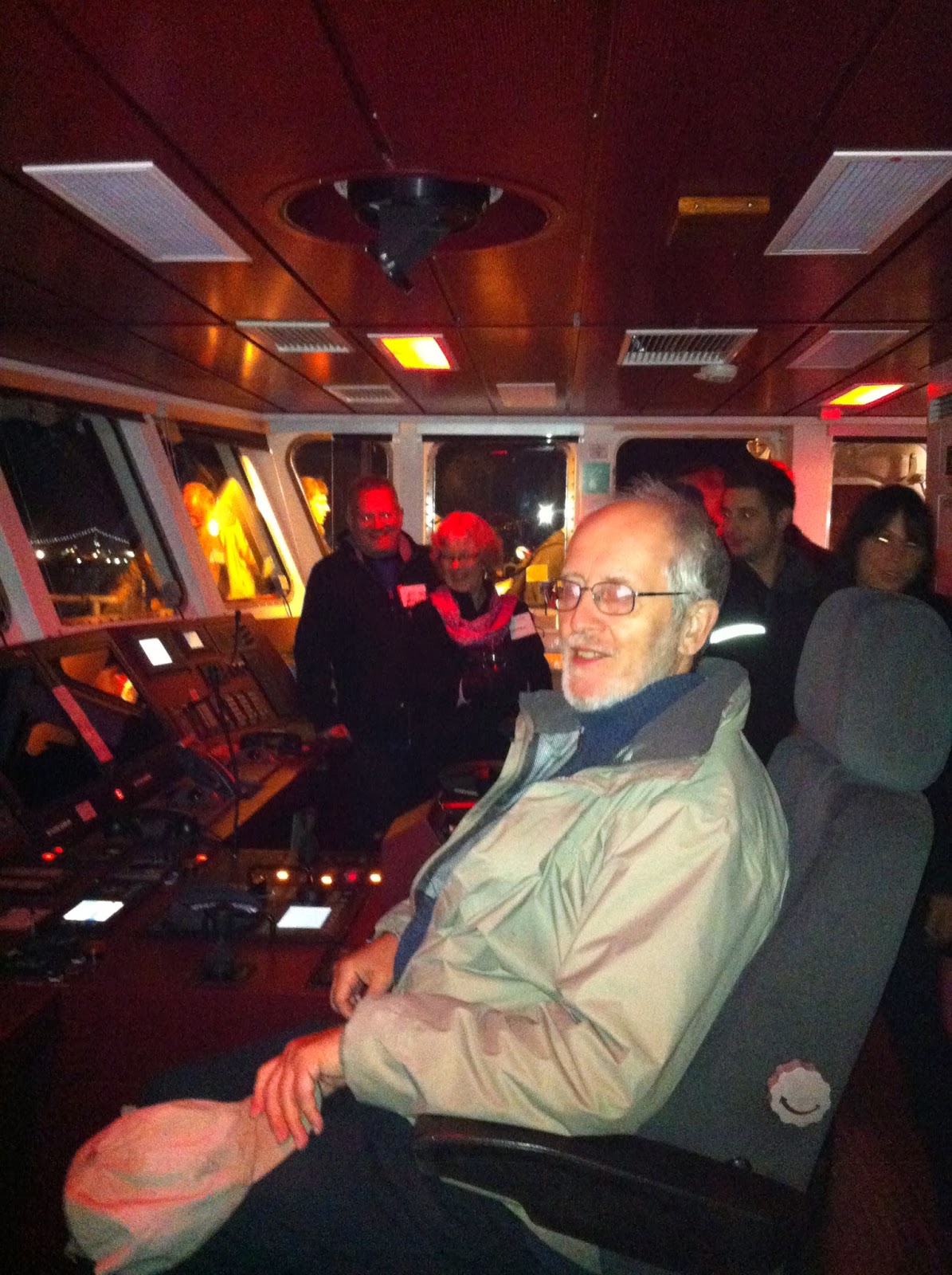
Here is a rare photo of Alex Smith, on the bridge of the Rainbow Warrior III in Vancouver in October.

Too bad my eyes were not open! But trust me, I'm not asleep at the wheel.


The Warrior III is a custom-built ship which can use sails instead of oil to cross the Pacific. It's a fast unique design, with a new type of mast, that any sailor would envy.

While the Warrior was in Vancouver, it launched an action against the expansion of the Kinder Morgan pipeline from the Tar Sands to the Port of Vancouver. Hundreds of tankers would to through the port, carrying diluted bitmumen. Unlike oil, "dilbit" sinks to the bottom as a gooey mess. What will they do to clean up the inevitable spill? Dam up the First Narrows and drain the whole port, to scrub the bottom?

One of the world's most gorgeous cities is under threat from the Tar Sands. But then, all cities are threatened by the Tar Sands, as our first speaker Peter Ward explained.

THANK YOU FOR YOUR SUPPORT

A small group of donors and members keep me going with Radio Ecoshock. We need a few more monthly members. Please join us, here at ecoshock.org.

While you are at the site, feel free to download a ton of free mp3's. Pass them out far and wide.

Background music for this program was provided from album "Deafmix" by Shane Philips from Vancouver Island. Thank you Shane. Check him out on You tube. Shane is a one-man band beyond belief.

We are out of time. Thank you for listening.

Tuesday, October 15, 2013

I Have A Confession To Make

Emerging threats analyst and author Robert Marston Fanney on new frontiers of climate change. Dr. Alex Rogers of Oxford: State of the Oceans 2013. Radio Ecoshock 131016 1 hour.


Illustration by Marek Okon for Luthiel's Song by Robert Marston Fanney.

Download/listen to this Radio Ecoshock show in CD Quality (56 MB) or Lo-Fi (14 MB)

WE ARE IN TROUBLE

Yes, we are in trouble. Last week, in this interview with Nicole Foss, we peered into the impending crash of the economy. It may dance on for a while using funny money from the Federal Reserve and other central banks. But fall it will.

A mere Depression would be good news, if the climate could stay the same for humans and all creatures. But even during hard times, we'll keep on dragging more and more dirty fossil fuels out of the ground. It's a burning party, maybe a funeral pyre.

Coming up we'll talk it all through with emerging threats analyst and author Robert Marston Fanney. You'll also hear an interview with a top marine biologist from the UK. Alex Rogers is the co-lead author of the new State of the Oceans 2013 report.

Alex reminds us that global warming is more a story of the oceans than our experiences of floods, fires, and storms on land. Most of our excess carbon is going into the sea, changing its chemistry, temperature, and the basis of the food chain. The ocean is where it's happening, and the ocean is a news nowhere land where reporters don't go, and humans don't care.

Going through the emerging science, I'm also alarmed to discover big changes in Antarctica can reshape our world. Climate change is like the many-headed Hydra. We think we know it, but we don't. The Earth is re-arranging in all the places humans don't look: at sea, at the poles, deep in the melting permafrost, and in the farthest forests and mountain tops.

In our opening show this Fall of 2013, climate scientist Paul Beckwith suggested warming could come very suddenly, even in a decade or two. A new paper by Morgan Schaller and James Wright of Rutgers finds, as Joe Romm writes, "When CO2 Levels Doubled 55 Million Years Ago, Earth May Have Warmed 9°F In 13 Years". It's a shocking example of what could happen.

The helpful Rutgers press piece on this study is here.

Business and political leaders have already announced they expect, or will tolerate a doubling of CO2 levels from the pre-industrial level of 270 parts per million to over 600 parts per million. We are already on our way, touching 400 parts per million this year, and adding more carbon faster every year, as the fossil fuel party expands around the world.

Canada, Australia, the UK, Europe, Brazil, and every country who can is promising to develop more fossil fuel resources. We are investing billions, possibly trillions, into more mega-coal mines, more fracked gas and Liquid Natural Gas plants, bigger tar sands and shale oil projects. Humans seem intent on fossil suicide.

Next week we'll talk with Morgan Schaller to find out what can happen in a mere 13 years on this fragile planet.

2047: WHEN OUR HOTTEST YEARS BECOME OUR COLDEST YEARS

Look at it another way. Another paper released this week says that by 2047 the coldest years will be hotter than the warmest years of the last two decades. We've already set new temperature records, and those will be the old years we look back on.

This paper was published in the Journal "Nature", by a team of post-grads at the University of Hawaii, led by Dr. Camilo Mora.

In an article by Justin Gillis of the New York Times, Dr. Mora says: quote

Go back in your life to think about the hottest, most traumatic event you have experienced.” “What we’re saying is that very soon, that event is going to become the norm.

Do it. Remember the heat wave you prayed would end. The day the sun seemed to be the enemy. You waited impatiently for the cooler darkness. That's the new day in 2047. Just 34 years from now. How old will you be then? How about your kids or grand-kids?

Other scientists suggest a concerted effort to kick the fossil fuel habit, going with reduced energy from renewable resources, could delay that heating by at least 25 years. That's more precious time for humans to move away from the rising seas on the coast, to re-think the whole food supply system, to work out ways to survive the coming heat. We must at least give our children that time.

WHY THERE WILL BE MASS EXTINCTIONS AROUND THE EQUATOR

That climate hydra pops out of this new paper again. I thought, and many scientists have suggested, that climate change would be less stressful around the equator. Most models suggest the extra heating will be the most extreme in temperate areas, and even more closer to the Poles. Certainly that's where we see the big news stories, about storms and fires in North America, Europe and Russia. Plus those crazy heat waves developing around the Arctic.

Dr. Mora says it only takes a small change in the tropics to create major damage. Why? Because the plants and animals there developed into a stable climate that doesn't change much during the year. Even a degree or two, combined with some changes in ocean or atmospheric currents, could bring down the rainforests, wreck the coral reefs, and cause mass extinctions of species. Tropical plants and animals are less able to adapt.

We simply haven't thought it through. Our unintentional geoengineering of the Earth has created a maze of cascading changes beyond our imagination. We are heading to a different world, if we survive to see it.

I'm asking for your help. I'm asking you to use every engine of communication, and every link to all the people you know, to raise the alarm. Join with me in this pledge I make for Radio Ecoshock: say it. We will speak the truth about what we are doing.

Our political and corporate leadership is bankrupt and dangerous. They don't know what they are doing, or their short-term gain seems worth risking the whole future. We let them, because we are comfortable and most of us too well fed. Geared to hunt and migrate as a species, now we have super powers to travel and kill. All of us have a thousand energy slaves to serve us delicacies every day. We're addicted to fossil fuels.

I don't know what twelve-step program can break us out of this master complex. I don't know if we will survive the fossil trap. But we have to try.

Nobody want to hear this. Your friends and family don't. But honestly, when we add up the science and our experiences in the real world, when we look the unstable weather in the face, there is no choice but to speak up.

Forget the envy of a better car or truck. Forget chasing paper wealth. Look at the young innocents and the other un-knowing species, the other passengers on this planet. Even in small steps, whatever changes we can make in our own lives matters most. Whatever sign we can make, whatever we can do, matters now.

Become a climate activist. Start with this interview with Robert Marston Fanney.

ROBERT MARSTON FANNEY ON EMERGING CLIMATE THREATS


Download/listen to this Robert Fanney 34 minute interview in CD Quality (31 MB) or Lo-Fi (8 MB)

We begin with Robert Marston Fanney reading from the introduction to his new book "Growth Shock, Tragedy and Hope at the Limits of a Finite World".

"I have a confession to make. One that is not easy to vocalize. One that is equally difficult to listen to. My confession is not one of a personal nature. I am not revealing my own, petty, individual sins. Instead, I’m making a confession for us all. A revelation of the ongoing and maturing tragedy of our race. One we will each need to be made aware of soon if we are to effectively act. For the age of excess is rapidly coming to a close and we are now entering a difficult and hard to manage age of consequences.

My confession is simply this: we are in trouble...
"

We'll get to the book, but that isn't why I called Robert. He captured my undivided attention with his searing analysis into large-scale patterns of climate change, based on real-time events happening around the world, right now. That's in his blog called "robertscribbler" at wordpress.com.

There it is, the scientific maps and satellite shots of extreme weather events and danger, brought together in ways we can all understand. Then Robert tops it off with analysis that I think raises whole new questions about our future together.

Maybe that's Fanney's previous training as an intelligence analyst, and years gathering scientific and technical assessments, as Editor for Jane's Information Group's emerging threats books, magazines, and electronic publications.

But there's another side to Robert Fanney that helps him imagine the future. He's the author of the science fiction series Luthiel's Song, which attracted a cult following, including many artists. You heard a few snippets written for the book "Luthiel's Song: Dreams of the Ringed Vale" by multi-media artist Ethan Jackson.

Details on composer Ethan Jackson here.

STATE OF THE OCEANS 2013


We humans have always believed the sea is so vast we can't seriously damage it. A new report warns this isn't so. It's called "The State of the Ocean 2013: Perils, Prognoses and Proposals". We've reached one of the lead authors, Professor Alex Rogers of Somerville College, Oxford, and Scientific Director of IPSO, The International Programme on the State of the Ocean.

The informative press release about this State of the Ocean is here. It contains a fast summary of the gravest concerns.

Copies of the report can be found here.

The United Nations' latest climate report concludes most of our carbon pollution is falling into, and damaging, the oceans rather than the land.

Download/listen to my 16 minute interview with Alex Rogers in CD Quality (14 MB) or Lo-Fi (4 MB)

HELP RADIO ACTIVISM

That's it this week for radio activism. Download our past programs and help the cause at our web site, ecoshock.org. Next week, the climate scientists speak freely.

Our opening music was DANCE Live at the Labyrinth at Shambhala Music Festival 2011. That closes the show as well.